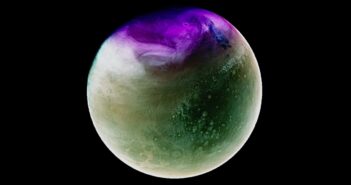
Solar Storm Versus Mars
What happens to Mars when it’s struck by a coronal mass ejection? Two spacecraft on opposite sides of the planet gave us a unique perspective on the event.

What happens to Mars when it’s struck by a coronal mass ejection? Two spacecraft on opposite sides of the planet gave us a unique perspective on the event.
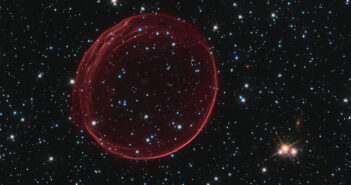
The non-detection of six supernovae allowed researchers to place limits on the properties of the exploded stars’ mass-donating companions.
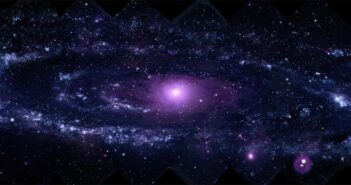
By modeling the motions of the Milky Way and our galactic neighbor, researchers have placed a constraint on the cosmological constant, and by extension, dark energy.
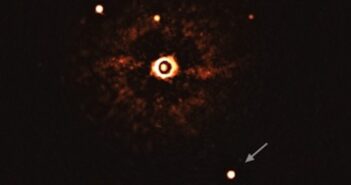
JWST, now a 20-month-old space toddler, is still serving up astronomical “firsts” nearly two years since its launch. Recently, it snapped the first-ever direct picture of an exoplanet taken in wavelengths beyond 5 microns.
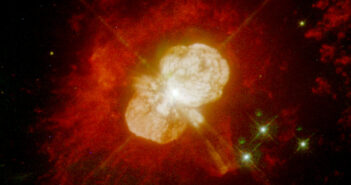
The hunt for the source of a gravitational wave signal came up short, but it revealed a supernova with a curious double-peaked light curve.
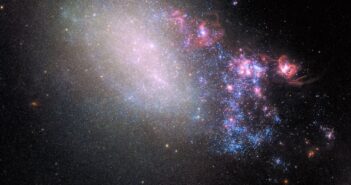
Researchers have analyzed images and spectra of hundreds of galaxies to determine if star formation proceeds smoothly or in fits and starts.
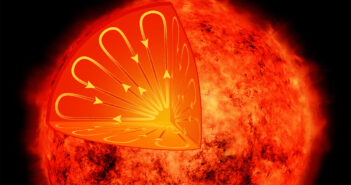
New research dives into tiny gaps and dips on the H–R diagram to study the connection between stellar interiors and stellar activity.

“Ice, Ice, Maybe?” Probably not in the case of comet 46P/Wirtanen.
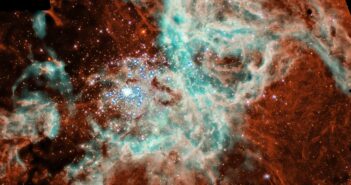
We’ve measured more elements in HD 222925’s spectrum than we have for any other star except for the Sun. Could this star provide a new benchmark for our understanding of how heavy metals are created?
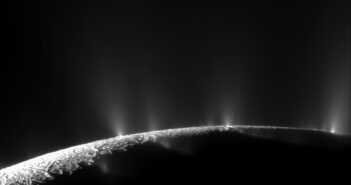
A recent article describes a spacecraft mission that aims to determine if Saturn’s tiny, frosty moon Enceladus hosts life in its global subsurface ocean.