
It’s no secret that Uranus has a dramatic past, but the formation of its innermost rings and moons may be even more complicated than we knew.
More Than Meets the Eye
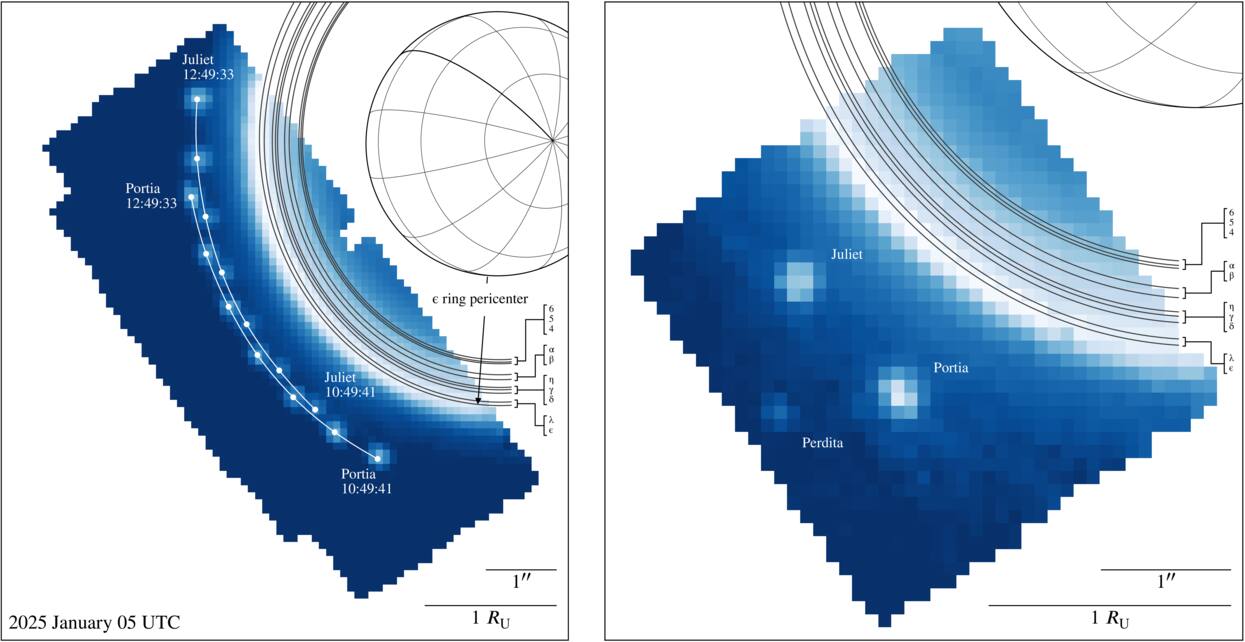
JWST NIRSpec detector images at 2.48 microns during Portia observations. Click to enlarge. [Belyakov et al. 2026]
Uncovering the composition of the ring-moon system is a crucial step in understanding the formation of the Uranian satellites. However, prior to JWST, ring moons were notoriously hard to observe due to their small size and proximity to Uranus. A new study led by Matthew Belyakov at the California Institute of Technology presents the first JWST 1–5 micron spectra of Uranus’s ring-moon system and sheds new light on its origins.
Breaking the Ice
The team used the Near-Infrared Spectrograph (NIRSpec) instrument on JWST to obtain spectra of the Uranian rings and ring moons Puck, Perdita, Portia, and Juliet. After subtracting the background contribution from Uranus, they analyzed the objects’ spectra. The Uranian rings and moons all show evidence for water ice, water-ice grains, and carbon dioxide ice. However, the rings exhibit much shallower 2.0- and 4.5-micron water-ice features than the moons, potentially suggesting a lesser ice abundance or smaller grain sizes on the rings than the moons.
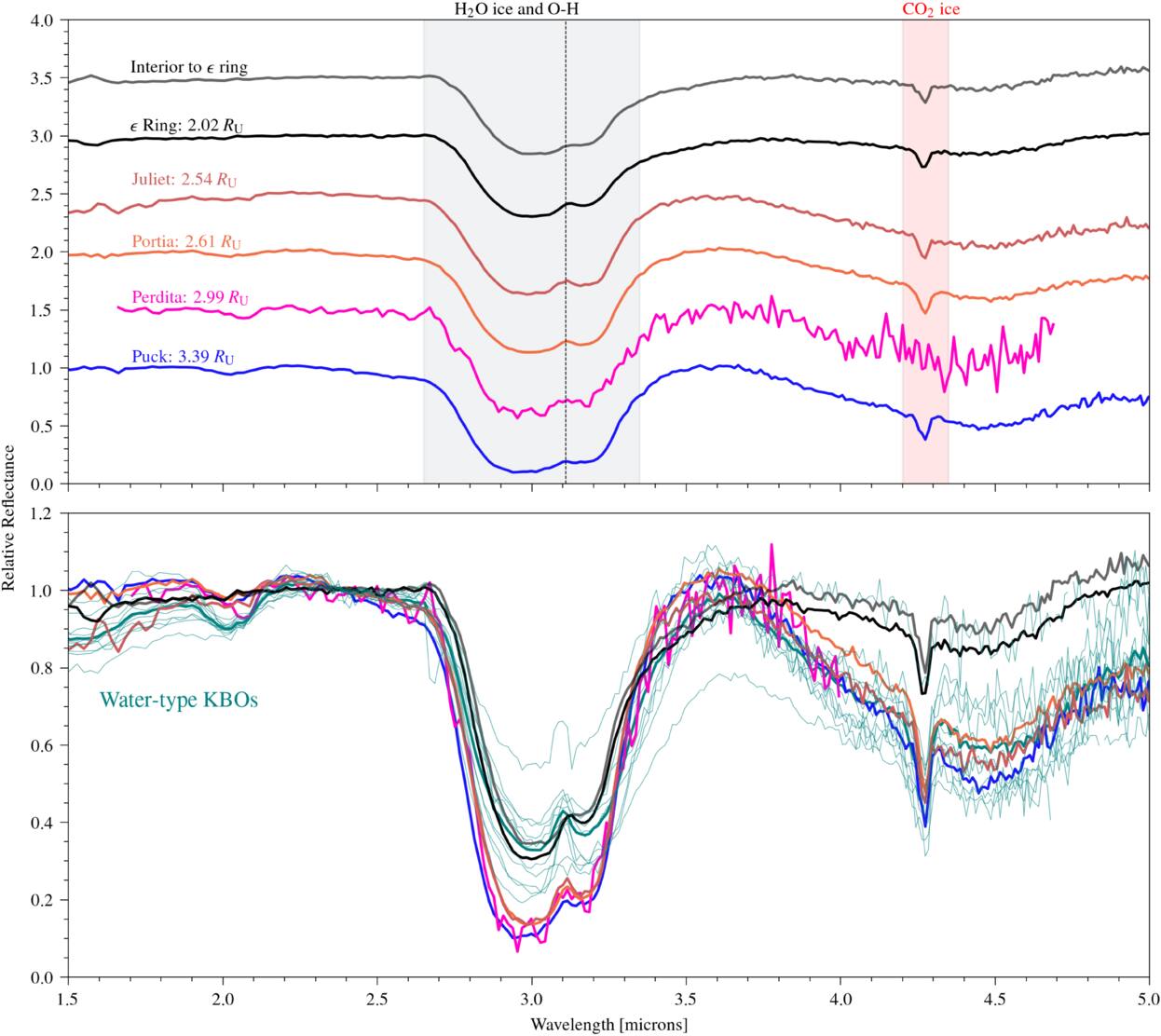
Top: JWST NIRSpec 1–5 micron relative reflectance spectra of Uranian inner moons Puck, Perdita, Portia, and Juliet; Bottom: Comparison of the above spectra to water-type KBOs (in teal). Click to enlarge. [Belyakov et al. 2026]
Next, the team compared the spectra to water-type Kuiper Belt objects (KBOs). These KBOs are hypothesized to be old planetesimals that formed closer to the giant planets than other KBOs. Overall, the ring moon spectra are remarkably similar to water-type KBOs. The main difference is that the ring moons have deeper 3.0-micron features and shallower 2.0-micron features than the average water-type KBO. These differences can be chalked up to grain size, with the moons and rings of Uranus having finer-grained water ice than typical KBO surfaces.
Back to the Beginning
Given this close spectral match, the team posed two plausible formation scenarios for Uranus’s ring-moon system.
The first is that a water-type KBO was responsible for the Uranus-tilting impact, and the rings and moons accreted from the debris disk left behind. A caveat of this theory is that the innermost moons must have been able to form from undifferentiated KBO material to explain the lack of certain minerals called phyllosilicates in their spectra. This formation theory could also explain properties of one of Uranus’s main satellites, Miranda, suggesting that it formed concurrently with the inner moons. However, additional measurements of the deuterium-to-hydrogen ratio of the inner ring-moon system would be needed to pin down their relationship further.
The second theory is that the inner moons formed after the main satellites, from a tidally disrupted KBO. The idea is that a KBO passed too close to Uranus, was torn apart, and formed a ring of debris, from which the rings and ring moons accreted.
These new insights show that there’s much more to the Uranian system than its wonky rotation.
Citation
“JWST Reveals the Kuiper Belt–like Compositions of the Uranian Rings and Small Moons,” Matthew Belyakov et al 2026 ApJL 1010 L18. doi:10.3847/2041-8213/aeacc0