Astrobites RSS

Illustration of a supermassive black hole snacking on a star

Editor’s Note: Astrobites is a graduate-student-run organization that digests astrophysical literature for undergraduate students. As part of the partnership between the AAS and astrobites, we occasionally repost astrobites content here at AAS Nova. We hope you enjoy this post from astrobites; the original can be viewed at astrobites.org.

Title: Optical Appearance of Eccentric Tidal Disruption Events
Authors: Fangyi (Fitz) Hu et al.
First Author’s Institution: Monash University
Status: Published in ApJL

While the typical image of a supermassive black hole swallowing up everything in its path may be a trope of science fiction, there is some truth to the violent nature of these enigmatic cosmic objects. Namely, the ultra-strong gravitational fields surrounding supermassive black holes have been observed to shred stars, tearing them apart and producing bright and dramatic transient phenomena known as tidal disruption events, or TDEs. In the process, much of the stellar material becomes unbound and is flung away from the system, with the remainder surrounding the black hole in an accretion disk, the source of the emitted radiation.

As per usual, though, nothing in astrophysics is ever straightforward. Over the years, a disparity between what we expect and what we actually see has emerged when it comes to these events that are reminiscent of a Shakespearean tragedy. More specifically, due to the very-high-temperature gases involved, X-rays are expected to dominate the spectrum of most TDEs. However, observers have found that most TDEs are instead observed at lower energies, producing significant but poorly understood optical emission.

Enter today’s article from researchers at Monash University in Australia, who have simulated the tidal disruption of a Sun-like star in the hopes of uncovering the origin of the perplexing optical emission.

The Nitty Gritty of the Simulation

For simulations to be realistic, theorists typically attempt to account for as many physical processes as possible. Thus, the authors of today’s article employed the PHANTOM code, which includes both general relativistic and hydrodynamical effects. The protagonists of this astrophysical tragedy are a solar-mass star and a million-solar-mass, non-spinning black hole with a highly eccentric, or elliptical, orbit.

Cut to several days later, and the simulation has evolved to a point where the star is in tatters and the supermassive black hole is surrounded by a bright and brand-new accretion disk composed of stolen material from the star. By tracking the time evolution of the system, the authors were able to understand how the accretion disk formed, with the hope of unmasking the source of the optical emission.

The Last Dance

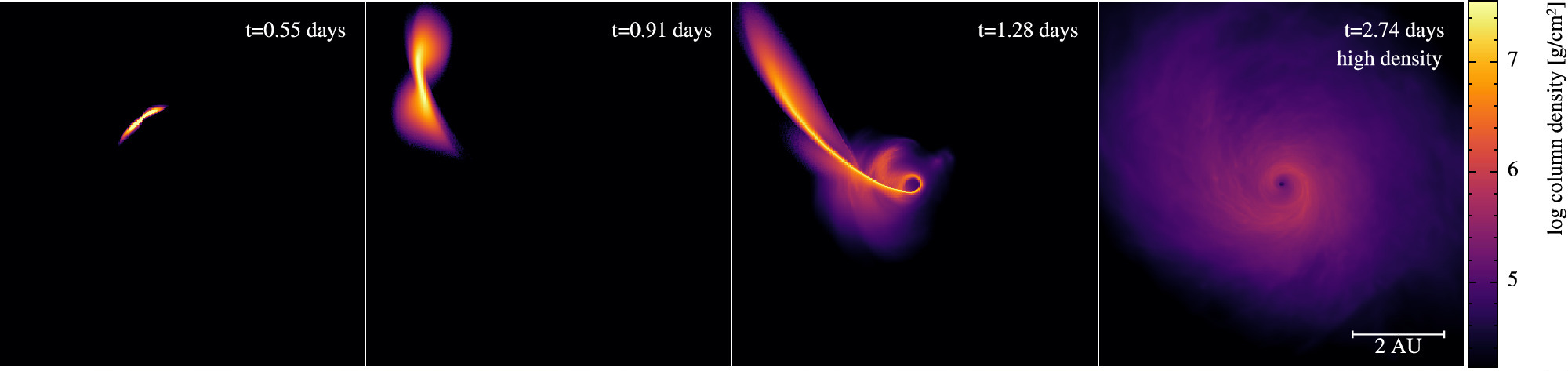
Figure 1 shows the evolution of the system’s column density, indicating the location of the stolen stellar material. In the first two panels at 0.55 and 0.91 day, the stellar debris stream is visible. In the third panel, the debris stream collides with itself, leading to the formation of the accretion disk. In the fourth panel at 2.74 days, the accretion disk is clearly seen as a circular structure surrounding the supermassive black hole at the centre.

time evolution of stellar material tidally disrupted by a black hole

Figure 1: The column density of the stellar material surrounding the supermassive black hole at different times. Larger column densities are indicated by more yellow colours, while lower column densities are shown in purple and black. From left to right, the panels show the simulation at 0.55, 0.91, 1.28, and 2.74 days. [Adapted from Hu et al. 2024]

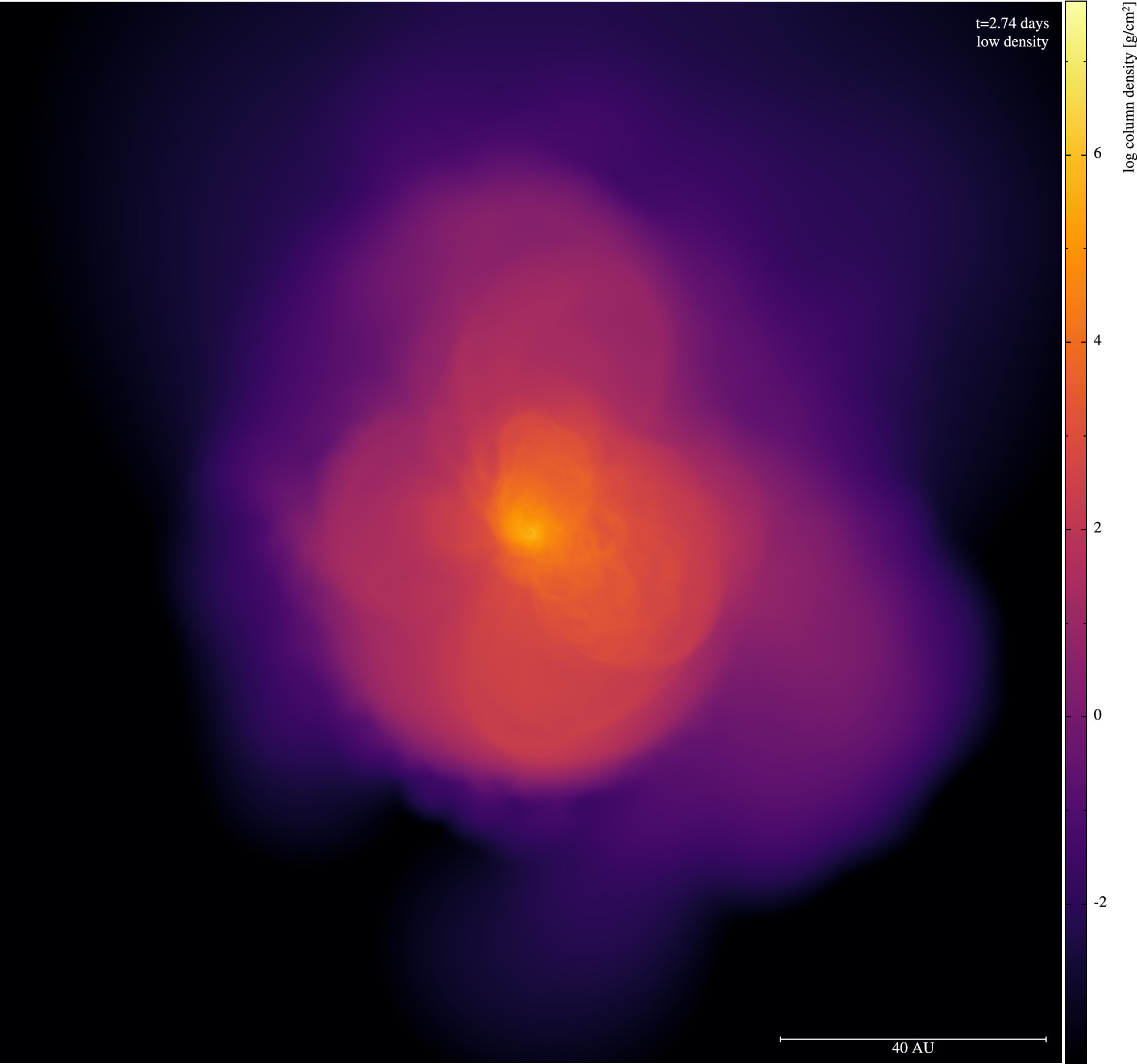
By considering the system from afar, the authors gained a new perspective on TDE accretion disk formation. They found significant quantities of low-density material ejected out to large distances. This material is shown in Figure 2, which gives the column density of the system at 2.74 days as in Figure 1, but on a much larger scale.

density of stellar material surrounding the supermassive black hole

Figure 2: The column density of the stellar material surrounding the supermassive black hole at t = 2.74 days as in Figure 1, but from a zoomed-out perspective (note the larger scale compared to Figure 1). [Adapted from Hu et al. 2024]

This low-density material is not part of the accretion disk but instead flows out asymmetrically from the centre of the system. Previous studies have hypothesised that the source of the optical emission from TDEs might be some form of reprocessing layer that surrounds the accretion disk and converts X-ray photons into lower-energy optical photons. And that appears to be exactly what is seen in the simulation. The surrounding low-density material in Figure 2 acts as the reprocessing layer with which X-ray photons interact, causing them to lose energy and be observed as optical emission.

But how does this match with actual TDE observations? To test this, the authors constructed spectra and light curves from their simulation results. They found that their synthetic spectra were broadly consistent with the genuine TDE spectra, as were their inferred luminosities from their synthetic light curves. However, their calculated blackbody radii and temperatures were systematically higher or lower than the observations, albeit of the correct order of magnitude. Therefore, the authors conclude that while the model is realistic, it does not yet accurately account for certain physical processes such as radiation transport, which can be improved upon in future simulations.

And thus ends the tragic tale of a supermassive black hole and its stellar neighbour that came a little too close. Clearly, surrounding outflows play an important role in this astrophysical tragedy that rivals Hamlet or Macbeth, processing the high-energy X-rays from the accretion disk into the lower-energy optical photons seen by observers. Unfortunately for us, though, we’ll have to wait for future simulations to find out how the story truly ends.

Original astrobite edited by Archana Aravindan.

About the author, Sonja Panjkov:

I’m a second-year PhD student at the University of Melbourne. My research focuses on the high-energy emission from the supernova remnants in the Magellanic Clouds. In my spare time, I enjoy hanging out with my cats and going to see live music.

illustration of a jet from an exploding star

Editor’s Note: Astrobites is a graduate-student-run organization that digests astrophysical literature for undergraduate students. As part of the partnership between the AAS and astrobites, we occasionally repost astrobites content here at AAS Nova. We hope you enjoy this post from astrobites; the original can be viewed at astrobites.org.

Title: Search for 10–1,000 GeV Neutrinos from Gamma-ray Bursts with IceCube
Authors: IceCube Collaboration
Status: Published in ApJ

Particle Accelerators, but in Space!

Gamma-ray bursts are some of the most powerful explosions in the universe, releasing a “fireball” of particle-filled plasma in a powerful jet that accelerates these particles through the universe. Gamma-ray bursts are understood to originate either from compact object (neutron star or stellar-mass black hole) mergers (these are called short gamma-ray bursts and last less than two seconds!) or from core-collapse supernovae (these are called long gamma-ray bursts but are just defined as anything longer than two seconds). Gamma-ray bursts are the most powerful particle accelerators in the universe and are really useful for looking for new particles and new particle interactions!

Today’s authors look at gamma-ray bursts as a possible source of ghost particles, i.e., neutrinos. Neutrinos rarely interact with other matter, which makes them really hard to detect — like a ghost! The IceCube Neutrino Observatory sees neutrinos all over the sky but can’t pinpoint where they’re coming from. Since gamma-ray bursts could produce neutrinos in their outbursts, the authors search through all of IceCube’s data to see if there are any bursts of high-energy neutrinos that came in at the same time as a gamma-ray bursts.

How Many Gamma-ray Bursts Does It Take to Find a Neutrino?

Today’s authors search for coincident neutrinos in the time periods surrounding the 2,298 bursts that happened during the lifetime of IceCube-DeepCore (IceCube’s highest-energy neutrino detector). They do this by looking at each time window individually and by combining many time windows to add faint signals that might not be seen in individual windows, but together might show an association between neutrinos and gamma-ray bursts.

histogram showing the duration of prompt gamma-ray burst emission

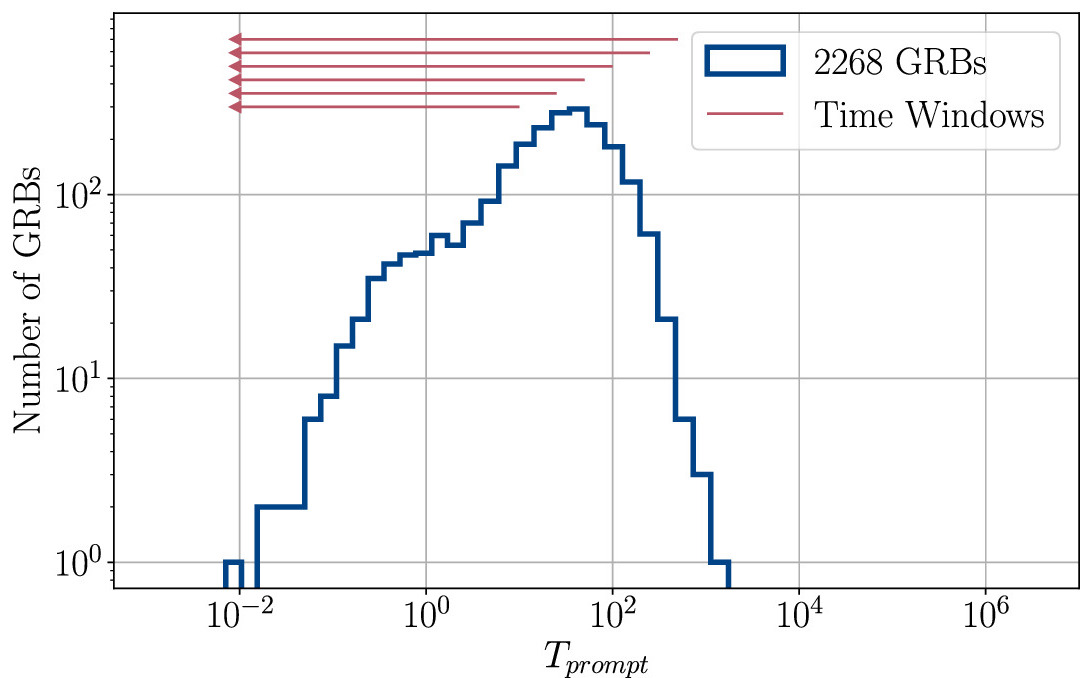
Figure 1: A histogram of the initial gamma-ray burst emission (called prompt emission) duration for all 2,268 gamma-ray bursts used in this study. The time windows investigated in this article are shown as red arrows. [Adapted from IceCube Collaboration et al. 2024]

In the first search, the authors define search windows before and after each burst to look for neutrinos (see Figure 1). Since neutrinos don’t interact with matter very often, they can easily stream out of dusty environments from which photons struggle to escape, meaning that the neutrinos could actually be expected to arrive at Earth before gamma-ray (and other photon) emission. The authors search the entire sky for neutrinos in these windows and assess the probability that there is an excess of neutrinos coming from the source location compared to the neutrino background that we see all over the sky.

The second search looks at groups of gamma-ray bursts that are associated in location and time with neutrino events. The authors look at the combined probability of burst/neutrino association of all the events in this group. This makes it possible to correlate gamma-ray bursts with neutrinos even if the events don’t individually stand out. Using this method, the authors didn’t find any groups of neutrinos that are any more statistically significant than individual neutrinos that fall within gamma-ray burst time windows.

Trials Factors and Tribulations

The winning burst of the first search (i.e., the most significant neutrino–gamma-ray burst correlation) is GRB bn 140807500. (Since there are a lot of gamma-ray bursts recorded by burst-hunting instruments like the Fermi Gamma-ray Burst Monitor (Fermi-GBM) and the Swift Burst Alert Telescope (Swift-BAT), it’s too much of a hassle to give the bursts individual names. Instead, the bursts get “telephone numbers” corresponding to the date they were detected.) The corresponding neutrino falls within 100 seconds of GRB bn 140807500 and has a p-value of 4.6 x 10⁻⁵, which is the probability that the correlation between the burst and the neutrino is just a lucky coincidence and not from actual correlation (i.e., small p-values mean a more likely detection of neutrinos from gamma-ray bursts!).

This probability seems really small, and at first glance it seems like the neutrino and the gamma-ray burst are most likely connected here! Unfortunately, this doesn’t take into account trials factors (also called the look-elsewhere effect), which quantify the statistical statement that if you look at enough gamma-ray bursts and neutrinos, there will be some events that line up with each other in space and time, just by chance. To account for this, the authors must correct for 2,268 trials, one for each burst. After correcting for trials, this leaves us with a much larger p-value of 0.097, meaning there’s a one in ten chance that the gamma-ray burst and the neutrino aren’t really connected. Generally particle (and astroparticle) physicists require a p-value of 3×10⁻⁷ (about 1 in 3.5 million, corresponding to the [in]famous 5-sigma threshold!) to feel confident in saying that these events are actually correlated.

Don’t Forget About the BOAT

plot of neutrino flux for more than 2,000 gamma-ray bursts compared to the flux from just the single brightest burst

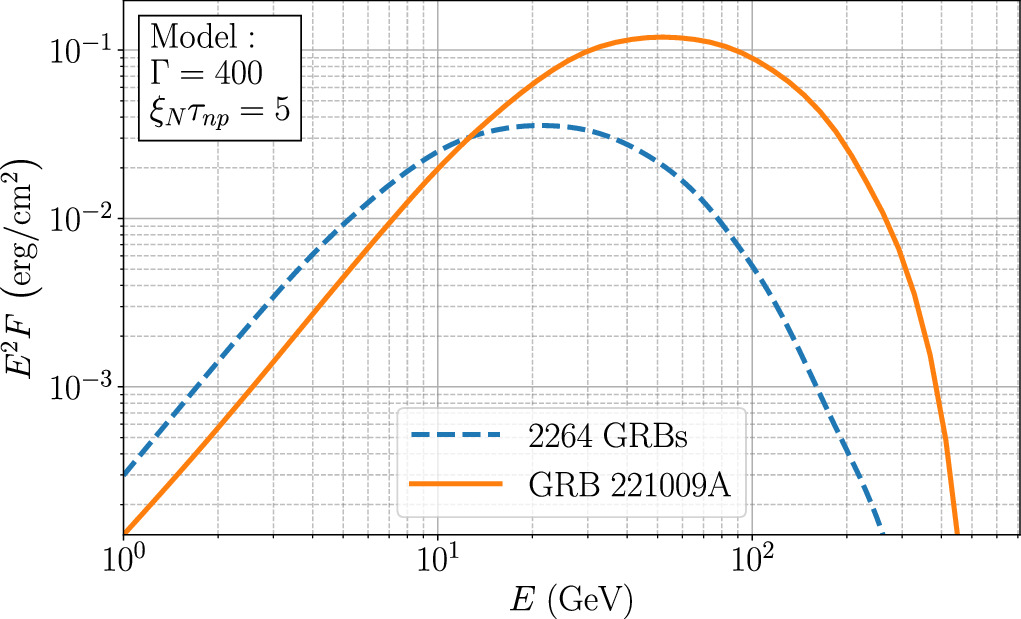
Figure 2: Estimated neutrino flux (number of neutrinos detected at a given energy per area) for 2,264 gamma-ray bursts combined (blue) compared with the BOAT gamma-ray burst (orange). (Four of the bursts used in this study were excluded from this analysis.) [IceCube Collaboration et al. 2024]

At the same time as this article was being prepared, the brightest of all time (BOAT) gamma-ray burst was detected. The authors didn’t include the BOAT directly in their dataset, but they made some predictions as to how it would measure up to the other gamma-ray bursts that were considered. The BOAT was so bright that the authors calculated the expected neutrino signal to be 6–8 times the combined expected signal of all 2,264 gamma-ray bursts used in this part of the study (see Figure 2)! This is because the BOAT is so much more energetic in gamma rays than other gamma-ray bursts, implying a large flux of high-energy neutrinos, which are localized to more precise regions in the sky than the lower-energy neutrinos expected to accompany other bursts. This means that we can more confidently associate any observed neutrinos with the location of the burst.

There’s still work to be done to see if there are any neutrino events that seem to come from the BOAT gamma-ray burst, but this leaves the idea open that neutrinos could come from gamma-ray bursts (or at least, that we can more confidently say that they don’t)! The universe sometimes throws surprises like the BOAT at us, allowing astronomers to study the high-energy universe a lot more easily. Luckily, we’ve entered into the era of time-domain astronomy where instruments like Fermi-GBM and Swift-BAT allow us to catch more bursts and explosions than ever before, giving us an increasingly large sample of gamma-ray bursts to study!

Original astrobite edited by Cole Meldorf.

About the author, Samantha Wong:

I’m a graduate student at McGill University, where I study high-energy astrophysics. This includes studying all sorts of extreme environments in the universe like active galactic nuclei, pulsars, and supernova remnants with the VERITAS gamma-ray telescope.

image showing the change in brightness of a star that is microlensed by a black hole

Editor’s Note: Astrobites is a graduate-student-run organization that digests astrophysical literature for undergraduate students. As part of the partnership between the AAS and astrobites, we occasionally repost astrobites content here at AAS Nova. We hope you enjoy this post from astrobites; the original can be viewed at astrobites.org.

Title: Disentangling the Black Hole Mass Spectrum with Photometric Microlensing Surveys
Authors: Scott Ellis Perkins et al.
First Author’s Institution:
Lawrence Livermore National Laboratory
Status: Published in ApJ

Lonesome Black Holes

Seeing the darkness is something that is a great mystery in modern physics, from dark matter to black holes. How do you see something that doesn’t emit light?

Current methods of detecting black holes include observing their accretion from surrounding matter, whether that’s supermassive black holes in the centres of galaxies or smaller black holes that are stealing matter from a stellar companion. Black holes that don’t have any glowing surrounding matter may have a black hole or neutron star partner to spiral into, releasing gravitational waves that we detect with the LIGO, Virgo, and KAGRA detectors. But lonely black holes sitting in the darkness are significantly harder to uncover. In the Milky Way, it’s expected that there are 100 million isolated and binary black holes that are born from dead massive stars. Of those, only ~50 have been detected.

Twinkling Lights

Fortunately, there’s a detection method that can fill this gap: microlensing. If an isolated black hole is located in front of a star or galaxy much farther away, that background object’s brightness will vary with time as its light is lensed by the black hole moving in front of it (see Figure 1). This is similar to a magnifying glass passing in front of the star’s tiny pinprick of light, but instead the lens of the glass is the curvature of spacetime due to the mass of the black hole. Because the lens magnifies the background object, it will appear to change in brightness, twinkling like fairy lights.

Figure 1: An animation of a black hole passing in front of a background star. Because the black hole bends spacetime along the path from the star to the observer, two images of the star are created. The lensing also changes the apparent brightness of the star, which is still detectable photometrically even when the different images are too close to be separately resolved by the observer. [NASA’s Goddard Space Flight Center Conceptual Image Lab]

However, there are a few different kinds of objects that can lens background stars. Black holes, white dwarfs, neutron stars, and free-floating planets have all been found through microlensing. If we can know the mass of the lens, then we can characterise a lens as a stellar-mass black hole (usually 5–100 times the mass of the Sun). However, an individual microlensing light curve doesn’t carry any useful information about the mass of the lens without also knowing the astrometric shift in the lensed object — something we don’t have for many microlensing observations. However, studying a larger group of microlensing events can break the degeneracies present in individual light curves, helping researchers classify lensing events and search for the hidden black holes in the dark. Today’s article defines a framework for determining the class of individual detections and groups of microlensing events using probabilistic models and Bayesian statistics.

Looking at Populations of Black Hole Lenses

Different types of lenses will be distributed differently in the effects they create in the light curves that we detect. For example, there will be more black holes over a certain range of masses and more white dwarfs over a different range of masses. This means that the distributions of some of the measurements of the lensing profile, such as the angle between the image of the source and the actual source location, will be different because of correlations between these parameters and the lens mass.

This article looks at three kinds of lenses: free-floating planets, stellar-mass black holes, and primordial black holes. Accounting for primordial black holes in the model separately from stellar-mass black holes allows this method to demonstrate a measure of the abundance of primordial black holes, which could provide an explanation for dark matter or evidence for the first black hole seeds in the early universe. The authors construct five simulated universes with the same number of mock microlensing events for free-floating planets and stellar-mass black holes, but each with a different number of primordial black holes. For each of these universes, the distribution of the distances and the kinematics of the events are the same, but there is a different distribution of lens masses caused by the varying fraction of primordial black holes.

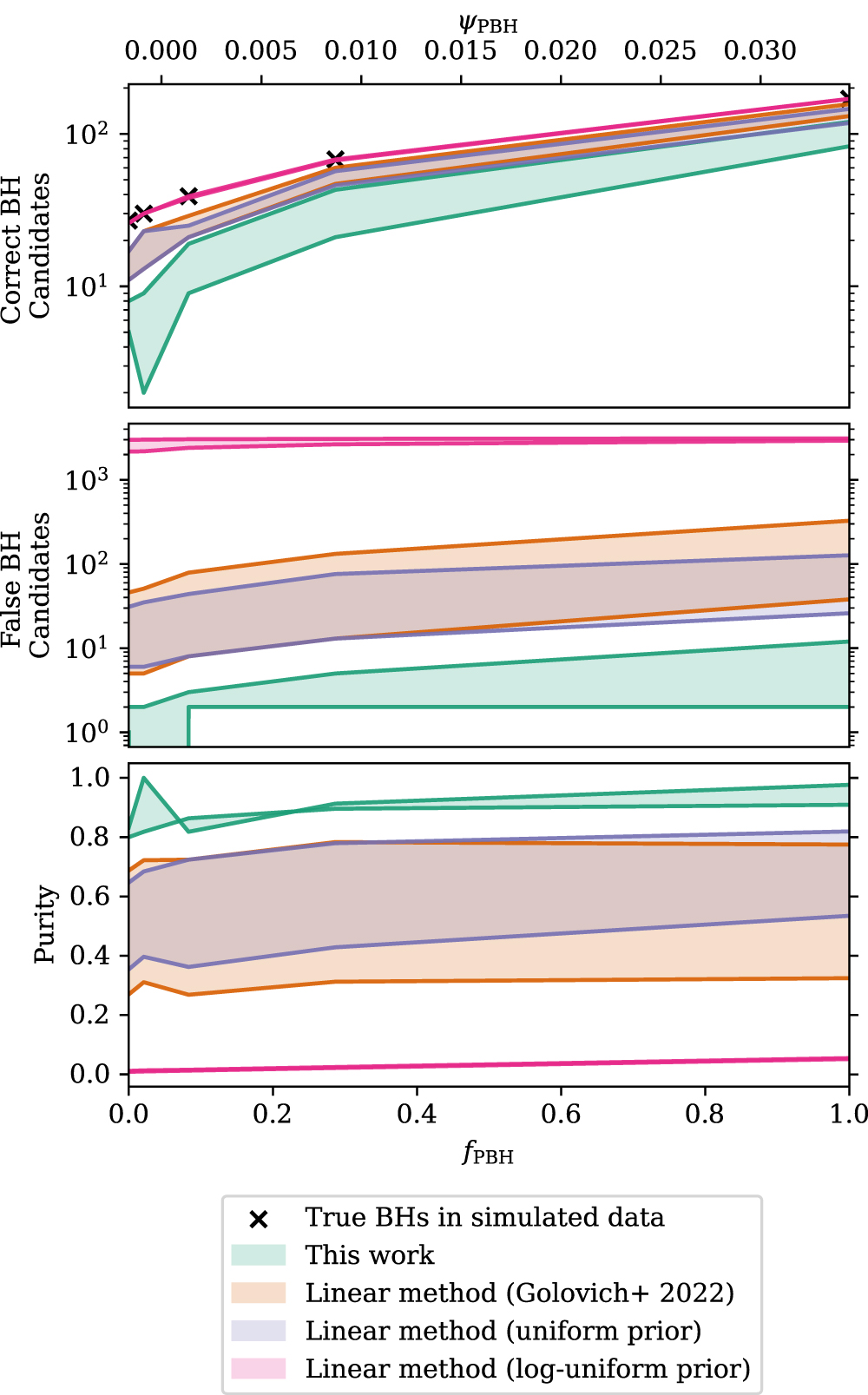
Using these mock events, the authors construct a probability distribution for events belonging to a certain class for each universe. If you assume a fixed group of certain types of lenses (meaning a fixed mock universe and lens mass distribution), and you know the profiles of the microlensing light curves that are likely to be produced by each of those different lens types, you can say how probable it is that a microlensing event is caused by a specific type of object. Their method reliably classifies most of the true black hole events from each population’s mock events, as shown in Figure 2. While their method has fewer correct black hole candidates, or “true positives,” than previous methods, their identified population of black holes has many fewer false black hole identifications and therefore a much higher purity of detection.

plot comparing the results of this study with the results from previous studies

Figure 2: The number of mock microlensing events correctly categorised as black holes (top panel), incorrectly categorised as black holes (e.g., these were simulated free-floating planets but appeared to be black holes in their framework; middle panel), and the fraction of correctly identified black holes divided by the total number of black hole identifications (bottom panel), versus the fraction of primordial black holes in each population. This method is shown in the green band, while previous methods are shown in orange, purple and pink. The bottom edge of each band represents the number for which the classification probability is above a 50% confidence, while the upper edge is 90% confidence. While this method does not reach the true number of correctly identified black hole events (black crosses), it does have the highest purity of all methods. [Perkins et al. 2024]

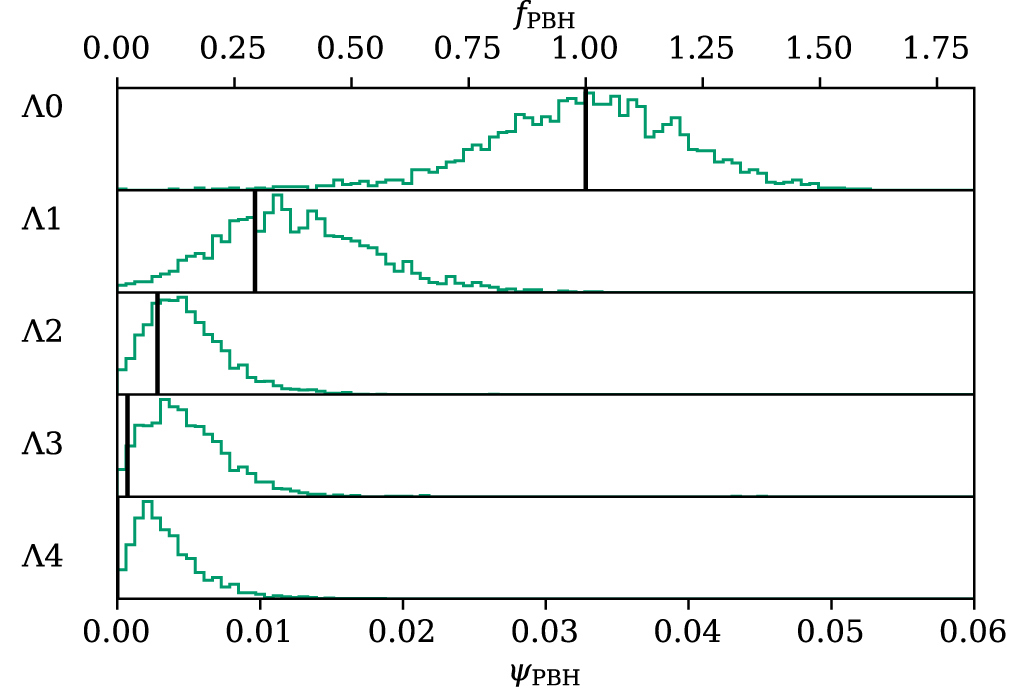
Alternatively, if you have a group of microlensing events and a model for the universe, you can say how probable it is that you are observing events in that universe. When drawing a group of events from their five mock universes, the authors characterise how well they can recover the fraction of primordial black holes from these groups of events, as seen in Figure 3. The probability of the fraction of primordial black holes follows the true value, meaning if there really were lots of primordial black holes in the Milky Way that match these models well, we could say that primordial black holes exist with high confidence. If the fraction of primordial black holes is smaller, then we would be able to place upper limits on what we can detect.

plot showing the predicted values for the fraction of primordial black holes with the authors’ framework for five simulated universes

Figure 3: The predicted values for the fraction of primordial black holes (fPBH) with the authors’ framework (green), for five simulated universes (Λ 0-4). The true value is marked with the black vertical line for each universe. The predicted fraction follows the true fraction well, and the width of this distribution represents the uncertainty determined by the framework. [Adapted from Perkins et al. 2024]

The Future of Black Hole Microlensing Surveys

The next step for the authors’ statistical framework is to test it with real photometric measurements of microlensing from the Optical Gravitational Lensing Experiment (OGLE), a survey of more than a billion stars for time-domain astrophysics. By combining this method and real observations with more realistic model universes and more sophisticated simulations of primordial black holes, stellar-mass black holes, and other types of lenses, this could tell us more about the population of stellar-mass black holes alone in the wild. Pairing these results up with astrometric measurements that will come from the Nancy Grace Roman Space Telescope in the next few years will provide even more knowledge about the kinds of black holes making stars (or fairy lights?!) twinkle in the night sky.

Original astrobite edited by Samantha Wong.

About the author, Storm Colloms:

Storm is a postgraduate researcher at the University of Glasgow, Scotland. They work on understanding populations of binary black holes and neutron stars from the gravitational wave signals emitted when they merge, and what that tells us about the lives and deaths of massive stars. Outwith astrophysics they spend their time taking digital and film photos and making fun doodles of their research.

illustration of a neutron star

Editor’s Note: Astrobites is a graduate-student-run organization that digests astrophysical literature for undergraduate students. As part of the partnership between the AAS and astrobites, we occasionally repost astrobites content here at AAS Nova. We hope you enjoy this post from astrobites; the original can be viewed at astrobites.org.

Title: Long-Period Radio Pulsars: Population Study in the Neutron Star and White Dwarf Rotating Dipole Scenarios
Authors: Nanda Rea et al.
First Author’s Institution:
Institute of Space Sciences (ICE-CSIC), Barcelona, Spain
Status: Published in ApJ

Earth is constantly bombarded by radio waves from all across the Milky Way. The shorter time-scale signals, known as “radio transients,” can sometimes be periodic. These periodic signals are often attributed to rotating neutron stars, which act as cosmic lighthouses, sending out radio waves that appear to us as “pulses” of emission. Normally, the slowest of these sources have pulses separated by milliseconds or seconds. However, the recent detection of two signals with astounding periods of 18 and 21 minutes has completely surpassed even the slowest signals previously detected. What could be causing these ultra-long-period radio signals, and what can they tell us about the populations of extreme compact objects they come from? The authors of today’s article investigate these very questions.

Time for a Mystery

GLEAM-X J1627–52 and GPM J1839–10 (astronomers love brevity) are the names given to these two ultra-long-period radio transients. Amazingly, we have archival data dating back to 1988 showing that GPM J1839–10 has been active for more than 30 years! It is still a great mystery what kind of object could produce such a long-period signal, but two kinds of stars might be the culprits.

White dwarfs, Earth-sized stars that form toward the end of the lifecycle of intermediate-mass stars like the Sun, are the first potential source of these signals. White dwarfs often have slow enough rotation periods to account for the ultra-long-period signals, but there is no known mechanism by which lone white dwarfs could produce bright enough radio signals. It is thought that a companion star could possibly enhance the white dwarf’s radio emission via the companion’s stellar wind. As the white dwarf’s emission beams cross through this stellar wind, the emission accelerates particles within the stellar wind, releasing radio waves as accelerated electrons interact with the white dwarf’s magnetic field.

Only two radio-emitting white dwarfs have ever been observed, and both were in binary systems. Based on the lack of an optical or infrared component, researchers thing that GLEAM-X J1627−52 is likely not in a main-sequence binary system similar to these radio-emitting white dwarfs. GLEAM-X J1627−52 could still have a low-mass companion, similar to the AR Scorpii system, which is a white dwarf pulsar binary containing a low-mass, red dwarf companion star (learn more about AR Scorpii in this Astrobite). GPM J1839–10 has not yet been constrained to be in a binary using optical and infrared observations.

Highly magnetized neutron stars known as magnetars are the second potential source. Magnetars are the extremely dense, extremely magnetic leftovers of stellar explosions. How dense and how magnetic, you might ask? Just one tablespoon of magnetar matter weighs as much as Mount Everest, and their magnetic fields, which are a thousand trillion times stronger than Earth’s magnetic field, make them the most magnetic objects known. Magnetars tap directly into their magnetic fields to fuel their powerful beams of radio waves.

Not So Perfect Sources

Despite the amazing properties of both white dwarfs and magnetars, the authors find several issues when trying to explain GLEAM-X J1627–52 and GPM J1839–10 using these types of objects. While observations from back in 2018 show that GLEAM-X J1627−52 does have a brightness and polarization similar to other radio magnetars, X-ray measurements put limits on the source that challenge a magnetar being responsible. The ultra-long period is also not in line with the rest of the neutron star population. On the other hand, white dwarfs are not known to produce the observed bright emission.

Crossing the Line

To figure out whether neutron stars or white dwarfs might be responsible for these long-period signals, the authors use two methods: death-line analyses and population-synthesis simulations.

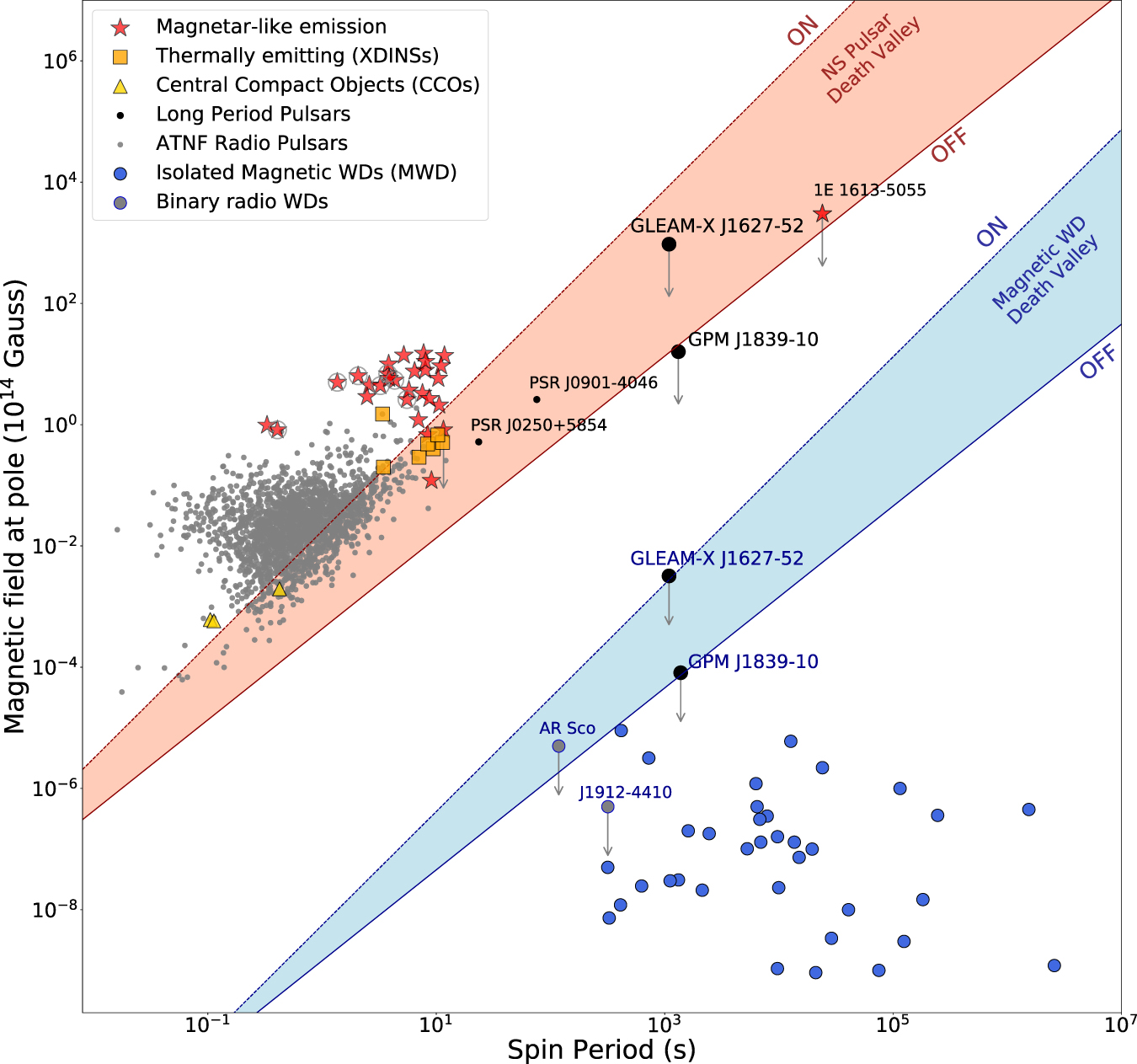
“Death line” sounds like an ominous term, but it simply defines the threshold at which radio emitters no longer put out bright enough signals for us to detect with our telescopes, meaning they are effectively “dead.” The authors create a range of death lines (shown in Figure 1) based on models ranging from the simplest models available to more extreme models that incorporate complicated physics like twisted magnetic field lines.

plot of surface magnetic field at poles versus spin period

Figure 1: The two death “valleys” of the neutron star and white dwarf populations. An object that falls below the death line no longer emits strongly enough for detection using our current radio telescopes or no longer emits at all, hence why it is “dead.” The neutron star death lines are marked in red and white dwarf death lines are marked in blue. The bounds of the valleys come from the range of different models. For both populations, GPM J1839-10 falls below even the most extreme death line. [Rea et al. 2024]

Based on these death lines, the authors conclude that neutron stars could create the type of signal seen from GLEAM-X J1627−52, but not the signal seen from GPM J1839–10, since it falls below even the most extreme death line. The same is true for magnetized white dwarfs.

The second method is called population synthesis, which uses statistics from the already existing sample of neutron stars and white dwarfs to try and simulate the total population of these stars. The authors vary different parameters like magnetic field strength, birth rate, and the angle between the magnetic field axis and rotational axis to try and figure out if a special population of neutron stars or white dwarfs with these slow periods might exist in the galaxy.

The authors find that a large population of long-period radio emitters cannot be easily explained by neutron stars, even when assuming extremes like no magnetic field decay, stronger magnetic fields, etc. The white dwarf population synthesis shows that magnetized white dwarfs with long periods are more common, but isolated white dwarfs are not expected to be able to emit bright, coherent (constant phase) radio emission, based on the existing population.

This is likely just the first step in uncovering an entire unknown population of ultra-long-period radio transients. Many more sources like the two discussed in today’s article could be out there, but for now the authors recognize that the sample size is small. If either of the two sources, GLEAM-X J1627−52 or GPM J1839–10, is confirmed to be a neutron star or white dwarf in the future, it will tell us a lot about the physics of these extreme objects. It may even require a revision of our understanding of neutron stars or white dwarfs, both in terms of how exactly they emit radio waves, and what their populations look like in the galaxy!

Original astrobite edited by Maryum Sayeed and Annelia Anderson.

About the author, Magnus L’Argent:

Magnus is a first-year Master’s student and Trottier Fellow at McGill University. When not searching for new pulsars, fast radio bursts, and other radio transients, he enjoys going on hikes, reading sci-fi, and watching movies.

active galaxy Hercules A

Editor’s Note: Astrobites is a graduate-student-run organization that digests astrophysical literature for undergraduate students. As part of the partnership between the AAS and astrobites, we occasionally repost astrobites content here at AAS Nova. We hope you enjoy this post from astrobites; the original can be viewed at astrobites.org.

Title: Exploring Changing-Look Active Galactic Nuclei with the Sloan Digital Sky Survey V: First Year Results
Authors: Grisha Zeltyn et al.
First Author’s Institution:
Tel Aviv University
Status: Published in ApJ

Challenging the Original Picture

Supermassive black holes are among the most powerful objects in the universe. Those that are accreting gas from their surroundings (called active galactic nuclei, or AGN for short) release an enormous amount of energy back to their surroundings — enough to unbind an entire galaxy! Historically, AGN have been classified by the emission lines in their optical spectra: Type 1 AGN show broad emission lines, especially from the Balmer series of hydrogen, whereas Type 2 AGN do not show broad emission lines (see this Astrobite for details on the different classifications). As early as the late 1980s/early 1990s, it was hypothesized that these two classifications could be unified into a single model, where the difference in AGN optical spectra was related to the viewing angle to the nucleus. In this model, broad emission lines can only be seen if the observer is seeing the AGN nearly face-on, whereas these lines tend not to be seen in edge-on systems where the observer is probably looking through dense clouds of gas and dust called the torus (see this Astrobite for more on the dusty torus).

This view is supported by the existence of Type 2 AGN with broad emission lines in their polarized spectra. These spectra only contain polarized light, which can contain emission from the broad lines being scattered off of the gas and dust. However, recently there have been a subset of AGN that show changes between these different spectral types on timescales of months to decades. This new class is called “changing-look” AGN, and they challenge the idea that the viewing angle alone determines the type of AGN you see. An example of a changing-look AGN (newly found in today’s article) is shown in Figure 1. The black spectrum was taken 20 years after the blue one and clearly shows a newly formed broad Hβ line as well as an increasingly strong Hα line.

Example changing-look AGN spectrum

Figure 1: Example of a changing-look AGN spectrum. The blue spectrum shows the original spectrum from 2002, and the other spectra are from 2021–2022, where there is now a strong, broad Hβ line and a blue continuum. [Adapted from Zeltyn et al. 2024]

What causes these strange changes, you may ask? There are two main ideas behind what causes these changing-look events — changes to the amounts of dust and gas along our view to the black hole, or changes to something intrinsic about the black hole. For example, a change in how fast the black hole gobbles up the surrounding material could be responsible. Researchers have argued that individual events point to either one of these two scenarios, but building up a large sample is crucial to telling which is the dominant cause.

Introducing: Changing-Look AGN in SDSS-V

Detecting changing-look AGN is difficult because the changes occur on relatively long timescales and require multiple optical spectra of the same AGN (which is rather rare to have!). However, no need to fear, today’s article is here! The authors of today’s article present one of the first systematic searches for changing-look AGN using a new survey, the Black Hole Mapper program as part of SDSS-V, the fifth generation of the Sloan Digital Sky Survey. This survey was designed to take numerous optical spectra of hundreds of thousands of AGN. Today’s article focuses on the first year of data, which contains almost 30,000 AGN with multiple optical spectra. From this sample, the authors find 116 changing-look AGN that vary on timescales ranging from 2 months to 19 years!

It’s All About the Rate!

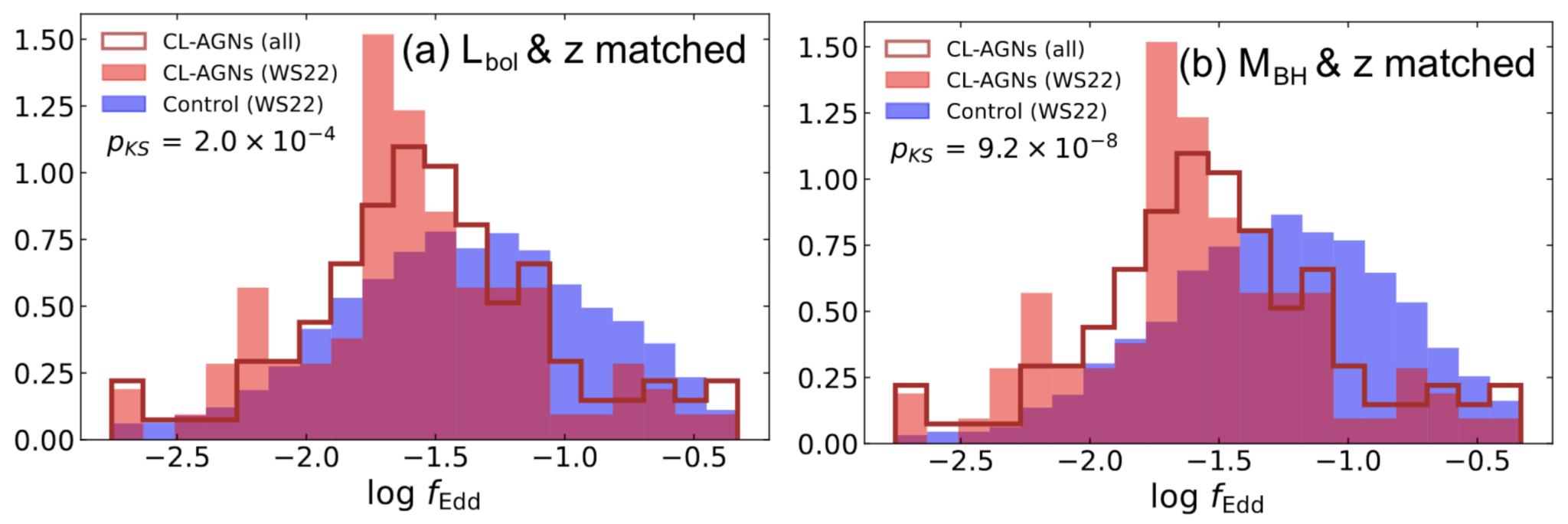
By comparing their new, robust sample of changing-look AGN to a control sample of ordinary AGN, the authors investigated if there were any crucial differences between the two samples that could help illuminate the origin of changing-look AGN. They found that the black hole mass and total energy output were not significantly different between the two samples, but the accretion rate normalized to the black hole mass (also known as the Eddington ratio) was different. This is shown in Figure 2, with the red showing the changing-look AGN and the blue showing the control sample of ordinary AGN. The two different panels show different control samples, but importantly, they both show this same exact trend. This confirms what other studies have suggested — that the most important factor for determining whether an AGN will undergo a changing-look event is its relative accretion rate!

comparison of the Eddington ratio for ordinary AGN and changing-look AGN

Figure 2: Comparison of the Eddington ratio (the accretion rate normalized to the black hole mass) of ordinary AGN (blue) and changing-look AGN (red). The ordinary AGN (control sample) are drawn from a past research article and are matched to other quantities — the bolometric luminosity (left) and black hole mass (right) — of the changing-look AGN to control against. The changing-look AGN show a statistically lower Eddington ratio than both control samples. [Adapted from Zeltyn et al. 2024]

plot showing the change in strength of the Hα and Hβ for active galactic nuclei

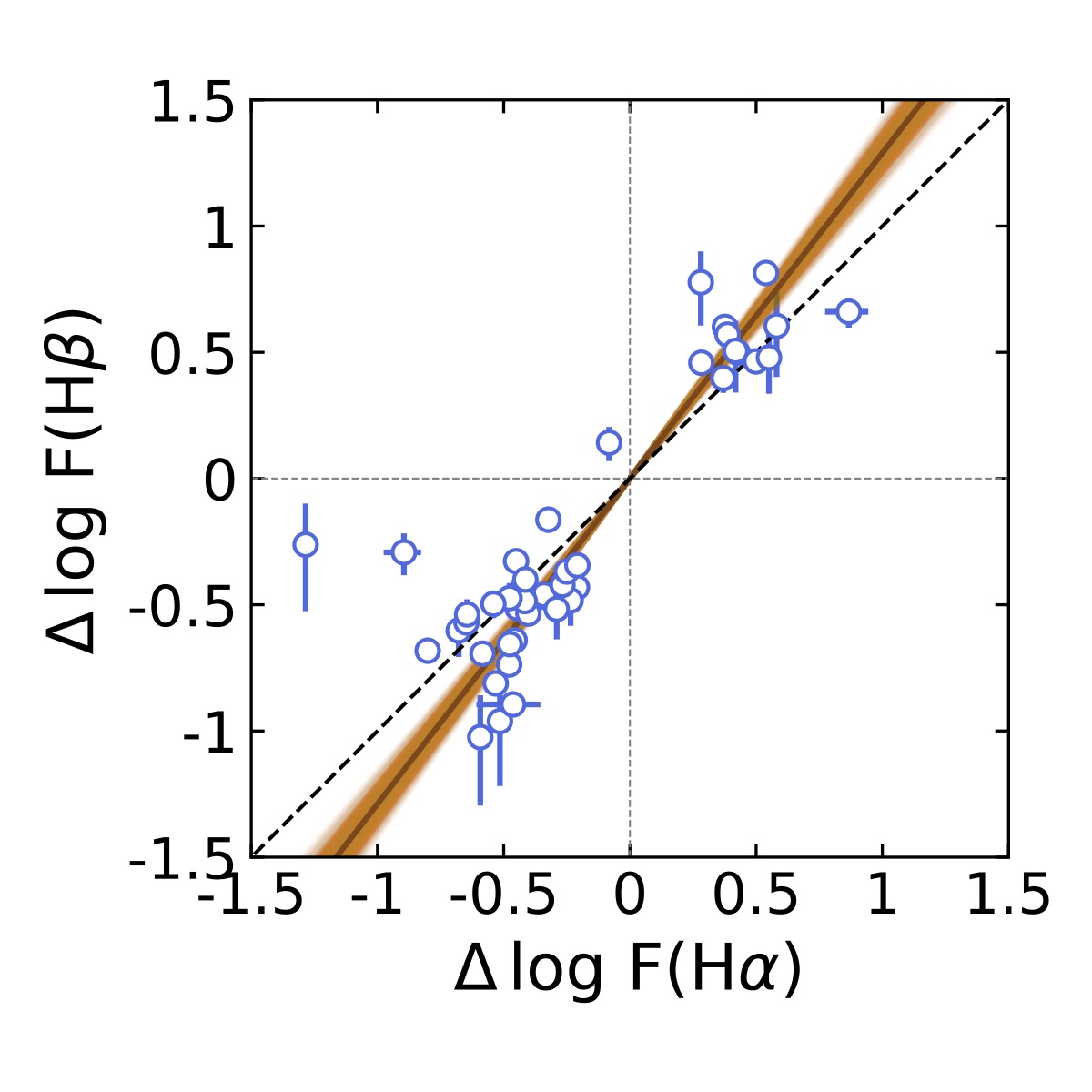
Figure 3: Comparing the relative change in the Hα and Hβ lines for AGN where both can be observed. The two are positively correlated, which is expected, but the Hβ lines seem to vary more than the Hα on average. This could indicate that the observed changes are due to some alterations to the gas and dust along our sight line to the supermassive black hole. [Adapted from Zeltyn et al. 2024]

To investigate the dominant cause of these changing-look AGN, the authors used two different measurements. First, they looked at the relationship between flux changes in different spectral lines. For example, in sources where both Hα and Hβ were observed, they found that the two seemed to change in a correlated manner, but the Hβ changes more than Hα on average (Figure 3). They hypothesized that this could be due to variable dust and gas that would affect the bluer Hβ line more. However, the infrared data for most of these objects showed significant changes as well, which is not consistent with this variable dust and gas model. Thus, the authors concluded that the majority of the changing-look AGN in their sample are the result of changes to the accretion rate.

Wondering how these cosmic curiosities fit into the grand picture of AGN? Keep your eyes peeled because this is coming next! The authors stress that continued SDSS-V/Black Hole Mapper observations will lead to larger samples of changing-look AGN and will help us better understand how these changing-look events relate to normal AGN variability.

Original astrobite edited by Janette Suherli.

About the author, Megan Masterson:

I’m a 4th-year PhD student at MIT studying transient accretion events around supermassive black holes, including tidal disruption events and changing-look active galactic nuclei. I primarily use multi-wavelength observations to study from the inner accretion flow to the obscuring material in these transients. In my free time, you’ll find me hiking, reading, and watching women’s soccer.

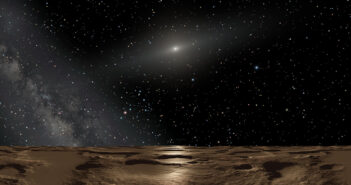
artist's impression of the view from the surface of Sedna

Editor’s Note: Astrobites is a graduate-student-run organization that digests astrophysical literature for undergraduate students. As part of the partnership between the AAS and astrobites, we occasionally repost astrobites content here at AAS Nova. We hope you enjoy this post from astrobites; the original can be viewed at astrobites.org.

Title: Primordial Orbital Alignment of Sednoids
Authors: Yukun Huang (黄宇坤) and Brett Gladman
First Author’s Institution: University of British Columbia
Status: Published in ApJL

The outermost region of our solar system is home to a small group of distant objects with orbits that deviate significantly from the rest of the objects at similar distances from the Sun: Sedna, 2012 VP113, and Leleākūhonua — collectively known as sednoids — have peculiar orbital characteristics that have intrigued astronomers and led to questions about the earliest conditions of the solar system.

The Remarkable Orbits of Sednoids

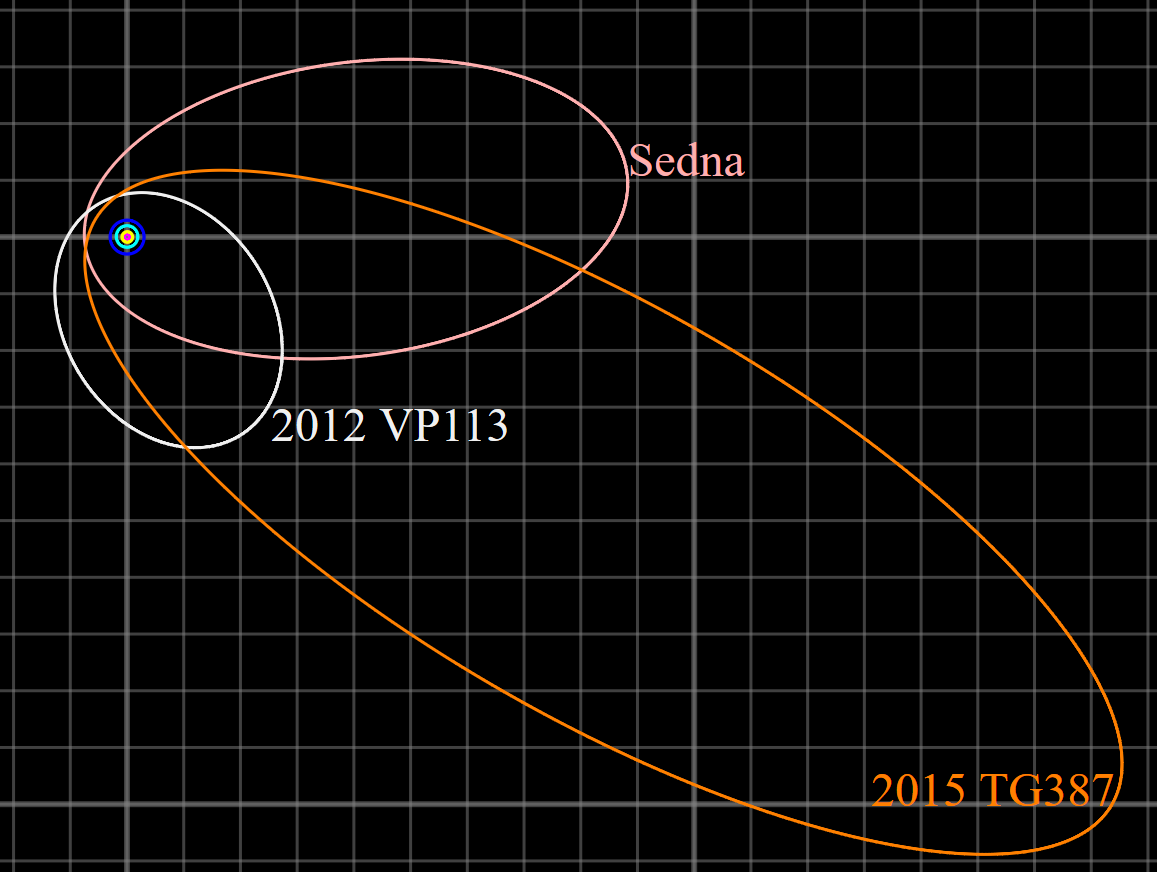
plot of the orbits of the three sednoids

Figure 1: Orbital configuration of the three sednoids. (Leleākūhonua is also cataloged as 2015 TG387.) [Wikipedia user Tomruen; CC BY-SA 4.0]

Trans-Neptunian objects, located beyond Neptune’s orbit, are a diverse collection of icy bodies that include dwarf planets like Pluto and make up the Kuiper Belt — a vast region of space starting at Neptune’s orbit extending outward, populated by countless objects often no larger than a few kilometers across. Among these, sednoids are remarkable due to their incredibly high perihelion distances (see Fig. 1), which means they remain very far from the Sun even at their closest approach (Sedna’s perihelion distance is about 80 times Earth’s distance to the Sun). The sednoids also remain far from our solar system’s planets, and this detachment from the gravitational influence of the major planets raises questions about the sednoids’ origins and the forces that shaped their current trajectories.

Today’s authors set out to determine whether the current orbital alignment of the sednoids could be traced back to an event, such as the possible encounter with a rogue planet or a close stellar flyby, that occurred during the planet formation epoch approximately 4.5 billion years ago. This event would have had the power to imprint a lasting apsidal orientation on these distant objects, guiding them into the peculiar orbits we observe today.

The authors used computer simulations to trace the orbits of the three sednoids backward in time, thus effectively simulating the dynamical evolution of Sedna, 2012 VP113, and Leleakuhonua over billions of years. These simulations calculated the gravitational influence of the Sun and the giant planets — Jupiter, Saturn, Uranus, and Neptune — on the sednoids’ trajectories. To enhance the accuracy of their model, the researchers also took into account a range of initial conditions that reflect the current observational uncertainties in the sednoids’ orbits. This approach allowed them to assess how these uncertainties could influence the backward-in-time orbital paths of these distant objects, ensuring a robust analysis of the sednoids’ dynamical history while minimizing the impact of potential observational biases.

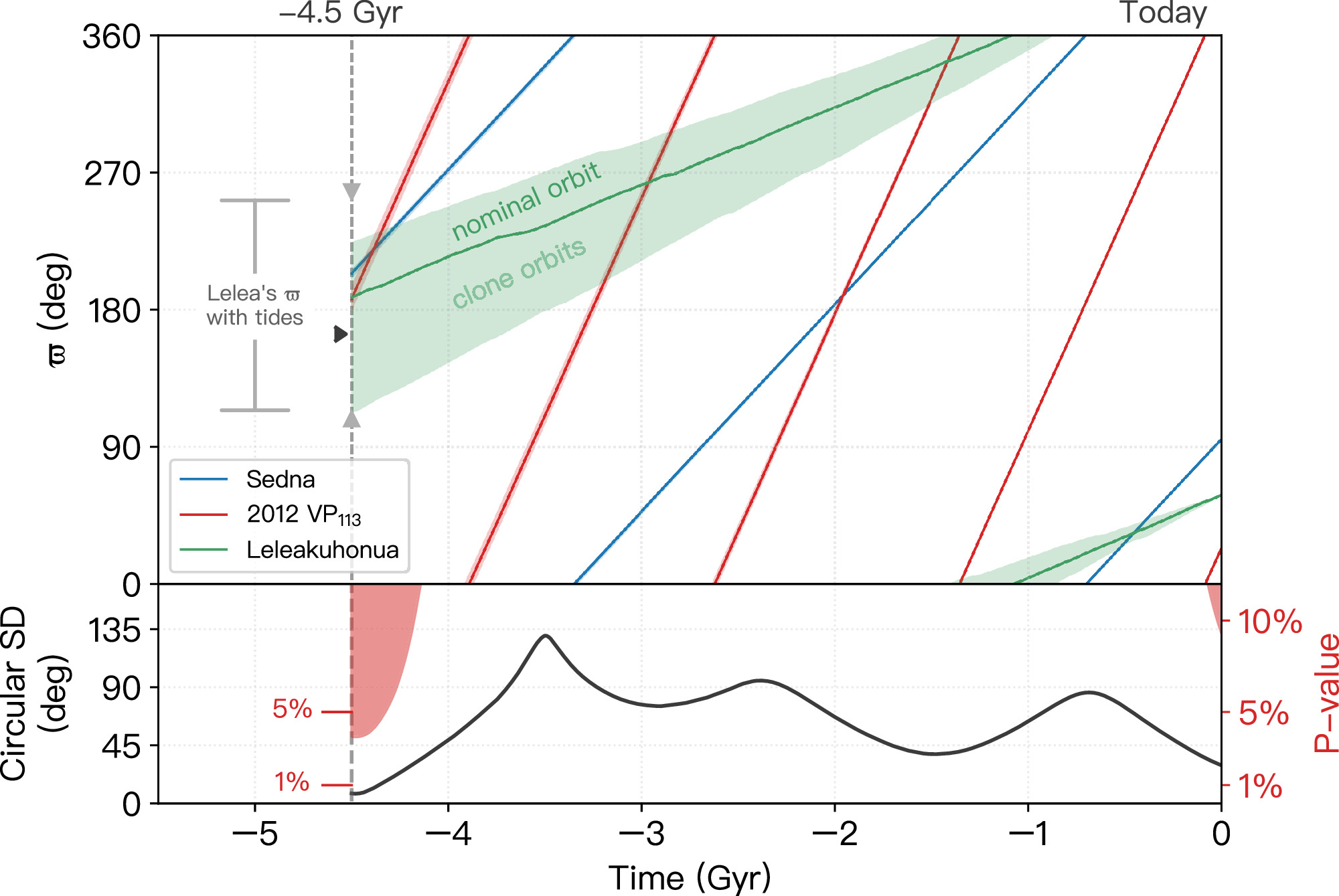
The simulations revealed that 4.5 billion years ago, the sednoids’ orbits may have aligned such that the lines connecting their closest approaches to the Sun, known as their apsidal lines, converged at a perihelion longitude of 200° (see Fig. 2). The perihelion longitude is a specific angle measured in the plane of the solar system that pinpoints the direction toward which each object makes its closest approach to the Sun in its elliptical path. The fact that these apsidal lines clustered so closely in the past suggests that the sednoids did not arrive at their current orbits by random processes alone. Instead, it hints at a shared historical influence or event, potentially during the formation of the solar system, that nudged these objects into such precisely aligned paths. This event could be the gravitational disturbance from a passing star, which may have been common in the densely packed environment where the Sun formed.

plot of the simulated perihelion longitude over time

Figure 2: Past evolutions of perihelion longitudes for the three sednoids. The only time that the three apsidal lines converge is about 4.5 billion years ago. [Huang & Gladman 2024]

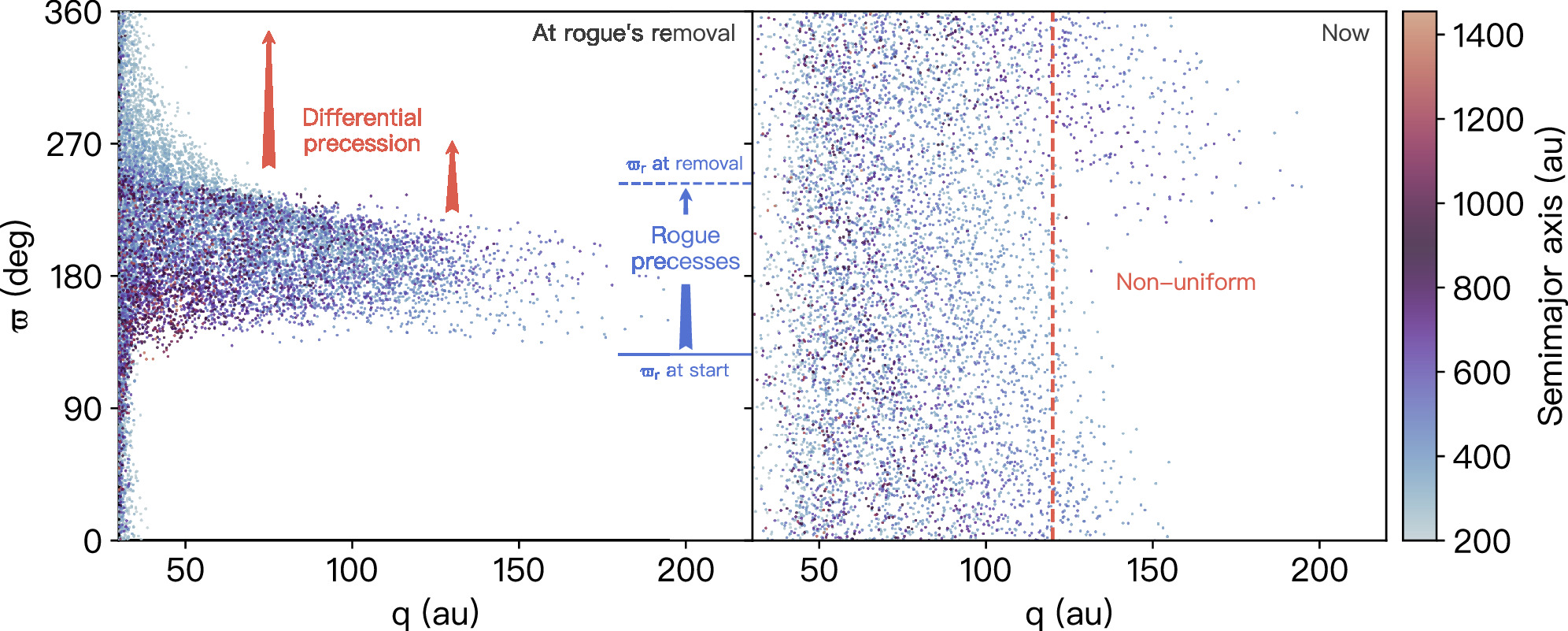
Alternatively, the authors of the study consider the possibility of a rogue planet — a massive planet that was once part of our solar system but was ejected due to gravitational interactions. This hypothetical planet could have been in a position to significantly influence the orbits of the sednoids, aligning their paths to the observed perihelion longitude of 200° before the planet was itself cast out into the galaxy as seen in Fig. 3. The concept of such a rogue planet adds a fascinating layer to the history of our cosmic neighborhood, suggesting that our solar system’s architecture could have been quite different in the distant past.

plots of longitude of perihelion for simulated trans-Neptunian objects

Figure 3: Simulation demonstrating the influence of a hypothetical rogue planet on the orbits of trans-Neptunian objects by plotting longitude of perihelion versus perihelion distance. The left panel shows the orbital configurations shortly after the rogue planet’s departure 185 million years post-formation, while the right panel depicts the current arrangement. The ejection of the rogue planet leads the initially clustered longitudes of perihelion to homogenize, except for bodies where precession periods are comparable to the age of the solar system. As this is the case for sednoids, this may hint at the presence of an additional planet in the early solar system. [Huang & Gladman 2024]

Bad News for Planet Nine

The discovery of unusual orbital patterns among trans-Neptunian objects led to the Planet Nine hypothesis, which posits a yet-undetected ninth planet far beyond Neptune that influences the orbits of these distant celestial bodies. However, the apparent one-time alignment of the sednoids’ orbits 4.5 billion years ago suggests a singular historical event, not consistent with the ongoing perturbations expected from a persistent ninth planet. Such a planet would actively sculpt the orbits over time, potentially erasing the signatures of past orbital configurations. The lack of current apsidal clustering supports the idea that today’s orbital architecture of sednoids stems from an early solar system incident, rather than the continuous presence of a large, undiscovered planet.

Future Discoveries and Solar System Secrets

Nonetheless, due to the intricate nature of the solar system’s dynamics, a more comprehensive dataset is essential to substantiate these findings. The advent of advanced telescopic technology and extended astronomical surveys holds promise for the detection of additional sednoid-like objects. Such observations would be crucial, as they could either corroborate the theory of a primordial event influencing sednoid orbits or compel us to reconsider our current understanding of the solar system’s evolution.

The study on sednoids offers a glimpse into the conditions of the early solar system. The sednoids’ unique orbital alignment could serve as a record of a major event that occurred shortly after the solar system’s formation. As more data become available, we may be able to piece together a clearer picture of our solar system’s history, from its most chaotic beginnings to its current state.

Original astrobite edited by Mark Dodici.

About the author, Konstantin Gerbig:

I’m a PhD student in astronomy at Yale University. I’m interested in the theory of (exo)planets and protoplanetary disks and do hydro simulations thereof. I also like music, as well as dancing salsa and tango.

An illustration of an M-dwarf star covered in starspots

Editor’s Note: Astrobites is a graduate-student-run organization that digests astrophysical literature for undergraduate students. As part of the partnership between the AAS and astrobites, we occasionally repost astrobites content here at AAS Nova. We hope you enjoy this post from astrobites; the original can be viewed at astrobites.org.

Title: Transient Corotating Clumps Around Adolescent Low-Mass Stars from Four Years of TESS
Authors: Luke G. Bouma et al.
First Author’s Institution:
California Institute of Technology
Status: Published in AJ

The flow of time gently pushes us all downstream, making the present past and the future present. So much of science, and even life, is trying to understand how time will change what we experience and observe. What remains the same? Is this something stable that we can rely on? What changes? Is this moment precious? Just a fleeting incident? And how can we tell the difference? These are hard questions, no matter the subject. Today’s authors are unfazed by the challenge and seek to understand what can be said about a mysterious group of M-dwarf stars that seem to be stable in their changing!

Complex Periodic Variables

The subjects of today’s study are complex periodic variables, a new name for objects previously called complex rotators and, before that, scallop-shell objects. While the name has changed, the type of object the name describes hasn’t. Complex periodic variables are all young (less than 200 million years old), rapidly spinning (rotation periods of less than two days), small M-dwarf stars. Only about 150 of them are known, and each has been associated with groups of other young stars, ranging from 2 to 200 million years of age.

What makes complex periodic variables stand out from the crowd in their young groups are their light curves: the measure of their brightness over time. Young stars tend to have big, dark starspots on their surfaces that rotate into and out of view. Starspots normally produce a smooth repeating pattern in the light curve, varying at the spin rate of the star. However, complex periodic variables’ light curves show sudden, sharp repeating features rather than smooth ones. This can’t be caused by starspots alone, but like starspots, these repeating features are stable for weeks and seem to change with the star’s rotation. These sharp features are thought to be caused by either clumps of material orbiting at the right distance to be phased with the star and blocking starlight, or material in prominences formed off the surface of the star due to its magnetic field (Figure 1).

diagram illustrating the clumps of material in orbit or trapped in the star's magnetic field

Figure 1: Two possible physical causes for the complex light curve shapes. The spotted star is seen with clumps of material orbiting around it (left), or with material trapped in the star’s magnetic field as prominences off the surface (right). [Adapted from Bouma et al. 2024]

What Remains the Same? What Changes?

To get a better handle on how stable these complex variations are, and to potentially find some more, the authors searched the two-minute-cadence data from the Transiting Exoplanet Survey Satellite (TESS) for objects with complex variability and found 50 of them. Many of the objects were previously known, but some were new, and the 50 objects served as a great data set for looking at the complex shapes of the light curves. Of the 50, a subset had observations at least two years apart. The authors show the difference in the repeating light curve shape for 27 of the objects in Figure 2.

light curves of 27 complex periodic variables as seen by TESS

Figure 2: Twenty-seven complex periodic variables that have TESS observations separated by at least two years. For each object there are two panels, showing first the earlier and then the later observations. The x axis is the rotational phase, or when the star is in the repeating pattern, and the y axis is the percent change in brightness. Tag yourself, I’m TIC 264767454. [Bouma et al. 2024]

The authors found, for the most part, that the objects’ light curves were still showing complex shapes in the later observations, but the shapes were different between years. Furthermore, some stars (TIC 201898222, TIC 404144841) actually do lose all complexity between observation windows. So while the complexity is stable over the course of weeks or months, it looks like things do change over the course of years.

To examine that further, the authors did a deep dive on a particular star: LP 12-502. They broke up the light curve patterns even further; now, instead of looking at month-long TESS observation sectors, they look at a specific number of cycle repetitions for the object (Figure 3). This finer subdivision revealed that even after every 10–20 cycles of rotation there were subtle, and sometimes dramatic, changes in the shape of the light curve. Furthermore, they were able to point to noticeable flares occurring before some of the changes in the light curve, potentially pointing to a link between flares and changing light curve shape.

light curves of the complex rotator LP 12-502

Figure 3: The light curves of the complex rotator LP 12-502 broken up over particular cycles of rotation (given in the title of each panel). Gaps in coverage are caused by TESS’s observation windows. The patterns of complexity shift and change subtly even over these short time frames. [Bouma et al. 2024]

The River of Time

river plot for the star LP 12-502

Figure 4: A river plot for the star LP 12-502, showing the change in brightness as a function of cycle on the y axis and rotational phase on the x axis. The light curve has been sliced into cycles of rotation and then converted into strips of color stacked on top of each other. [Adapted from Bouma et al. 2024]

The authors concluded that the complex variability of the complex periodic variables changes on multiple time scales, and even more analysis needs to be done. To really drive the point home, they made a series of river plots, such as those shown in Figure 4. Instead of a light curve, the change in brightness in each cycle is laid out as a strip of color, and then the strips from each cycle are stitched together on top of one another. It creates a river of time, each cycle a slice of the river seen from above. This view shows the variation as crests or waves. From our “bird’s-eye view,” we can see the texture of the “water” or brightness changes.

I find these plots peaceful; I want to be sat in an inner tube, floating along their surface. Tough questions of change become easier when considered in comfort. The ripples of brightness ferry me down the lazy-flowing river of time, the gentle motion meandering my thoughts around the potential cause of these mysterious objects.

Original astrobite edited by Ivey Davis.

About the author, Mark Popinchalk:

I’m a postdoc at the American Museum of Natural History. I study the age of stars by measuring how quickly they rotate. I enjoy ultimate frisbee, baking bread, and all kinds of games. My favorite color is sky-blue-pink.

Hubble image of the galaxy Messier 87

Editor’s Note: Astrobites is a graduate-student-run organization that digests astrophysical literature for undergraduate students. As part of the partnership between the AAS and astrobites, we occasionally repost astrobites content here at AAS Nova. We hope you enjoy this post from astrobites; the original can be viewed at astrobites.org.

Title: Distinguishing Active Galactic Nuclei Feedback Models with the Thermal Sunyaev–Zel’dovich Effect
Authors: Skylar Grayson et al.
First Author’s Institution:
Arizona State University
Status: Published in ApJ

Let’s imagine the evolution of the universe as a regular day on Earth. If the Big Bang was when the clock struck midnight, then the cosmic “dawn” is when the first stars and galaxies started to light up our universe. After the cosmic dawn ended, galaxies continued to form stars and grew rapidly throughout the morning. Around cosmic “noon,” most galaxies in our universe were huge and even hosted massive black holes at their centers. However, as the afternoon rolled by, the universe seems to have gotten pretty lethargic in forming stars and expanding galaxies. Looks like the universe is fond of taking an afternoon siesta!

What caused the rapidly forming galaxies in the universe to suddenly slow down and stop star formation? Why didn’t they continue growing to bigger and bigger sizes? Some astronomers believe this cosmic downsizing is due to feedback from active black holes (also known as active galactic nuclei). This feedback typically occurs when the black hole spews out fast winds called outflows that contain gas and dust and expel it to large distances, sometimes far beyond the galaxy itself. Such outflows can clear the galaxy of any star-forming gas and effectively shut down star formation.

There is still much mystery around exactly how the active galactic nucleus feedback affects star formation in the galaxy. Nevertheless, various feedback models are often incorporated into simulations of galaxy formation to understand how the universe evolved. This leads to contrasting theories of galaxy evolution, so comparing the simulation feedback models to actual observations of feedback effects is essential to improve our understanding of active galactic nucleus feedback.

It is hard to directly observe an active galactic nucleus outflow, as they can be as fast as thousands of kilometers per second and cannot be captured instantaneously. Instead, we can look for indirect evidence. Our universe is filled with a microwave background believed to be a remnant of the primordial universe. If we have some high-energy electrons from gas heated by a powerful activity, such as a black hole ejecting material, they would possibly interact with the low-energy photons from the cosmic microwave background and give the low-energy photons a slight boost. This effect, known as the thermal Sunyaev–Zeldovich effect, is a good clue of a possible active galactic nucleus feedback episode.

The authors of today’s research article set out to do look for this indirect evidence of active galactic nucleus feedback. They compare observations of galaxies with signals from the thermal Sunyaev–Zeldovich effect and signals produced by galaxy simulations with and without active galactic nucleus feedback. This can help them determine if the simulations correctly model feedback and if this feedback accurately explains the observed cosmic downsizing.

Comparing Simulations vs. Observations

The authors generate maps of the thermal Sunyaev–Zeldovich effect signal from SIMBA, which is a simulation that explores the co-evolution of galaxies and black holes. They generate one set of maps with galaxies that have active galactic nucleus feedback and another set with no feedback. They highlight a sub-sample of galaxies from the former as quiescent or galaxies that have shut down and have no ongoing star formation. There are plenty of such galaxies in the universe, and they are likely there because active galactic nucleus feedback completely removed all the gas in the galaxy and thus permanently halted star formation.

The thermal Sunyaev–Zeldovich effect can be detected in observations by looking for distortions in the cosmic microwave background from data collected by radio telescopes. (The photons of the cosmic microwave background have low energies and thus need telescopes sensitive to long wavelengths of light to study them.) The authors take radio data of a similar sample of galaxies with active galactic nuclei (including quiescent galaxies) and without. They do this at two different redshifts, z = 1 and z = 0.5. The authors matched the simulated data with suitable observational effects so they could be compared realistically.

The Compton y-parameter is then used to compare the observed signal to the simulated signal. The Compton y-parameter is defined as the number of scatterings multiplied by the energy gained per scatter instance and is a commonly used term to characterize scattering in a system. As seen in Figure 1, at z = 1, the observed data match well with the quiescent active galactic nucleus model and the active galactic nucleus model in general. The data do not line up well with the no active galactic nucleus (i.e., no feedback) model, indicating that the feedback incorporated by the simulation is successful at replicating observed properties at these redshifts.

A plot of the Compton y-parameter versus radius for observed and simulated signals

Figure 1: A comparison of observed and simulated thermal Sunyaev–Zeldovich signals at a redshift of z = 1. The observed data (black points) agree with the active galactic nucleus feedback model. [Grayson et al. 2023]

At z = 0.5, the authors compare temperature fluctuations, which also depend on the Compton y-parameter. In doing this, they find that the observed properties match the model without active galactic nuclei rather than the model with them (Figure 2). However, this could also indicate that the simulations are not correctly modeling the active galactic nucleus feedback. The simulations likely inject too much power into their feedback models at later redshifts, which can harm our understanding of the galaxy properties that they reproduce.

Plot comparing the observed and simulated thermal Sunyaev–Zel'dovich signals at a redshift of z = 0.5

Figure 2: A comparison of observed and simulated thermal Sunyaev–Zeldovich signals at a redshift of z = 0.5.  The observed data (black points) do not agree with the active galactic nucleus feedback model, but this is likely because the feedback is modeled incorrectly in the simulations. [Grayson et al. 2023]

This work highlights the importance of looking for signatures to compare the observations and simulations to improve our understanding of how galaxies evolved, specifically after cosmic noon. The benefits of this are two-fold: to see if the observations agree with our understanding of how galaxies are supposed to evolve by incorporating the physics in the feedback models, and to help us understand if the simulations are modeling the physics correctly and if any modifications are required in our knowledge of the feedback processes.

Original astrobite edited by Jack Lubin.

About the author, Archana Aravindan:

I am a PhD candidate at the University of California, Riverside, where I study black hole activity in small galaxies. When I am not looking through some incredible telescopes, you can usually find me reading, thinking about policy, or learning a cool language!

Hubble image of the galaxy NGC 5728

Editor’s Note: Astrobites is a graduate-student-run organization that digests astrophysical literature for undergraduate students. As part of the partnership between the AAS and astrobites, we occasionally repost astrobites content here at AAS Nova. We hope you enjoy this post from astrobites; the original can be viewed at astrobites.org.

Title: Deconvolution of JWST/MIRI Images: Applications to an AGN Model and GATOS Observations of NGC 5728
Authors: M. T. Leist et al.
First Author’s Institution:
The University of Texas at San Antonio
Status: Published in AJ

Optical Instrumentation 101

When it comes to optical instrumentation in astronomy, one of the fundamental principles is the Rayleigh criterion for angular resolution: how far apart on the sky do two sources need to be for you to distinguish them from each other? For single-piece circular apertures — i.e., most apertures smaller than about 5 meters — the angular scale is famously defined as 1.22 λ/D, where λ is the wavelength you’re observing at and D is the diameter of your aperture. This equation comes from taking the Fourier transform (a translation from spatial information to spatial frequency information) of a circular aperture and describes how the aperture “responds” to light coming in. This response is more commonly referred to as the point spread function, in part because it describes how a point source (like most stars) looks on your detector. More specifically, what your detector sees is the convolution of the point source with the point spread function. An example of this is shown in Figure 1.

illustration of the process of convolution

Figure 1: From left to right: 1) A point spread function for a circular aperture made from the AiryDisk2DKernel class, a part of astropy’s convolution module; 2) a fake field of stars acting as “true sources” made using the random module in numpy and the CircularAperture class in photutils; and 3) the convolution between the point spread function and the field of stars to make a model image of how a telescope might see the star field, done using the convolve function of astropy’s convolution module. This is a very simplified version of the model image building that the authors do, and you can play around with the parameters yourself here! [Ivey Davis]

However, many large telescopes these days — including JWST — are composed of many hexagonal pieces rather than one singular aperture. This changes the shape of the point spread function significantly. Compare, for instance, the point spread function in Figure 1 to the JWST point spread functions in Figure 2; there are quite strong, repeating hexagonal features in JWST’s point spread functions, as well as spike features originating from the support structures of additional mirrors. This poses a problem: how do we distinguish sources from the point spread function effects? What happens to faint sources that lie in the brightest regions of the artifacts? And what happens to extended sources (like galaxies and nebulae) when convolved with such a point spread function? The authors of today’s article work to remove the effects of JWST’s point spread function by deconvolving the image, specifically in the context of active galactic nuclei, actively accreting regions at the center of some galaxies that have a variety of both extended features and point-source components.

illustration of JWST's point spread functions

Figure 2: Modeled JWST point spread functions of five different filters ranging from 5.6 microns (leftmost panel) to 21 microns (rightmost panel) made with the WebbPSF package. [Leist et al. 2024]

This Work

To figure out how effectively they can deconvolve a JWST image of an active galactic nucleus, the authors start by building a model image of what they expect the active galactic nucleus to look like to JWST’s mid-infrared imaging instrument, MIRI. This way, they’ll know what the deconvolved image is supposed to look like and can thus better evaluate the performance of the deconvolution methods.

Their active galactic nucleus model has four components: 1) The central region of the active galactic nucleus (panel 1 in Figure 3); 2) long, collimated outflows of dust originating from the poles of the central region, called polar outflows (panel 2 in Figure 3); 3) two cones of ionization, called ionization bicones, that are commonly seen in certain types of active galactic nuclei (panel 3 in Figure 3); and 4) the host galaxy of the active galactic nucleus, taken here to be the galaxy NGC 5728 (panel 4 in Figure 3). While the host galaxy and the ionization bicones can be resolved and are thus extended features, the polar outflows can only be resolved along one axis, and the central region appears only as a point source. This makes the model a really rigorous example for the effects of both the point spread function and the deconvolution processes.

four components of the active galactic nucleus model

Figure 3: The four components of the active galactic nucleus model used as a “real source” for the model JWST observation. [Leist et al. 2024]

After building their model to act as a “true” image, the authors then use it and the JWST point spread function to make fake MIRI images for five filters ranging from 5.6 microns to 21 microns (1 micron = 10-6 meter). It is this dataset that they use to test five deconvolution methods. Although each method is different, they all work by deconvolving over many iterations until either the size of the point spread function stops significantly shrinking between iterations or until the difference in flux of a source is different enough from the original image.

Of the five deconvolution methods used, the method that improved the point spread function the most, and did so at all wavelengths, was a method called Kraken deconvolution. Not only did it improve the point spread function the most, but it also did it in the fewest number of iterations — 22 iterations at most, while all other methods required between 29 and 105 iterations. Despite the quality of Kraken’s performance, it was not able to make the polar outflow component detectable. Regardless, the method showed true improvement in image quality and so was used to deconvolve a real JWST observation of NGC 5728 that was collected as a part of the Galactic Activity, Torus, and Outflow Survey (GATOS).

The original JWST image of NGC 5728 and the results of running the Kraken deconvolution method are shown in Figure 4. The Kraken method deconvolved the JWST image both in a similar number of iterations as well as to a similar quality as it had for the mock observation, meaning the results are consistent with expectations! The results also reveal extended structure to the south east of the central region, as shown in Figure 4. Although this feature had been observed in 2019 with other instruments, it would be undetectable in JWST images without the deconvolution technique.

two views of the spiral galaxy NGC 5728 showing the result of the deconvolution method

Figure 4: The JWST observation of NGC 5728 as observed by the MIRI instrument (left) and the result of deconvolving the image using the Kraken method (right). Although the outflow is indistinguishable in the original JWST image, it is readily observed to the bottom left of the central region in the deconvolved image. [Leist et al. 2024]

Overall, the authors demonstrate the power — and necessity — of deconvolution for doing science with JWST data. It’ll be interesting to see how the deconvolution methods’ performance holds up at shorter wavelengths, as well as to find other fun features that might have already been missed in previous observations!

Original astrobite edited by Isabella Trierweiler.

About the author, Ivey Davis:

I’m a fourth-year astrophysics grad student working on the radio and optical instrumentation and science for studying magnetic activity on stars. When I’m not crying over radio-frequency interference, I’m usually baking, knitting, harassing my cat, or playing the banjo!

X-rays, dark matter and galaxies in cluster Abell 2744

Editor’s Note: Astrobites is a graduate-student-run organization that digests astrophysical literature for undergraduate students. As part of the partnership between the AAS and astrobites, we occasionally repost astrobites content here at AAS Nova. We hope you enjoy this post from astrobites; the original can be viewed at astrobites.org.

Title: Deep Chandra Observations of Abell 2495: A Possible Sloshing-Regulated Feedback Cycle in a Triple-Offset Galaxy Cluster
Authors: Luca Rosignoli et al.
First Author’s Institution:
University of Bologna and National Institute for Astrophysics, Italy
Status: Published in ApJ

Galaxy clusters are the biggest gravitationally bound objects in the universe. They have three main components: galaxies, their surrounding dark matter halos, and hot gas between the galaxies known as the intracluster medium. It’s the interaction between these components that makes galaxy clusters so interesting, and also (we think) significantly affects galaxy formation and evolution as a whole. As an example of this interaction, many galaxy clusters have a supermassive black hole inside their central galaxy (known as the brightest cluster galaxy) that’s acting as an active galactic nucleus — it’s being fed so much material by the galaxy and the cluster that it can’t contain it all, and it’s spitting material and energy back out into the cluster.

Thanks to gravity, each of these three components in a galaxy cluster should be centered on the same point in space — the dark matter forms a kind of gravitational “pit” that both the intracluster medium and the galaxies themselves can’t help but be pulled into. Other forms of energy (like heat keeping the intracluster medium puffed out, or leftover kinetic energy keeping the galaxies orbiting) prevent the intracluster medium and galaxies from collapsing entirely into the center of the pit, but they’re still definitely centered on where the pit is deepest. It’s very interesting, therefore, when the mass centers in galaxy clusters aren’t fully lined up. In today’s article, the authors explore one of these cases.

A Misaligned Galaxy Cluster

The cluster explored in this study, called Abell 2495, has been known about for a long time — it was discovered in 1998 through an X-ray search for clusters using the ROSAT satellite. Since then, a wide variety of data have been collected about this cluster at many different wavelengths that trace different components of the cluster. The data that are most relevant here are radio data from the Very Large Array at a frequency of 5 gigahertz (tracing activity from the active galactic nucleus inside the central brightest cluster galaxy) and optical images (showing the positions of the galaxies in the cluster) from the Hubble Space Telescope.

In addition to the ROSAT observations used to discover the galaxy cluster, there were also Chandra X-ray Observatory data of Abell 2495. However, the observations from both telescopes had very low sensitivity, making it difficult to distinguish any features in the X-ray-emitting gas. The authors present six new deep Chandra observations in this article, vastly improving the sensitivity of the X-ray observations (which trace the hot gas of the intracluster medium). Figure 1 combines several of these different types of observations, plotting them together as contours. X’s mark the various centers of the galaxy cluster components.

observations of the galaxy cluster Abell 2495

Figure 1: Multiwavelength observations of the galaxy cluster Abell 2495. The greyscale (and black contours) shows the X-ray emission from the hot gas in the galaxy cluster, the red contours show hydrogen gas (Hα), and the green contours show radio emission coming from the supermassive black hole inside the cluster’s central galaxy. The X’s show the center of the cluster determined in different ways: the black X is the center of the X-ray emission, the red X is the center of the Hα emission, the yellow X is the center of mass of the cluster (determined using the positions of the individual cluster galaxies), and the green X is the center of the brightest cluster galaxy. [Rosignoli et al. 2024]

A Gassy History

In order to understand why the galaxy cluster isn’t centered properly, we need to look back at the history of its movements. Luckily, there’s an easy way to do that — the X-ray light, which traces the intracluster medium, contains signatures of any strange happenings in the cluster’s recent history. This is because the intracluster medium is normally smooth and symmetric, but it takes a while to settle after disturbances. The authors’ new Chandra observations are thus perfect for finding out what’s going on in Abell 2495.

Some of the more interesting features the authors found in the X-ray observations are shown in Figure 2. The four cavities (the dark regions in Figure 2a) are indicators that the active galactic nucleus inside Abell 2495’s brightest cluster galaxy had periods in the past where it was extra active, emitting enough energy to blast holes in the intracluster medium. What’s particularly interesting is how some of these cavities line up with the current position of the emission from that active galactic nucleus (shown with the blue contours). The authors also found a significant density jump on one side of the intracluster medium (the light region in Figure 2b), suggesting that some force has piled up the gas on one side of the cluster in a dense cold front.

depictions of the cavities and cold front seen by the authors in this work

Figure 2: Interesting features in the X-ray observations of Abell 2495. In the left panel, the four cavities discovered by the authors are circled in green. These are areas of the otherwise smooth intracluster medium where very little material is present. In the right panel, a fitted profile of the intracluster medium has been removed, showing a large asymmetry with a significant jump — a “cold front.” [Adapted from Rosignoli et al. 2024]

temperature map of the intracluster medium of Abell 2495

Figure 3: A binned temperature map of the intracluster medium inside Abell 2495, measured using the X-ray emission. The regions outlined in black are cold enough to condense significantly in a reasonable timescale. [Adapted from Rosignoli et al. 2024]

Finally, the authors bin up their X-ray image in 2D space so they can use the spectra of the X-rays to calculate the temperature of the intracluster medium gas in each bin. Figure 3 shows the resulting temperature map. The regions of the map outlined in black have gas temperatures below a key threshold that means it can likely condense enough to fuel the active galactic nucleus in the center of the cluster. This also means that the cluster is cool-core (see an astrobite about this here). Interestingly, there’s also an extended tail of cold intracluster medium spiraling away from the center of the cluster, in a position that almost lines up with the cold front discussed above.

The Cosmic Bathtub

The authors of this article believe that all of this evidence points to one very interesting phenomenon: the galaxy cluster is sloshing. This is a phenomenon that’s appeared widely in simulations and has also been observed several times. It happens when some gravitational disturbance, typically a small “sub-cluster” of galaxies, passes by the cluster. This disturbance pulls both the dark matter and the intracluster medium in its direction. The dark matter can pass right through anything in its way, but the intracluster medium of the sub-cluster collides with the other intracluster medium of the other cluster, creating cold fronts, and so the two components get separated. This results in offsets between the centers, just like the ones observed in Abell 2495! As the disturbance passes, the dark matter and intracluster medium fall back towards the center of the cluster, setting up an oscillation just like water sloshing in a bathtub.

The Scientific Relevance of Baths

The reason why sloshing is so fascinating is because it could be regulating active galactic nucleus feedback. Normally, galaxy clusters act out the feedback cycle described in the introduction — the intracluster medium cools and collapses onto the active galactic nucleus, which in turn gets extra active and heats the intracluster medium back up again. In this case, however, the authors believe that the sloshing in this galaxy cluster is driving the whole feedback cycle. There is some quantitative evidence for this — the time the cluster takes to slosh is fairly consistent with the time between the formation of the different cavities in the intracluster medium, and the size of the X-ray cavities is consistent with the amount of energy that would be involved. If this is the case, sloshing could drive the whole life cycle of the cluster.

Sloshing Towards the Future

The authors have done a lot of analysis to come up with these findings, but there are some limitations in the data that mean significant uncertainties remain. Better X-ray data could uncover more details about the X-ray cavities, helping to narrow down when they were formed and how much energy was required to create them. A clearer picture of the cold front would allow the intracluster medium in the cluster center to be examined in more detail. It would also be helpful to get a larger sample of clusters with active galactic nucleus feedback potentially regulated by sloshing to understand if this is a common process, or if Abell 2495 is unique. Either way, this is a fascinating addition to our picture of one of the most extreme places in the universe — the center of a galaxy cluster.

Original astrobite edited by Lina Kimmig.

About the author, Delaney Dunne:

I’m a PhD student at Caltech, where I study how galaxies form and evolve by mapping their molecular gas! I do this using COMAP, a radio-frequency line intensity mapping experiment based in California’s Owens Valley.

1 7 8 9 10 11 46