
Teamwork Makes the Intensity-Mapping Dream Work
Astrobites reports on research that brings together data from multiple wavelengths to make a detection of distant 21-cm radiation.

Astrobites reports on research that brings together data from multiple wavelengths to make a detection of distant 21-cm radiation.
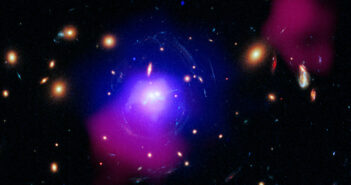
Astrobites reports on the aftermath of a massive active galactic nucleus outburst that left behind a string of star formation.
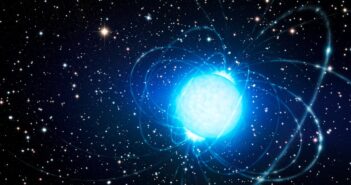
Astrobites reports on the fast blue optical transient AT2018cow, which has remained a mystery to astronomers since it was discovered.
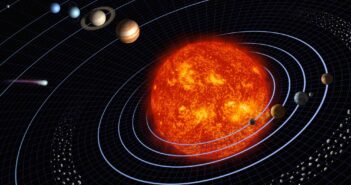
Astrobites reports on the likelihood of exoplanetary systems having both small, close-in planets and large, far-out gas giant planets.
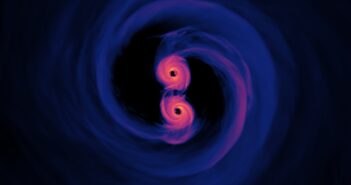
Astrobites reports on new evidence that suggests the density of dark matter spikes near a supermassive black hole.
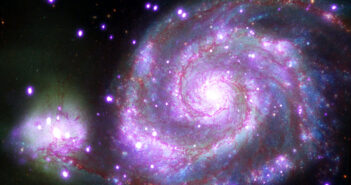
Astrobites reports on “little red dots” in the early universe and how to use X-rays to determine if these galaxies host massive black holes.
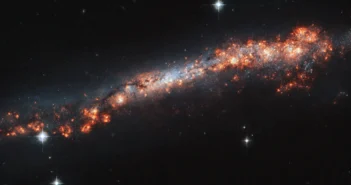
Astrobites reports on simulations of the circumgalactic medium, a reservoir of gas that helps regulate a galaxy’s ability to form stars.
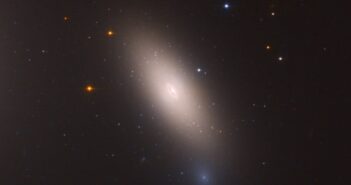
Astrobites reports on galaxies that may be forming a remarkable number of stars in the first few hundred million years of the universe.
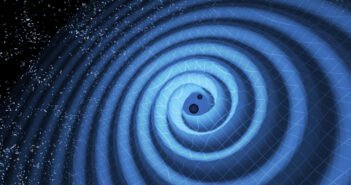
Astrobites reports on efforts to study black holes across cosmic time via the observational limits on the gravitational wave background.
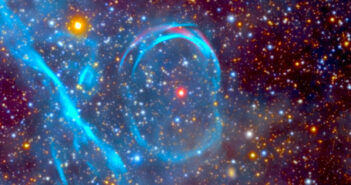
Astrobites reports on the never-seen-before optical emission shell around the CI Camelopardalis X-ray binary system.