Black Holes Grow Better with a Friend
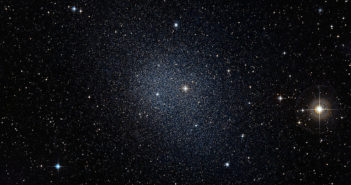
Astrobites reports on observations of dwarf galaxies that show how a buddy galaxy can help trigger phases of rapid black hole growth.

Astrobites reports on observations of dwarf galaxies that show how a buddy galaxy can help trigger phases of rapid black hole growth.

Since 2017, the Research Notes of the American Astronomical Society (RNAAS) has provided a venue for brief research reports, student work, null results, and more. Editor Chris Lintott shares his reflections on a recent RNAAS milestone: 2,000 Notes.
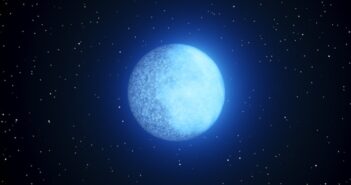
A search for white dwarfs that present different compositional “faces” as they spin has dredged up two new members of the emerging class of double-faced white dwarfs.
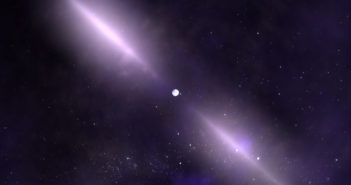
A serendipitous discovery illuminates the kinds of objects that might bridge the gap between pulsars and long-period radio transients.
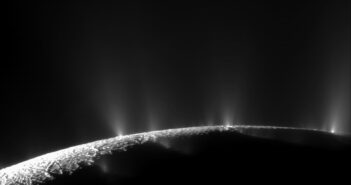
Saturn’s tiny moon Enceladus was the first moon in the solar system known to spout plumes of water ice and vapor. A new study investigates the behavior of these plumes and the network of fissures from which they emerge.
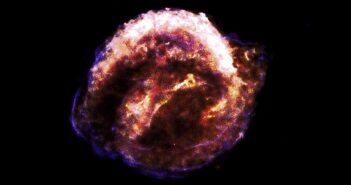
Astrobites reports on how standard candles might not be quite as standard as previously thought, and how a particular type of supernova is making a name for itself.
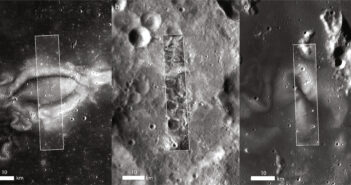
Researchers investigate the cause of bright, sinuous swirls that are associated with magnetic fields embedded within the Moon’s surface.
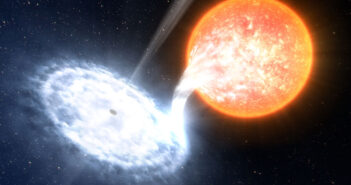
How do interactions binary black holes experience in dense star clusters impact the gravitational waves we detect on Earth? Recent simulations show that stellar collisions leave imprints on the masses and spins of these black holes.
Astrobites reports on how we can use simulations of stellar populations to rapidly estimate the identity of the lensing object in a microlensing event.
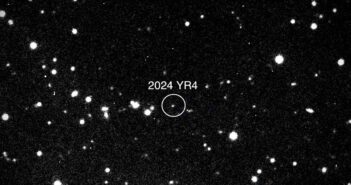
Though the odds of asteroid 2024 YR4 striking Earth in 2032 have fallen to almost zero, the asteroid still has a slim chance of a collision with the Moon. New JWST observations tell us more about this potential impactor.
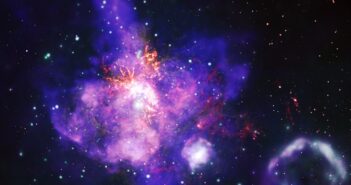
An ultra-high-energy neutrino, a galactic PeVatron, and a fading quasar at cosmic dawn are the subjects of today’s Monthly Roundup.
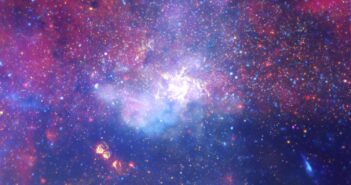
Could there have been two massive black holes in our galaxy’s center at one time? New modeling of fast-moving stars in the Milky Way’s halo suggests the answer is yes.