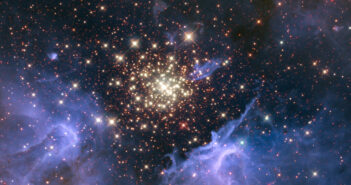
Crafting Compact Clusters in the Early Universe
Recent simulations tackle the question of how dense star clusters like those spotted by JWST formed in the early universe.

Recent simulations tackle the question of how dense star clusters like those spotted by JWST formed in the early universe.
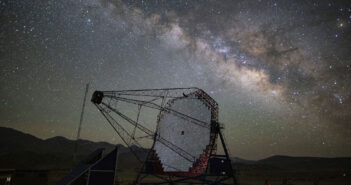
Astrobites reports on two mysterious flares detected from a radio galaxy by the brand new MACE gamma-ray telescope.
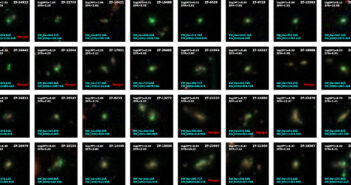
An exploration of galaxies during our universe’s star-formation heyday reveals a population of bright, compact regions called green seeds.
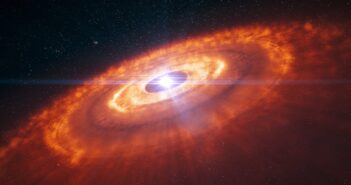
What happens when a young star captures some extra gas and dust? New observations of a dusty disk reveals how a late-stage infall event may be influencing planet formation in AB Aurigae.
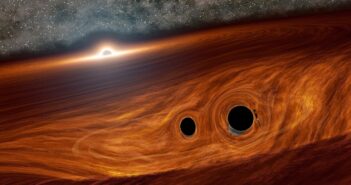
Gravitational-wave detectors have spotted dozens of merging black hole pairs. New research explores whether any of these collisions could have happened in the disk around an accreting supermassive black hole.
Astrobites reports on a study that shows that hot stars seem to host fewer small planets than their cooler stellar cousins.
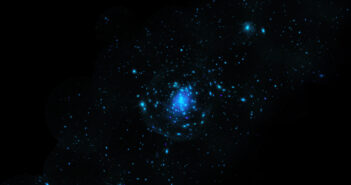
What has the supermassive black hole at the center of the Milky Way’s galactic neighbor been up to? The Chandra X-ray Observatory provides all the details.
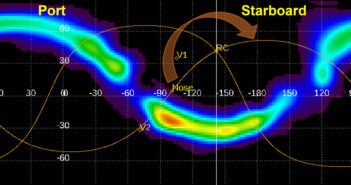
When mapping energetic atoms from the edge of our solar system, the Interstellar Boundary Explorer discovered an unexpected ribbon-like feature that researchers are still working to understand.
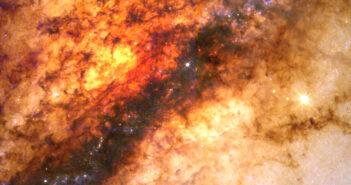
Astrobites reports on what might be powering the strange, puzzling young galaxies known as little red dots.
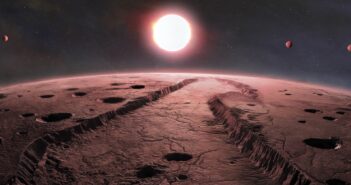
Following decades of disproven claims, four small exoplanets have been confirmed to orbit Barnard’s Star, the second-closest star system to Earth after Alpha Centauri.
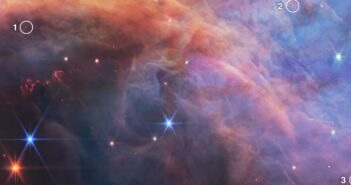
When a gas cloud collapses to form a star cluster, how many objects form, and what are their masses? Research published today provides answers about the low-mass end of the star and brown dwarf formation process.
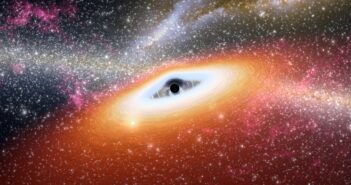
Recent JWST observations have stirred up concerns about over-massive black holes in the early universe. A new study allays these concerns while showing that over-massive black holes are just scratching the surface of the full black hole population.