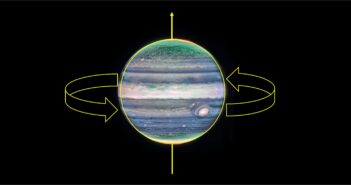
How Squished Is That Planet? Astronomers Measure Oblateness of a Sub-Neptune
HIP 41378f — a cold, puffy exoplanet with four known siblings — becomes one of just a handful of planets with an estimate of its rotation period.

HIP 41378f — a cold, puffy exoplanet with four known siblings — becomes one of just a handful of planets with an estimate of its rotation period.
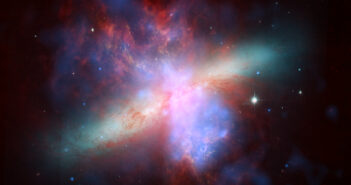
Astrobites reports on the results of a cosmic-ray investigation of the starburst galaxy Messier 82 using the VERITAS gamma-ray telescopes.
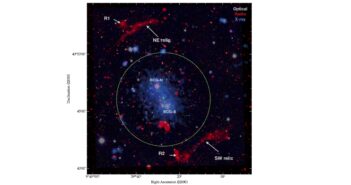
What at first appeared to be an unremarkable low-mass galaxy cluster has been revealed to host a rare pair of parenthesis-shaped radio sources.
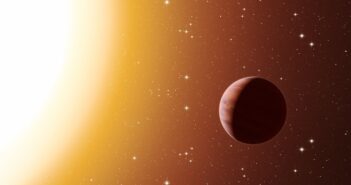
What is pulling exoplanet XO-3b out of alignment with its host star? A recent study explores the system and reveals an emerging trend that provides a boundary for planet formation mechanisms.
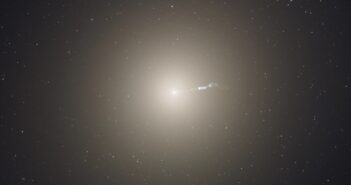
Sensitive polarized-light observations of the relativistic jets of supermassive black holes may provide an entirely new way to measure the spin of a black hole.
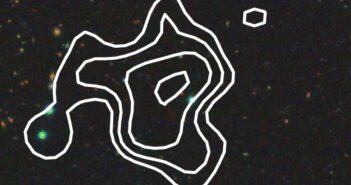
Astrobites reports on an investigation of Cloud-9, a cloud of hydrogen gas that may be a galaxy containing dark matter but no stars.
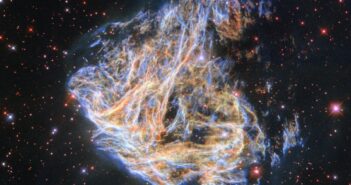
Mark your calendars for a few tens of millions of years in the future: a core-collapse supernova at just 228 light-years away is sure to be spectacular.
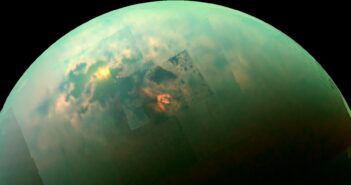
From its vantage point in orbit around Saturn, the Cassini spacecraft captured the brilliant gleam of sunlight reflecting off of Titan’s oily hydrocarbon seas. New research explores what sunglint can tell us about the interaction between Titan’s seas and atmosphere.
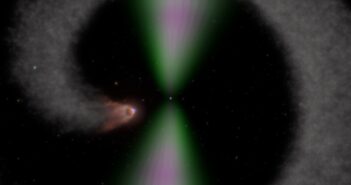
Arachnophobes beware: today’s post concerns the behavior of the voracious stellar remnants called spider pulsars.
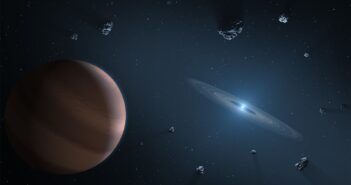
Astrobites reports on whether planets around Sun-like stars destined to become white dwarfs are able to hold on to their oceans.
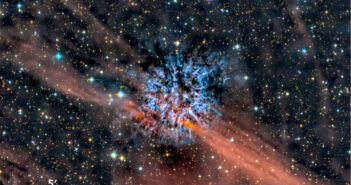
New images highlight the clumpy ejecta and radial streaks surrounding WR 8, a Wolf–Rayet star that may be changing from one spectral subclass to another.
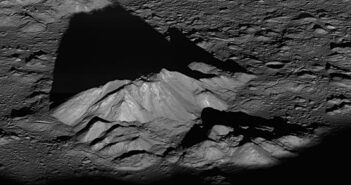
New high-resolution maps of the Moon’s north pole reveal interesting terrain and locations possibly preserving water ice, which will inform future lunar exploration.