By pushing JWST to its limits, astronomers may have just spotted a planet around the nearest Sun-like star, Alpha Centauri A. Though another look at the star is needed next year to confirm the finding, if the detection holds up, this discovery easily earns several superlatives: the planet would be the nearest, oldest, coldest, and lowest-mass world ever directly imaged beyond our solar system.
Hi, Neighbor!
The scale of our Milky Way galaxy is hard to comprehend with our Earth-bound minds that are more attuned to measuring distances in miles than in light-years. However, even though our suburban stellar neighborhood is tens of thousands of light-years from the galactic downtown, it is not empty: there are a handful of nearby systems that offer unique opportunities to study stars and their potential planet children “up close.”
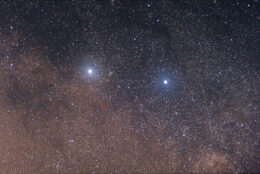
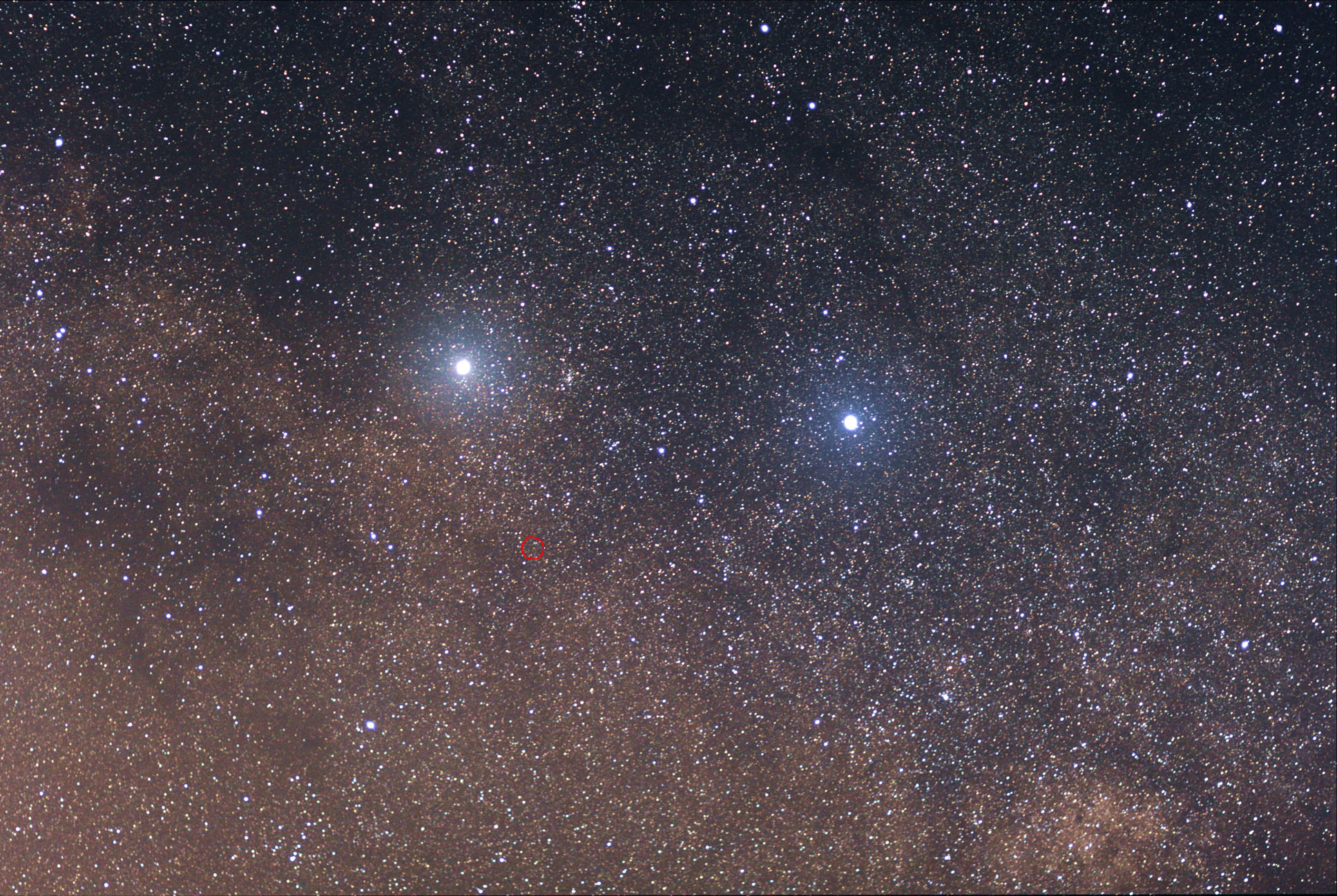
Alpha Centauri A and B (bright stars), along with Proxima Centauri, circled in red. [Wikipedia; CC BY-SA 3.0]
The nearest star system to the Sun at just over 4 light-years away is called Alpha Centauri. It’s a star “system” since what appears to the naked eye to be one star is actually three objects orbiting each other: Alpha Centauri A and Alpha Centauri B are two Sun-like stars that circle each other every 80 years or so, while Alpha Centauri C, better known as Proxima Centauri, circles the inner pair on a much wider orbit.
Though Proxima Centauri is the most famous of the trio, since it’s technically the closest star to the Sun, its larger siblings are arguably better targets for searching for planets. Since these stars are more massive, their habitable zones are large enough that astronomers can block out the star itself and search the surrounding area for planets using a tool called a coronagraph.
Challenging Observations
Back in 2019, a team of astronomers using a coronagraph on the Very Large Telescope uncovered tantalizing evidence of a giant planet orbiting Alpha Centauri A. However, confirming or rejecting this initial peek using telescopes on Earth’s surface was challenging. When JWST finally launched in 2021, following up on this hint was a top priority. Astronomers first attempted to point JWST toward the Alpha Centauri system in 2023, but unfortunately, the observations from that attempt were unusable.
Though one might think aiming a telescope at a nearby star is easier than taking a look at something more distant, this is unfortunately not the case. For one thing, the stars of the Alpha Centauri system are bright enough to overwhelm JWST’s sensitive detectors without careful calibration. For another, keeping the telescope locked on target and the star behind the coronagraph requires continuous tweaks to account for the Sun’s motion relative to Alpha Centauri, JWST’s motion relative to the Sun, and Alpha Centauri A’s motion relative to Alpha Centauri B. The team regrouped, tested a new observing strategy in mid-2024, then took three long observations in August 2024, February 2025, and April 2025.
A Planet Candidate
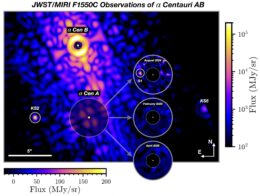
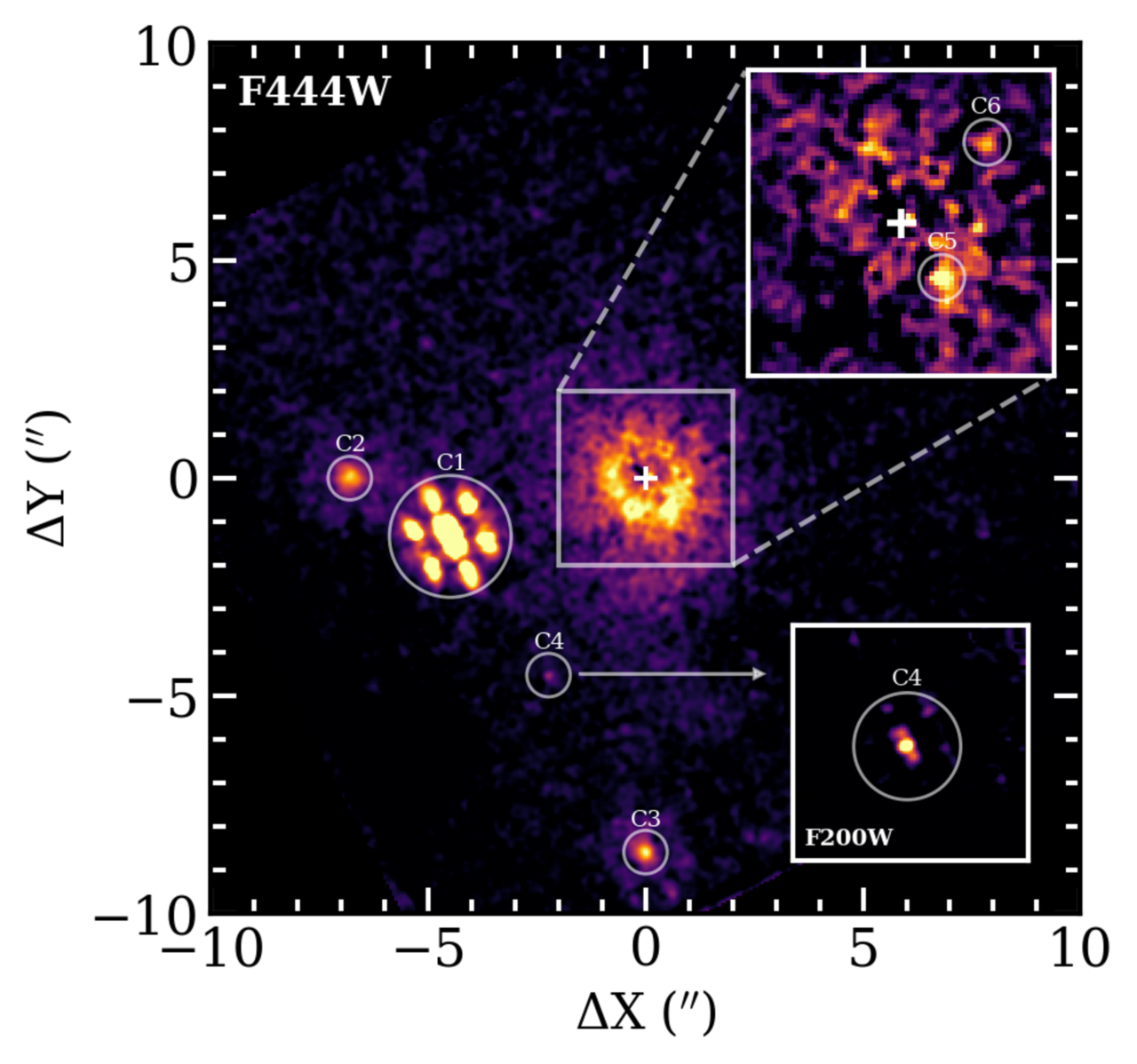
JWST coronagraph image of the Alpha Centauri system. Alpha Centauri B is the bright labeled star at the top, while Alpha Centauri A is labeled but hidden behind the coronagraph. The inset shows the region around Alpha Centauri A during the three different observations. The planet candidate, labeled S1, is only visible in the August 2024 observation. Click to enlarge. [Beichman & Sanghi et al. 2025]
This time, the observations went off nearly without a hitch. After careful data processing, the team led by Charles Beichman and Aniket Sanghi of the California Institute of Technology found a bright blob positioned right beside the star in their August data. Interestingly, the blob disappeared in the next two observations. Working on the hunch that this blob was the same object as the planet candidate seen by the Very Large Telescope, the team realized that most allowed orbits would place the planet too close to the star to be visible in those later observations. In other words, the planet might be playing hide-and-seek, peeking out from behind the star in one month only to vanish in the next.
The authors estimated that the source is a 1–1.1 Jupiter radius planet with a mass of 90–150 Earth masses (0.28–0.47 Jupiter mass) on a 2–3-year orbit. The team stressed that with just one detection, this should still be regarded as a planet candidate, not a confirmed discovery. If the planet is eventually verified, however, it stands out among its peers as the first mature, cold planet ever imaged within its star’s habitable zone. Future detectors may be able to collect spectra of the planet itself, unlocking new insights into giant planet evolution and composition in multiple-star systems with nested orbits, like the Alpha Centauri system.
Now that JWST has a proven strategy for observing this challenging system, it should be possible to take follow-up images. If the planet is real and traveling on its expected orbit, it should reappear beside Alpha Centauri A in August 2026. Hopefully, JWST will be looking when it does, and we can finally confirm that we have a planetary neighbor next door.
Citation
“Worlds Next Door: A Candidate Giant Planet Imaged in the Habitable Zone of α Cen A. I. Observations, Orbital and Physical Properties, and Exozodi Upper Limits,” Charles Beichman et al 2025 ApJL 989 L22. doi:10.3847/2041-8213/adf53f
“Worlds Next Door: A Candidate Giant Planet Imaged in the Habitable Zone of α Cen A. II. Binary Star Modeling, Planet and Exozodi Search, and Sensitivity Analysis,” Aniket Sanghi et al 2025 ApJL 989 L23. doi:10.3847/2041-8213/adf53e



.jpg#file)