
Editor’s Note: For the remainder of 2025, we’ll be looking at a few selections that we haven’t yet discussed on AAS Nova from among the most-downloaded articles published in AAS journals this year. The usual posting schedule will resume January 2nd.
JWST-TST DREAMS: Secondary Atmosphere Constraints for the Habitable Zone Planet TRAPPIST-1 e
Published September 2025
Main takeaway:
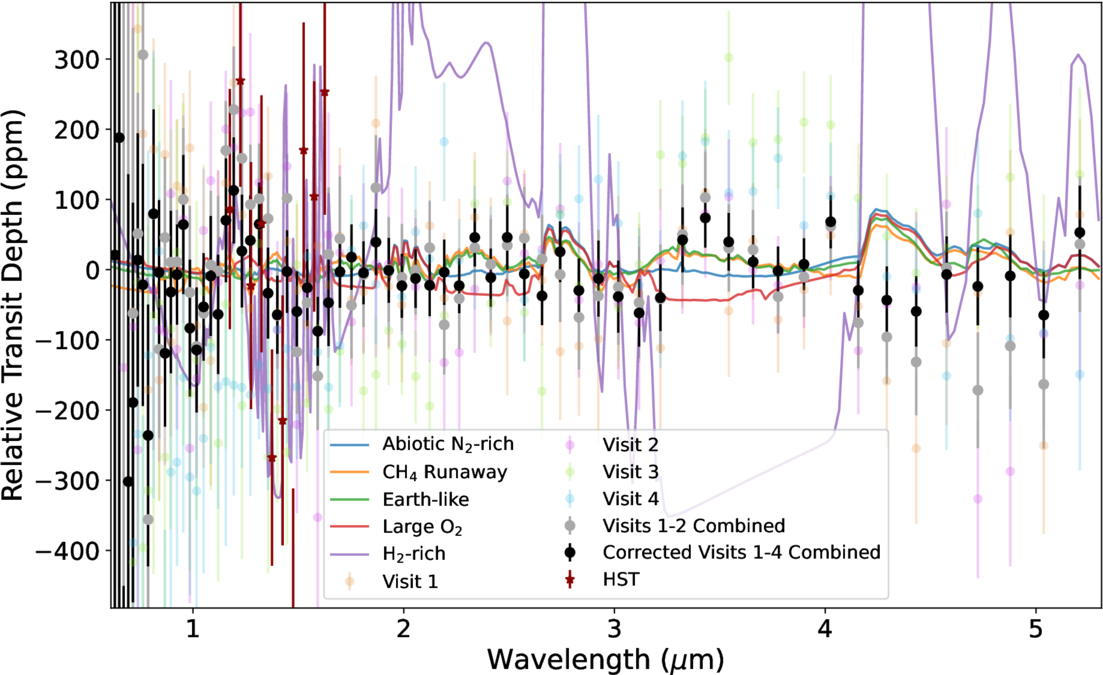
JWST spectra of TRAPPIST-1e (circles) and model outputs for several different atmospheric compositions and pressures (lines). Click to enlarge. [Glidden et al. 2025]
Why it’s interesting:
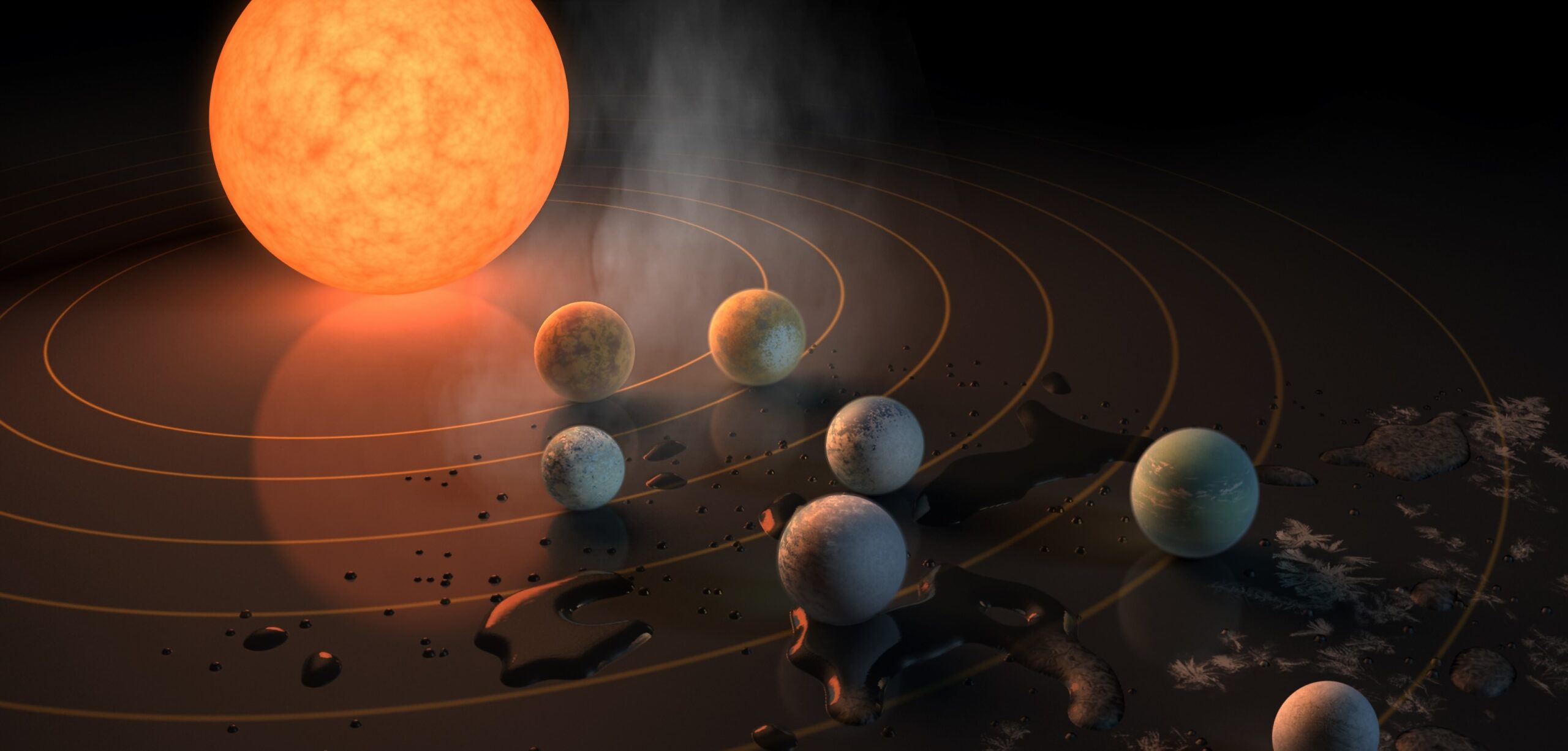
TRAPPIST-1e is one of seven confirmed planets orbiting TRAPPIST-1, a cool M-dwarf star that is just larger than Jupiter and only 41 light-years away. All of these planets are roughly the size and mass of Earth, and as many as four of them — planets d through h — are thought to lie within the tiny star’s habitable zone. Thus, this system offers an excellent opportunity for powerful observatories like JWST to characterize the atmospheres of several potentially habitable planets. This study by Glidden’s team presents JWST’s first look at TRAPPIST-1e’s atmosphere through transmission spectroscopy.
How TRAPPIST-1 complicated the observations:
When examining an exoplanet that closely orbits its host star, special care must be taken to separate the signals from the planet and the star. This is especially tricky for active stars like TRAPPIST-1, whose surfaces are peppered with dark starspots and bright faculae. TRAPPIST-1’s surface features have contaminated observations of other planets in the system, as described in previous research, and these observations of TRAPPIST-1e were not exempt from the star’s meddling. Luckily, researchers are conducting further JWST observations that should help disentangle the star’s impact; an ongoing program will capture closely spaced transits of TRAPPIST-1e and TRAPPIST-1b, which trace nearly the same track across the star’s disk. Since TRAPPIST-1b appears to be a bare rock, any features that are shared between its spectrum and TRAPPIST-1e’s are likely to come from the star. Identifying these features will allow for better characterization of TRAPPIST-1e’s spectrum and atmosphere.
Citation
Ana Glidden et al 2025 ApJL 990 L53. doi:10.3847/2041-8213/adf62e