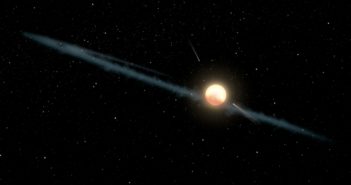
Where’s the Flux? Dust? Discuss.
Boyajian’s star is still at it! Astrobites reports on the latest clues revealed by this star’s mysterious flux dips.

Boyajian’s star is still at it! Astrobites reports on the latest clues revealed by this star’s mysterious flux dips.
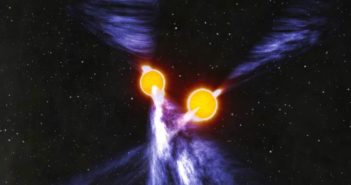
For the first time, we’ve directly determined the direction that a pulsar — a highly magnetized neutron star — is spinning. Astrobites reports on the outcome.
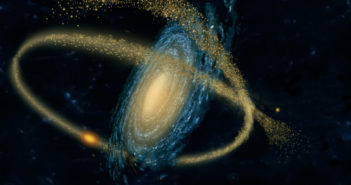
Astrobites reports on how we might learn about the speed of nearby dark matter by tracking metal-poor stars.
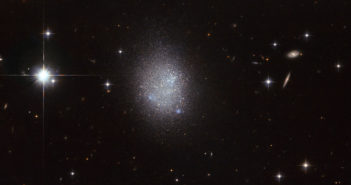
Astrobites reports on how we might find faint and distant dwarf galaxies without individually resolving their stars.
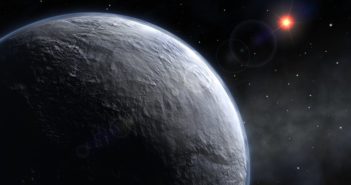
Astrobites reports on a survey with the Spitzer Space Telescope to find distant exoplanets acting as tiny lenses.
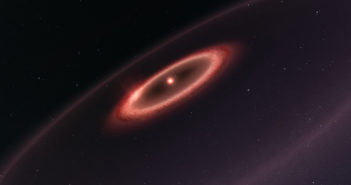
Astrobites reports on belts of dust discovered around our nearest neighbor, the star Proxima Centauri.
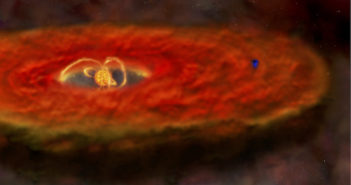
How do the protoplanetary disks surrounding newly formed stars eventually disappear? Astrobites reports on the role that turbulence in the disks might play.
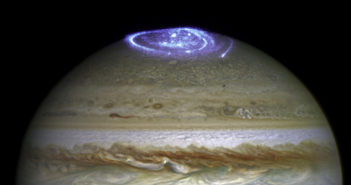
A planet’s aurorae (like the northern lights on Earth) can tell us about the planet itself — but we’ve never before detected aurorae from an exoplanet. Astrobites reports on the prospect of observing aurorae from Proxima Centauri b.
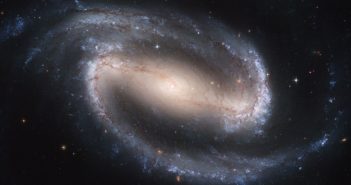
Galactic bars channel gas into the central regions of spiral galaxies to birth new stars. Astrobites reports on whether they are also responsible for lighting up their black holes.
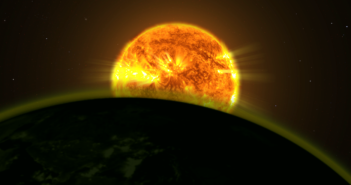
Astrobites reports on how we can better understand the signatures in exoplanet atmospheres — something that we can use in our search for life on other planets.