Editor’s Note: This week we’re at the 53rd meeting of the AAS Division for Planetary Sciences. Along with a team of authors from Astrobites, we will be writing updates on selected events at the meeting. You can read the recaps here or at astrobites.com. The usual posting schedule for AAS Nova will resume next week.
Wednesday Press Conference (by Macy Huston)
Tight Twins in the Kuiper Belt
Hal Weaver (Johns Hopkins University Applied Physics Laboratory)
Dr. Hal Weaver began today’s press conference with a presentation about the New Horizons spacecraft’s exploration of the Kuiper belt. The spacecraft has made close passes by many objects to obtain unprecedented resolution in the outer solar system. The excellent resolution was achieved by the New Horizons instrument LORRI (Long Range Reconnaissance Imager) taking many long exposures, and then sending cropped images back to Earth for careful combination. In the Kuiper belt, New Horizons is searching for “tight twins:” pairs of similarly sized, close-together objects that cannot be resolved from Earth. In the LORRI images, two cold classical Kuiper belt objects (CCKBOs), 2011 JY31 and 2014 OS393, appear as elongated spots rather than round objects like stars. Analysis revealed that each of these images is much better fit by a 2-body model than by a single body. A third CCKBO studied by New Horizons, Arrakoth (formerly nicknamed Ultima Thule), is a contact binary, composed of two adjoined planetesimals. With two of the three observed CCKBOs being disconnected binaries, this may tell us something important about planetesimal formation in the outer solar system. The high binary fraction supports a model in which low-velocity collisions of pebbles in the protosolar disk produce larger clouds of pebbles that collapse, producing binary pairs, where some systems remain separated while others merge into contact binaries.
Active Asteroids Citizen Science
Colin Chandler (Northern Arizona University)
Next, PhD candidate Colin Chandler presented the Active Asteroids citizen science project, which leverages volunteers to identify asteroids with comet-like features such as a tail. These objects can teach us about where water is in the solar system now and where Earth’s water may have come from, but fewer than 30 of them have been discovered so far. With 16 million asteroid images from across the sky, finding active asteroids is a real “needle in a haystack” search. With way too much data for a small team to sift through, citizen science allows the work to be crowd-sourced from the public worldwide, with no special requirements for participants. Machine learning is not yet viable for this project, but the citizen science results may be able to train future algorithms. On the Active Asteroids website, volunteers are shown an image centered on an asteroid and asked whether it shows a tail or dust cloud. Tests run with over 1,000 vetted examples showed that participants can effectively identify these features. The first result from the project is the discovery of a new active asteroid, Jupiter-family comet 2015 TC1, with a “coma” — a surrounding fuzzy cloud of dust and/or gas. Want to try your hand at identifying active asteroids? The project is live at http://activeasteroids.net. Press release
NASA’s OSIRIS-REx Team Discovers Why Bennu and Asteroids Like It Have Surprisingly Rugged Surfaces
Saverio Cambioni (Massachusetts Institute of Technology)
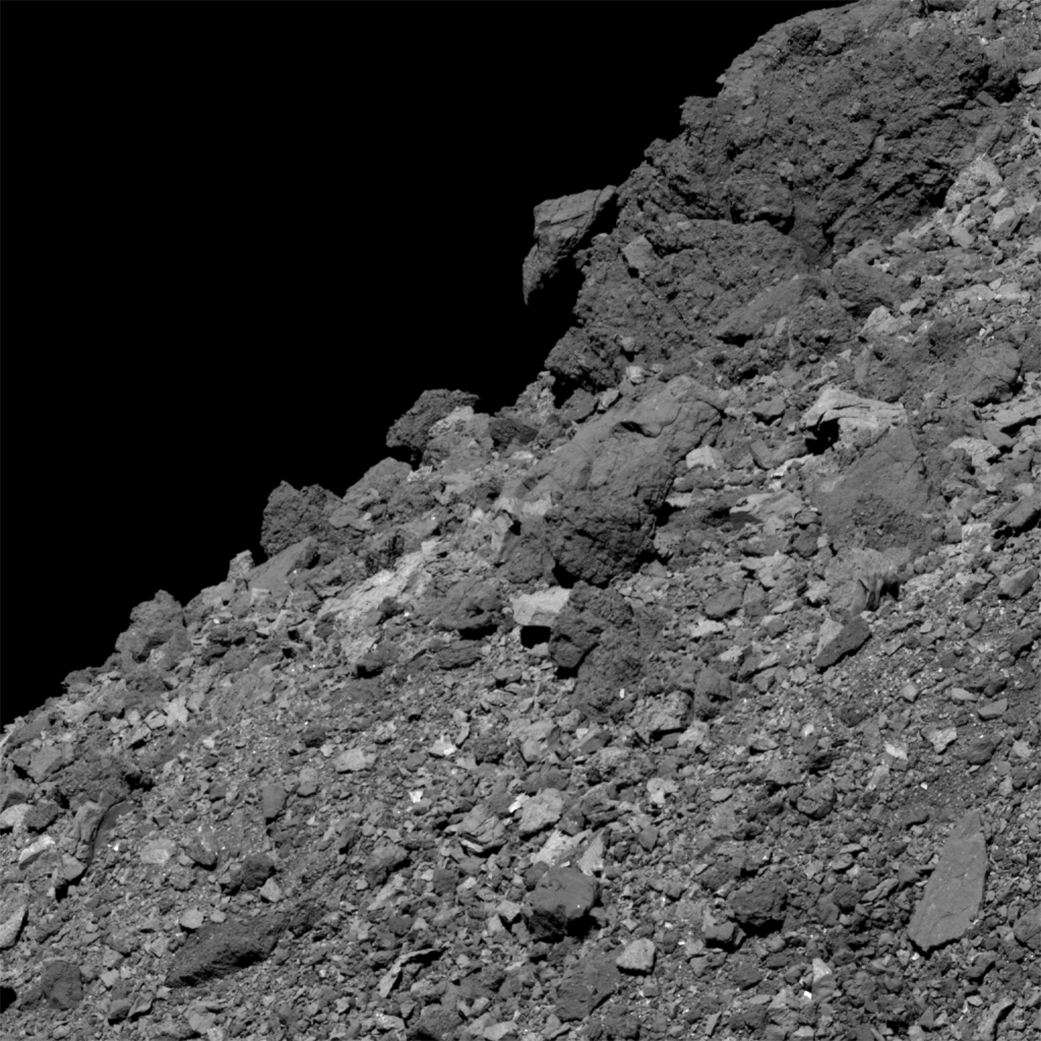
The final presentation of this session was given by Dr. Saverio Cambioni about the OSIRIS-REx mission to collect and return a sample of material from the asteroid Bennu. The mission expected to find fine-grained materials comprising Bennu, but instead they found big rocks. They measured the surface temperature of multiple asteroids with both fine-grained materials and large rocks, and they used machine learning algorithms to explore each component’s contributions to temperature and the materials’ resistance to temperature change. Their results showed a correlation where temperature change resistance decreases with an increasing volume of voids, or higher porosity. Few fine-grained materials were found in the more porous rocks, like those making up Bennu. Fine grains are formed when low-porosity rocks are excavated and fragmented by impacts. High-porosity rocks behave differently — they compact on impact rather than fragment, so they do not produce these fine materials. Bennu and another near-Earth asteroid Ryugu are both composed of high-porosity rocks and lack fine-grained materials. Conversely, the asteroid Itokawa was found to be made up of low-porosity rocks and have abundant fine-grained materials. These are representative of the two most common asteroid types: carbonaceous, which are highly porous and lack fine grains, and S-type, which are made of low-porosity rocks and abundant in fine-grained material. As OSIRIS-REx makes its way back toward Earth with its successfully gathered sample, this experience and new discovery can better prepare scientists for future sample-return missions. The diversity of asteroids can reveal a great deal about how the solar system was formed. Press release 1, press release 2, press release 3
Mission Updates from Hubble, Webb, and Roman (by Macy Huston)
Hubble Space Telescope (HST)
Dr. Carol Christian, the HST outreach project scientist at Space Telescope Science Institute (STScI), presented a history of HST’s work in planetary science throughout its 31-year life so far. Solar system science has been very popular with the public, with ~1 billion viewers/readers of the related Hubble press releases. In the most recent observation cycle (Cycle 29), 6.3% of orbits were devoted to solar system science, including the study of an interstellar comet, Europa’s surface, and a broken piece of one of Neptune’s moons. The most recent solar system press releases have covered Jupiter’s shrinking red spot, the disintegrating ATLAS comet, evidence of water vapor in Ganymede’s atmosphere, and a captured comet among the trojan asteroids. The long timescale over which HST has observed the skies has allowed for great time-domain study of planets, allowing us to learn a lot about weather on Jupiter, Saturn, Mars, and Neptune. HST has also made valuable contributions to the field of exoplanets, studying unique planets like GJ 1132b, which lost its first atmosphere and gained a new one; PDS 70b, which is Jupiter-sized and gaining mass from a dust disk; and HD 206906, which is on an extended orbit analogous to the hypothetical Planet 9 in our solar system. HST observed the dramatic outburst and dimming of Betelgeuse in 2019, which was initially considered a possible supernova precursor, but ultimately the dimming was most likely caused by a dust cloud from the outburst. On a larger scale, HST has observed an interesting supernova imposter — a lensed supernova, which is expected to reappear in 2037 — and the physics of the universe’s expansion.
James Webb Space Telescope (JWST)
Dr. Stefanie Milam, the JWST deputy project scientist for planetary science, presented the mission’s current status and near-future plans. The science and operations center are wrapping up their preparations and launch-day rehearsals are underway. The telescope is currently on a boat heading from California to French Guiana, where it is scheduled to launch on December 18, 2021. After roughly a month of travel to its home at the L2 lagrange point, it will begin a very long and detailed commissioning process. Science operations are expected to begin roughly 6 months after launch, during the summer of 2022. About 7% of the total Cycle 1 science time (including Early Release Science, Guaranteed Time Observations, and General Observers) will be devoted to solar system science. Researchers are working on a large point spread function and scattered-light model for observations of big and bright objects like the giant solar system planets. The telescope will initially be able to track moving targets up to 30 milliarcseconds per second, and achieving faster rates is a goal for Cycle 2. The community can get involved via data analysis tutorials, access nonproprietary data from Cycle 1 Guaranteed Time Observations and Early Release Science programs, and get ready for Cycle 2 with new tools and targets available.
Nancy Grace Roman Space Telescope (Roman)
Dr. Bryan Holler gave an update on NASA’s next flagship after JWST, the Roman Space Telescope, which is anticipated to launch in the mid-2020s. Roman is nearing the end of Phase C (hardware construction) and will soon be entering Phase D (testing). The mission fully passed its recent critical design review. The telescope will be placed at the L2 lagrange point with a nominal 5-year mission with the possibility of a 5-year extension. It will house two instruments: the Wide Field Instrument (WFI) and the Coronagraph Instrument (CGI). The WFI has 18 detectors, with 300 megapixels and 0.11 arcsecond/pixel sampling, which is comparable to JWST’s Mid-Infrared Instrument (MIRI). Its field of view is much larger than those of Hubble and JWST at roughly a quarter of a square degree, which makes it great for large surveys. The imager will contain wide-band filters across the visible through near-IR range. Roman will produce massive amounts of data — roughly 1.4 terabytes per day — which will all be non-proprietary. The CGI is a “technology demonstration” and will be used for three of the first 18 months in space. It will perform direct imaging and spectroscopy of planets a billion times fainter than their host star. 75% of the 5-year primary mission is currently defined for WFI surveys: a high-galactic-latitude wide-area survey, a high-galactic-latitude time-domain survey, and a galactic bulge time-domain survey. The mission is currently seeking input from the community on whether to preselect an astrophysics survey to execute within the first 2 years, as well as ideas for what that survey might be. These may be submitted until October 22, 2021. There will also be a NASA ROSES-21 proposal call in the near future for Roman planning, regarding key project teams, CGI observation planning, and data preparation. A couple of unique opportunities this telescope presents for planetary science are a deep search of the outer solar system for inner Oort cloud objects, a search for small and irregular satellites around the giant planets, and a survey of Earth’s L4 and L5 Lagrange points.
Venus Plenary (by Sasha Warren)
The meeting’s Venus Plenary, led by moderators Dr. Candace Gray and Dr. Nancy Chanover, set the scene for the upcoming “decade of Venus” with an update from the only mission still active at Venus and presentations on the plans for three of the Venus missions scheduled to launch in about 10 years’ time.
Dr. Takeshi Imamura, project scientist of JAXA’s Akatsuki (Venus Climate Orbiter), shared just a few of the most exciting results to come out of the mission in recent years. By monitoring Venus’s cloud tops, the Akatsuki team has measured the speeds and directions of Venus’s winds, revealing a change from winds blowing polewards during the day to equatorwards during the night. Akatsuki cannot see beneath the top of the clouds on Venus, but how the behaviour of winds changes over time can be used to understand what is happening at deeper levels in the atmosphere because the effects of changes in solar radiation between day and night (thermal tides) trigger atmospheric disturbances with different wavelengths. Akatsuki’s most exciting observation so far might be atmospheric waves caused by interactions between Venus’s mountain tops and its thick, super-rotating atmosphere, which may give clues about how wind patterns change with altitude and — most importantly — how Venus’s surface affects the air above it. Looking forward, the Akatsuki team is hoping that future missions will provide more data about atmosphere–surface interactions on Venus — for example, imagery of wind-blown streaks on the surface like those observed on Mars.
Lead scientist Dr. Richard Ghail described ESA’s planned EnVision Venus Orbiter mission, a holistic mission designed to help understand how Venus works as a planet. EnVision’s wide variety of instruments will characterize Venus’s surface mineralogy and texture (e.g. is Venus’s surface all smooth lava flows, volcanic boulders, or covered in wind-blown sand dunes?), image the subsurface down to a depth of hundreds of meters to look at geologic history, monitor for plumes of water and sulphur dioxide gas to track down active volcanoes, and much more! Dr. Ghail described how EnVision builds upon lessons learned from Mars exploration, and how the mission will complement NASA’s missions. EnVision will launch after DAVINCI+ and VERITAS, so there will be more data available to plan which areas of Venus to focus on to follow up on the most interesting observations from VERITAS’s planned global dataset, and the highly detailed local data DAVINCI+ will gather in Alpha Regio.
Dr. Stephanie Getty, Deputy Principal Investigator of NASA’s DAVINCI+ mission, continued the discussion about the future of Venus exploration by describing how DAVINCI+ will help answer the question “was Venus ever an ocean world?” During its descent through Venus’s atmosphere in the early 2030s, the probe will measure the ratio of deuterium to hydrogen — a clue to how much water Venus has lost to space over time — as well as noble gas abundances, which can be used to extract details of the planet’s formation and its history of volcanic eruptions. It will also image the surface and composition of a potentially ancient region on Venus made up of tessera terrain. The DAVINCI+ team is currently debating whether to expand the capabilities of their spectrometer to address the controversial detection of phosphine in 2020, which could be a signature of life on rocky planets. In the Q&A, Dr. Getty described plans for the unlikely (but not impossible!) event of the descent probe surviving its impact with Venus, which might provide 18 minutes of science at the surface. She also mentioned that the mission will involve more than 120 STEAM students over its lifetime, including those at underserved minority institutions, with the goal of “bringing up the next generation of Venus enthusiasts.”
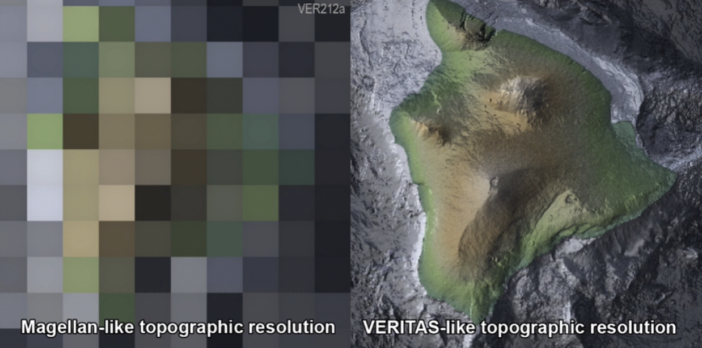
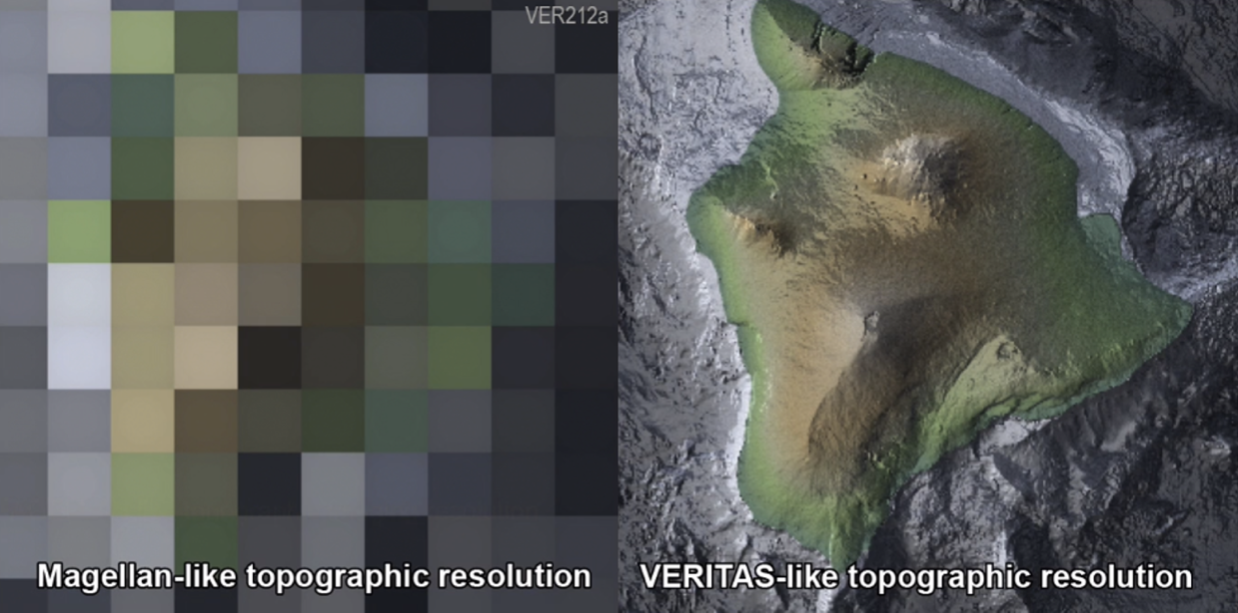
Simulated topography of Hawaii with Magellan-like resolution and VERITAS-like resolution, which will be 100 times better! [Dr. Sue Smrekar, NASA.]
Thursday Press Conference (by Macy Huston)
Evaluation of Bioburden Requirements for Mars Missions
Amanda Hendrix (Planetary Science Institute)
NASA currently has strict requirements for sterilization processes to reduce the “bioburden” of spacecraft before they travel to Mars, given the risk of contamination by terrestrial life and interference with the search for indigenous life on the planet. The Committee on Planetary Protection within the National Academies of Sciences, Engineering, and Medicine released a new report with the goal of determining whether sterilization processes are necessary for missions that are not searching for life if they’re entering zones that are known to be uninhabitable. To calculate the risk involved, one must consider the possibility of microbial contamination: how it might be delivered, survive, proliferate, and be transported. This also brings into consideration the factors that affect microbial survival and growth: temperature, water, atmosphere, nutrients, energy, and wind. This includes a discussion about the viability of Mars as a research target for astrobiology. The discovery of life on Mars would be monumental, so it is essential to be able to distinguish indigenous Mars life from terrestrial contamination. Microbial life would be more likely to survive in some regions of Mars than others. Avoiding areas with ice or subsurface access (e.g., through caves) can help mitigate this risk. The report concluded that bioburden requirements may be relaxed for missions meeting both of the following conditions:
- No subsurface activity planned at all OR nothing deeper than 1 m in a landing site with no detected ice
- Remaining a safe distance from astrobiologically interesting sites (e.g. caves).
Some sterilization requirements would still be in place for missions to these regions, but they would not need to be as restrictive as the current regulations. They recommend a risk-management approach and considering the possibility of in-situ bioburden reduction on Mars as a complementary measure. Overall, the decision-making process for these safety measures would be to identify the risks, assess their likelihood and consequences, rate the risks, and identify mitigation measures for those above some set threshold. Press release 1, press release 2
The NASA Lucy Mission and Its Newest Target, Queta
Simone Marchi (Southwest Research Institute)
For the last press conference presentation of DPS 53, Dr. Simone Marchi gave an update on the soon-to-launch Lucy mission. This will be the first mission to the trojan asteroids (those that orbit the Sun in two groups on either side of Jupiter in its orbit), visiting seven asteroids with a variety of spectral types. The trojan asteroids are a diverse population that present the opportunity to constrain models of giant planet migration with a better understanding of these planetesimals that may have formed in different parts of the solar system’s protoplanetary disk. The Lucy spacecraft hosts five instruments that will work together to investigate the surface geology, surface color and composition, interiors, satellites, and rings of these asteroids. The mission recently gained a new target of opportunity when Hubble discovered that one of the original targets, Eurybates, has a small satellite called Queta.
Lucy will make a couple of loops through the inner solar system before heading to Jupiter’s L4 Lagrange point to visit its first set of asteroids. It will then pass through the inner solar system again and head to the L5 trojan asteroid group. It will have a chance to fly through the main asteroid belt between Mars and Jupiter’s orbits on its way as well. Lucy is on track to embark on this long journey across 4 billion miles over twelve years on October 16, next week!
Planetary Science and Astrobiology Decadal Survey Update (by Ali Crisp)
Every decade, NASA and the National Academies of Sciences, Engineering, and Medicine (NASEM) sponsor studies of different scientific communities to find out what their priorities should be for the coming years. The results of these studies are used to guide science funding and — more recently — diversity, equity, inclusion, and accessibility (DEIA) initiatives. In today’s session, Drs. Robin Canup (Southwest Research Institute), Phil Christensen (Arizona State University), and David Smith (NASEM) gave an overview of the status of the Planetary Science and Astrobiology Decadal Survey 2023–2032 and did a Q&A with the community. The panel was moderated by Dr. Amy Mainzer (University of Arizona) and Dr. Diana Blaney (NASA Jet Propulsion Lab).
The study was performed by a steering committee of 19 people, co-chaired by Dr. Canup and Dr. Christensen, and six destination panels: Mercury and the Moon; Venus; Mars; small solar system bodies (i.e., asteroids); ocean worlds and dwarf planets; and giant planet systems. The survey has identified 12 priority science questions, organized by three different themes. The report will be finalized and sent to peer review in November 2021 and should be publicly available by late March 2022.
Overall, the panel was not allowed to give many specifics about the science question results due to the rules of the survey, but they emphasized two key points:
- This year, they were asked to restructure the survey studies and write chapters around science goals, rather than around specific planetary bodies. They found that this structure allowed more cross-collaboration between subject panels, and they think it will make the report more useful to the planetary science community.
- They chose committee members with diversity in mind, both in scientific expertise and social representation. Dr. Mahzarin Banaji (Harvard), a leading expert in implicit biases, was included in the steering committee to ensure that the survey was conscious of DEIA principles. In addition to chapters addressing the key science questions, there will also be a “State of the Profession” chapter to inform the community of where it stands in regard to DEIA and offer suggestions for improvement.
Galilean Satellites Plenary (by Sabina Sagynbayeva)
Today’s Galilean Satellites Plenary was all about excitement and a hope of finding out more about famous but mysterious moons of Jupiter. This plenary was moderated by Dr. Diana Blaney and Dr. James Keane, both from JPL. Juno is the primary mission that has allowed us to learn more about the Galilean satellites. Its recent flybys gave us more insights about Ganymede, and now the researchers are very excited to see what the upcoming mission to Europa, Europa Clipper, will show us.
The first speaker, Dr. Julie Rathbun from
Planetary Science Institute, talked about a very hot moon,
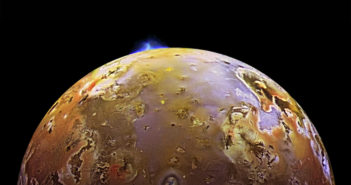
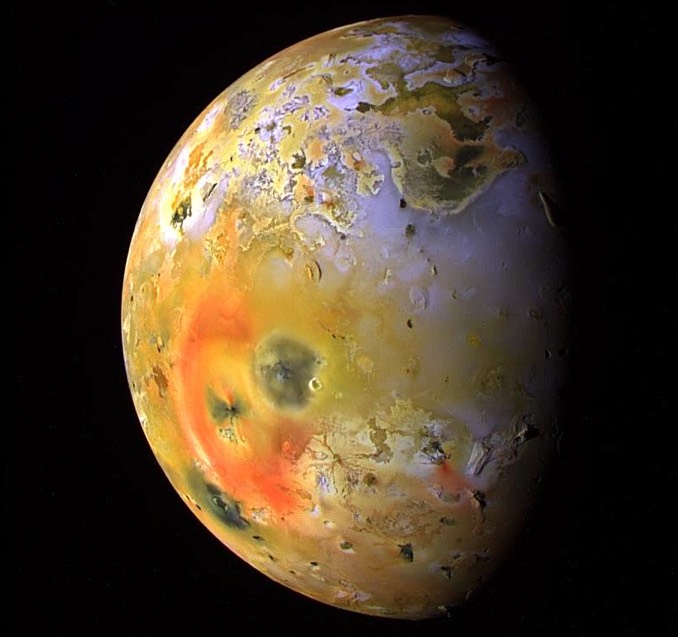
Io. Io is a very interesting object due to its unusual volcanic activities. Primarily, Dr. Rathbun is interested in one of its volcanoes,
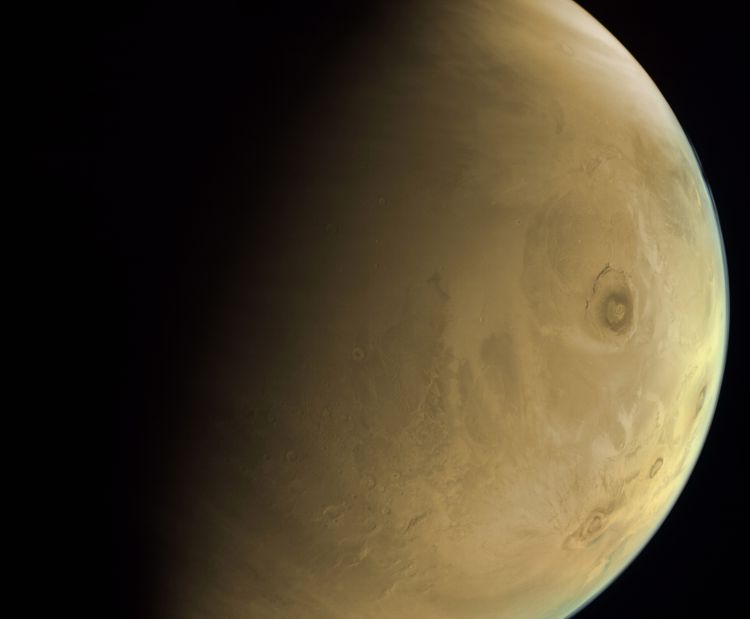
Loki, which naturally reminds everyone of a famous Marvel villain. Maybe that is not a coincidence! The thing is, Loki is very different from any volcano we know by its size and activity. Why? Dr. Rathbun says that this is what they are trying to figure out! Remarkably, Loki is the largest volcano in the solar system; comparing it to Mars’s famous volcanoes, Dr. Rathbun says “Loki kicks Mars’s butt.” With the help of the Juno spacecraft, the team is planning to look at new images of Loki’s surface and compare them to the existing ones from the Voyager mission in order to find out more about this strange volcano.
The next speaker was Dr. Candice Hansen from Planetary Science Institute. Dr. Hansen also acknowledges the work that’s been done by Juno spacecraft. Over the past four years the orbit of Juno has evolved, which provided opportunities to get close to Jupiter’s moons. Dr. Hansen’s team is mostly interested in Ganymede, the largest of the moons. Juno has recently collected astonishing and detailed images of Ganymede, including five visible light images acquired by Juno’s Stellar Reference Unit and JunoCam with 1-2 km resolution. The detail and quality of these images surpass existing data used in previous maps of Ganymede.
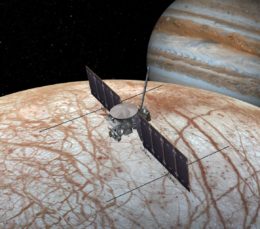
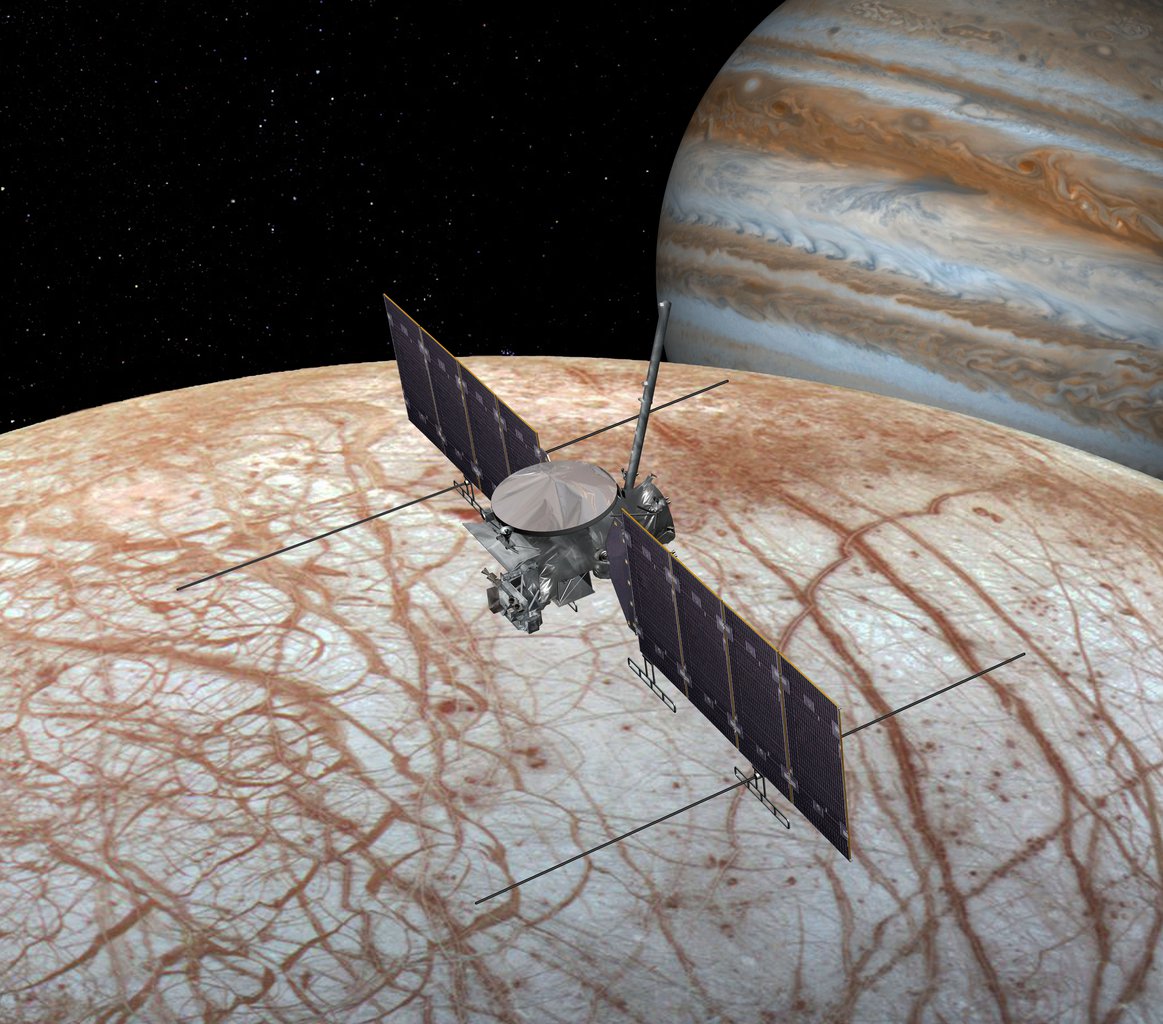
Illustration of NASA’s Europa Clipper mission flying over Jupiter’s icy moon. [NASA/JPL-Caltech]
Now, it’s time for Jupiter’s icy moon, Europa! Dr. Kathleen Craft from
Johns Hopkins University talked about the upcoming exciting missions to Europa. This satellite is very special, because it might actually contain life under its icy surface! The two missions that are going to investigate that are
Europa Clipper and
Europa Lander. They are basically going to dig through the crust to look at the moon’s chemistry and explore whether Europa may be habitable or not. Naturally, there is a concern that ice might be too hard to drill through. However, Dr. Craft mentioned that they are considering that, and JPL is making different samples of ice to test in preparation for the missions! In addition, Dr. Rathbun reminded us that one of the most exciting aspects of a mission is what you can’t predict — some time ago, Juno was as young as Europa Clipper is now and solely focused on Jupiter. It hadn’t even planned its flybys to the satellites, and now it has exceeded all expectations.
The last but definitely not least was Dr. Federico Tosi, who is working with the Jovian Infrared Auroral Mapper (JIRAM) instrument on Juno. JIRAM data reached an unprecedented resolution of about 0.3 km, about 2.5 American football fields in length. Infrared spectroscopic data helped researchers investigate Ganymede’s surface composition. Their data showed signs of mineral salts and organic compounds, which are interesting because this might be the reason they see different spectral signatures at different wavelengths. Dr. Tosi also mentioned that their team prefers to observe the satellites from a safe distance to acquire data without applying too much engineering effort.
Galilean satellites contain so many mysteries, and we can’t wait to see what else they’re holding!
IDEA Plenary (by Briley Lewis)
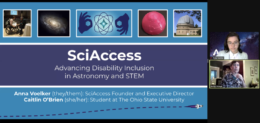
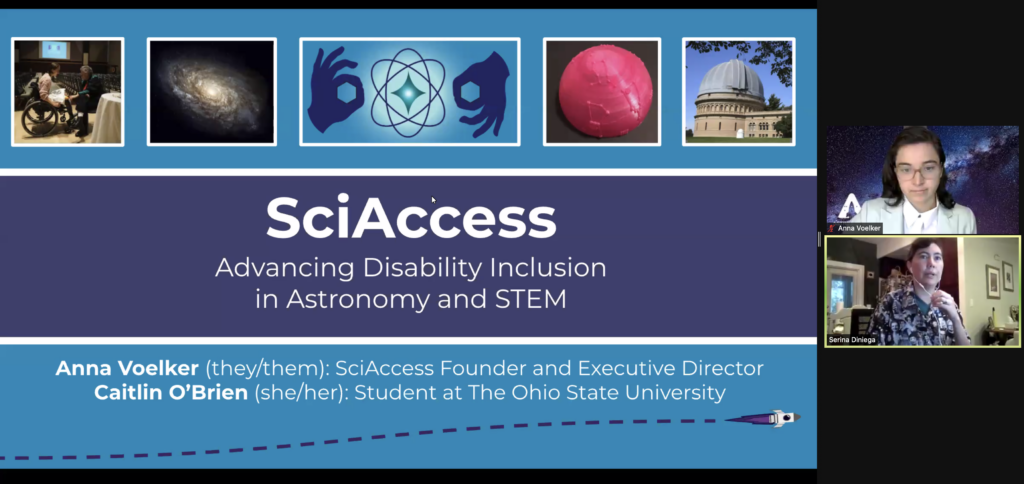
Introducing SciAccess, an organization dedicated to advancing disability inclusion in astronomy and STEM, also the focus of this year’s DEI plenary. [Anna Voelker]
In the last plenary of the week, titled “SciAccess: Advancing Disability Inclusion in Astronomy and STEM”, speakers
Anna Voelker and
Caitlin O’Brien discussed this relatively new international organization, SciAccess, and provided recommendations for making future events more inclusive and accessible. The speakers led by example to make things accessible to those with visual impairments by explaining what they look like while introducing themselves.
SciAccess has many different initiatives for improving disability inclusion: a yearly conference that draws thousands of people from across the globe, a working group of professionals trying to improve accessibility in their institutions/communities, a mentorship program for blind and visually impaired high schoolers, and more. Bonus: If you’re presenting at AAS this coming January, you can get free registration to both their November virtual conference and their AAS workshop!
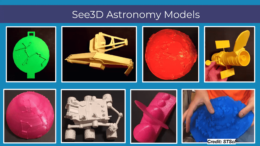
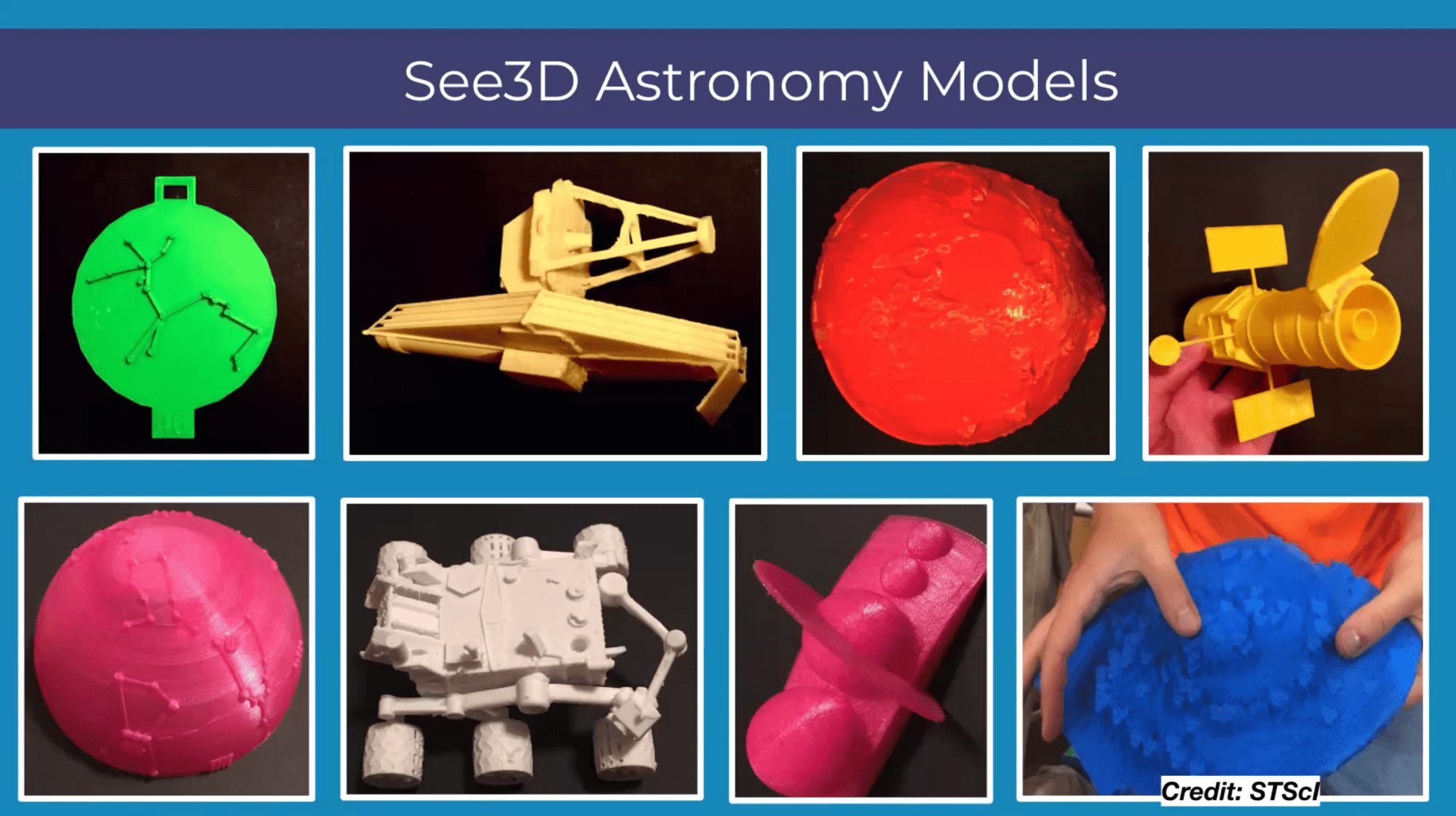
3D models of various space-related objects, including JWST, the solar system, and a galaxy. [Anna Voelker]
They also have a very exciting event coming up in less than two weeks on October 17th: the first flight of
Mission: AstroAccess, an initiative to pave the way for disabled astronauts. The goal is to show that disabled crewmembers are able to perform the tasks required of astronauts and demonstrate solutions to make microgravity more accessible. This
Zero-G flight, featuring 12 “disability ambassadors”, is only the first flight in a series, hopefully culminating in an orbital spaceflight. Voelker contextualized this project with a story of the
Gallaudet Eleven, a group of deaf men who worked with NASA on motion sickness studies in the early days of the space program. The research found that the deaf men were more resistant to motion sickness than hearing people, showing the natural strengths and assets of historically excluded disabled people. Although none of these men were offered a chance to go to space, SciAccess is now partnering with
Gallaudet University on Mission: AstroAccess.
Voelker and O’Brien also offered a wide array of tips for organizing an accessible event, starting with physical accessibility. Make sure your venue and seating options are wheelchair accessible — a noted problem with star parties, since many of them take place on grass or on inaccessible trails. Uncomfortable conference chairs are another common offender; while they are an inconvenience to most people, they can be a real barrier for those with chronic pain. Conference social and networking events also often use high cocktail tables, which are inaccessible to those in wheelchairs or who cannot stand for long periods of time. It can also help blind and visually impaired people to offer a tactile or large print map or guide volunteers. Quiet rooms are another great option to offer, since they are beneficial for anyone with sensory processing needs or social anxiety.
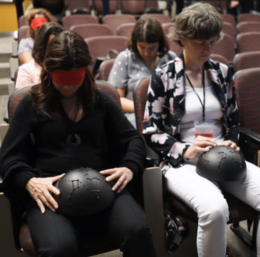
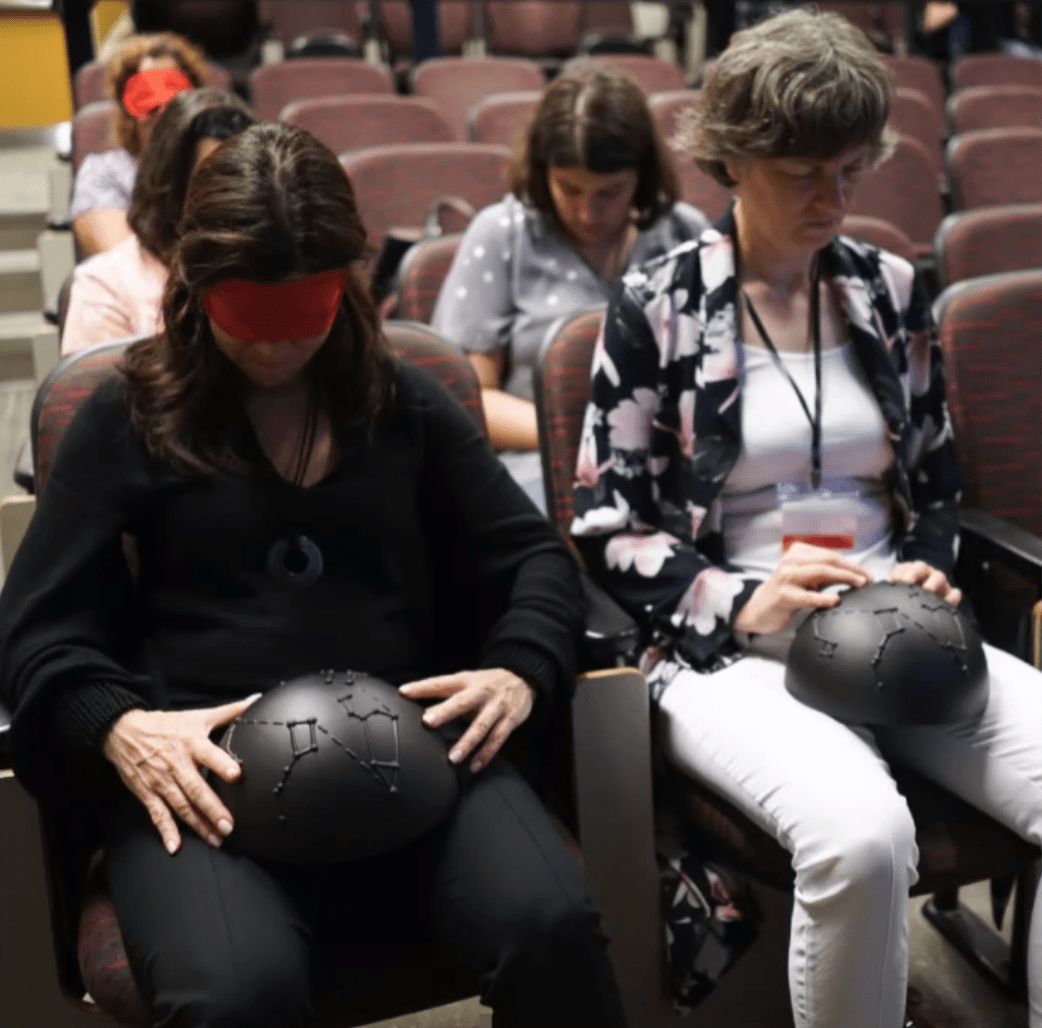
Audience members holding a tactile star dome in a planetarium show for those with visual impairments. [Anna Volker]
Another consideration is
communication accessibility. By making practices like captioning and
ASL interpretation a default, more people will be able to attend without the barrier of making special requests. Braille and large print materials and slide descriptions may also be useful for visually impaired audiences, and color communication badges (recommended by autism experts, but also helpful for those with social anxiety) use green, yellow, and red to signify an individual’s willingness to socialize with new people or friends in conference settings. One of SciAccess’s particularly cool projects is making planetarium shows more accessible, by illuminating an ASL interpreter in red light (to preserve night vision) and providing tactile constellation domes.
Although it may seem like you need extravagant resources or fancy 3D printing to make these accessibility changes happen, Voelker reminded the audience that accessibility is a change in mindset and intention more than anything, and it will benefit everyone. The important thing is to be intentional about inclusive design from the start, with things such as pronouns on name tags as the default and ensuring diverse representation on panels.
As Voelker says, “By making spaces more inclusive, we’re not only welcoming people who have been traditionally excluded, but we’re making things better for everyone.”
If you want to learn more, you can join SciAccess’s email list or follow their Facebook page.