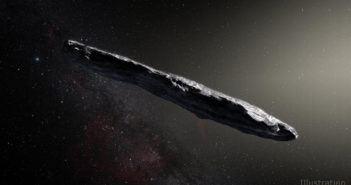
‘Oumuamua’s Star Trek: Potential Origin in a Giant Molecular Cloud?
Did ‘Oumuamua originate in a nearby giant molecular cloud? Astrobites reports on the continued debate of this interstellar visitor’s origin.

Did ‘Oumuamua originate in a nearby giant molecular cloud? Astrobites reports on the continued debate of this interstellar visitor’s origin.
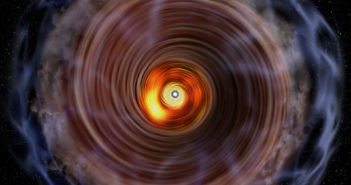
New images reveal the role played by whirling magnetic fields in the shrouded centers of clouds forming baby massive stars.

CU Virginis emits beams of radio waves like a pulsar — so what’s going on in its magnetosphere? Astrobites reports.
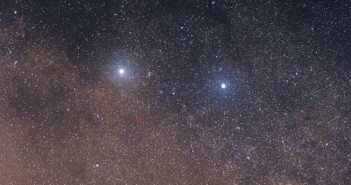
Scientists are using a powerful telescope to hunt for planets in our nearest star system, Alpha Centauri AB.
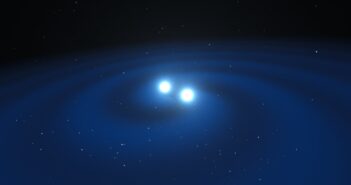
Astrobites reports the latest updates from a neutron star collision that happened more than 3 years ago.
After careful testing and calibration, the Chandrayaan-2 mission is now providing valuable information about the Moon.
With data from the Gaia satellite and spectroscopic surveys, machine learning can fill in gaps in our knowledge of how stars move.
New research has explored the populations of black holes involved in catastrophic, gravitational-wave-emitting collisions — and an interesting pattern has emerged.
Astrobites reports on the closest look yet at the mysterious outflows from high-mass newborn stars.
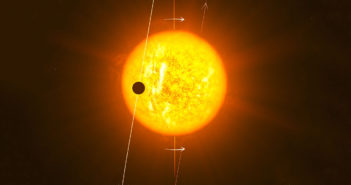
A new study explores what we can learn from planets that are misaligned with their stars.
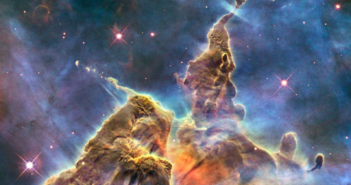
Astrobites reports on how cosmic rays can knock molecules from the ice layers on dust grains into gas, a process known as desorption.
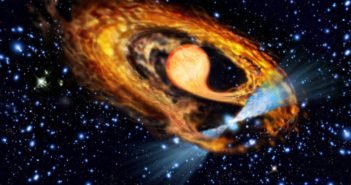
The largest filled-aperture radio telescope in the world has discovered a new assortment of distant, pulsating neutron stars.