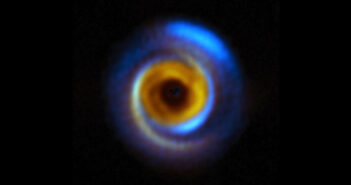
Dusty Crescents Around a Baby Star
What’s the origin of the dusty crescents in the disk around the young star MWC 758? Researchers have tracked the movements of two crescents to find out.

What’s the origin of the dusty crescents in the disk around the young star MWC 758? Researchers have tracked the movements of two crescents to find out.

Astrobites reports on two research articles that find evidence for one of the most well-studied stars in the night sky having a binary companion.
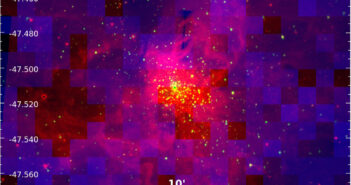
An investigation of the Milky Way’s youngest super star cluster tests whether the winds of massive stars could be a source of cosmic rays.
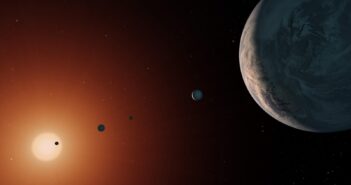
Bombarded by powerful radiation or visited by comets carrying life’s ingredients, the Sun’s migration through the Milky Way likely contributed to the solar system’s ability to harbor life.
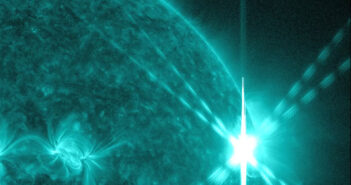
Is the high-energy radiation of a solar flare only rarely accompanied by a flash at visible wavelengths, or are visible-light flares more common than expected?

Astrobites reports on three neutron-star bow shocks photographed in unprecedented detail, revealing new insights into the hidden physics behind these cosmic collisions.
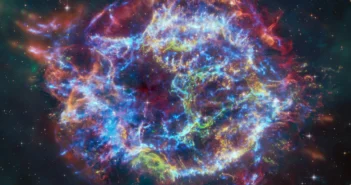
What has poked holes in the filamentary green structure in front of Cassiopeia A? A new research article offers answers.
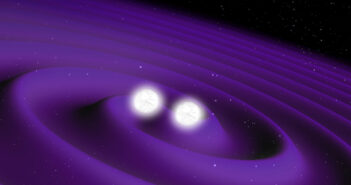
Gravitational waves from collapsars, mass-gap black holes, and local supermassive black holes are the subject of this Monthly Roundup.

Astrobites reports on how machine learning can help researchers simulate the phase of planet formation in which planetary embryos interact, collide, and combine to form the planets we know and love.
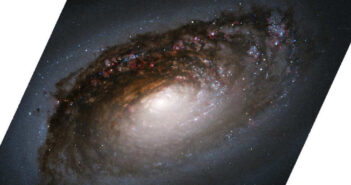
Easily recognized by the dense band of dust swirled around its center, the Black Eye Galaxy is the subject of a new study that investigates the connection between galaxy structure and supermassive black hole properties.
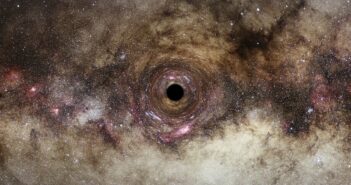
Is dark matter actually ancient black holes the size of planets? New research places a limit on how much of the universe’s most mysterious matter could be made up of tiny black holes.
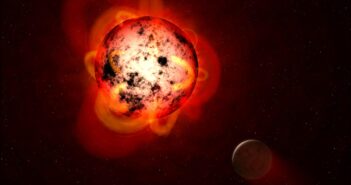
New observations of the M-dwarf exoplanet Gliese 486b help astronomers map the location of the cosmic shoreline, which separates planets with atmospheres from those without.