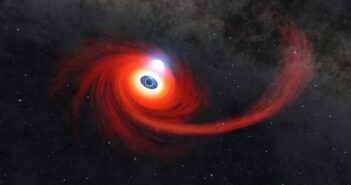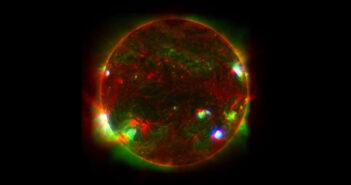
Black Hole Fireworks: Tidal Disruption Events Light Up Supermassive Black Holes
Astrobites reports on the radio signals from stars being ripped apart by supermassive black holes.
Recent upgrades to a powerful neutrino detector may help us spot future nearby supernovae before they burst onto the scene in visible light.
From planetary systems to colliding galaxies, the universe is full of intricate structures. This month’s roundup examines where three vastly different types of structures come from.
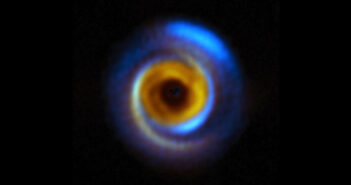
Researchers find even more evidence for planets forming in the disk around TW Hydrae, the nearest protoplanetary disk to Earth.
Astrobites reports on research that brings together data from multiple wavelengths to make a detection of distant 21-cm radiation.
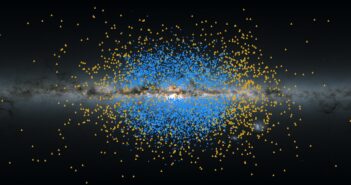
Data made mesmerizing: check out this swirling visualization of 170 million stars in the Milky Way.
NASA is going to send a robot to Uranus someday. When it gets there, how close should it fly to the surface?
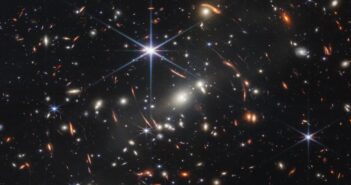
The venerable Hubble Space Telescope recently revisited the famous Ultra-Deep Field. How has this patch of sky changed since it was first photographed?
Astrobites reports on the aftermath of a massive active galactic nucleus outburst that left behind a string of star formation.
Cygnus X-1 recently made the long-awaited switch between hard and soft spectral states. What can IXPE observations tell us about this transition?
New surveys with the world’s largest filled-aperture radio dish are turning up more and more millisecond pulsars. What do these surveys tell us about the best places to look for these extreme objects?
The Hubble tension is one of the most pressing problems in cosmology. Today, we’re looking at five articles that address the Hubble tension — either suggesting ways to alleviate it or staunchly reinforcing its existence.