Searching Five Million Stars for Disks, Debris, and Dyson Spheres
A data-driven approach identifies stars with interesting infrared emission without relying on computationally expensive modeling.

A data-driven approach identifies stars with interesting infrared emission without relying on computationally expensive modeling.

Astrobites reports on an analysis of the orbital architecture of JWST’s first directly imaged exoplanet using time-series photometry data from the Transiting Exoplanet Survey Satellite.
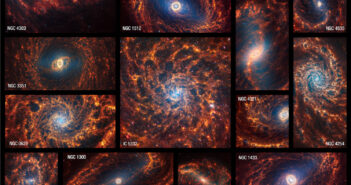
Nineteen nearby spiral galaxies surveyed by JWST are presented in one grand ensemble along with a customized image-processing pipeline.
While Type Ia supernovae have been used to determine cosmological distances and study the expansion of the universe, their origins are still under investigation. Recent simulations point to a double-detonation scenario being the catalyst for some of these extremely energetic events.
New observations show that Gliese 229 B is two brown dwarfs rather than one, resolving the mismatch between its measured mass and predictions of evolutionary models.

Astrobites reports on a study that uses JWST to investigate how warm, star-forming molecular gas is blown away by active galactic nuclei.
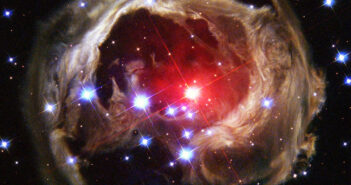
Widely spaced binary stars may get voted “Least Likely to Interact,” but they might surprise you: new research shows that under the right conditions, these distant stellar companions can get catastrophically close.
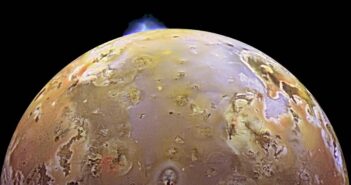
JWST observations of giant exoplanet atmospheres, investigations of heating on Io and in asteroids, and a primer on open science brought the final day of DPS 56 to a close.
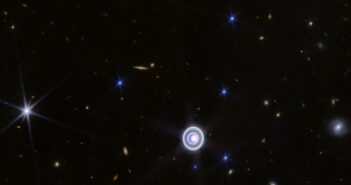
Day 3 of DPS 56 brought a discussion of mental health in the planetary science community and new results regarding Jupiter’s Great Red Spot, Uranian moons, and co-orbiting bodies.
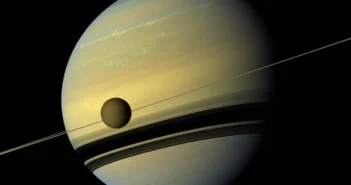
Plenary talks during Day 2 of DPS 56 tackled the connection between exoplanet science and solar system science.
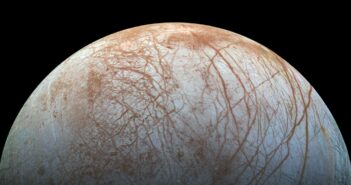
This week we’re bringing you updates from the 56th meeting of the AAS Division for Planetary Sciences. Day 1 was all about asteroids and lab experiments!
Kerry Kroffe recently joined the AAS staff as the Director of Scholarly Publishing. Read on to learn about his journey to his current role and his goals for the publishing experience.