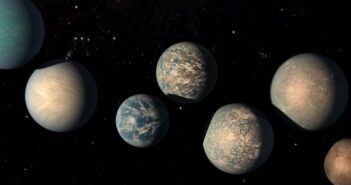
Life Is Like a Box of Potential Biosignatures
Astrobites reports on how habitable exoplanets resembling Earth in its younger years might appear to the Habitable Worlds Observatory.

Astrobites reports on how habitable exoplanets resembling Earth in its younger years might appear to the Habitable Worlds Observatory.
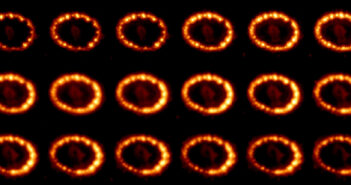
A ring of bright “hotspots” adorns the remnant of the supernova SN 1987A. Now, researchers have analyzed two decades of Hubble Space Telescope observations to track the evolution of this ring.
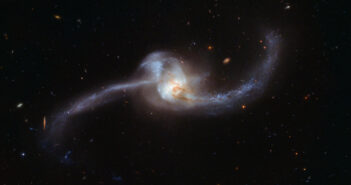
Across cosmic time, galaxies interact and merge with each other, causing disruptions in their behavior. Recent simulations explore the impacts interactions have on the star formation activity in interacting galaxies.
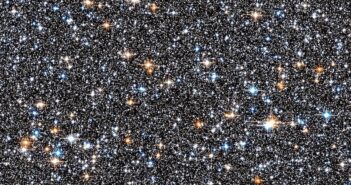
What’s the status of the brown dwarf discovered 12.6 light-years from Regulus: group member or unrelated neighbor? New research provides clues.
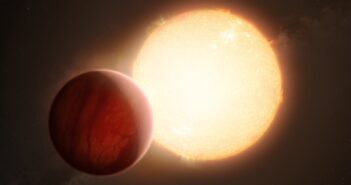
Astrobites reports on how spectroscopic observations of an exoplanet can help us understand its composition and formation history.
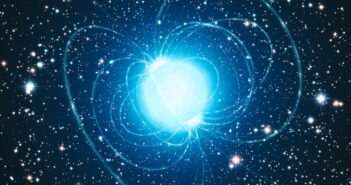
Neutron stars seem to rotate at only half their maximum rate. Can the splitting of a neutron star’s crust explain why?
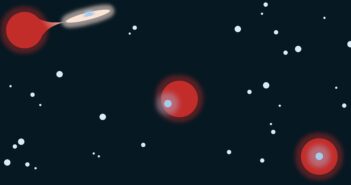
A Thorne–Żytkow object is a star with a neutron star at its core. New work examines whether these theoretical objects could be made, as proposed, in X-ray binary systems.
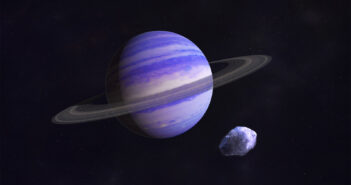
The discovery of nearly 6,000 exoplanets has made it clear that not all planets in our galaxy resemble those in our solar system. Today’s Monthly Roundup introduces three studies involving planets entirely unlike our own.
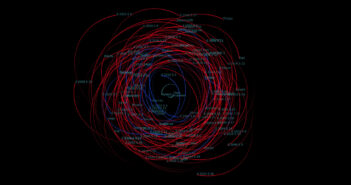
Astrobites reports on how a star flying by the early solar system could have delivered irregular moons to the giant planets.
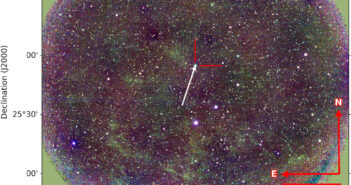
In advance of T Coronae Borealis’s much-anticipated outburst, astronomers went searching for a super-remnant surrounding the system.
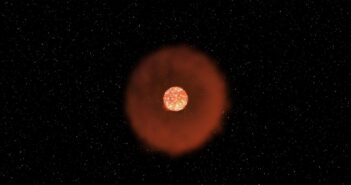
What happens right before a massive star explodes violently in a supernova explosion? A recent study predicts an influx of pre-explosion observations will arise after the Vera C. Rubin Observatory turns on this summer, unlocking the mysteries surrounding massive stars’ ends.
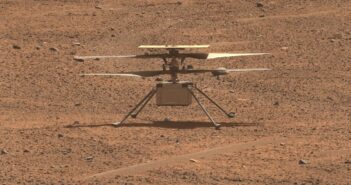
The Ingenuity helicopter made history as the first aircraft to carry out a controlled, powered flight on another planet. Now, just over a year after its final flight, Ingenuity is still enabling more firsts.