
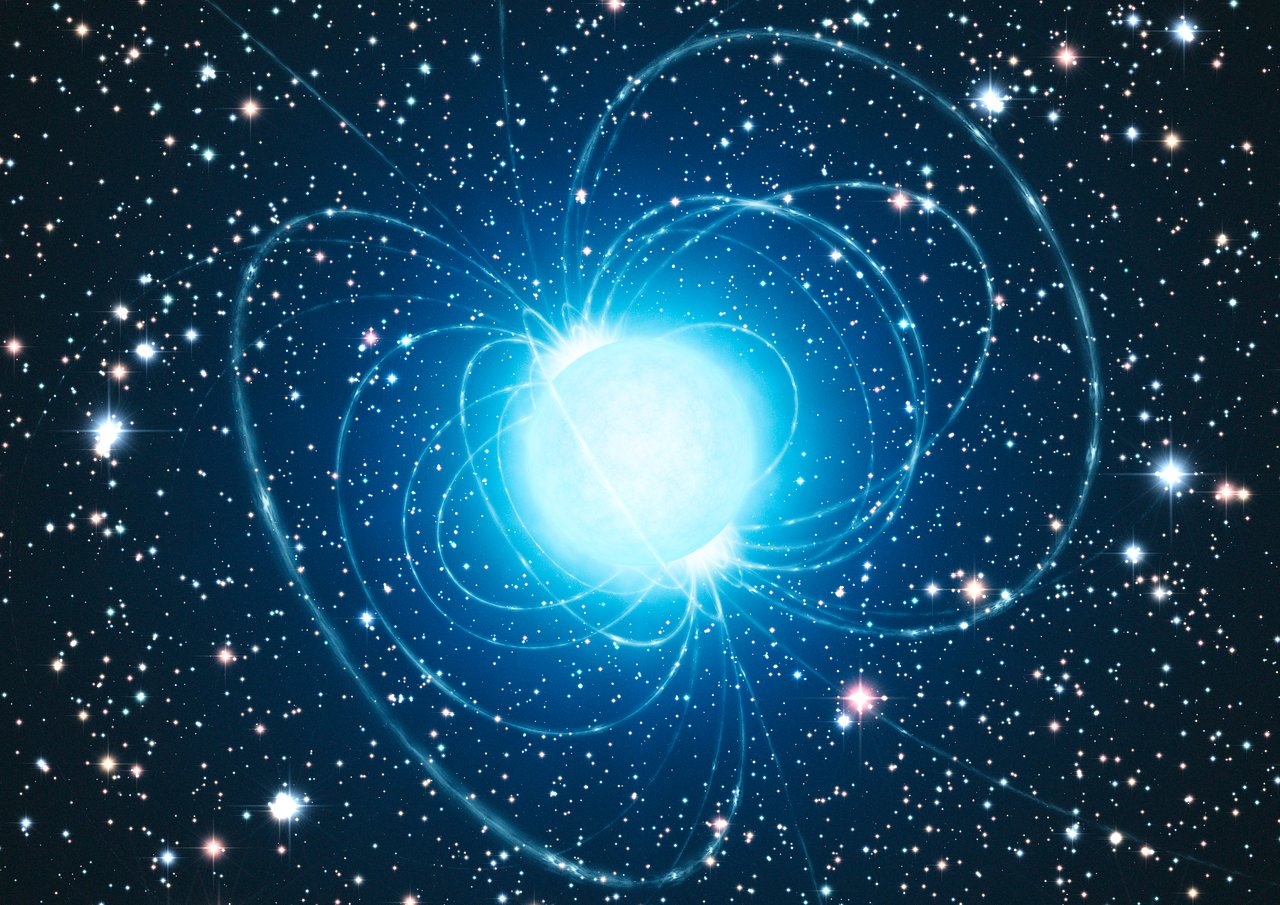
Neutron stars are composed of some of the most extreme material in the universe, and their internal properties are challenging to determine. Recently, researchers investigated an unusual spectral feature that may help to probe the interiors of neutron stars.
Examining Extreme Matter
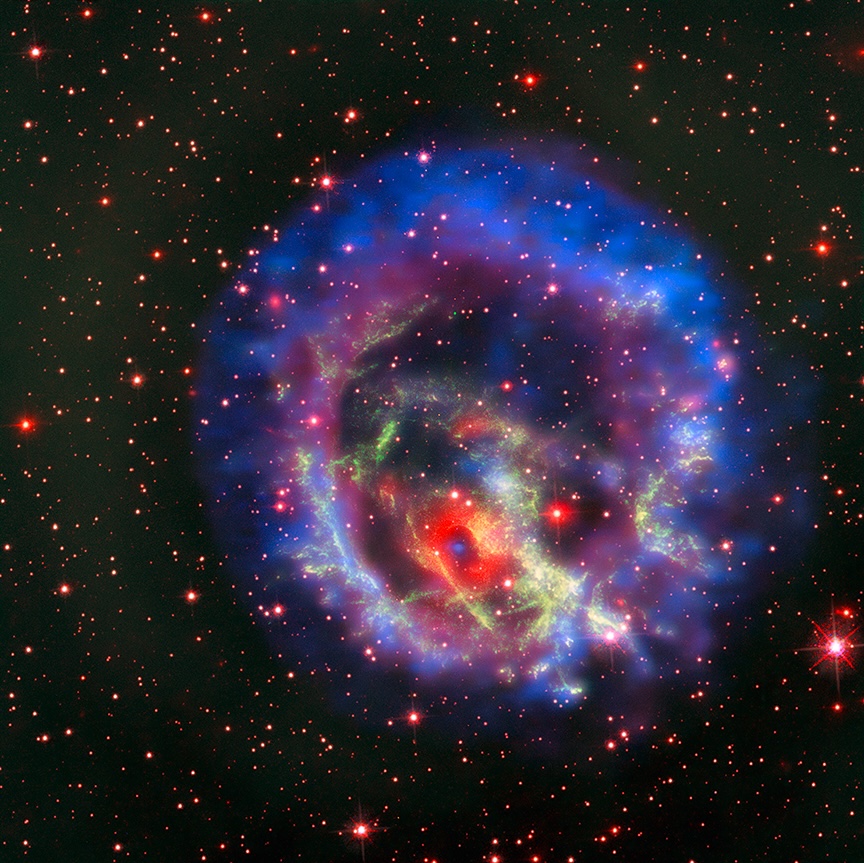
This composite X-ray and optical image shows the supernova remnant 1E 0102.2-7219. The blue source at the center of the bright red ring inside the remnant is a neutron star that was created in the supernova explosion. [X-ray (NASA/CXC/ESO/F.Vogt et al); Optical (ESO/VLT/MUSE & NASA/STScI)]
By observing neutron stars, astronomers attempt to pin down their equation of state, or the relationship between their interior density and pressure. In a recent research article led by Rosario Iaria (University of Palermo) described a promising way to probe the interior of a neutron star.
This method relies on measurements of a spectral line that originates near the neutron star’s surface and is gravitationally redshifted as it escapes from the intense gravitational pull of the star. The gravitational redshift provides a direct measurement of the compactness of the neutron star, or the ratio of its radius to its mass. Despite the promise of this method, definitive identification of gravitationally redshifted absorption lines has been challenging.
Directly Measuring Compactness
Iaria’s team identified potential evidence of this phenomenon in Neutron star Interior Composition Explorer (NICER) observations of 4U 1820-30, a close binary system containing a neutron star that is accreting matter from a white dwarf companion. (4U 1820-30 is famous for having one of the most rapidly rotating neutron stars known, with a blistering rate of 716 rotations per second.)
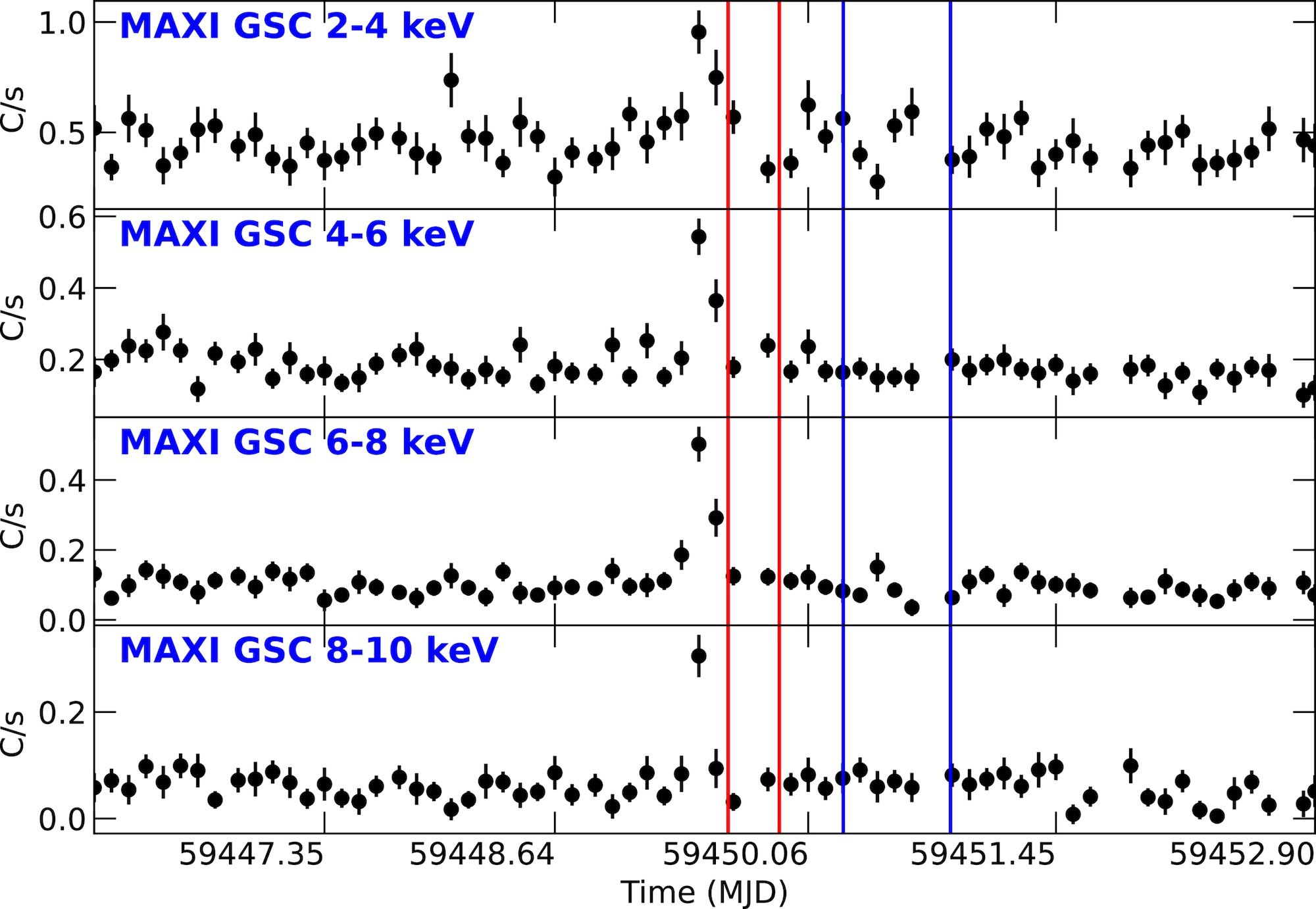
Observations of 4U 1820-30 from the Monitor of All-Sky X-ray Image (MAXI) showing the sudden increase in counts during the superburst, which was followed by two observing epochs by NICER, marked with red and blue vertical lines. Click to enlarge. [Iaria et al. 2026]
The team proposed that the rare superburst paved the way for the gravitationally redshifted absorption line to appear. During the superburst, a powerful radiation-driven wind swept away most or all of the neutron star’s corona, a diffuse cloud of plasma floating above and below the accretion disk. After the superburst ended and the wind subsided, but before the obscuring corona reformed, the tell-tale absorption line was visible for a short time.
Cracking the Mystery of Neutron Star Structure
By interpreting the 3.8 keV absorption feature as a gravitationally redshifted spectral line arising near the neutron star’s surface, Iaria and collaborators measured a redshift of 1 + z ≅ 1.72. This corresponds to a compactness of 4.46 kilometers per solar mass, which translates to a radius of 6.4 km for a typical mass of 1.4 solar masses or a mass of 2.2 solar masses for a typical radius of 10 km.
The interpretation of the 3.8 keV absorption line as a gravitationally redshifted iron line is still tentative. Further measurements with NICER, or with future facilities like the Advanced Telescope for High-ENergy Astrophysics (Athena) X-ray observatory (planned launch in 2037) or the enhanced X-ray Timing and Polarimetry (eXTP) mission (planned launch in 2030), may help to advance the study of neutron star interiors using this technique.
Citation
“A Mysterious Feature in the NICER Spectrum of 4U 1820-30: A Gravitationally Redshifted Absorption Line?” R. Iaria et al 2026 ApJ 998 58. doi:10.3847/1538-4357/ae2758