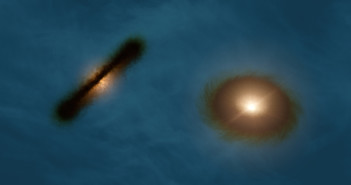
Exploring the Birth of Binary Stars
More than half of all stars are thought to be in binary or multiple star systems. But how do these systems form? The misaligned spins of some binary protostars might provide a clue.

More than half of all stars are thought to be in binary or multiple star systems. But how do these systems form? The misaligned spins of some binary protostars might provide a clue.
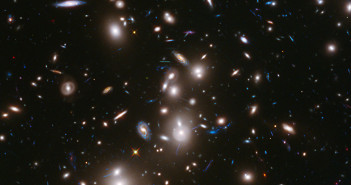
Astrobites reports on a study of nearby galaxies that mimic the properties of those found in the distant universe.
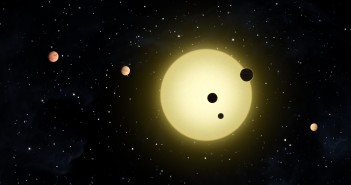
Kepler’s K2 mission has found its first planetary system containing more than three planets — an exciting five-planet system located ~380 light-years from Earth.

In late April of this year, asteroid P/2016 G1 was discovered streaking through space, a tail of dust extending behind it. What caused this asteroid’s tail?
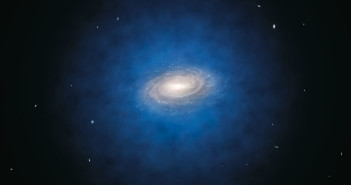
Are massive black holes hiding in the halos of galaxies, making up the majority of the universe’s mysterious dark matter?
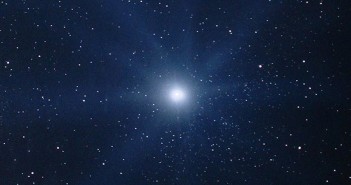
Astrobites reports on a Kepler spacecraft finding: two new white dwarfs that are “outbursting” — suddenly brightening every few days before quieting down again.
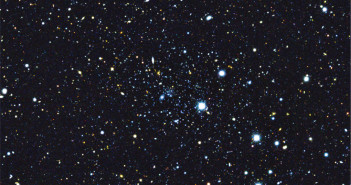
This beautiful image features Eridanus II, an ultra-faint dwarf galaxy that is orbiting the Milky Way.
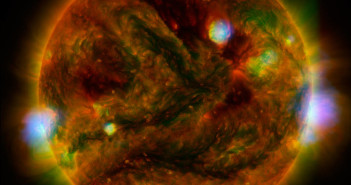
A high-energy telescope designed to observe distant astrophysical sources has recently been used to point much closer to home. Can it solve a few longstanding mysteries about the Sun?
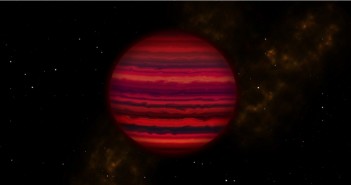
New observations have provided evidence of water clouds in the atmosphere of a brown dwarf located just 7.2 light-years away.
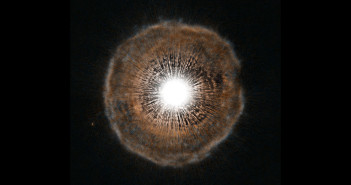
By the time a star becomes a white dwarf, much of its mass will have been lost. When does this mass loss occur and what drives it?

Recent, unusual X-ray observations from the Small Magellanic Cloud have led to an interesting model for SXP 214, a pulsar in a binary star system.
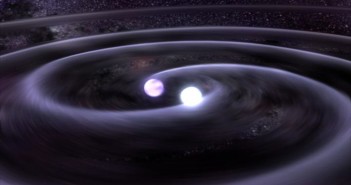
In September 2015, two days after the detection of GW150914, an alert went out to 63 ground- and space-based observatories. This launched the very first hunt for an electromagnetic counterpart to a gravitational wave signal.