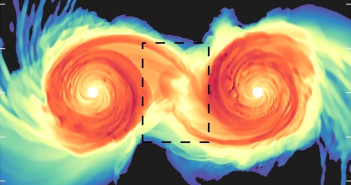
Featured Image: Mini-Disks in a Black-Hole Binary
New simulations show how gas is passed back and forth between the accretion disks surrounding the two black holes in a binary system.

New simulations show how gas is passed back and forth between the accretion disks surrounding the two black holes in a binary system.

Why is Earth hospitable to life and Venus not? Kepler-1649b, a newly discovered exo-Venus, may help us figure this out!
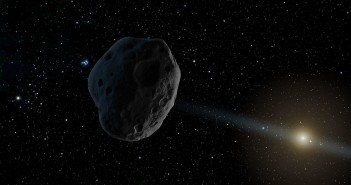
How many comets, asteroids, and planetary bodies are floating through interstellar space, not gravitationally bound to any solar system?
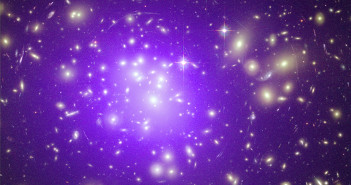
Astrobites reports on X-ray studies of galaxy clusters, which tell us how the extremely hot gas is distributed within these gigantic structures.
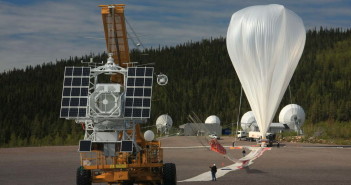
In 2013, a team of scientists gathered in Sweden to launch a balloon carrying the largest solar telescope to leave Earth. Now they’re sharing what they learned from the flight!
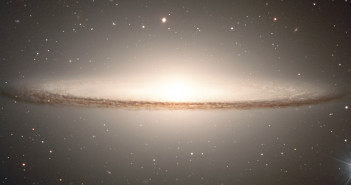
What determines how much mass will end up in the bulge and the black hole at the center of a Milky-Way-like galaxy?
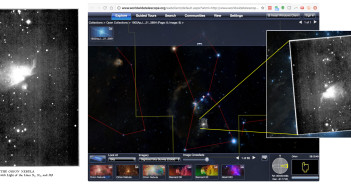
Looking for something fun and rewarding to do in your spare time? A new citizen-science project has been added to the Zooniverse platform: Astronomy Rewind.
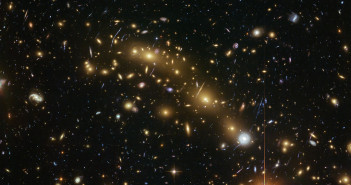
Astrobites reports on super star clusters discovered using gravitational lensing.
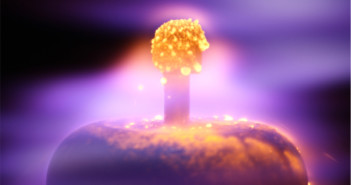
Ever wonder what experimental astronomy looks like? Some days, it looks like this piece of agrillite in a wind tunnel.
Twenty-three new objects have been added to the growing collection of stars that have unusual dips in their light curves.
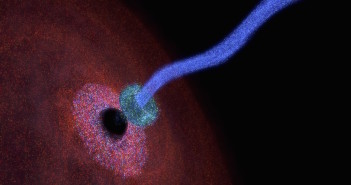
A new study provides us with clues to the relationship between accretion and outflows near the supermassive black holes at the centers of active galaxies.

Astrobites reports on whether volcanos can expand the region around a star within which life can survive.