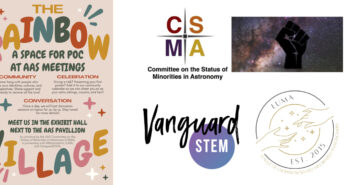
The Rainbow Village at AAS: A Gathering Place for People of Color in Astronomy
Astrobites introduces the Rainbow Village, a new initiative to bring together astronomers of color at the upcoming AAS meeting in New Orleans.

Astrobites introduces the Rainbow Village, a new initiative to bring together astronomers of color at the upcoming AAS meeting in New Orleans.
Astrobites reports on the use of high-resolution spectroscopy to trace the origins of a metal-poor star in the Milky Way halo.
Astrobites reports on the differences between planets orbiting M dwarfs in single-planet and multi-planet systems.
Astrobites reports on the far-out possibility of using continuous gravitational waves from faraway pulsars to learn about the inside of the Sun.

Astrobites reports on the assumptions used in photoionization models that affect our understanding of ionized gas clouds surrounding hot stars.
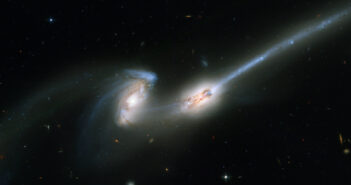
Astrobites reports on how to identify merging galaxies and investigate the importance of these collisions over cosmic time.
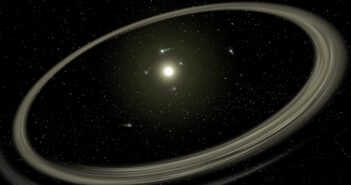
Astrobites reports on whether Jupiter-like exoplanets are responsible for defining the edges of multiple-planet systems.
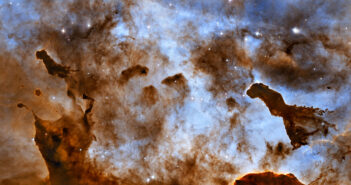
Astrobites reports on how modeling molecular clouds can help us understand how these cosmic nurseries form stars.

Astrobites reports on a way to use an unlucky star to learn about a pair of supermassive black holes.
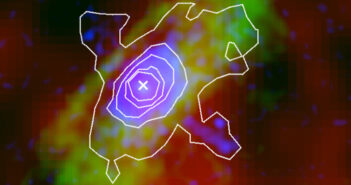
Astrobites reports on a new study of the Dragonfly pulsar wind nebula — a possible source of particles with energies up to a quadrillion electronvolts!