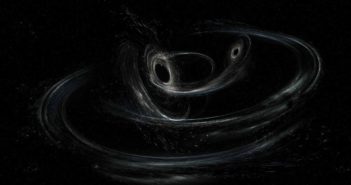
A New Spin on Binary Black Hole Evolution
Today’s article might leave your head spinning — read on for an investigation into how the spins of binary black holes have changed across cosmic time!

Today’s article might leave your head spinning — read on for an investigation into how the spins of binary black holes have changed across cosmic time!
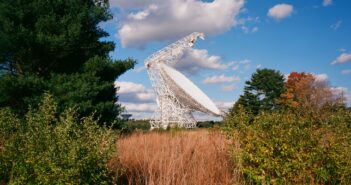
Astrobites reports on a search for broadband radio waves coming from our closest stellar neighbors.
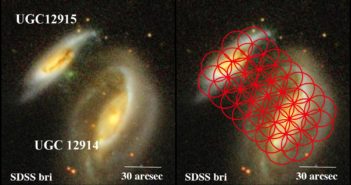
When galaxies clash, is star formation heightened or quenched? The Taffy galaxies (UGC 12914/5) provide an excellent setting to probe this question.
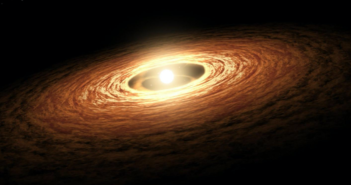
What’s the culprit that can cause misalignment between a star’s axis and the plane of its surrounding protoplanetary disk? An outside force, or the system itself?
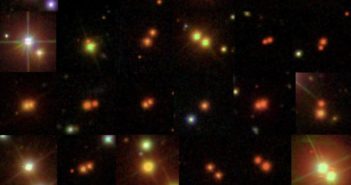
Thanks to large-scale astronomical surveys, we can study huge numbers of binary star systems. What can our observations of these systems tell us about how our galaxy influences binary stars?

How clearly will JWST see exoplanetary atmospheres? Astrobites reports on the use of artificial stars and planets to estimate JWST’s precision.
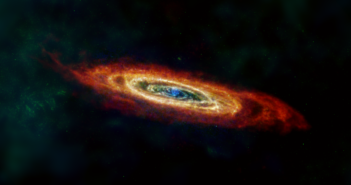
The final day of AAS 240 brought balloon-borne science, dusty discoveries, and a workshop by our very own Astrobites authors!
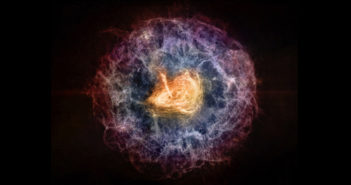
Eclipse expectations, destructive white dwarfs, and discussing the decommissioning of a telescope — all that and more in our summary of Day 3 of AAS 240!
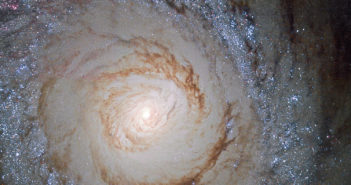
Get the latest on the Milky Way’s supermassive black hole, first results from a new X-ray mission, and more with our summary of AAS 240 Day 2!

Phosphine and magnetic fields and dust, oh my! Missed any sessions at AAS 240 yesterday? Get caught up with science summaries from the Astrobites team!
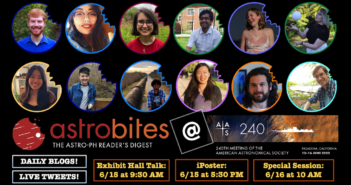
This week we’ll be bringing you updates from the 240th AAS meeting, happening in Pasadena, CA, and online.
Will you be at the 240th American Astronomical Society meeting? We look forward to seeing you there!