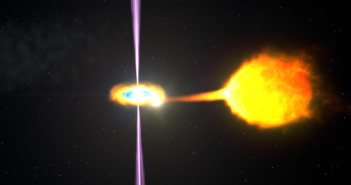
A New Spider Joins a Deadly Club
Arachnophobes, take notice: another black widow pulsar has been spotted hunting in the night.

Arachnophobes, take notice: another black widow pulsar has been spotted hunting in the night.

New research suggests that as our universe expands, black holes gain mass, and this connection between black holes and the universe’s expansion is the source of dark energy.
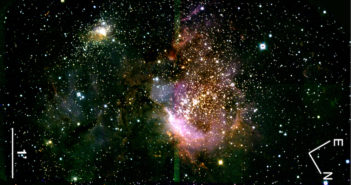
Researchers track down a pair of metal-poor star clusters on the outskirts of the Milky Way to understand how metallicity affects the masses of young stars.
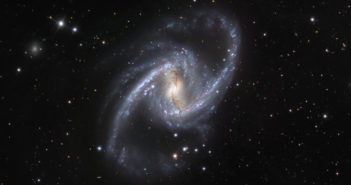
Certain variable stars provide a way for us to measure the distances to nearby galaxies, and JWST will allow us to monitor these stars with greater precision.
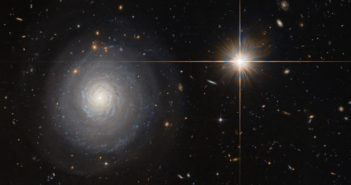
JWST has observed many galaxies that researchers believe are from the first 500 million years after the Big Bang, but dusty interlopers might be skewing our perception of this important period in our universe’s history.
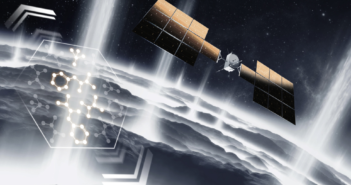
Though it exists only on paper for now, a proposed mission to send a spacecraft straight through the plumes of Enceladus offers planetary scientists and adrenaline junkies alike plenty to get excited about.
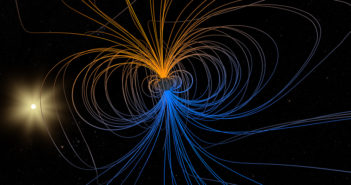
Astrobites reports on a promising method for detecting and constraining exoplanetary magnetic fields: measuring their effects on a host star’s radio emission during transits.

When two coronal mass ejections collide in interplanetary space, they can create an even more powerful storm. Recent research explores exactly which characteristics can turn solar storms from moderate to severe.
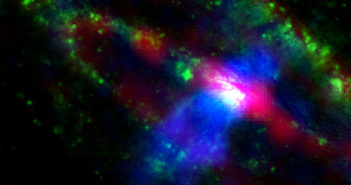
About 11 million light-years away, the starburst galaxy NGC 253 spews gas into circumgalactic space. What can X-ray observations tell us about this star-forming system?
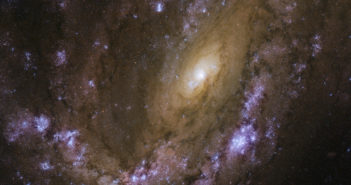
How did supermassive black holes come to be? Researchers have devised a plan to track down the “seeds” that sprouted into the behemoths we see today.
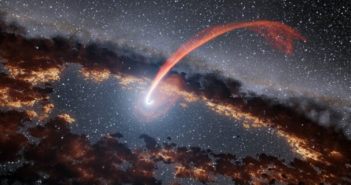
A new look at 30 instances of stars being torn apart by black holes gives insight into the physical properties of these events.
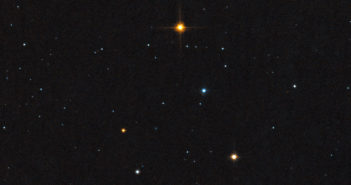
Astrobites reports on a newly discovered local galaxy, which has re-ignited the debate about the role that reionization plays in quenching ultra-faint dwarf galaxies.