Sizing Up Galaxies at Cosmic Noon
JWST observations might make astronomers rethink established “rules” that govern how galaxies of different masses and star-formation rates evolve.

JWST observations might make astronomers rethink established “rules” that govern how galaxies of different masses and star-formation rates evolve.
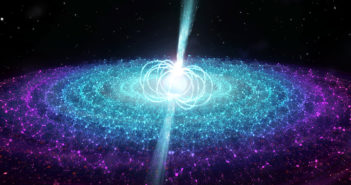
Four recent articles give different perspectives on the ultra-dense, rapidly spinning, highly magnetized remnants of massive stars.
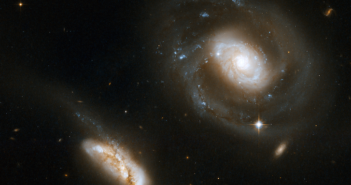
Astrobites reports on how the outflows from NGC 7469’s active galactic nucleus interact with the surrounding interstellar medium.
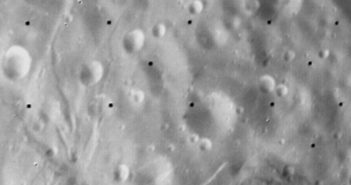
Icy solar system moons typically have sharp, well-defined craters, but Uranus’s moon Miranda has gentler surface features. What makes Miranda’s craters so subtle?
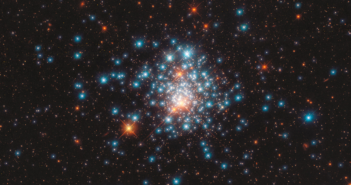
A flurry of eclipses, then back to eclipsing binary business as usual: what could cause such a strange light curve?
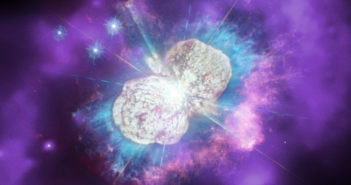
Astrobites reports on an updated neutrino detector that may be able to alert us to impending supernovae hours in advance.

A new study loosens the constraints on planet formation, suggesting that most protoplanetary disks stick around for at least 5 million years.

How did the stars at the center of our galaxy attain their curious arrangement? A new theory suggests that a shredded star paved the way for new stars to form in a narrow disk.
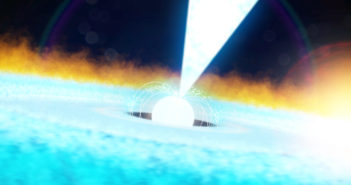
Researchers analyze 51 X-ray bursts from a neutron star snaring material from its stellar companion, forming one of the most active low-mass X-ray binaries known.
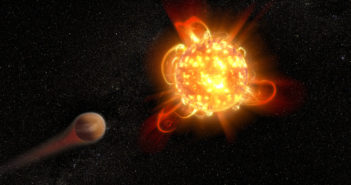
Astrobites reports on a tiny stellar flare from the Sun’s next-door neighbor: Proxima Centauri.
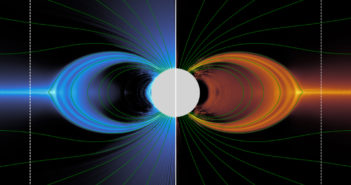
New simulations explore plasma production and particle acceleration near the surface of a dense, highly magnetized pulsar.
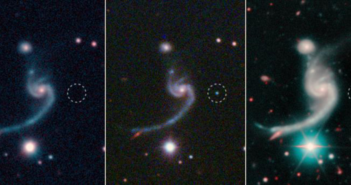
In 2021, astronomers saw a star explode, then watched as its remains strangely changed colors. A recent study suggests an explanation for this behavior: the remnants hit a speed bump.