How to Make (and Find) Neutron Stars with a Dash of Dark Matter
Neutron stars containing a small amount of dark matter might be able to explain some unusual observations. How would these objects form, and how can we study them further?
Astrobites reports on some of the initial instrumentation challenges and solutions for JWST’s Near Infrared Camera.
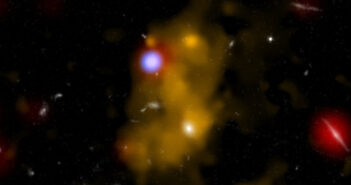
The discovery of hot, star-forming cores in the Milky Way’s galactic neighbor lends insight into the formation of massive stars in metal-poor galaxies.
Researchers rely on complex models to estimate the magnetic field of the Sun’s upper atmosphere. Could there be an easier way?
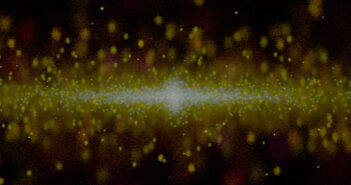
Maps of nearby galaxies using data from the Herschel Space Telescope give researchers a new perspective on dust evolution.
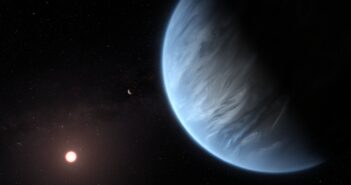
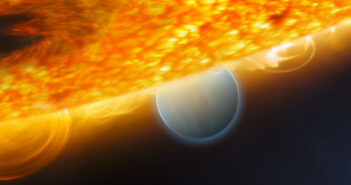
Converting raw JWST data into an inventory of an exoplanet’s atmosphere requires many modeling choices. Recently, a new study investigated the implication of these choices, and dove into how astronomer’s assumptions influence their conclusions about what molecules float about in exo-airs.
A new Focus Issue of the Astrophysical Journal Letters published yesterday takes a close look at GRB 221009A: a spectacular once-in-ten-millennia event.
Where should we start our search for the highest-energy cosmic rays? A recent research article maps out a possible answer.
Researchers use spacecraft data to understand how the highly magnetized remnant of a dead star released a powerful X-ray flare.
Astrobites reports on how to determine the ages of stars by measuring their uranium reserves as they slowly tick away.
Researchers use complex fluid dynamics models to understand what happens when neutron stars — the ultra-dense remnants of massive stars — meet in a catastrophic collision.
Modern machine learning algorithms, paired with the most cutting edge JWST data, are uncovering previously hidden young disk galaxies.