Update on JWST Observations of Galaxy Cluster SMACS 0723
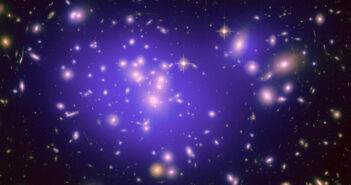
Five recent research articles examine the first JWST image, demystifying dark matter distributions, cataloging chemical abundances, and glimpsing globular clusters.
Astrobites reports on K2-33b: a potentially puffy planet that might be a Saturn-like satellite instead.
Scientists have taken stock of the Sun’s many spectral lines to find the best way to measure its magnetic field — key to understanding a wide range of explosive phenomena.
When gravitational waves from colliding neutron stars rumbled through our detectors in 2017, astronomers raced to track down the light emitted in the collision — but caught critical wavelengths too late to distinguish between competing theories.
Researchers use simulations to explore the possible masses of the first stars in the universe — which may determine whether those stars are still present in the universe today.
Astronomers can learn much from gravitational waves and high-energy neutrinos separately, but could gain much more if both were ever spotted together emanating from the same source. A new publication the Astrophysical Journal summarizes ongoing efforts to do just that.
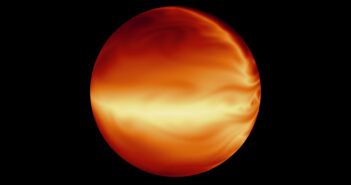
A well-known hot Jupiter exoplanet gets a new phase curve thanks to JWST, and the results support the hypothesis that this scorching planet has metallic clouds.
Astrobites reports on a new way to pick out dead galaxies that may help us learn how star formation stops in the early universe.
A research team tackles a complex three-star, five-planet system and finds evidence for a dustier protoplanetary disk than previously thought.
Step aside, solar flares: two recent research articles explore the Sun when it’s at its calmest and find that there’s plenty to discover.
Arachnophobes, take notice: another black widow pulsar has been spotted hunting in the night.
New research suggests that as our universe expands, black holes gain mass, and this connection between black holes and the universe’s expansion is the source of dark energy.