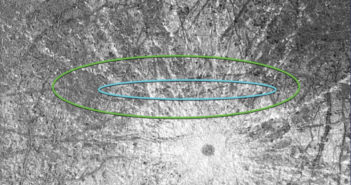
Featured Image: Active Cryovolcanism on Europa?
Evidence is mounting that Europa’s icy surface is active and vents water vapor from its subsurface ocean.

Evidence is mounting that Europa’s icy surface is active and vents water vapor from its subsurface ocean.
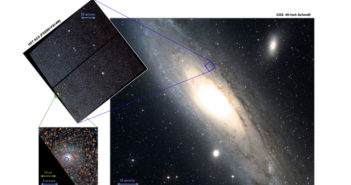
A pulsar in the Andromeda galaxy has recently been caught in the act of being “recycled” by a companion.
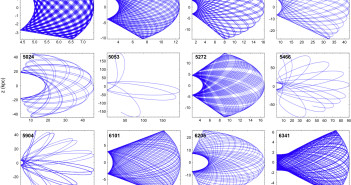
The release of data from Gaia has allowed us to improve our understanding of the globular clusters that orbit the Milky Way.
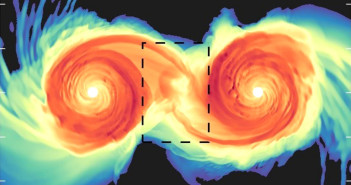
New simulations show how gas is passed back and forth between the accretion disks surrounding the two black holes in a binary system.
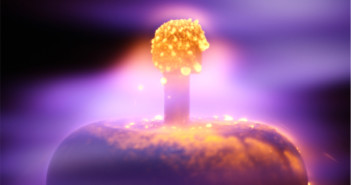
Ever wonder what experimental astronomy looks like? Some days, it looks like this piece of agrillite in a wind tunnel.
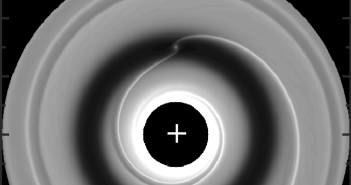
Can we use observations of gaps in protoplanetary disks to estimate the mass of planets orbiting within them?
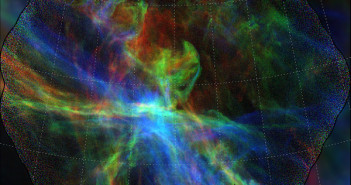
A new survey has provided a high-resolution look at some of the structures in the diffuse hydrogen gas of our galaxy.
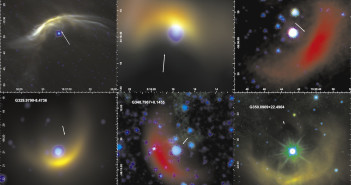
More than 700 candidate stellar bow shock nebulae — signs of runaway stars — have been discovered in the Milky Way.
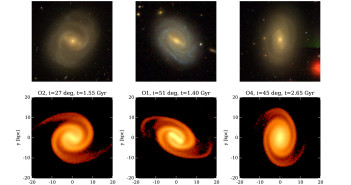
How are the arms of spiral galaxies like the Milky Way created? The gravitational pull of a galaxy cluster might play a role.
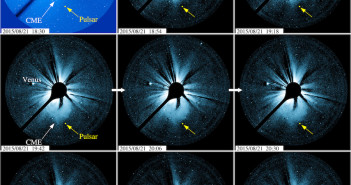
What can we learn about a coronal mass ejection as it passes between us and a distant pulsar?