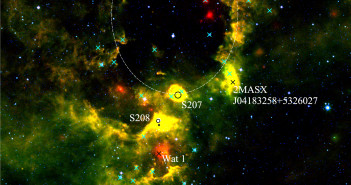
Featured Image: A Bubble Triggering Star Formation
The expanding bubble captured in this infrared image is triggering star-formation as it passes.

The expanding bubble captured in this infrared image is triggering star-formation as it passes.
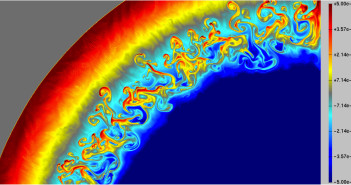
A new study examines how a one-dimensional model can be used to reproduce the multidimensional effects of mixing in supernova remnants.
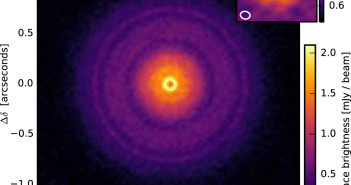
Recent ALMA observations reveal beautiful concentric ring structure within the protoplanetary disk that surrounds a young, Sun-like star.
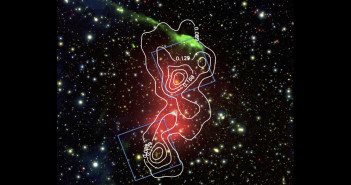
The Toothbrush Cluster’s enormous radio relic may have been caused by a past merger between clusters.
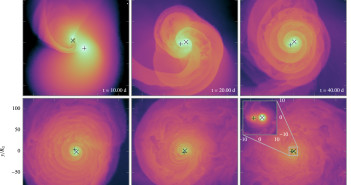
This beautiful series of snapshots from a simulation shows what happens when two stars in a binary system become enclosed in the same stellar envelope.
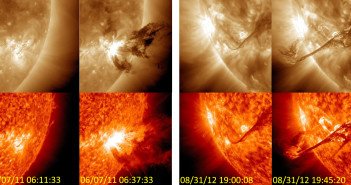
Images of two powerful solar prominence eruptions have helped astronomers model how these eruptions travel away from the Sun.
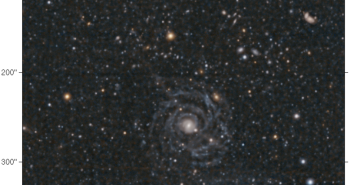
We now have a spectacular new view of the very faint spiral galaxy Malin 1, located roughly 1.2 billion light-years away.
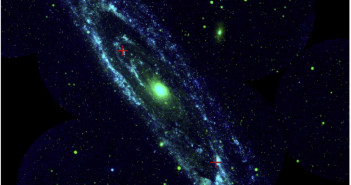
A recent study has used the reddening of several stars in nearby Andromeda to learn about the properties of the dust within this galaxy.
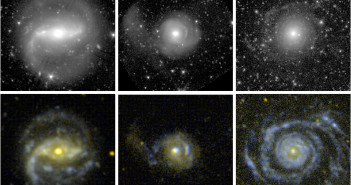
Spitzer has recently taken beautiful infrared images of 2352 nearby galaxies, as a part of the Spitzer Survey of Stellar Structure in Galaxies (S4G).
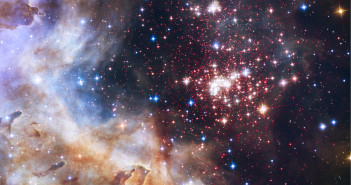
A recent study used the Hubble Space Telescope to perform a high-resolution multi-band survey of Westerland 2, the very young star cluster visible in this spectacular image.