Features RSS

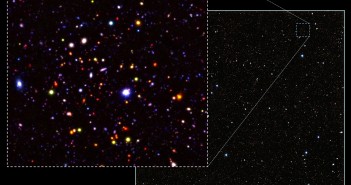
HUDF

Editor’s note: In these last two weeks of 2016, we’ll be looking at a few selections that we haven’t yet discussed on AAS Nova from among the most-downloaded papers published in AAS journals this year. The usual posting schedule will resume after the AAS winter meeting.

The Evolution of Galaxy Number Density at z < 8 and Its Implications

Published October 2016


Main takeaway:

How many galaxies are there in the observable universe? The latest estimate is approximately 2 trillion, according to a study led by Christopher Conselice (University of Nottingham, UK). The authors produced this estimate by using observations of the number of galaxies in recent deep-field surveys by Hubble and other telescopes, and then extrapolating this number to account for small and faint galaxies that we aren’t able to see.

Why it’s interesting:

The original Hubble Deep Field study from the mid-1990s provided the basis for our previous working estimate of the number of galaxies the universe contains, which was around 120 billion. The new estimate from Conselice and collaborators therefore suggests that there are a factor of ten more galaxies in the universe than we previously thought!

What to expect from observations:

Right now we only have the capability to see roughly 10% of these 2 trillion galaxies. But future observatories like the James Webb Space Telescope will be able to pick out many more distant galaxies than what we’ve found so far, helping us to understand how these galaxies formed in the early universe.

Citation

Christopher J. Conselice et al 2016 ApJ 830 83. doi:10.3847/0004-637X/830/2/83

HL Tau

Editor’s note: In these last two weeks of 2016, we’ll be looking at a few selections that we haven’t yet discussed on AAS Nova from among the most-downloaded papers published in AAS journals this year. The usual posting schedule will resume after the AAS winter meeting.

Gas Gaps in the Protoplanetary Disk Around the Young Protostar HL Tau

Published March 2016


HL Tau

The dust (left) and gas (right) emission from HL Tau show that the gaps in its disk match up. [Yen et al. 2016]

Main takeaway:

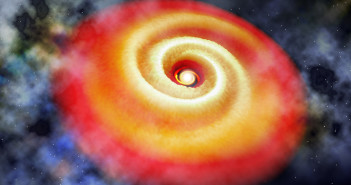
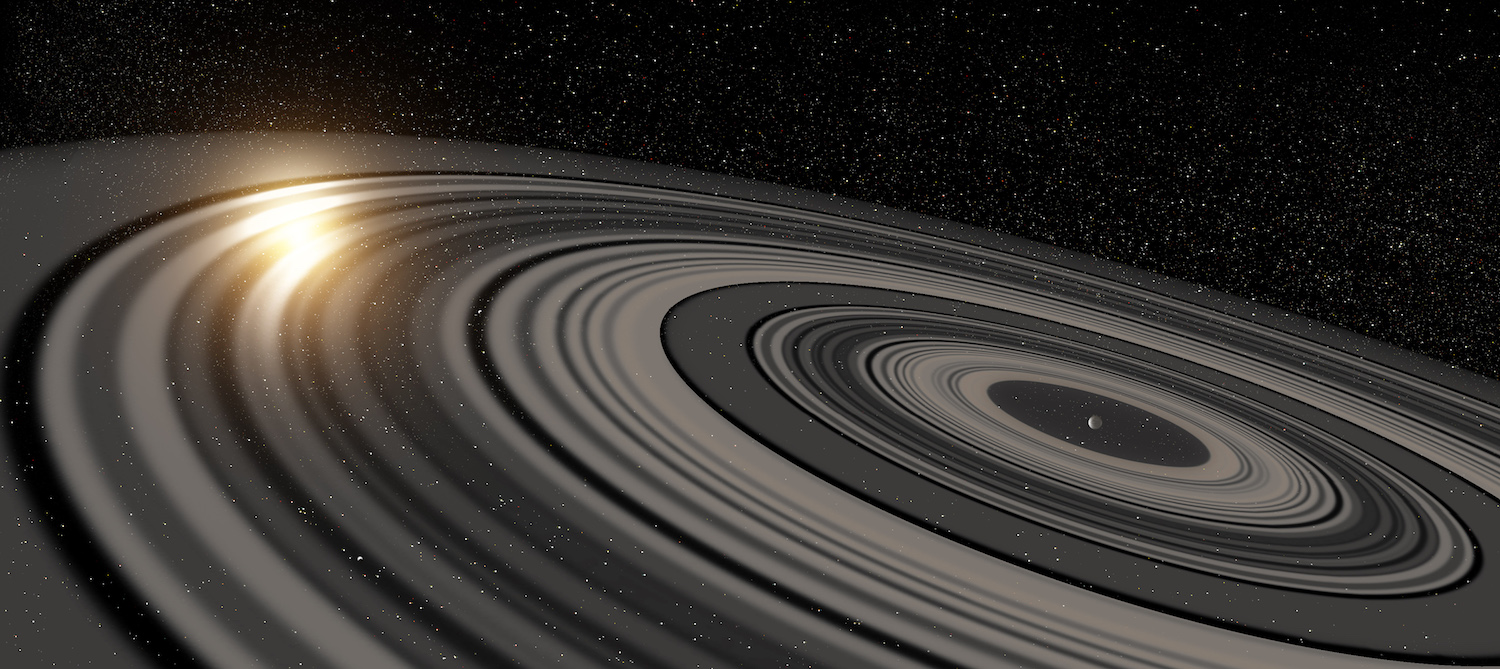
At the end of last year, the Atacama Large Millimeter/Submillimeter Array released some of its first data — including a spectacular observation of a dusty protoplanetary disk around the young star HL Tau. In this follow-up study, a team led by Hsi-Wei Yen (Academia Sinica Institute of Astronomy and Astrophysics, Taiwan) analyzed the ALMA data and confirmed the presence of two gaps in the gas of HL Tau’s disk, at radii of ~28 and ~69 AU.

Why it’s interesting:

The original ALMA image of HL Tau’s disk suggests the presence of gaps in disk, but scientists weren’t sure if they were caused by effects like gravitational instabilities or dust clumping, or if the gaps were created by the presence of young planets. Yen and collaborators showed that gaps in the disk’s gas line up with gaps in its dust, supporting the model in which these gaps have been carved out by newly formed planets.

Added intrigue:

The evidence for planets in this disk came as a bit of a surprise, since it was originally believed that it takes tens of millions of years to form planets from the dust of protoplanetary disks — but HL Tau is only a million years old. These observations therefore suggest that planets start to form much earlier than we thought.

Citation

Hsi-Wei Yen et al 2016 ApJL 820 L25. doi:10.3847/2041-8205/820/2/L25

solar fragment path

falling fragment path

The path taken by the falling fragment in the June 2011 event. [Adapted from Petralia et al. 2016]

Sometimes plasma emitted from the Sun doesn’t escape into space, but instead comes crashing back down to the solar surface. What can observations and models of this process tell us about how the plasma falls and the local conditions on the Sun?

Fallback from a Flare

On 7 June 2011, an M-class flare erupted from the solar surface. As the Solar Dynamics Observatory’s Atmospheric Imaging Assembly looked on, plasma fragments from the flare arced away from the Sun and then fell back to the surface.

Some fragments fell back where the Sun’s magnetic field was weak, returning directly to the surface. But others fell within active regions, where they crashed into the Sun’s magnetic field lines, brightening the channels and funneling along them through the dense corona and back to the Sun’s surface.

fragment model

The authors’ model of the falling blobs at several different times in their simulation. The blobs get disrupted when they encounter the field lines, and are then funneled along the channels to the solar surface. [Adapted from Petralia et al. 2016]

This sort of flare and fall-back event is a common occurrence with the Sun, and SDO’s observations of the June 2011 event present an excellent opportunity to understand the process better. A team of scientists led by Antonino Petralia (University of Palermo, Italy and INAF-OAPA) modeled this event in an effort to learn more about how the falling plasma interacts with strong magnetic fields above the solar surface.

Magnetic Fields as Guides

Petralia and collaborators used three-dimensional magnetohydrodynamical modeling to attempt to reproduce the observations of this event. They simulated blobs of plasma as they fall back to the solar surface and interact with magnetic field lines over a range of different conditions.

The team found that only simulations that assume a relatively strong magnetic field resulted in the blobs funneling along a channel to the Sun’s surface; with weaker fields the blobs to simply broke through the field lines.

The observations were best reproduced by downfall channeled in a million-Kelvin coronal loop confined by a magnetic field of ~10–20 Gauss. In this scenario, a falling fragment is deviated from its path by the field and disrupted. It’s then channeled along the magnetic flux tube, driving a shock and heating in the tube ahead of it — which, the authors find, is the cause the observed brightening that occurs ahead of the actual plasma passage.

Petralia and collaborators point out that this new mechanism for brightening downflows channeled by the magnetic field is applicable not only in our Sun, but also in young, accreting stars. Events like these can therefore work as probes of the ambient atmosphere of such stars, providing information about the local plasma density and magnetic field.

Bonus

Check out the two awesome videos below! In the first one, you can see the SDO/AIA observations of the plasma fragment falling back down and hitting a magnetic channel, which lights up as the shock propagates. In the second one, you can see one of the authors’ models of this process; this video renders the density of blobs of plasma as they fall and strike magnetic field lines.

Citation

A. Petralia et al 2016 ApJ 832 2. doi:10.3847/0004-637X/832/1/2

Milky Way

Though we don’t notice it from our point of view, we’re hurtling through space at breakneck speed — and one of the contributors to our overall motion through the universe is the Sun’s revolution around the center of our galaxy. A recent study uses an unusual approach to measure the speed of this rotation.

Moving While Sitting Still

We know that the Sun zips rapidly around the center of the Milky Way — our orbital speed is somewhere around 250 km/s, or ~560,000 mph! Getting a precise measurement of this velocity is useful because we can combine it with the observed proper motion of Sgr A*, the black hole at the center of our galaxy, to determine the distance from us to the center of the Milky Way. This is an important baseline for lots of other measurements.

modeled orbits

Example particle orbits modeled within the galactic potential. The top panel represents a star with zero angular momentum, which is scattered into a chaotic orbit after interacting with the galactic nucleus. [Hunt et al. 2016]

But how can we measure the Sun’s revolution speed accurately? A team of scientists led by Jason Hunt (Dunlap Institute at University of Toronto, Canada) have suggested a unique approach to pin down this value: look for missing stars in the solar neighborhood.

Missing Stars

The stars around us should exhibit a distribution of velocities describing their orbits about the galactic center — but those stars with zero angular momentum should have plunged directly into the galactic center long ago. These stars would have been scattered onto chaotic halo orbits after their plunge, resulting in a dearth of stars with zero angular momentum around us today.

By looking at the relative speeds of the stars moving around us, then, we should see a dip in the velocity distribution corresponding to the missing zero-angular-momentum stars. By noting the relative velocity at which that dip occurs, we cleverly reveal the negative of our motion around the galactic center.

velocity distribution

Velocity distribution for stars within 700 pc of the Sun. A dip in the distribution (marked with an arrow) is noticeable between –210 and –270 km/s. [Hunt et al. 2016]

Where Are We and How Fast Are We Going?

Hunt and collaborators use a combination of the first data release from ESA’s Gaia mission and a star catalog from the Radial Velocity Experiment to examine the motions of a total of over 200,000 stars in the solar neighborhood. They find that there is indeed a lack of disk stars with velocities close to zero angular momentum. They then compare modeled stellar orbits to the data to estimate the relative speed at which the dip in the velocity distribution occurs.

From this information, the authors obtain a measurement of 239±9 km/s for the Sun’s revolution velocity around the galactic center. They combine this value with a proper motion measurement of Sgr A* to calculate the distance to the galactic center: 7.9±0.3 kpc (or about 26,000 light-years).

Both of these measurements can be improved with future Gaia data releases, which will contain many orders of magnitude more stars. This clever technique, therefore, proves a useful way of better constraining our position and motion through the Milky Way.

Citation

Jason A. S. Hunt et al 2016 ApJL 832 L25. doi:10.3847/2041-8205/832/2/L25

SMBH

Where does the angular momentum come from that causes supermassive black holes (SMBHs) to spin on their axes and launch powerful jets? A new study of nearby SMBHs may help to answer this question.

High-mass SMBHs are thought to form when two galaxies collide and the SMBHs at their centers merge. [NASA/Hubble Heritage Team (STScI)]

High-mass SMBHs are thought to form when two galaxies collide and the SMBHs at their centers merge. [NASA/Hubble Heritage Team (STScI)]

High- vs. Low-Mass Monsters

Observational evidence suggests a dichotomy between low-mass SMBHs (those with 106-7 M) and high-mass ones (those with 108-10 M). High-mass SMBHs are thought to form via the merger of two smaller black holes, and the final black hole is likely spun up by the rotational dynamics of the merger. But what spins up low-mass SMBHs, which are thought to build up very gradually via accretion?

A team of scientists led by Jing Wang (National Astronomical Observatories, Chinese Academy of Sciences) have attempted to address this puzzle by examining the properties of the galaxies hosting low-mass SMBHs.

A Sample of Neighboring SMBHs

Wang and collaborators began by constructing a sample of radio-selected nearby Seyfert 2 galaxies: those galaxies in which the stellar population and morphology of the host galaxy are visible to us, instead of being overwhelmed by continuum emission from the galaxy’s active nucleus.

sersic index

An example of a galaxy with a concentrated, classical bulge (M87; top) and a one with a disk-like pseudo bulge (Triangulum Galaxy; bottom). The authors find that for galaxies hosting low-mass SMBHs, those with more disk-like bulges appear to have more powerful radio jets. [Top: NASA/Hubble Heritage Team (STScI), Bottom: Hewholooks]

From this sample, the authors then selected 31 galaxies that have low-mass SMBHs at their centers, as measured using the surrounding stellar dynamics. Wang and collaborators cataloged radio information revealing properties of the powerful jets launched by the SMBHs, and they analyzed the host galaxies’ properties by modeling their brightness profiles.

Spin-Up From Accreting Gas

By examining this sample, the authors discovered an intriguing relationship: the radio power of jets launched by an SMBH appears to be dependent upon its host galaxy’s bulge surface brightness. Specifically, Wang and collaborators found that more powerful radio emission comes from SMBHs associated with less-concentrated bulges, i.e. those that are more disk-like.

The authors’ findings allow them to rule out many common explanations for the radio-loudness of such galaxies with small SMBH masses. Instead, they argue that the tendency for galaxies with more disk-like bulges to host SMBHs with more powerful jets is evidence that low-mass SMBHs are spun up by the accretion of surrounding gas.

In this scenario, the angular momentum of gas with significant disk-like rotational dynamics provides the spin to the SMBH, and this rotational energy can then be extracted to launch the powerful jets. If this explanation is correct, it strengthens the dichotomy between low-mass and high-mass SMBHs, supporting the idea that the two categories of black holes are indeed formed and spun up via completely different mechanisms.

Citation

J. Wang et al 2016 ApJL 833 L2. doi:10.3847/2041-8205/833/1/L2

stellar flare and exoplanet

As the exoplanet count continues to increase, we are making progressively more measurements of exoplanets’ outer atmospheres through spectroscopy. A new study, however, reveals that these measurements may be influenced by the planets’ hosts.

Spectra From Transits

Exoplanet spectra taken as they transit their hosts can tell us about the chemical compositions of their atmospheres. Detailed spectroscopic measurements of planet atmospheres should become even more common with the next generation of missions, such as the James Webb Space Telescope (JWST), or Planetary Transits and Oscillations of Stars (PLATO).

But is the spectrum that we measure in the brief moment of a planet’s transit necessarily representative of its spectrum all of the time? A team of scientists led by Olivia Venot (University of Leuven in Belgium) argue that it might not be, due to the influence of the planet’s stellar host.

atmospheric composition

Atmospheric composition of a planet before flare impacts (dotted lines), during the steady state reached after a flare impact (dashed lines), and during the steady state reached after a second flare impact (solid lines). [Venot et al. 2016]

The team suggests that when a host’s flares impact upon a planet’s atmosphere (especially likely in the case of active M-dwarfs that commonly harbor planetary systems), this activity may modify the chemical composition of the planet’s atmosphere. This would in turn alter the spectrum that we measure from the exoplanet.

Modeling Atmospheres

Venot and collaborators set out to test the effect of stellar flares on exoplanet atmospheres by modeling the atmospheres of two hypothetical planets orbiting the star AD Leo — an active and flaring M dwarf located roughly 16 light-years away — at two different distances. The team then examined what happened to the atmospheres, and to the resulting spectra that we would observe, when they were hit with a stellar flare typical of AD Leo.

absorption

The difference in relative absorption between the initial steady-state and the instantaneous transmission spectra, obtained during the different phases of the flare. The left plot examines the impulsive and gradual phases, when the flare first impacts and then starts to pass. The peak photon flux occurs at 912 seconds. The right plot examines the return to a steady state over 1012 seconds, or roughly ~30,000 years. [Adapted from Venot et al. 2016]

The authors found that the planets’ atmospheric compositions were significantly affected by the incoming stellar flare. The sudden increase in incoming photon flux changed the chemical abundances of several important molecular species, like hydrogen and ammonia — which resulted in changes to the spectrum that would be observed during the planet’s transit.

Permanent Impact

In addition to demonstrating that a planet’s atmospheric composition changes during and immediately after a flare impact, Venot and collaborators show that the chemical alteration isn’t temporary: the planet’s atmosphere doesn’t fully return to its original state after the flare passes. Instead, the authors find that it settles to a new steady-state composition that can be significantly different from the pre-flare composition.

For a planet that is repeatedly hit by stellar flares, therefore, its atmospheric composition never actually settles to a steady state. Instead it is continually and permanently modified by its host’s activity.

Venot and collaborators demonstrate that the variations of planetary spectra due to stellar flares should be easily detectable by future missions like JWST. We must therefore be careful about the conclusions we draw about planetary atmospheres from measurements of their spectra.

Citation

Olivia Venot et al 2016 ApJ 830 77. doi:10.3847/0004-637X/830/2/77

Andromeda

You might think that small satellite galaxies would be distributed evenly around their larger galactic hosts — but local evidence suggests otherwise. Are satellite distributions lopsided throughout the universe?

Satellites in the Local Group

The distribution of the satellite galaxies orbiting Andromeda, our neighboring galaxy, is puzzling: 21 out of 27 (~80%) of its satellites are on the side of Andromeda closest to us. In a similar fashion, 4 of the 11 brightest Milky Way satellites are stacked on the side closest to Andromeda.

It seems to be the case, then, that satellites around our pair of galaxies preferentially occupy the space between the two galaxies. But is this behavior specific to the Local Group? Or is it commonplace throughout the universe? In a recent study, a team of scientists led by Noam Libeskind (Leibniz Institute for Astrophysics Potsdam, Germany) set out to answer this question.

Properties of the galaxies included in the authors’ sample. Left: redshifts for galaxy pairs. Right: Number of satellite galaxies around hosts. [Adapted from Libeskind et al. 2016]

Properties of the galaxies included in the authors’ sample. Left: redshifts for galaxy pairs. Right: Number of satellite galaxies around hosts. [Adapted from Libeskind et al. 2016]

Asymmetry at Large

Libeskind and collaborators tested whether this behavior is common by searching through Sloan Digital Sky Survey observations for galaxy pairs that are similar to the Milky Way/Andromeda pair. The resulting sample consists of 12,210 pairs of galaxies, which have 46,043 potential satellites among them. The team then performed statistical tests on these observations to quantify the anisotropic distribution of the satellites around the host galaxies.

Libeskind and collaborators find that roughly 8% more galaxies are seen within a ~15° angle facing the other galaxy of a pair than would be expected in a uniform distribution. The odds that this asymmetric behavior is randomly produced, they show, are lower than 1 in 10 million — indicating that the lopsidedness of satellites around galaxies in pairs is a real effect and occurs beyond just the Local Group.

Caution for Modeling

Probability that satellites are located at an angle of θ degrees from the direction pointing toward the other galaxy in the pair. There are more satellites found in the space between the pair than predicted by a uniform distribution. [Libeskind et al. 2016]

Probability that satellites are located at an angle of θ degrees from the direction pointing toward the other galaxy in the pair. There are more satellites found in the space between the pair than predicted by a uniform distribution. [Libeskind et al. 2016]

What might cause this asymmetric distribution? The authors suggest the primary cause is that galaxies in pairs are not necessarily relaxed halos in equilibrium — a case in which spherical symmetry would apply. Instead, these are likely merging, dynamically active pairs of galaxies, so we cannot assume that they have axially symmetric halos.

Simulations of Local-Group-like pairs of galaxies will be the next step needed to understand how such asymmetries in the distribution of satellites form and evolve. Meanwhile, the results presented here suggest that the commonly adopted axially symmetric models of the Milky Way (and other galaxies in pairs) should be used with caution, as they may not be capturing the true shape of the halo.

Citation

Noam I. Libeskind et al 2016 ApJ 830 121. doi:10.3847/0004-637X/830/2/121

double pulsar

Have you been contributing your computer idle time to the Einstein@Home project? If so, you’re partly responsible for the program’s recent discovery of a new double-neutron-star system that will be key to learning about general relativity and stellar evolution.

Arecibo

The 305-m Arecibo Radio Telescope, built into the landscape at Arecibo, Puerto Rico. [NOAO/AURA/NSF/H. Schweiker/WIYN]

The Hunt for Pulsars

Observing binary systems containing two neutron stars — and in particular, measuring the timing of the pulses when one or both companions is a pulsar — can provide highly useful tests of general relativity and binary stellar evolution. Unfortunately, these systems are quite rare: of ~2500 known radio pulsars, only 14 of them are in double-neutron-star binaries.

To find more systems like these, we perform large-scale, untargeted radio-pulsar surveys — like the ongoing Pulsar-ALFA survey conducted with the enormous 305-m radio telescope at Arecibo Observatory in Puerto Rico. But combing through these data for the signature of a highly accelerated pulsar (the acceleration is a clue that it’s in a compact binary) is very computationally expensive.

pulse profile

PSR J1913+1102’s L-band pulse profile, created by phase-aligning and summing all observations. [Adapted from Lazarus et al. 2016]

To combat this problem, the Einstein@Home project was developed. Einstein@Home allows anyone to volunteer their personal computer’s idle time to help run the analysis of survey data in the search for pulsars. In a recent publication led by Patrick Lazarus (Max Planck Institute for Radio Astronomy), the Einstein@Home team announced the discovery of the pulsar PSR J1913+1102 — a member of what seems to be a brand new double-neutron-star system.

An Intriguing Discovery

Lazarus and collaborators followed up on the discovery to obtain timing measurements of the pulsar, which they found to have a spin period of 27.3 ms. They measured PSR J1913+1102 to be in a 4.95-hr, nearly circular (e~0.09) binary orbit with a massive companion that, based on its properties, is most likely another neutron star. The team wasn’t able to detect pulsations from the companion, but that could mean that its beam doesn’t cross the Earth, or it’s very faint, or it’s simply no longer active as a pulsar.

DNS orbital evolution

Orbital evolution of the six known double-neutron-star systems that will coalesce within a Hubble time, including J1913+1102 (black solid line). They move toward the origin as they lose energy to gravitational waves and approach merger. Shown are current positions (black dots), estimates of the positions when the compact binaries were formed (grey dots), and future evolution. [Lazarus et al. 2016]

Lazarus and collaborators use their observations of the system to argue that PSR J1913+1102 was likely spun up (“recycled”) by accretion of matter from its companion’s progenitor. The companion then exploded in the second supernova of the system, providing a very small kick — hence the low eccentricity of the system — and resulting in the current double-neutron-star binary we observe.

Lessons from PSR J1913+1102

Observations of compact binaries such as this one can reveal a wealth of information. Besides providing clues about how the binary evolved, precise timing measurements (now being made) will also allow powerful tests of general relativity. One of the measurements that may be possible by the end of this year will provide information about the orbital decay of the binary — expected to continue for ~0.5 Gyr until the system merges — due to the emission of gravitational waves.

In the meantime, you can bet that Einstein@Home will continue hunting for more systems like PSR J1913+1102 and its companion!

Citation

P. Lazarus et al 2016 ApJ 831 150. doi:10.3847/0004-637X/831/2/150

Milky Way

The Milky Way’s dense central bulge is a very different environment than the surrounding galactic disk in which we live. Do the differences affect the ability of planets to form in the bulge?

Exploring Galactic Planets

gravitational microlensing

Schematic illustrating how gravitational microlensing by an extrasolar planet works. [NASA]

Planet formation is a complex process with many aspects that we don’t yet understand. Do environmental properties like host star metallicity, the density of nearby stars, or the intensity of the ambient radiation field affect the ability of planets to form? To answer these questions, we will ultimately need to search for planets around stars in a large variety of different environments in our galaxy.

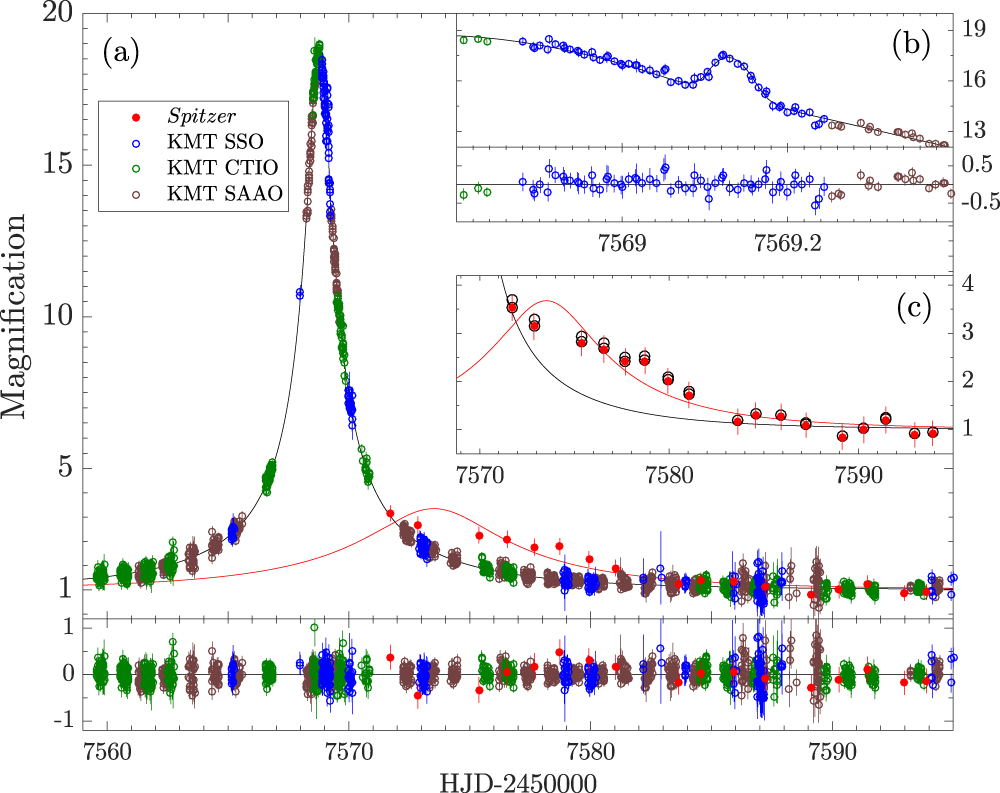
One way to detect recently formed, distant planets is by gravitational microlensing. In this process, light from a distant source star is bent by a lens star that is briefly located between us and the source. As the Earth moves, this momentary alignment causes a blip in the source’s light curve that we can detect — and planets hosted by the lens star can cause an additional observable bump.

Milky Way bulge

Artist’s impression of the Milky Way galaxy. The central bulge is much denser than the surrounding disk. [ESO/NASA/JPL-Caltech/M. Kornmesser/R. Hurt]

Relative Abundances

Most source stars reside in the galactic bulge, so microlensing events can probe planetary systems at any distance between the Earth and the galactic bulge. This means that planet detections from microlensing could potentially be used to measure the relative abundances of exoplanets in different parts of our galaxy.

A team of scientists led by Matthew Penny, a Sagan postdoctoral fellow at Ohio State University, set out to do just that. The group considered a sample of 31 exoplanetary systems detected by microlensing and asked the following question: are the planet abundances in the galactic bulge and the galactic disk the same?

A Paucity of Planets

To answer this question, Penny and collaborators derived the expected distribution of host distances from a simulated microlensing survey, correcting for dominant selection effects. They then compared the distribution of distances in this model sample to the distribution of distances measured for the actual, observed systems.

planet hosts

Histogram and cumulative distribution (black lines) of distance estimates for microlensing planet hosts. Red lines show the distributions predicted by the model if the disk and bulge abundances were the same. [Penny et al. 2016]

Intriguingly, the two distributions don’t match when you assume that the planet abundances in the disk and the bulge are the same. The relative abundances appear to be higher in the disk than in the bulge, according to the team’s results: the observations agree with a model in which the bulge/disk abundance ratio is less than 0.54.

What’s to Blame?

There are a few ways to interpret this result: 1) distance measurements for the sample of planets discovered by microlensing have errors, 2) the model is too simplified; it needs to also include dependence of planet abundance and detection sensitivity on properties like host mass and metallicity, or 3) the galactic bulge actually has fewer planets than the disk.

Penny and collaborators suspect some combination of the first two interpretations is most likely, but an actual paucity of planets in the galactic bulge can’t be ruled out. Performing similar analysis on a larger sample of microlensing planets — expected from upcoming, second-generation microlensing searches — and obtaining more accurate distance measurements will help us to address this puzzle more definitively in the future.

Citation

Matthew T. Penny et al 2016 ApJ 830 150. doi:10.3847/0004-637X/830/2/150

SN 1994D

One of the major challenges for modern supernova surveys is identifying the galaxy that hosted each explosion. Is there an accurate and efficient way to do this that avoids investing significant human resources?

Why Identify Hosts?

supernova host

One problem in host galaxy identification. Here, the supernova lies between two galaxies — but though the centroid of the galaxy on the right is closer in angular separation, this may be a distant background galaxy that is not actually near the supernova. [Gupta et al. 2016]

Supernovae are a critical tool for making cosmological predictions that help us to understand our universe. But supernova cosmology relies on accurately identifying the properties of the supernovae — including their redshifts. Since spectroscopic followup of supernova detections often isn’t possible, we rely on observations of the supernova host galaxies to obtain redshifts.

But how do we identify which galaxy hosted a supernova? This seems like a simple problem, but there are many complicating factors — a seemingly nearby galaxy could be a distant background galaxy, for instance, or a supernova’s host could be too faint to spot.

confusion

The authors’ algorithm takes into account “confusion”, a measure of how likely the supernova is to be mismatched. In these illustrations of low (left) and high (right) confusion, the supernova is represented by a blue star, and the green circles represent possible host galaxies. [Gupta et al. 2016]

Turning to Automation

Before the era of large supernovae surveys, searching for host galaxies was done primarily by visual inspection. But current projects like the Dark Energy Survey’s Supernova Program is finding supernovae by the thousands, and the upcoming Large Synoptic Survey Telescope will likely discover hundreds of thousands. Visual inspection will not be possible in the face of this volume of data — so an accurate and efficient automated method is clearly needed!

To this end, a team of scientists led by Ravi Gupta (Argonne National Laboratory) has recently developed a new automated algorithm for matching supernovae to their host galaxies. Their work builds on currently existing algorithms and makes use of information about the nearby galaxies, accounts for the uncertainty of the match, and even includes a machine learning component to improve the matching accuracy.

Gupta and collaborators test their matching algorithm on catalogs of galaxies and simulated supernova events to quantify how well the algorithm is able to accurately recover the true hosts.

Successful Matching

The matching algorithm’s accuracy (“purity”) as a function of the true supernova-host separation, the supernova redshift, the true host’s brightness, and the true host’s size. [Gupta et al. 2016]

The matching algorithm’s accuracy (“purity”) as a function of the true supernova-host separation, the supernova redshift, the true host’s brightness, and the true host’s size. [Gupta et al. 2016]

The authors find that when the basic algorithm is run on catalog data, it matches supernovae to their hosts with 91% accuracy. Including the machine learning component, which is run after the initial matching algorithm, improves the accuracy of the matching to 97%.

The encouraging results of this work — which was intended as a proof of concept — suggest that methods similar to this could prove very practical for tackling future survey data. And the method explored here has use beyond matching just supernovae to their host galaxies: it could also be applied to other extragalactic transients, such as gamma-ray bursts, tidal disruption events, or electromagnetic counterparts to gravitational-wave detections.

Citation

Ravi R. Gupta et al 2016 AJ 152 154. doi:10.3847/0004-6256/152/6/154

1 94 95 96 97 98 113