Features RSS

While classic spiral and elliptical galaxies shine brightly, another class of galaxy flies under the radar. A recent study uses a new technique to search for galaxies so faint they are nearly completely dark.

Ultra-Diffuse Galaxies

Hard to see and harder to understand, ultra-diffuse galaxies are a galaxy class with extremely low surface brightness. With low luminosities but large physical extents, these galaxies appear as barely visible smudges, making them difficult to detect. Historically, astronomers have searched for ultra-diffuse galaxies using methods that search for diffuse stellar light; however, this method only catches those bright enough to spot — if even darker galaxies exist, they will not be found this way. Is there another way to discover these elusive galaxies?

Recent studies have shown that ultra-diffuse galaxies tend to have more globular clusters on average than typical galaxies. While this raises questions surrounding their formation and evolution, the abundance of globular clusters provides another way to search for ultra-diffuse galaxies. In general, globular clusters do not clump together in space unless there is additional mass, like dark matter, pulling them together. Thus, searching for overdensities of globular clusters could reveal a hidden population of ultra-diffuse galaxies.

Candidate Confirmation

Discovered as an overdensity of three globular clusters, Candidate Dark Galaxy-2 (CDG-2) was found in data from a Hubble Space Telescope (HST) program aimed at imaging the Perseus galaxy cluster. With an updated globular cluster catalog and improved statistical method for detecting overdensities, Dayi (David) Li (University of Toronto) and collaborators perform a follow-up search and analysis to confirm CDG-2 as a galaxy. Their method searches for clustering of globular clusters that do not appear to belong to any bright galaxy and are unlikely to be randomly grouped so closely in the intergalactic medium.

CDG-2

Euclid images of CDG-2 showing the four identified globular clusters (blue circles) and the faint diffuse emission (orange circles) associated with the galaxy. Click to enlarge. [Modified from Li et al 2025]

From their analysis, the authors find an additional globular cluster that belongs to CDG-2, making the object even more statistically likely to be a galaxy as opposed to four randomly clumped globular clusters. Further pointing to CDG-2’s galactic nature, two stacked HST images reveal a very faint light surrounding these globular clusters. To confirm that this diffuse emission is truly associated with CDG-2, the authors use data from Euclid, a space telescope that is optimized for detecting diffuse structures. The Euclid data confirm a low-surface-brightness fuzzy emission that coincides with the emission seen with HST and corresponds to the location of the four globular clusters — strong evidence that CDG-2 is indeed a galaxy.

Globular Cluster and Dark Matter Dominated

plot

Plot showing globular cluster total luminosity versus total galaxy luminosity for multiple galaxies. CDG-2 falls along the line corresponding to 16% of the total galaxy light coming from globular clusters. Click to enlarge. [Li et al 2025]

Further analysis of CDG-2 reveals that at least ~16.6% of its total light is contained within its globular clusters. However, if CDG-2 follows the typical distribution of globular clusters in galaxies and some are still undetected, this fraction could be as high as 33%, which would make CDG-2 have the highest globular cluster-to-stellar mass ratio of any galaxy to date. With additional analysis of the mass contained within the observed globular clusters, the authors estimate that CDG-2 is highly dark-matter dominated with 99.94%–99.98% of its total mass contained within dark matter. The dark-matter fraction could be even higher if CDG-2 contains more undetected globular clusters. Future observations of CDG-2 with deeper imaging and spectroscopy will more confidently determine the galaxy’s extreme and unique structure.

Through this study, the authors have confirmed the first galaxy ever detected solely through its globular cluster population. This technique opens a promising avenue to discovering more galaxies hiding out in the dark.

Citation

“Candidate Dark Galaxy-2: Validation and Analysis of an Almost Dark Galaxy in the Perseus Cluster,” Dayi (David) Li et al 2025 ApJL 986 L18. doi:10.3847/2041-8213/adddab

Messier 87 jet

M87 EHT image

The first detailed image of a black hole, M87*, taken with the Event Horizon Telescope. [Adapted from EHT Collaboration et al. 2019]

Messier 87, or M87, is a massive elliptical galaxy that hosts one of the best-studied supermassive black holes in the universe. The black hole, commonly called M87*, was the subject of the first-ever photograph of a black hole, which was released by the Event Horizon Telescope collaboration in 2019. Two years after that groundbreaking first photograph was revealed to the public, the collaboration released a set of polarized images of the black hole, illuminating the magnetic field conditions close to the black hole and fueling years of research since.

Today’s Monthly Roundup explores three aspects of this supermassive black hole: how fast it spins, the properties of its relativistic jet, and the source of its powerful flares.

Taking M87’s Black Hole for a Spin

Spin is one of the fundamental parameters describing a black hole, along with mass and electric charge, and it’s a challenging quantity to measure. In a recent research article, Michael Drew (University of Central Lancashire) and collaborators used data from the Event Horizon Telescope from 2017 and 2018 to measure the spin of M87*. Their goal was to measure the angular momentum of the innermost region of the disk of material swirling around the black hole. For a 10-billion-year-old black hole like M87’s, the angular momentum of the inner reaches of the accretion disk is fundamentally linked to the spin of the black hole.

Radial brightness profiles of M87*

Radial brightness profiles of the Event Horizon Telescope images of M87*. The variation of the brightness of the ring is due in part to Doppler beaming. Click to enlarge. [Event Horizon Telescope Collaboration 2019]

The team’s measurement technique hinges on the existence of relativistic Doppler beaming, which affects the apparent brightness of the fast-spinning material in the black hole’s accretion disk; material moving toward us as the disk rotates appears brighter, while material moving away appears fainter. By comparing the brightness of the brightest and faintest parts of the ring, Drew and coauthors estimated the velocity of the inner edge of the accretion disk. Combining this estimate with a measure of the disk’s inner radius from the Event Horizon Telescope yielded a measurement of the disk’s angular momentum and, by extension, the black hole’s spin.

This method returned a spin parameter of 0.8, which is within the broad range of previous estimates for M87*’s spin (0.1–0.98). Given certain assumptions made in this work, the team expects that this spin measurement is a lower limit on the black hole’s spin.

Closeup of Messier 87's relativistic jet

Closeup of Messier 87’s relativistic jet. [NASA and the Hubble Heritage Team (STScI/AURA)]

In addition to measuring the spin, the team also found a range of plausible accretion rates, from 4×10⁻⁵ to 4×10⁻¹ solar mass per year (about 0.04–400 times the mass of Jupiter). These values are far below the theoretical maximum accretion rate for M87*, suggesting that while M87* is far more active than the black hole at the Milky Way’s center, it’s still fairly calm as far as black holes go. Finally, the team estimated the black hole’s accretion energy per unit time to be 6×1033–6×1037 Joules per second. These estimates largely overlap with existing estimates for the energy of M87*’s relativistic jet, supporting models in which the jet is powered by accretion.

A New Model for Bright-Edged Jets

One of the most dramatic features of Messier 87 is its prominent jet. Researchers have noted that M87*’s jet exhibits limb brightening, meaning that the jet appears brighter along its edges than in its center. This characteristic is present throughout M87*’s jet, from close to the point at which it’s launched to far down its length, and is also seen in other black hole jets.

simulation results showing that anisotropy results in a limb-brightened jet

Demonstration of limb brightening in models that include an anisotropic electron distribution. [Tsunetoe et al. 2025]

So far, simulations have succeeded in producing a limb-brightened jet under carefully tailored conditions, but they have not yet managed to produce this feature across a range of scales and black hole spins. A team led by Yuh Tsunetoe (Black Hole Initiative at Harvard University; University of Tsukuba) aimed to change that with their recent modeling study. The key feature of the team’s model is that the electrons that produce the jet’s prominent radio emission have much higher velocities parallel to the magnetic field lines that thread through the jet than perpendicular to the magnetic field (i.e., the electron distribution is anisotropic). Previous simulations using particle-in-cell methods, in which the behavior of individual particles is tracked, show that this anisotropic electron distribution is expected to arise in a relativistic, turbulent, magnetically dominated plasma.

Tsunetoe’s team used both general relativistic magnetohydrodynamics (GRMHD) and general relativistic force-free electrodynamics (GRFFE) in their modeling. These two modeling techniques have different strengths and weaknesses: GRMHD allows time variations to be studied, but is only effective close to the black hole, while GRFFE applies at a large distance from the black hole, but can only give a time-averaged result. By combining these two methods, the authors were able to generate synthetic radio-frequency images of M87*’s jet and compare them to observations.

simulated black hole jets

Simulated (left column) and observed (right column) jets. The top left shows the result from the GRMHD simulation and the bottom left shows the result from the GRFFE simulation. Note the difference in scale between the two simulations. Click to enlarge. [Adapted from Tsunetoe et al. 2025]

The resulting images show a clear limb-brightened jet across a wide range of both radio frequencies and spatial scales, as well as a striking resemblance to observations of the jet. In addition to comparing against existing data, Tsunetoe and collaborators produced images that can be compared against images from future facilities, such as the next-generation Event Horizon Telescope or the Black Hole Explorer. While more work remains to be done in the study of M87*’s jet — the team noted that their model doesn’t yet produce a counter-jet component as bright as what’s seen in observations — this work represents a significant advance in our ability to model the jets from supermassive black holes.

Investigating a Potential Source of Flares

Like many accreting supermassive black holes, M87* exhibits flares of high-energy radiation. These flares are highly variable, sometimes lasting only a couple of days, which suggests that they arise very close to the black hole’s event horizon. Precisely how these flares are generated is still unknown, though magnetic reconnection, in which magnetic fields rearrange and release pent-up magnetic energy, is a strong candidate.

Recently, Siddhant Solanki (University of Maryland) and collaborators investigated the source of M87*’s flares by tracing the paths of photons through a general relativistic magnetohydrodynamics simulation of an accreting spinning supermassive black hole. The simulation captured the region close to the black hole where magnetic reconnection is thought to occur, potentially launching electron–positron pairs that kick background photons up to high energies, powering a flare.

simulation of emission from M87* during a flare

Illustration of the origin of the simulated flare emission. The majority of the emission arises from very close to the black hole. The purple and cyan curves indicate magnetic field lines. [Solanki et al. 2025]

By charting the course of individual photons as they depart from the current sheet — the surface that separates magnetic fields of opposite direction — and navigate the magnetized plasma surrounding the black hole, Solanki and coauthors show that much of the flux from the simulated flares arises within just 5 gravitational radii of the black hole. This supports the hypothesis that quickly varying flares are generated near the black hole’s event horizon.

The timescales of the simulated flares were also instructive. While the simulated flares tended to last about 130 days, each flare was composed of multiple smaller subflares, which lasted roughly as long as the rapid, ~2-day flares seen from M87*. If these flares are truly subflares arrayed within a longer-duration flare, Solanki and collaborators noted, they should have different time variability at long and short wavelengths. This suggests a need for long-term, multiwavelength monitoring of M87* to clarify the source of its flares.

Citation

“New Estimates of the Spin and Accretion Rate of the Black Hole M87*,” Michael Drew et al 2025 ApJL 984 L31. doi:10.3847/2041-8213/adc90e

“Limb-Brightened Jet in M87 from Anisotropic Nonthermal Electrons,” Yuh Tsunetoe et al 2025 ApJ 984 35. doi:10.3847/1538-4357/adc37a

“Modeling of Lightcurves from Reconnection-Powered Very High-Energy Flares from M87*,” Siddhant Solanki et al 2025 ApJ 985 147. doi:10.3847/1538-4357/adcba9

Illustration of a planet around a red dwarf star

Which of the nearly 6,000 known exoplanets have atmospheres? New research suggests that small, rocky planets around the smallest and coolest stars are even less likely to hang on to their atmospheres than suggested by previous research. This result will help to guide the selection of target exoplanets for atmospheric characterization.

Approaching a Milestone

plot of the masses, orbital periods, and detection methods for currently confirmed exoplanets

Mass, period, and detection method for confirmed exoplanets as of 17 June 2025. Click to enlarge. [Exoplanet Archive/Caltech/NASA]

Today, the Exoplanet Archive reports that humanity has discovered 5,921 exoplanets, bringing us only a handful of detections away from the remarkable milestone of 6,000 known exoplanets. Though just a small fraction of the hundreds of billions to trillions of worlds estimated to occupy our galaxy, this planet sample is ripe for the search for atmospheres, habitable surfaces, and even life. But where to look?

When seeking planets with atmospheres, researchers must consider how a planet has fared in its lifelong battle between gravity and radiation. Massive planets orbiting calm stars are more likely to have atmospheres than lightweight planets around active stars. Astronomers define the cosmic shoreline as the dividing line between planets with atmospheres and planets without, in terms of escape velocity and the extreme-ultraviolet flux of the star.

Charting the Cosmic Shoreline

To predict on which side of the cosmic shoreline a particular planet lies, it’s not enough to know the current extreme-ultraviolet flux of its host star. A star’s extreme-ultraviolet flux changes over time, and integrating these changes over the lifetime of a planet yields its position along the shoreline. In a new research article, Emily Pass (Massachusetts Institute of Technology) and collaborators have suggested that this integration hasn’t been performed correctly for certain planets.

plot showing the rotation periods of M dwarf stars as a function of mass

Rotation periods of M dwarfs with masses less than 0.3 solar mass. The lack of M dwarfs with rotation periods between 9 and 50 days suggests a rapid transition between the two regimes. Click to enlarge. [Pass et al. 2025]

As stars age, they spin more slowly, and this slowdown is accompanied by a decrease in atmosphere-stealing stellar activity. For all stars down through early type M dwarfs, the slowdown is uniform, but research has shown that for mid-to-late M dwarfs, the transition from fast to slow rotation is sudden. Pass and coauthors suspected that this difference could impact how much radiation the planets of mid-to-late M dwarfs receive over their lifetimes.

Crossing the Line

Pass’s team estimated the flux of mid-to-late M dwarfs during two phases of their lives: the “saturated” phase, during which the stars rotate rapidly and their high-energy flux does not scale with their rotation rate, and the “unsaturated” phase, during which the high-energy flux declines as the rotation rate slows. The team consulted the literature to find the X-ray flux of M dwarfs during the two phases, then used a statistical approach to estimate how long the stars spend in each of these phases. The team also considered the impact of stellar flares as well as the stars’ lengthy pre-main-sequence phase, during which their overall luminosity is higher than it is once the star has fully contracted and begun its main-sequence lifetime.

positions of exoplanets relative to the cosmic shoreline

Previous and new positions of known exoplanets orbiting mid-to-late M dwarfs relative to the cosmic shoreline. Click to enlarge. [Pass et al. 2025]

Ultimately, these factors mean that it’s more challenging than previously predicted for planets around mid-to-late M dwarfs to hold on to their atmospheres. This recalculation even pushed some planets from one side of the cosmic shoreline to the other. The team also noted that certain planets still tagged as potentially having atmospheres may in reality be gaseous rather than terrestrial, highlighting the need for more work to characterize these worlds and guide the selection of target exoplanets for JWST and other sensitive telescopes.

Citation

“The Receding Cosmic Shoreline of Mid-to-Late M Dwarfs: Measurements of Active Lifetimes Worsen Challenges for Atmosphere Retention by Rocky Exoplanets,” Emily K. Pass et al 2025 ApJL 986 L3. doi:10.3847/2041-8213/adda39

Messier 81

New X-ray observations reveal the potential remnant of a dusty torus in the galaxy Messier 81. These observations help to advance our knowledge of low-luminosity active galactic nuclei, a population of accreting black holes that is still poorly understood.

Understanding Accretion

diagram of the unified model of active galactic nuclei

A diagram of the unified model of active galactic nuclei, showing an accretion disk, dusty torus, and jets. It’s not yet clear if LLAGNs conform to this model. [B. Saxton NRAO/AUI/NSF; CC BY 4.0]

Nearly all galaxies in our universe harbor a supermassive black hole. Many of these black holes are actively accreting matter from their surroundings, and these active galactic nuclei are powerful producers of radiation, winds, and jets. Roughly 40% of galaxies host a black hole that accretes matter at only a modest rate, which translates into a low-luminosity active galactic nucleus, or LLAGN.

Given how common it is for black holes to occupy this low-luminosity state, it’s critical to understand whether these systems are structured according to the typical picture of an active galactic nucleus, with a compact accretion disk surrounded by a dusty, donut-shaped torus. To probe the details of the LLAGN state, a team led by Jon Miller (University of Michigan) has turned to one of the best-studied — but still poorly understood — objects in this class.

Meet Messier 81

Just 12 million light-years away, the spiral galaxy Messier 81 is home to the nearest and brightest LLAGN. Messier 81’s central black hole was selected for observation during the 6-month Performance Verification phase of the X-ray Imaging and Spectroscopy Mission (XRISM), which launched in 2023. Messier 81 is the first LLAGN to be observed with a microcalorimeter, a type of instrument that detects photons by measuring minuscule changes in the temperature of the detector.

XRISM spectrum of Messier 81

XRISM spectrum of Messier 81’s nucleus (black line). The blue line shows the expected non-X-ray background. The bottom panel zooms in on the iron Kα line and several lines from highly ionized iron. Click to enlarge. [Miller et al. 2025]

Miller and collaborators focused on XRISM’s observations of several spectral lines from iron: the iron Kα emission line at 6.4 keV, which arises when neutral iron atoms in the vicinity of the active galactic nucleus reflect X-rays generated through accretion, and several emission lines from iron atoms stripped of all but one or two electrons.

Investigating a Diagnostic Line

The iron Kα line appears in the spectra of many active galactic nuclei, and it’s key to understanding whether LLAGNs like this one have the same accretion disk and torus structure as more vigorously accreting active galactic nuclei.

Modeling of the XRISM data suggests that the iron Kα line arises from material no closer than 27,000 gravitational radii from the black hole — a large distance compared to a typical compact accretion disk that closely rings the black hole. Miller and collaborators suggest that the likeliest explanation for the origin of the iron Kα emission is the remnant of a dusty torus that is only lightly obscuring the central accretion disk. This is in line with the hypothesis that LLAGNs are winding down from a higher-luminosity state, and that they maintain certain structures (i.e., a torus) from that highly active state as their accretion rate slows.

The team found that it’s also possible for the emission to arise from an accretion disk whose inner edge lies far from the black hole, in agreement with the predictions of an accretion model called radiatively inefficient accretion flow. The XRISM data didn’t place strong constraints on another possible accretion model, the magnetically arrested disk model. Future observations that either probe more deeply or attempt to detect variability could better illuminate the structure surrounding the black hole.

Fermi bubbles

Processing of data from the Fermi Gamma-ray Space Telescope reveals a dumbbell-shaped structure emerging from the center of the Milky Way. [NASA/DOE/Fermi LAT/D. Finkbeiner et al.]

Finally, a note about the emission lines from ionized iron: these might be due to a wind blowing outward from the accreting black hole, but Miller’s team suggests that they could also indicate the beginning of a feature similar to the so-called Fermi bubbles seen to extend on large scales from the center of the Milky Way.

Citation

“XRISM Reveals a Remnant Torus in the Low-Luminosity AGN M81*,” Jon M. Miller et al 2025 ApJL 985 L41. doi:10.3847/2041-8213/add262

NGC 6791

There’s more than one way to measure the age of a star in a cluster. But do different age-assigning methods agree?

Assessing Ages

stellar isochrones

Examples of isochrones for star clusters of various ages. [Ivan Ramirez; CC BY 4.0]

The ages of stars are critical components for many fields of astronomy, from the study of stars themselves to the planets that orbit them and the galaxies they make up. But measuring stellar ages is tricky. It’s considered relatively “easy” to measure the ages of stars in clusters; assuming all stars in a cluster are born from the same material at the same time, the age of the cluster’s stars can be determined using isochrones — theoretical curves describing the temperatures and luminosities of a group of stars of the same age.

However, most stars do not reside in clusters, and to measure the ages of stars that roam the galaxy solo or in small groups, astronomers must use other methods. One method is asteroseismology, in which researchers measure the changes in a star’s brightness or the motion of its surface due to sound waves bouncing around in its interior. Asteroseismology can reveal critical information about a star’s interior structure, composition, and age, but it’s not yet clear how asteroseismic age estimates compare to well-established isochrone-fitting methods for star clusters.

Measurement Matchup

To investigate how these methods compare, Jamie Tayar (University of Florida) and Meridith Joyce (University of Wyoming) compared the age estimates from asteroseismology and isochrone-fitting methods for seven well-studied open and globular clusters. The team scoured the literature for asteroseismic measurements of red giant stars, which are commonly used to calibrate studies of the Milky Way’s history and evolution, and selected a representative age for each cluster from isochrone-fitting methods from the literature.

comparison of asteroseismic and cluster ages for several star clusters

Offsets between asteroseismic ages and cluster ages for seven well-studied clusters. Asteroseismic measurements of individual stars are shown as gray circles, with the median values indicated by the pink hearts. The bottom panel shows the asymmetric dispersion of the asteroseismic data. [Tayar & Joyce 2025]

While the median ages derived from asteroseismic methods fell close to the cluster age for many of the clusters, the team found an enormous amount of spread in the asteroseismic ages of stars within a single cluster. The spread is far greater than expected from the uncertainty in a given asteroseismic measurement, or from the uncertainty arising from the use of different models.

In addition, two of the seven samples had median ages far from the isochrone-fitting cluster age. For these two clusters, especially the well-constrained open cluster NGC 6819, it’s possible that the asteroseismic ages and cluster age are systematically offset from one another — a possibility that would require a dedicated asteroseismic search with a single observatory and a single analysis pipeline to investigate further.

Ages at Odds

Asteroseismic stellar ages are increasingly used to probe the history of the Milky Way and calibrate other age determination methods — so what does it mean for the asteroseismic results to be so varied and potentially offset from the cluster fitting method?

It may mean that asteroseismic measurements require further investigation and calibration before they can achieve the accuracy necessary for galactic archaeology. Part of this endeavor may involve an investigation of binary processes such as accretion or mergers that could alter the masses of individual stars, affecting their inferred ages. These efforts could potentially unlock hundreds of thousands of stellar age measurements from past, present, and future datasets, aiding studies that explore everything from individual stars and their planets to the histories of entire galaxies.

Citation

“Star-Crossed Clusters: Asteroseismic Ages for Individual Stars Are in Tension with the Ages of Their Host Clusters,” Jamie Tayar and Meridith Joyce 2025 ApJL 984 L56. doi:10.3847/2041-8213/adcd6f

sub-neptune

Recent JWST observations of exoplanet GJ 3090b reveal intriguing qualities of one of the galaxy’s most abundant planet types.

Many Sub-Neptunes, Many Mysteries

Over the past 30 years, astronomers have discovered thousands of distant worlds. Within the growing exoplanet population, the sub-Neptune — a planet with a mass and radius between Earth’s and Neptune’s — has emerged as the most common planet type in the Milky Way. However, the composition and structure of these planets are not yet well understood. While sub-Neptunes orbiting Sun-like stars seem to separate into a small, rocky population and a larger, gaseous population, sub-Neptunes around cooler, lower-mass stars do not show such a clear division. 

For sub-Neptunes around Sun-like stars, the population separation between rocky and gaseous planets is inferred from a dearth of planets with radii between 1.8 and 2 times the Earth’s radius (a gap dubbed the “radius valley”). This gap provides hints to the formation and evolutionary processes that shaped the planet, but with a murkier radius valley for sub-Neptunes around lower-mass stars, their origins are more unclear. Recent observations of sub-Neptunes have revealed a diverse range of atmospheric compositions, further bolstering the need to continue exploring the galaxy’s most prevalent planet type.

gj 3090b

Planet equilibrium temperature versus planet radius plot showing where GJ 3090b falls with respect to the general sub-Neptune population. Click to enlarge. [Ahrer et al 2025]

JWST Observations of GJ 3090b

Aiming to add to the sample of well-characterized sub-Neptune atmospheres, Eva-Maria Ahrer (Max Planck Institute for Astronomy) and collaborators collected JWST spectroscopy of the sub-Neptune GJ 3090b. Previously discovered with the Transiting Exoplanet Survey Satellite (TESS), GJ 3090b orbits a late-type, low-mass star and has a radius that places it at the outer edge of the radius valley.

With the JWST spectroscopy, the authors search for a helium signature that traces how hydrogen and helium may be escaping the planet’s atmosphere. The authors detect a low-amplitude helium signature that suggests GJ 3090b has a metal-enriched atmosphere that slows down mass loss and weakens the helium feature. Additionally, the spectrum reveals the presence of heavy molecules like water, carbon dioxide, and sulfur dioxide, which points again to the planet’s atmosphere being metal enriched. What does this composition tell us about the planet?

spec

JWST spectrum of GJ 3090b’s atmosphere. The spectrum is best fit with a high-metallicity model. Click to enlarge. [Modified from Ahrer et al 2025]

Exploring Metal Enrichment and Planet Structure

Given the makeup of GJ 3090b’s atmosphere, the authors explore various theoretical models to understand why this planet may have a high-metallicity atmosphere. If the planet formed past its system’s snow line, where it is cool enough for water to freeze, the planet could have accreted water ice laced with enriched material. As the planet migrated inwards, the heat from the star melted the ice, allowing the enriched material to escape into the atmosphere. 

Alternatively, sub-Neptunes close to their host stars are expected to lose significant amounts of hydrogen and helium due to hydrodynamic effects. When these light elements escape the atmosphere, the remaining gas contains a higher fraction of metals as it is now less diluted with hydrogen and helium. Additionally, using structure models, the authors predict that GJ 3090b has a well-mixed core of rock and ice, further supporting the idea that it formed farther out where water could freeze and then migrated inward.

However, further high-resolution observations are needed to better constrain the true abundances of the metals in GJ 3090b’s atmosphere, which leaves the planet’s history and structure still a little hazy. With JWST opening the window for detailed atmospheric studies of exoplanets, more observations will allow astronomers to understand and characterize planets across the Milky Way.

Citation

“Escaping Helium and a Highly Muted Spectrum Suggest a Metal-enriched Atmosphere on Sub-Neptune GJ3090b from JWST Transit Spectroscopy,” Eva-Maria Ahrer et al 2025 ApJL 985 L10. doi:10.3847/2041-8213/add010

radio images of eight protoplanetary disks

Protoplanetary disks, the sites of planet formation around young stars, are rich and complex objects. An in-depth investigation of 15 protoplanetary disks has recently been published in a Focus Issue of the Astrophysical Journal Letters. This investigation leveraged the exquisite resolution and sensitivity of the Atacama Large Millimeter/submillimeter Array (ALMA), a moveable network of 66 radio dishes in the Atacama Desert in Chile.

Featuring high-resolution observations of multiple gas species, updated image processing techniques, and state-of-the-art modeling, the exoALMA project examines the early stages of planet formation, when protoplanets embedded within dusty disks induce rings, gaps, spirals, and other structures.

This Monthly Roundup consists of quick snippets describing each of the currently published research articles in the exoALMA Focus Issue of the Astrophysical Journal Letters. Each snippet links to the corresponding research article, and the Focus Issue landing page is linked at the bottom of this post.

Introducing exoALMA

exoALMA disks

The full exoALMA sample. All 15 disks show evidence of substructure in their gas emission. [Teague et al. 2025]

First up, exoALMA project PI Richard Teague (Massachusetts Institute of Technology) and collaborators introduced the survey, the disk sample, and the science goals. The team mapped the dust and gas distributions of 15 protoplanetary disks that were selected for their brightness, large size, lack of obscuration, and low inclination angles. The three key science goals were to 1) detect protoplanets hidden within the disks, 2) study the disks’ dynamical structures, especially as these structures relate to instabilities that can perturb the disks and determine their lifetimes, and 3) determine the disks’ density and temperature structure.

Interpreting interferometric data from ALMA requires special care, as Ryan Loomis (National Radio Astronomy Observatory) and coauthors show in their overview of the data calibration and imaging pipeline. The team described their methods of processing the data, including a recently developed alignment method that greatly reduces the number of artifacts that could be mistaken for planet-induced velocity perturbations.

plot of emitting surface of J1615

Emitting height from images processed using the standard method (CLEAN) and using regularized maximum likelihood (RML). [Adapted from Zawadzki et al. 2025]

Although extreme care was taken not to introduce spurious signals through the calibration process, it’s critical to perform additional tests to confirm that detected signals are real, rather than artifacts. To that end, Brianna Zawadzki (Wesleyan University) and coauthors presented exoALMA images processed with a procedure called regularized maximum likelihood. The regularized maximum likelihood–processed images showed the same non-Keplerian features as the images processed with the standard algorithm, suggesting that these features are real.

Analysis Methods and Toolkit Testing

Analyzing observations of protoplanetary disks is challenging, motivating Thomas Hilder (Monash University) and collaborators to take the first step toward addressing issues like beam smearing, the creation of probabilistic data products, and incorporating a realistic noise model. Using their newly developed methods, the team analyzed several disks in the exoALMA sample, finding velocity substructures at greater velocities than existing methods.

Vertical structure and Keplerian rotation of the exoALMA sample

Vertical structure and Keplerian rotation of the exoALMA sample as inferred from modeling. Click to enlarge. [Izquierdo et al. 2025]

Andrés Izquierdo (University of Florida; Leiden University; European Southern Observatory) and collaborators described their methodology for investigating gas structure in the exoALMA sample. The team’s fitting method allowed them to separate the contribution of a disk’s front and back sides from the rest of its emission, leading to estimates of the orientation and vertical profile of each disk.

Jaehan Bae (University of Florida) and collaborators drew attention to the tools astronomers use to interpret observations of protoplanetary disks — namely, forward models. Bae’s team used five different hydrodynamics models to simulate a protoplanetary disk harboring an embedded giant planet. Then, they used two radiative transfer models to simulate carbon monoxide channel maps and calculate the temperature of the disk. Finally, they extracted the location of the synthetic planet. This investigation ultimately showed good agreements between the model outputs, showing that any combination of the models tested in this work is suitable.

plots of nonaxisymmetry of the exoALMA sample

Residual signal-to-noise ratio for the exoALMA sample, ordered from least to most nonaxisymmetric. Rings and gaps are marked with solid and dashed ellipses, respectively. Click to enlarge. [Curone et al. 2025]

Seeking Structure

A team headed by Pietro Curone (University of Milan; University of Chile) examined the rich ALMA dataset for signs of structure within the disks. The team modeled each disk with an axisymmetric model, then subtracted off the best-fitting model to reveal substructures and asymmetries in the disks. Several features were revealed, including shadows, offsets between inner and outer disks, spiral structures, and crescent-shaped asymmetries. Though one disk, PDS 66, was apparently without any internal structure, this investigation showed that structures are common in this sample of large, bright disks. Further work is needed, however, to explore whether these features are common in the disk population as a whole.

Maria Galloway-Sprietsma (University of Florida) and collaborators identified the disk surfaces that emit particular spectral lines. The team found that 12CO traced the upper atmosphere of the disks, while 13CO — an isotopologue of the more common molecule 12CO — and CS (carbon monosulfide) probed deeper regions. In addition, nearly all of the disks showed evidence of localized substructure, highlighting the need for theoretical work to explain the wide variety of disk structures and behaviors.

Evidence for Planets

exoALMA images of disks with velocity kinks due to the presence of a planet

From top to bottom: velocity kinks associated with an embedded planet; 12CO observations with the identified velocity kinks; filtered ALMA observations, showing the location of the planetary wake; exoALMA continuum emission; and polarimetric images. The blue circles show the locations of the purported planets. Click to enlarge. [Pinte et al. 2025]

Christophe Pinte (University Grenoble Alpes; Monash University) and collaborators analyzed substructures revealed by 12CO emission. These images revealed arcs, spiral arms, and kinks in 13 out of the 15 disks in the sample. Of these, six were consistent with wakes forming due to planets with masses between 1 and 5 Jupiter masses orbiting at 80–310 au.

Charles Gardner (Rice University; Los Alamos National Laboratory) and coauthors focused on LkCa 15, a disk that appears markedly different in dust and gas emission. The disk’s dust continuum emission shows a 40-au-wide region depleted of dust, while the gas emission, traced by CO, shows no depletion of gas in the same region. Though previous infrared observations have suggested that this dust-depleted region could host massive planets, Gardner’s team concluded that a chain of small planets or processes unrelated to planet formation likely excavated the region instead.

A team led by Jochen Stadler (Côte d’Azur University) searched for deviations from Keplerian rotational velocity — potential evidence for embedded protoplanets. The team discovered deviations up to 15% from the background velocity, with deviations appearing at both large and small radial scales. Rings and gaps visible in the dust emission tended to align with gas pressure maxima and minima, respectively. However, the team also found gas pressure structures in the outer disk that were beyond the dust emission and were not accompanied by rings or gaps.

Comparison of kinematic and emission-line-derived masses for the exoALMA sample

Comparison of kinematic and emission-line-derived masses. Click to enlarge. [Trapman et al. 2025]

Masses and Abundances

A team led by Cristiano Longarini (University of Cambridge; University of Milan) put the disks of the exoALMA sample on the scale. By modeling the rotation curves of 12CO and 13CO, the team constrained the masses of 10 disks and their central stars. Leon Trapman (University of Wisconsin-Madison) and collaborators also considered the problem of disk masses. The team used CO and N2H+ emission to measure the gas masses of 11 disks in the exoALMA sample and compared the results to previous kinematic measurements. The two sets of measurements tend to agree within a factor of three.

Giovanni Rosotti (University of Milan) and collaborators introduced a new model that connects the emitting height of CO molecules to the gas surface density and temperature. Unlike existing models, the team’s new model can be applied to optically thick observations. Comparing the results of this new method with dynamical estimates relying on interstellar medium abundances of CO yields lower gas masses, suggesting that the CO abundance in the protoplanetary disks studied is depleted relative to the interstellar medium.

Turbulence, Traps, and Vortices

Protoplanetary disks are expected to experience turbulence, large-scale gas motions, and instabilities. Marcelo Barraza-Alfaro (Massachusetts Institute of Technology) and collaborators investigated whether a program like exoALMA could detect signs of these processes at work. The team used 3D numerical simulations to explore the observational signatures of the vertical shear instability, the magnetorotational instability, and the gravitational instability. They found that rings, arcs, and spirals can arise from instabilities. While spirals present in the disks in the exoALMA sample could feasibly be due to the magnetorotational instability or the gravitational instability, ring-like and arc-like features due to the vertical shear instability were not detected.

Tomohiro Yoshida (National Astronomical Observatory of Japan; The Graduate University for Advanced Studies) and collaborators reported on their detection of pressure-broadened emission-line wings in RX J1604.3−2130 A. This detection allowed the team to constrain the disk’s gas surface density — a critical property related to the mass available to form planets. They also clearly showed a dust ring coinciding with a gas pressure maximum, proving that gas pressure maxima can create dust traps. The gas-to-dust surface density ratio at the location of this dust trap suggests that the disk has already birthed protoplanets or the dust trapping efficiency is low.

dust crescents in four protoplanetary disks

Locations of crescent-shaped dust clumps in the four disks from this study. Click to enlarge. [Adapted from Wölfer et al. 2025]

Vortices are theorized to shepherd dust grains into crescent-shaped traps, providing an environment for dust grains to clump together and grow into planetesimals and eventually planets. Lisa Wölfer (Massachusetts Institute of Technology) and collaborators searched for kinematic signatures of dust-trapping vortices in CO line emission from four disks that exhibit crescent-shaped concentrations of dust. None of the four disks exhibited the clear signature of a vortex, and higher-resolution data or observations of emission lines that trace motions closer to the midplane of the disk may be necessary to probe this signal further.

The full list of articles in this Focus Issue can be found here.

Citation

“exoALMA. I. Science Goals, Project Design, and Data Products,” Richard Teague et al 2025 ApJL 984 L6. doi:10.3847/2041-8213/adc43b

Illustration of a white dwarf accreting gas from a companion star, a scenario that could lead to the white dwarf's accretion-induced collapse

Do neutron stars form solely through core-collapse supernovae, or is there another way? New research explores theorized processes in which a white dwarf shrinks down to become a neutron star.

Alternate Pathways

illustration of a magnetar, a type of magnetized neutron star that may form through accretion-induced collapse

Accretion-induced collapse and merger-induced collapse are potential formation pathways for magnetized neutron stars called magnetars, illustrated here. [NASA/Swift/Sonoma State University/A. Simonnet]

Neutron stars are known to form when high-mass stars explode in core-collapse supernovae. Theory suggests these stars can also form through accretion-induced collapse and merger-induced collapse. These scenarios involve a white dwarf, the remnant core of a low- to intermediate-mass star. If a white dwarf becomes too massive to support itself, either by accreting gas from a companion or colliding with another white dwarf, it could, under certain conditions, collapse into a neutron star.

So far, researchers have yet to definitively associate any transient signal with the creation of a neutron star from a collapsing white dwarf, though there are several candidates. To advance the search for these signals, researchers must understand the details of the collapse and predict its electromagnetic signature.

Collapsing Further

Eirini Batziou (Max Planck Institute for Astrophysics and Technical University of Munich) and collaborators investigated the burst of nucleosynthesis that might follow a white dwarf’s collapse, potentially powering an electromagnetic transient. The team performed two-dimensional hydrodynamic simulations of six white dwarfs on the cusp of collapsing into neutron stars. Each simulation run varied the mass, central density, rotation rate, and angular momentum profile of the white dwarf. Two of the modeled white dwarfs had masses very close to the Chandrasekhar limit, the mass above which a white dwarf can hypothetically no longer support itself through electron degeneracy pressure. The remaining synthetic stars had higher masses that were bolstered by rapid rotation.

Each of the modeled white dwarfs began to collapse when the crushing pressure of gravity forced the star’s sea of electrons to invade atomic nuclei, removing the support of electron degeneracy pressure. The white dwarfs’ cores shrank and condensed into protoneutron stars, while their outer layers fell inward and rebounded.

simulation results for a white dwarf undergoing accretion-induced collapse

Simulation snapshots showing the evolution of ejected material over time. The top row shows a non-rotating white dwarf and the bottom row shows a rapidly rotating white dwarf. The left side of each panel shows the mass density and the right side shows the radial velocity. Note that the times and the values represented by the color bars are different between the two rows. Click to enlarge. [Adapted from Batziou et al. 2025]

Setting the Stage for Element Creation

The simulations show that rotating and non-rotating white dwarfs have different outcomes when they collapse. Non-rotating white dwarfs cast off material in all directions, while rapidly rotating white dwarfs tend to lose material through wide outflows at their poles. The equator of the rapidly rotating white dwarf is ringed by a torus of material that feeds the neutron star as it forms.

These divergent outcomes affect the amount of ejected material and the production of neutrinos. Ultimately, these differences result in opposite behavior: in the non-rotating case, the ejected material is initially rich in neutrons before transitioning to a proton-rich outflow, while the rotating case starts out with proton-rich ejecta that transitions to a neutron-rich outflow. This suggests that elements created through the rapid capture of neutrons, like gold, can form when white dwarfs collapse into neutron stars, potentially powering an observable electromagnetic signal.

These simulations by Batziou and coauthors are the first to extend substantially beyond the moment the outer layers of the collapsing white dwarf bounce off the central protoneutron star, illuminating the ejection of material, production of neutrinos, and nucleosynthesis. Future work will dive deeper into the details of element creation, predict the luminosity of these events, and explore the role of magnetic fields.

Citation

“Nucleosynthesis Conditions in Outflows of White Dwarfs Collapsing to Neutron Stars,” Eirini Batziou et al 2025 ApJ 984 197. doi:10.3847/1538-4357/adc300

disk of hot gas swirling around a black hole

When JWST peered back into the early universe, its keen eyes revealed an unexpected population of galaxies nicknamed “little red dots” for their compact size and bright red hue. A new research article proposes that tidal disruption events could be responsible for the surprising appearance of these galaxies.

Galactic Surprises

galaxies known as little red dots

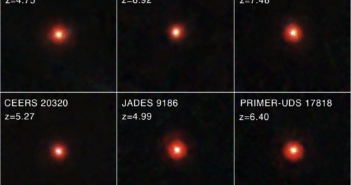
Six “little red dot” galaxies seen by JWST. [NASA, ESA, CSA, STScI, Dale Kocevski (Colby College)]

Using JWST, researchers have discovered more than 300 little red dots. Most of these galaxies are concentrated around when the universe was 600 million years old, though they’ve been spotted out to about 1.6 billion years after the Big Bang. But why do these galaxies look the way they do? Do they host enormous, active black holes, as many researchers suspect? Do they get their characteristic red color from a population of old, evolved stars? Or could rapid, dust-shrouded star formation be the cause?

A successful theory of little red dot identity must account for several observed properties: “V”-shaped spectra, broad H-alpha lines, and little or no emission at X-ray wavelengths. In a recent research article, Jillian Bellovary (Queensborough Community College; CUNY Graduate Center; American Museum of Natural History) has theorized that little red dots get their curious characteristics from stars being torn apart by a young and growing black hole.

A New Hypothesis

In this scenario, little red dots arise in the extremely dense star clusters created in the early universe. Because of their extraordinary density, these star clusters are vulnerable to gravitational collapse, causing the packed-together stars to crash into one another. The colliding stars combine to form a supermassive star that collapses, leaving behind an intermediate-mass black hole — a seed that could someday grow into a supermassive black hole.

Situated at the center of a dense star cluster, an intermediate-mass black hole would be poised to ensnare stars in its gravitational web, pulling the stars apart with its powerful tidal forces and stealing their mass. These star-shredding events are known as tidal disruption events.

predicted number density of intermediate-mass black holes and observed density of little red dots

Predicted number density of intermediate-mass black holes (blue and orange lines). The symbols show the observed number densities of little red dots as a function of redshift. [Bellovary 2025]

Simulations predict that in the era during which little red dots have been observed, a cubic megaparsec should contain about 0.3–1 intermediate-mass black holes. (These intermediate-mass black holes could arise through the cluster collapse scenario outlined above, or through other pathways like the collapse of the first stars in the universe.) Observations show roughly 10,000 fewer little red dots in this same volume.

Because tidal disruption events tend to remain bright for about a year, this implies that a tidal disruption event rate of one per 10,000 years is necessary for tidal disruption events to explain little red dots.

Matching Predictions

predicted tidal disruption event rates

Modeled tidal disruption event (TDE) rates for two different models and various values of velocity dispersion, σ, and stellar density, nstar. [Adapted from Bellovary 2025]

Using analytic and numerical models, Bellovary showed that this tidal disruption event rate is reasonable for intermediate-mass black holes with masses between 1,000 and 100,000 solar masses. But would tidal disruption events provide a match for other little red dot characteristics? Tidal disruption events tend to be faint at X-ray wavelengths and sport broad H-alpha lines, much like little red dots. Another plus is that unlike in the active black hole scenario, the H-alpha emission from a tidal disruption event doesn’t scale with the mass of the black hole; this means that black holes categorized as over-massive based on the strength of their H-alpha emission may not be over-massive after all. One drawback of the tidal disruption event scenario is that it doesn’t necessarily predict the characteristic red color of a little red dot; this color might come from the galaxy’s stars instead.

As Bellovary notes, little red dots could have multiple causes. Some might be due to tidal disruption events, while others could contain active black holes, ancient populations of red stars, or dusty starburst galaxies, as others have suggested.

To verify the tidal disruption event hypothesis, astronomers would need to find evidence for time variability at rest-frame ultraviolet wavelengths, as well as a characteristic decrease in brightness over time. These changes are expected to unfold over the course of years or decades, meaning that while observations may settle this question in due time, there will be plenty of time to ponder the mysteries of little red dots while we wait.

Citation

“Little Red Dots Are Tidal Disruption Events in Runaway-Collapsing Clusters,” Jillian Bellovary 2025 ApJL 984 L55. doi:10.3847/2041-8213/adce6c

globular cluster

JWST observations have begun uncovering some of the oldest star clusters in the universe, but their formation mechanisms are still uncertain. A recent study uses high-resolution simulations to understand early star formation and how local globular clusters may have originated. 

Supersonically Induced Gas Objects

Our leading cosmological model of the universe suggests that stars and galaxies coalesce within dark matter halos, eventually forming the larger structures we see today. However, some of the oldest astronomical objects in the universe — massive collections of stars called globular clusters — contain little to no dark matter, making their formation mechanisms somewhat mysterious. How do large clusters with thousands of stars form outside of dark matter halos?

supersonically induced gas objects

Visualizations of the gas density in the simulated star-forming regions in this study. Click to enlarge. [Lake et al 2025]

Recent studies have suggested that as the dark matter and baryons (i.e., normal matter) in the early universe began to clump together and form slightly denser areas, the pristine gas and dark matter began to move relative to one another. Baryons, still tightly coupled to photons, did not have the same freedom to collect in dense regions that the dark matter did, creating supersonic (about five times the speed of sound) relative motions that separated gas clumps and early dark matter halos. These separate, dark-matter-free gas clumps formed baryon-enriched structures known as supersonically induced gas objects.

Over the past decade, simulations and theory have shown that supersonically induced gas objects can form star clusters, which may be the origin story of many of the local globular clusters seen today. However, these simulations have been limited by their resolution. Unable to resolve individual star formation and not including key aspects like feedback, these simulations have left open questions about these dark-matter-free objects.  

High-Resolution Simulations

Seeking to more deeply understand supersonically induced gas objects, William Lake (University of California, Los Angeles; Dartmouth College) and collaborators perform high-resolution simulations that include detailed physics and can track the formation of individual stars. The simulations varied the metallicity and presence of protostellar jets, properties that are both known to impact the star formation process in gas clouds.

imf

Mass distribution for the stars formed in the simulated supersonically induced gas objects. The simulated clusters form more high-mass stars than what is seen in local star-forming regions. Click to enlarge. [Lake et al 2025]

From the simulations, the authors find that star formation occurs naturally in these early systems. Both feedback from jets and the metallicity of the gas affect star-formation outcomes — jets tend to have a minor impact on the star formation efficiency in low-metallicity clouds, but disruption from the jets can cause low-mass stars to form in metal-enriched systems. However, in general, the authors conclude that supersonically induced gas clouds tend to form higher-mass stars than local star clusters, which agrees with what is expected for the universe’s first stellar population. 

Given that these objects likely form very high-mass stars, these primordial star clusters will have extremely high stellar mass surface densities and brightnesses compared to what is observed locally. With such enhanced brightness, these objects may be bright enough for JWST to observe them. Further high-redshift observations of star clusters will allow for further constraints on the formation of the universe’s first stars and will yield more information about the possible origins of the globular clusters we see in the local universe.

Citation

“The Stellar Initial Mass Function of Early Dark Matter–Free Gas Objects,” William Lake et al 2025 ApJL 985 L6. doi:10.3847/2041-8213/add347

1 3 4 5 6 7 113