

The star HD 3167 made headlines when astronomers discovered that two of its planets have orbits that are perpendicular to one another. Does this extreme configuration hold up under further scrutiny?
Perpendicular Planets
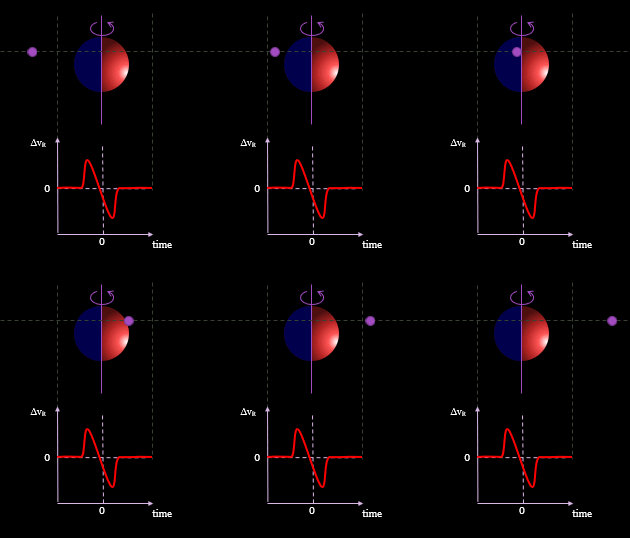
An animation of the Rossiter–McLaughlin effect. [Wikipedia user Amitchell125; CC BY-SA 4.0]

The strength of the observed RM signal depends on two factors: how quickly the star rotates and how tilted the planet’s orbit is relative to the host star’s spin. The signal will be largest for planets around fast-spinning stars and those with orbits aligned with their star’s equator. It will be smallest for planets around slowly spinning stars or those with orbits perpendicular to their star’s equator.
Measurements of the RM signal for HD 3167’s transiting planets revealed something unexpected: while the inner planet’s orbit is nearly equatorial — its projected tilt is just −6.6° — the outer planet’s orbit is almost fully perpendicular to it, with a projected tilt of −108.9°. This setup is at odds with previous observations, which have suggested that closely packed Earth-to-Neptune-sized planets around Sun-like stars have orbits that are, at most, mildly tilted relative to one another. If this result holds, it will require serious consideration of how these orbits could arise.
Preferring a Parallel (Possibly)
Joshua N. Winn (Princeton University) and collaborators investigated this issue by reexamining the orbit of the inner planet, HD 3167b. Because of HD 3167’s slow rotation and HD 3167b’s small size, measuring the planet’s RM signal is challenging. The team used three new transits observed with the Keck I telescope on Maunakea and two archival transits observed with the Echelle SPectrograph for Rocky Exoplanets and Stable Spectroscopic Observations (ESPRESSO). The previous low-tilt measurement for HD 3167b was based on an analysis of one ESPRESSO transit, while the other transit has not yet been analyzed in the literature.
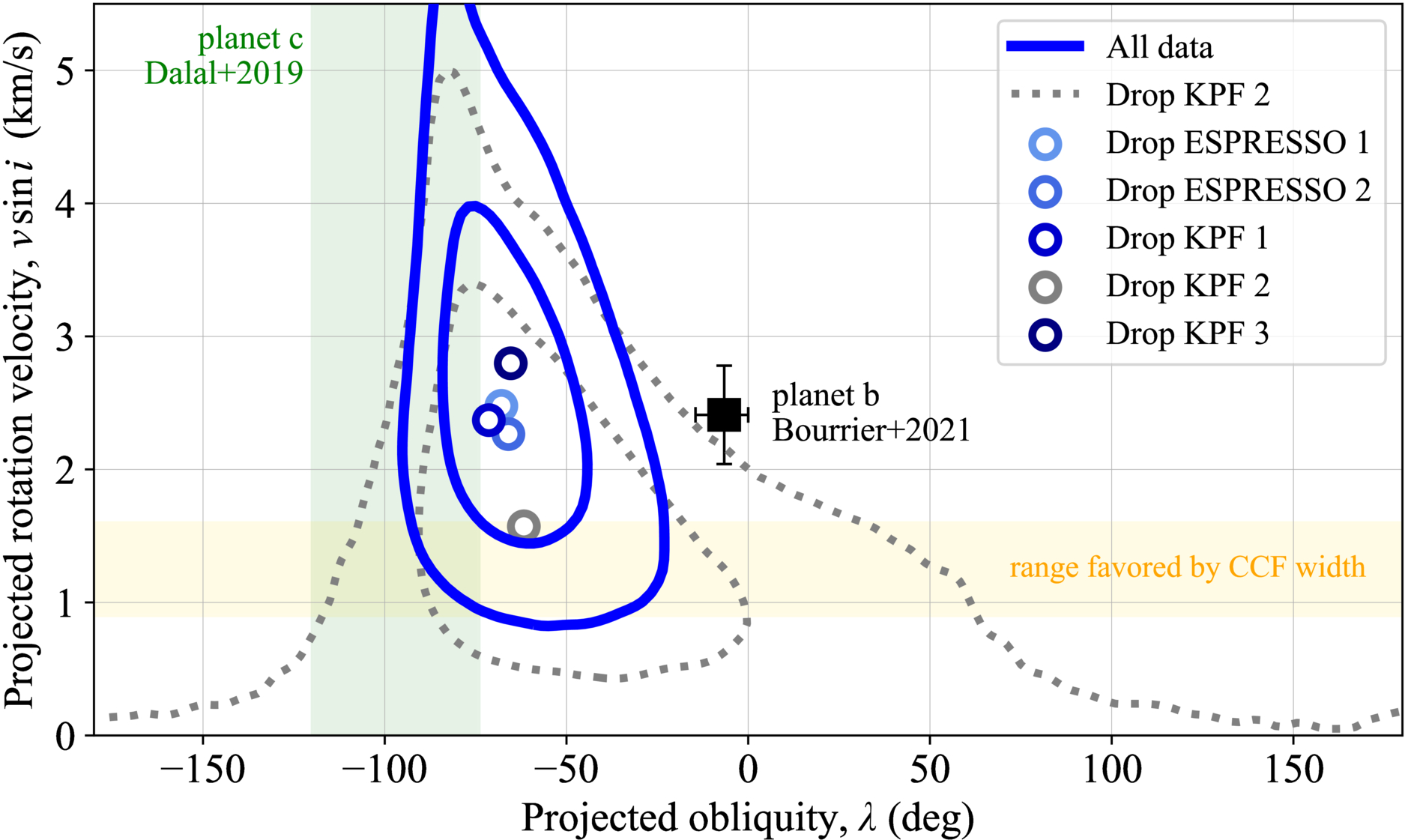
Probability density distribution for the star’s projected radial velocity, v sin i, and HD 3167b’s orbital tilt, λ. Removing the second Keck Planet Finder (KPF) transit from the analysis yields a v sin i that is in better agreement with other data, but it broadens the range of possible orbital tilts. Click to enlarge. [Winn et al. 2026]
While the best fit to the data suggests a tilt of −66° — greatly reducing the misalignment between HD 3167b and the outer transiting planet — the team was cautious of this result. One issue is that the star’s projected radial velocity suggested by the best-fit model is faster than what’s implied by HD 3167’s line widths. While removing the furthest outlier transit from the analysis yields a more reasonable radial velocity, it also broadens the range of possible orbital tilts.
Ultimately, Winn and collaborators concluded that the current data cannot constrain HD 3167b’s orbital tilt, leaving the (mis)alignment between the two transiting planets open to interpretation.
Citation
“Does HD 3167 Have Planets with Perpendicular Orbits?” Joshua N. Winn et al 2026 ApJL 1010 L22. doi:10.3847/2041-8213/aeab9d