
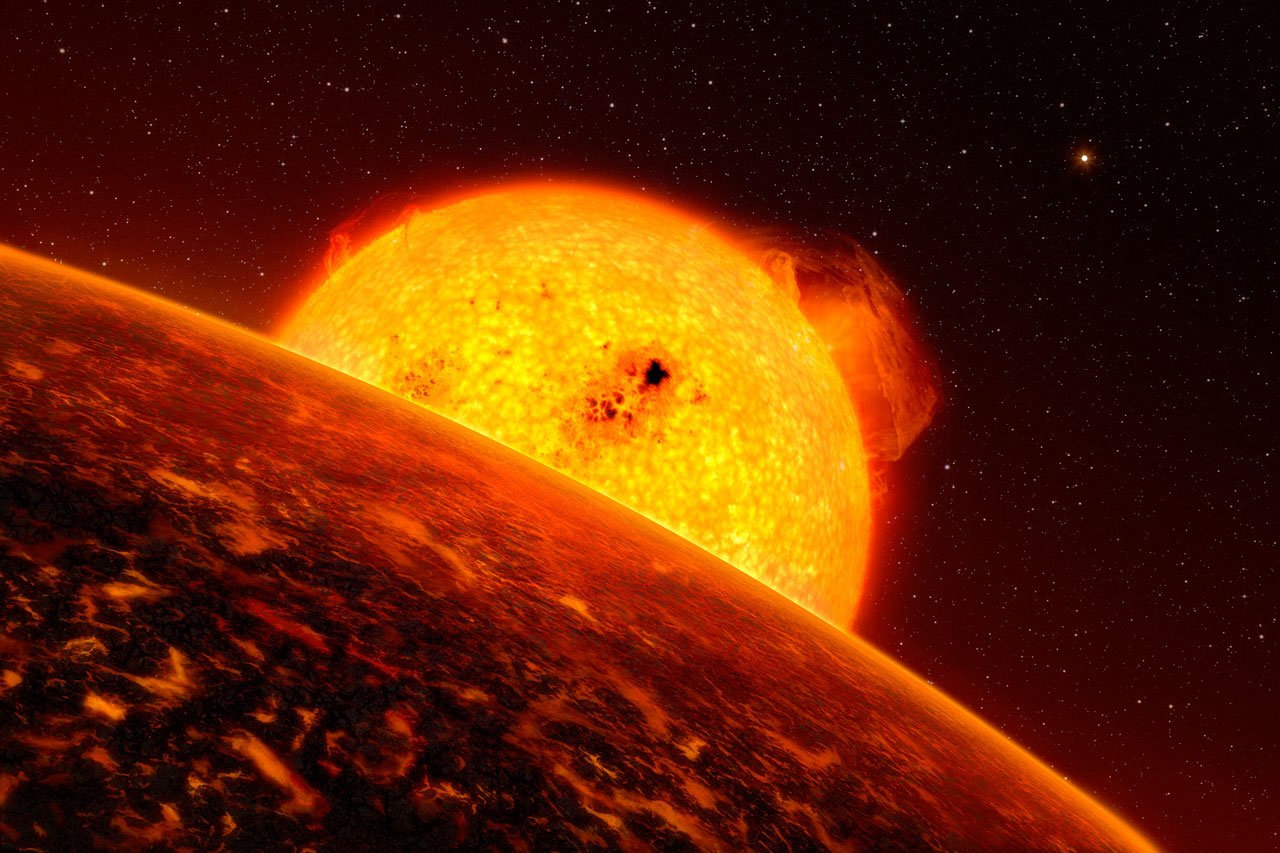
The Hubble Space Telescope has detected the secondary eclipse of a rocky exoplanet for the first time. These observations place constraints on the possible atmosphere of the lava world TOI-2431b.
Valuable Eclipses
Thousands of exoplanets have been discovered via the transit method, which captures the temporary dimming of a star’s light caused by a planet passing in front of a star from our perspective. Far fewer planets have been spotted passing behind their stars — what’s known as a secondary eclipse — creating a much subtler dip in the combined light from the star and the planet.
A planet’s secondary eclipse encodes valuable information about its dayside temperature, the reflectivity of its surface, and the properties of its atmosphere. Recently, Sebastian Zieba (Center for Astrophysics | Harvard & Smithsonian) and collaborators reported on Hubble Space Telescope observations of the extreme exoplanet TOI-2431b, marking the first time that Hubble has detected the secondary eclipse of a rocky exoplanet.
A First for Hubble
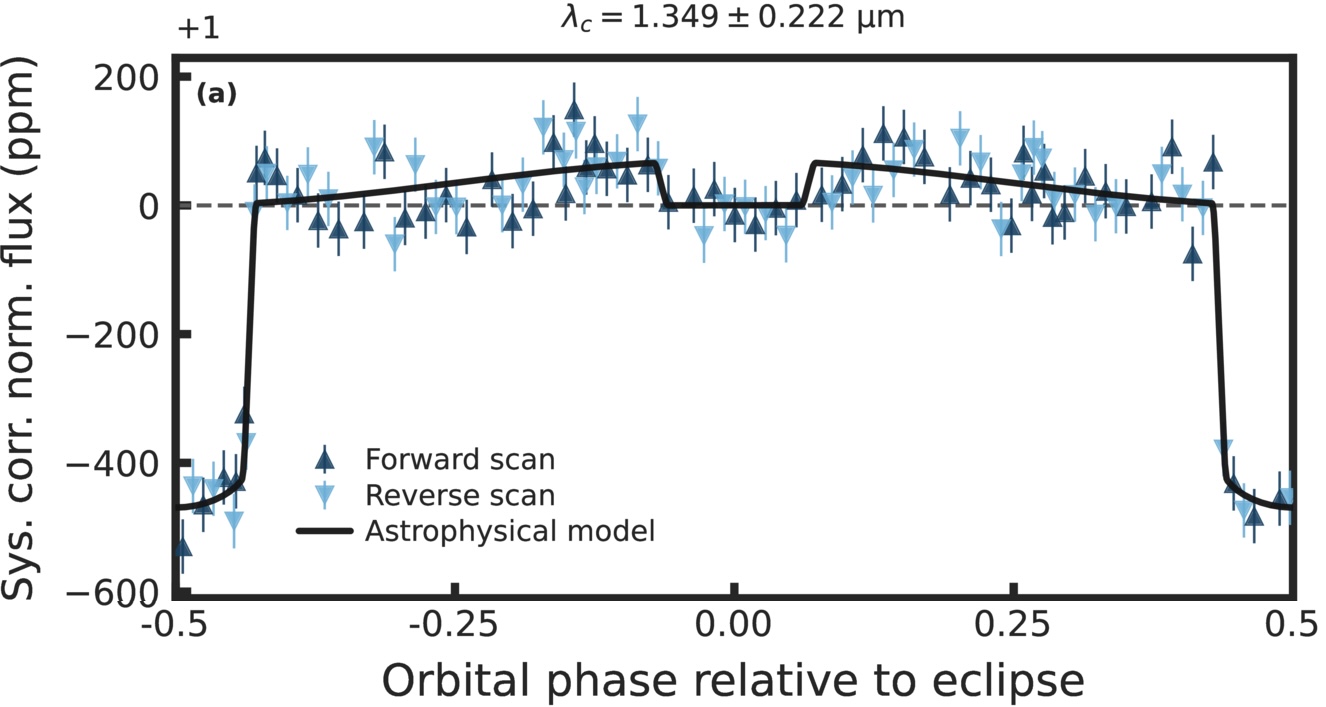
The combined light from TOI-2431b and its host star over all orbital phases. The secondary eclipse is located at 0.00. Click to enlarge. [Adapted from Zieba et al. 2026]
These planets orbit their host stars so closely that searing radiation and stellar winds have long since stripped away their primordial atmospheres, but observations have demonstrated that these planets can have atmospheres — albeit deeply un-Earth-like ones composed of superheated rock vapor.
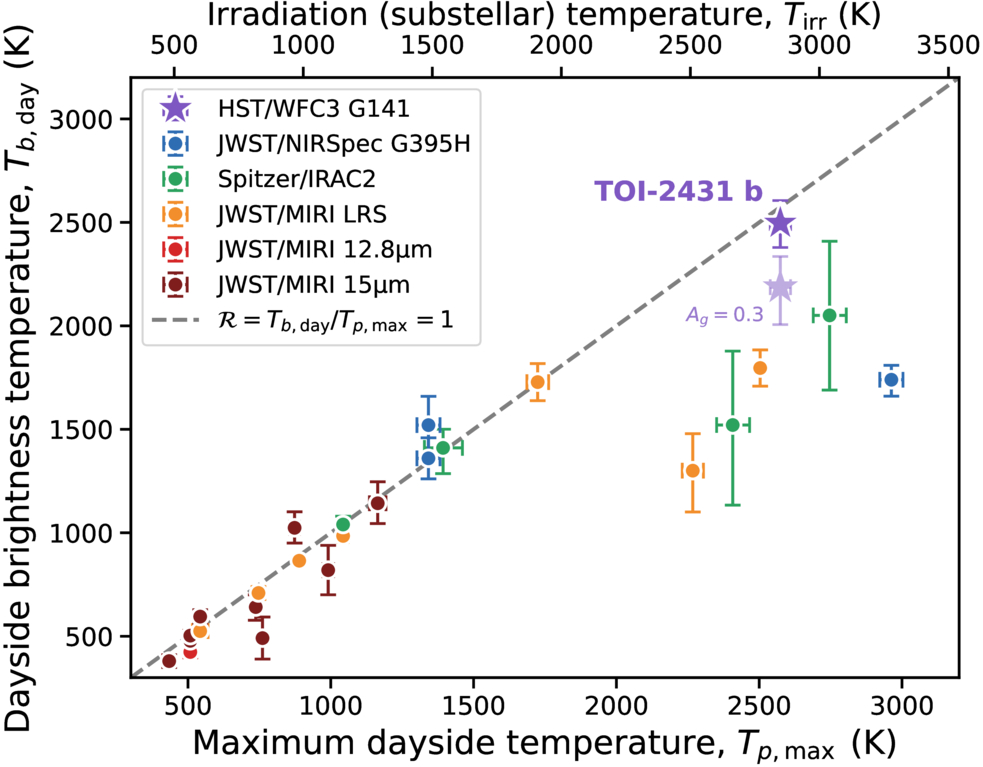
TOI-2431b (purple star) stands out from other lava worlds in terms of its dayside brightness temperature. The light purple star shows the estimated dayside temperature for an arbitrary nonzero albedo. [Zieba et al. 2026]
Atmosphere or Not?
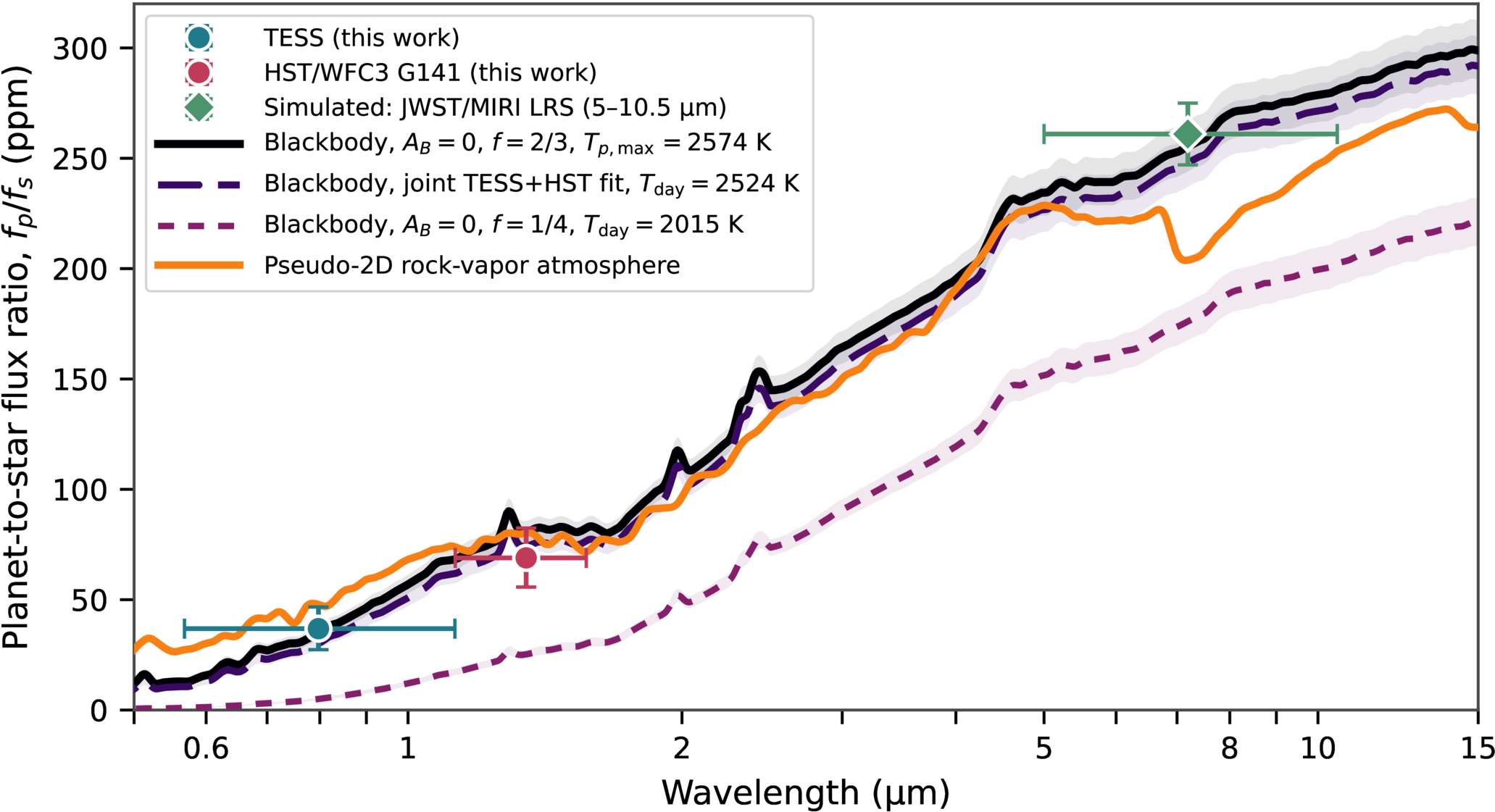
Modeled optical-to-infrared emission spectrum of TOI-2431b. The no-atmosphere and rock-vapor atmosphere models are indistinguishable with current Hubble and TESS data (red and blue circles) but may be distinguishable with JWST (simulated observation plotted with a green diamond). Click to enlarge. [Zieba et al. 2026]
While the current data are consistent with TOI-2431b having no atmosphere, JWST will push our observations into the wavelength realm in which a possible rock-vapor atmosphere could be detected. This work represents an exciting first for Hubble, demonstrating its ability to place constraints on hot rocky planets and setting the stage for further insights from JWST.
Citation
“The First Hubble Detection of a Secondary Eclipse from a Rocky Exoplanet: The 5.4 hr Planet TOI-2431 b,” Sebastian Zieba et al 2026 ApJL 1011 L32. doi:10.3847/2041-8213/aeb4ab