
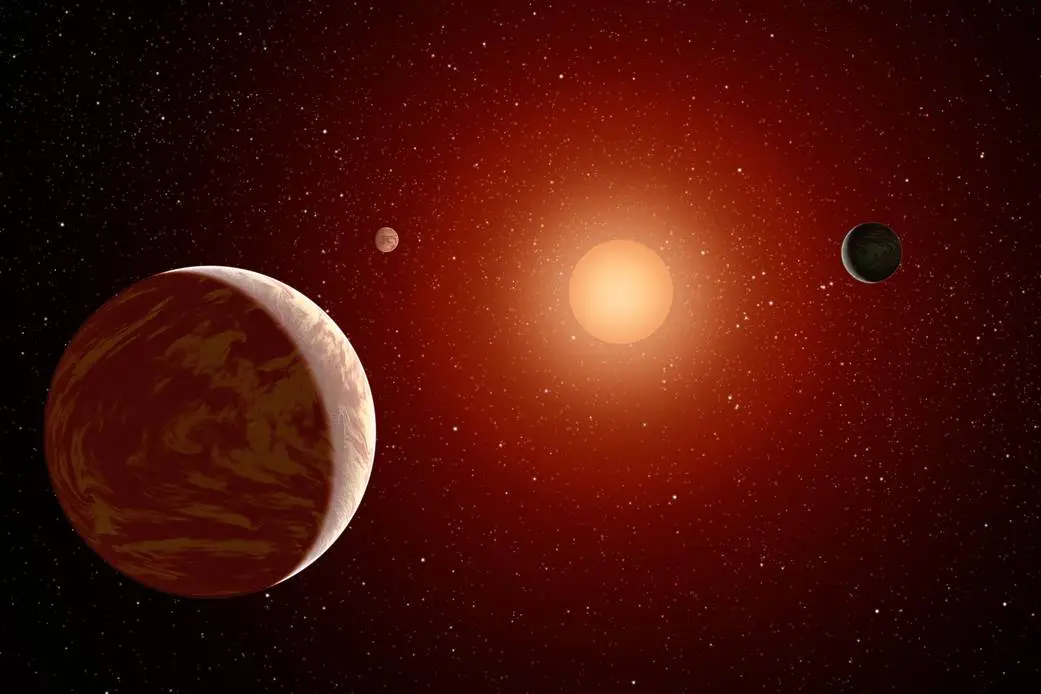
While our solar system sports one Jupiter-like planet, exoplanet discoveries have revealed that giant planets come in a few different forms in systems with varying architectures. A recent study has explored how the mass–eccentricity relationship in warm Jupiters is shaped by dynamical interactions between planets.
Jupiter-like Planet Eccentricities
Exoplanet surveys have uncovered three different Jupiter-like planet populations across the galaxy: hot, warm, and cold Jupiters. Much like our own, cold Jupiters orbit on long periods, far away from their host stars. Conversely, hot Jupiters zip around their host stars on extremely short-period orbits. Somewhere in between, warm Jupiters orbit their host stars with periods from 10 to 365 days.
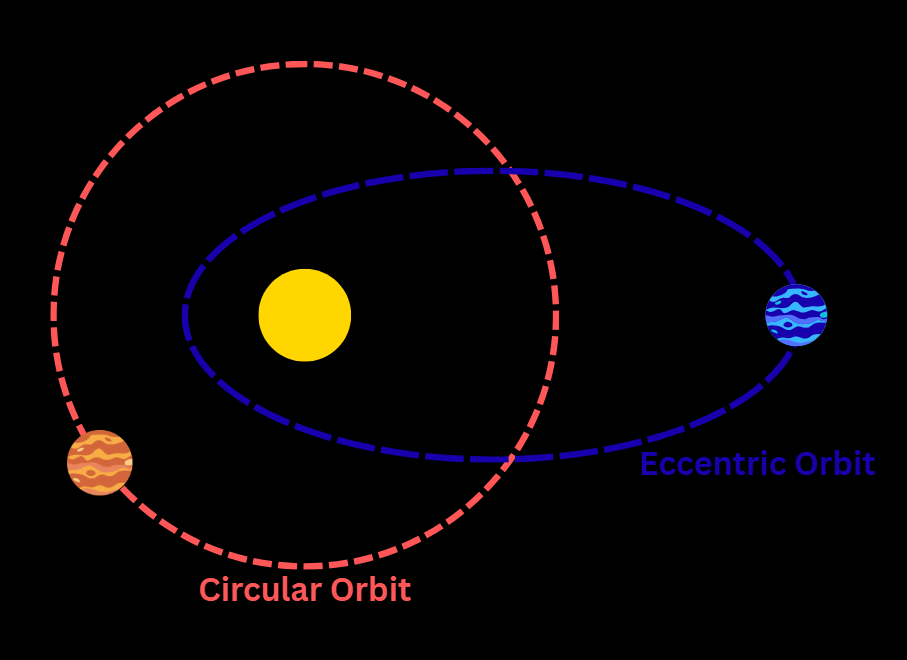
Diagram showing examples of a circular and an eccentric orbit. Click to enlarge. [AAS Nova/Lexi Gault]
Does this relationship extend to shorter-period giant planets as well? Hot Jupiters are heavily impacted by tidal interactions with their host stars, circularizing their orbits and erasing dynamical imprints on their eccentricities. Warm Jupiters, on the other hand, orbit far enough away for their eccentricities to preserve clues about their energetic histories. Recently, thanks to the Transiting Exoplanet Survey Satellite (TESS), astronomers have identified a positive correlation between planetary mass and eccentricity in a growing sample of warm Jupiters, but the exact driver of this trend has yet to be uncovered.
Planets Scattering Planets
To test if the positive mass–eccentricity correlation in warm Jupiters is consistent with planet–planet scattering, Jiayin Dong (University of Illinois at Urbana-Champaign) constructed a sample of 85 warm Jupiters from the NASA Exoplanet Archive. This carefully selected sample, dominated by discoveries from TESS and Kepler, included planets with masses between 0.3 and 15 Jupiter masses and orbital periods between 10 and 365 days. In conjunction with this sample, the authors built a planet–planet scattering framework to assess the range of properties anticipated for scattered warm Jupiter systems.
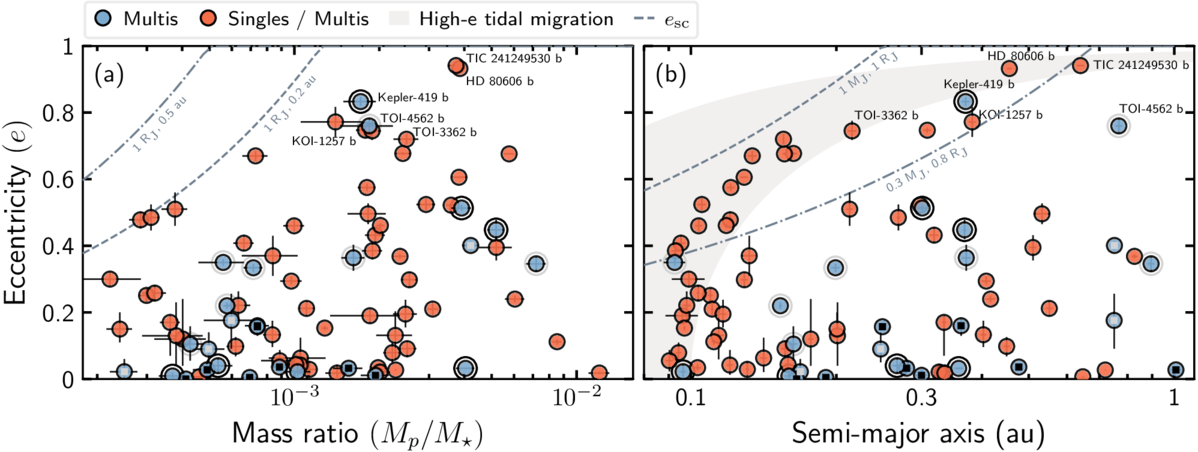
Warm Jupiter eccentricity versus planet–star mass ratio (left) and semimajor axis (right). Click to enlarge. [Dong et al 2026]
The mass–eccentricity relation of warm Jupiters, the authors suggested, represents a transition from collision-dominated interactions among low-mass planets to ejection-dominated interactions among high-mass planets. For massive enough systems, scattering can excite eccentricities high enough to trigger the high-eccentricity migration responsible for moving hot Jupiters to their close-in orbits. Overall, this study suggests that warm Jupiters are not a distinct planet species, but instead may represent the shorter-period counterparts of cold Jupiters whose orbits are shaped by the same dynamical processes. Future observations expanding the sample of warm Jupiters and discoveries of additional planet companions will further uncover the links between hot, warm, and cold Jupiter systems.
Citation
“Planet–Planet Scattering Explains the Mass–Eccentricity Relation of Warm Jupiters,” Jiayin Dong et al 2026 ApJL 1007 L29. doi:10.3847/2041-8213/ae930e