
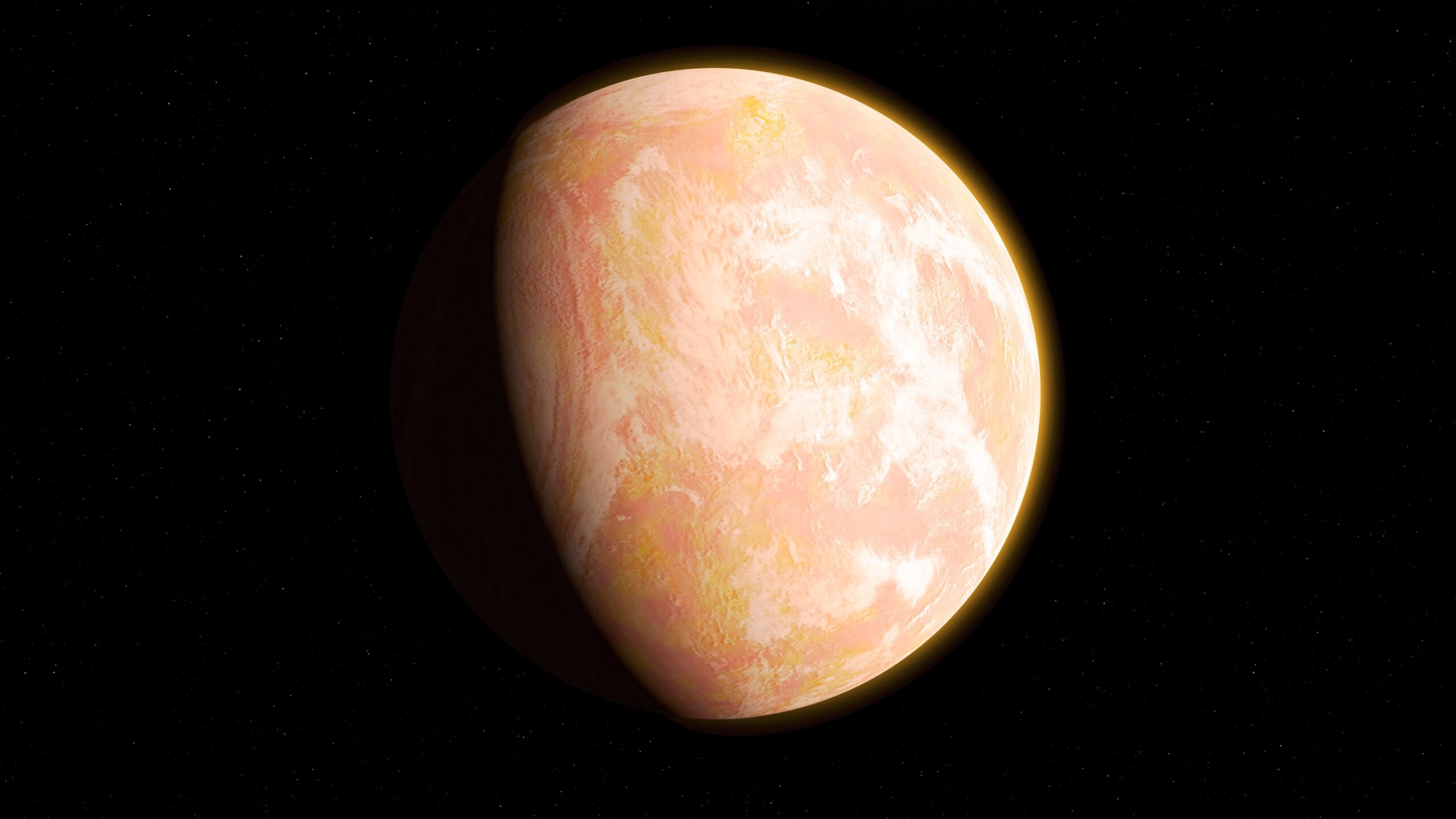
Editor’s Note: Astrobites is a graduate-student-run organization that digests astrophysical literature for undergraduate students. As part of the partnership between the AAS and astrobites, we occasionally repost astrobites content here at AAS Nova. We hope you enjoy this post from astrobites; the original can be viewed at astrobites.org.
Title: Ultraviolet-Driven Atmospheric Degeneracies Challenge Conventional Biosignature Frameworks for Terrestrial Planets with Ultracool M Dwarf Hosts: An Archean-Analog TRAPPIST-1e Case Study
Authors: Evan L. Sneed et al.
First Author’s Institution: University of California, Riverside
Status: Accepted to ApJ
Planets have been found around stars of all sizes, from hot and bright O and B stars to small and dim M-dwarf stars. But just because planets are found around these stars doesn’t mean they have conditions suitable for life. A host star’s properties have a fundamental impact on a planet’s ability to host life. O and B stars are so hot and bright that they only last a few million years, not quite long enough for life to evolve (life on Earth took at least a couple hundred million years to start). In contrast, M-dwarf stars are cool and long-lived, and they are so faint that their habitable zones, defined as the distance from the star at which the temperature is just right for liquid water to exist on a planet’s surface, are very close to the star. At first glance, being closer to the star might seem beneficial for habitability, but unfortunately, unlike stars like our Sun, M-dwarf stars have much more active lifestyles, with frequent powerful flares and prolonged X-ray and ultraviolet emission. These processes strip away planetary atmospheres and sterilize surfaces, possibly preventing life from ever evolving in the first place.
M-dwarf stars are still of great interest in the search for life, however, because they are the most common type of star in the galaxy. In particular, the planetary system TRAPPIST-1 has been instrumental in the search for life in these stellar environments. TRAPPIST-1 is a nearby M-dwarf star hosting an astonishing seven (possibly rocky) planets, three or four of which are in the habitable zone. But could the flares and high-energy emission from TRAPPIST-1 prevent life from evolving on these planets at all? The authors of today’s article set out to determine how uncertainties in the high-energy emission from TRAPPIST-1 affect our understanding of the atmospheric chemistry on its planets, and what this means for our ability to detect life on these planets.
Know Thy Star
The authors use TRAPPIST-1e as a case study to explore the impact of TRAPPIST-1’s high-energy radiation on the atmospheres of its planets. Instead of simulating an Earth-like atmosphere around TRAPPIST-1e, the authors choose to simulate an Archean Earth atmosphere. The Archean Eon occurred from about 4.5 to 2.5 billion years ago and is widely thought to represent the time period on Earth when microbial life first evolved. Earth’s atmosphere during this time had a much higher concentration of carbon dioxide and little oxygen. Methane would have been much more abundant as a product from microbial life. Nitrogen, on the other hand, would have been only as abundant, if not less abundant, than it is in Earth’s atmosphere today. (For reference, our atmosphere today is made up of 78% nitrogen and about 20% oxygen with trace amounts of carbon dioxide.) The authors choose to simulate this type of atmosphere because 1) the Archean Earth represents a transition in Earth’s history from a lifeless world to life playing a major role in our atmospheric composition, and 2) it provides an example of a habitable environment that differs substantially from modern life here on Earth.
The authors use four different models of TRAPPIST-1’s X-ray and ultraviolet emission as inputs to atmospheric models of an Archean-like TRAPPIST-1e along with one solar model for control. This is to understand how different stellar models can affect the overall atmospheric photochemistry (chemistry in the atmosphere caused by the absorption of starlight). Figure 1 shows the stellar models and the wavelengths of light that are absorbed by molecules in the planet’s atmosphere.
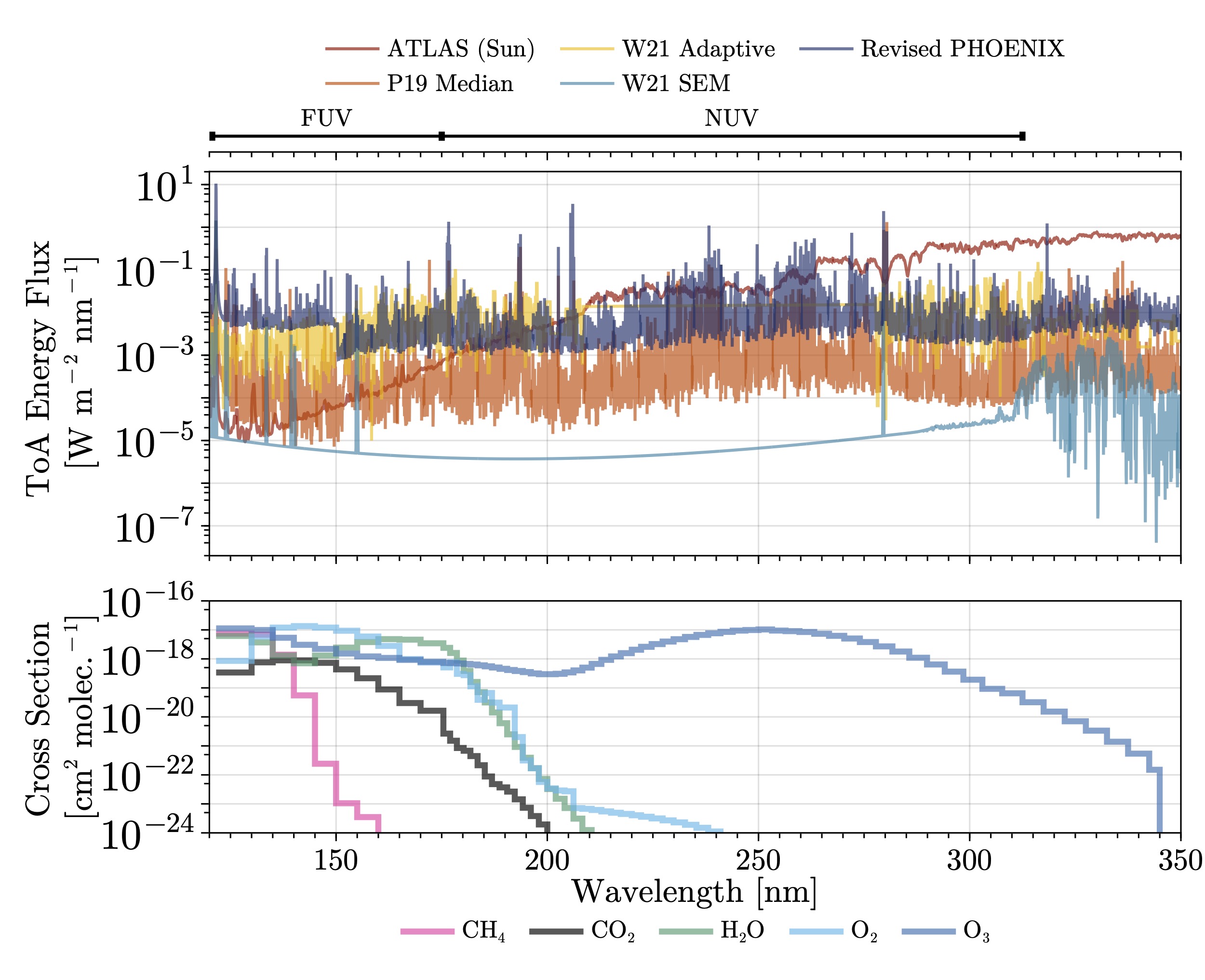
Figure 1: The top panel of the graph shows four different models of TRAPPIST-1’s ultraviolet emission used in this study along with a model for the Sun (red). The y-axis of that plot is total flux and the x-axis is wavelength in nanometers. Different assumptions and ways of modeling stellar emission result in different values for the star’s total ultraviolet emission. The bottom panel shows the main atmospheric molecules in an Archean atmosphere and where in the ultraviolet wavelength range these molecules absorb stellar light. The y-axis of that plot is the cross section of the molecule and the x-axis is wavelength in nanometers. It’s important to note where the molecules overlap as this means the emission at that wavelength impacts the chemistry of more molecules in the atmosphere. [Sneed et al., in press]
Know Thy Life
After computing the stellar flux and the associated uncertainties of each model, the authors construct 1D atmospheric models using the mass and radius of TRAPPIST-1e and the composition of Archean Earth. The models are broken down into two main classes: biotic and abiotic. To distinguish between a planet that has life (the biotic case) and one that does not (the abiotic case), the authors use a parameter called the dry deposition velocity. This velocity determines how much atmospheric gas is removed at the planet’s surface before the remaining gas returns to the atmosphere. Microbial life on the surface will consume more carbon monoxide, hydrogen, and oxygen in the atmosphere than a planet with no life on the surface. Thus, the dry deposition velocity will increase in the biotic case as there is a stronger exchange of molecules between the surface and the atmosphere than in the abiotic case.
After generating these atmospheric models, the authors use the resulting concentrations of molecules to simulate transmission spectra of the planet to understand how astronomers would see these differences observationally. The resulting concentrations are shown in Figure 2 for both the biotic atmosphere and the abiotic atmosphere. The presence of methane (CH4) and ozone (O3) together is thought to be an atmospheric biosignature, as these molecules typically destroy each other in chemical reactions. A high concentration of both suggests life on the surface is actively replenishing both molecules.
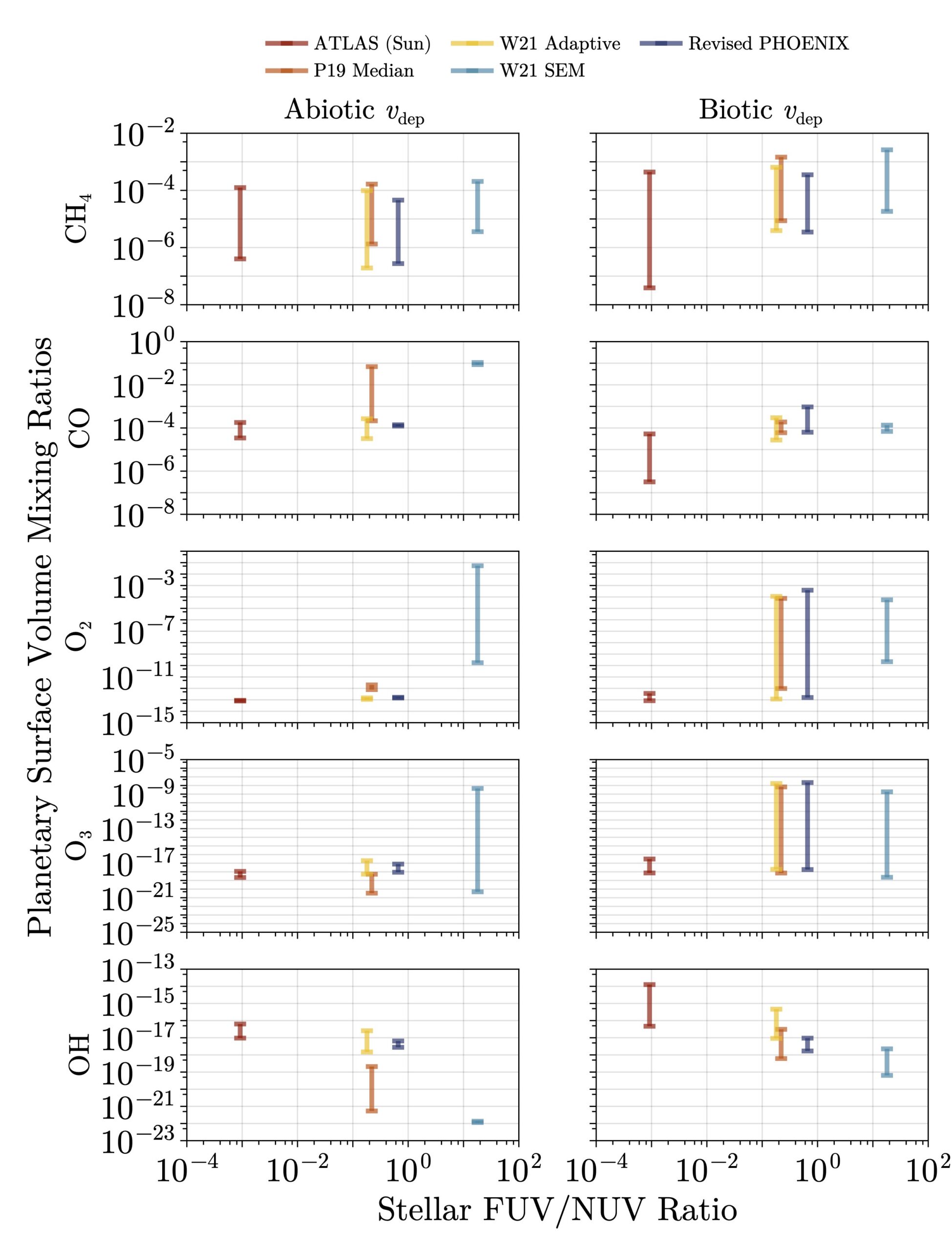
Figure 2: This figure depicts the differences in how much of a molecule is present in an atmosphere based upon the ultraviolet emission from a host star and the dry deposition velocity. The far-ultraviolet/near-ultraviolet (FUV/NUV) ratio on the x-axis represents how much of the stellar ultraviolet emission is from the far-ultraviolet regime (higher in energy) relative to the near-ultraviolet regime (lower in energy). Each stellar model is represented in a different color. [Sneed et al., in press]
Original astrobite edited by Niloofar Sharei.
About the author, Kaz Gary:
I am a fifth-year PhD candidate at The Ohio State University with a passion for planets. My current work focuses on modeling exoplanet observations for the Habitable Worlds Observatory and understanding planetary atmospheres. Outside of research, I help develop planetarium shows and love all forms of science communication. In my free time, I enjoy playing tabletop RPGs, painting, watching terrible reality TV, and hanging out with my pet hedgehog.