
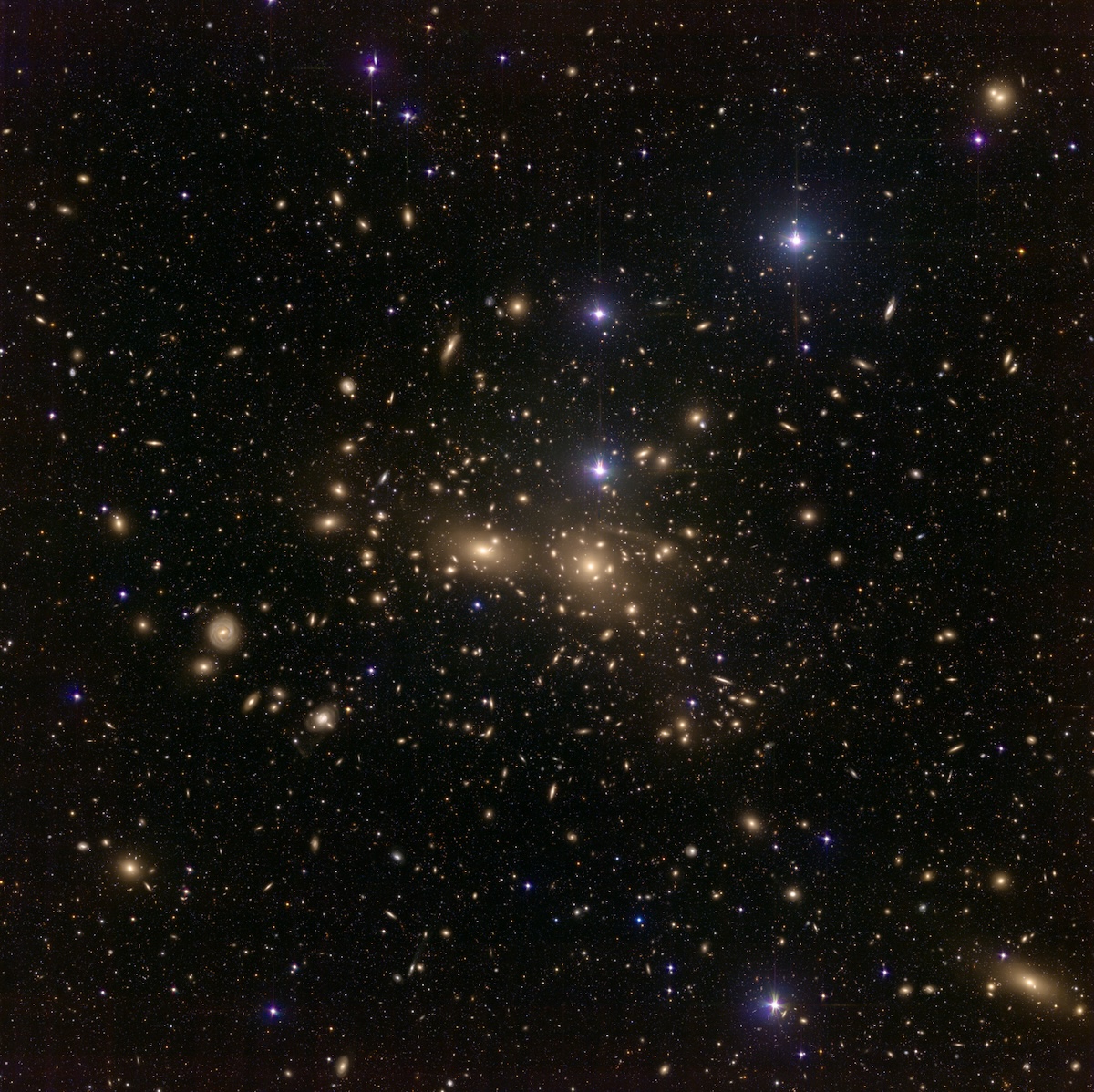
This image shows the Coma Cluster, a collection of thousands of galaxies located roughly 320 million light-years away. Using the 2.1-meter Fraunhofer Wendelstein Telescope, Raphael Zöller (Ludwig Maximilian University of Munich; Max Planck Institute for Extraterrestrial Physics) and collaborators observed the Coma Cluster to determine its galaxy luminosity function, or the distribution of galaxies at different luminosities within the cluster. This function is crucial for studies ranging from galaxy evolution to cosmology, but determining it is challenging; ruling out contamination from foreground and background sources and identifying faint galaxies both require visual inspection of the data. Zöller and coauthors identified more than 6,000 cluster member candidates and successfully determined the galaxy luminosity function, thanks in part to their method for automating the identification of dwarf galaxy members of the cluster — an advancement necessary for the upcoming deluge of survey data, which will be too vast to assess by eye. To learn more about the findings of this survey, be sure to check out the full research article linked below.
Citation
“Galaxy Luminosity Function of the Coma Cluster from Deep u’ − g’ − r’ Wendelstein Imaging Data,” Raphael Zöller et al 2026 ApJ 1011 177. doi:10.3847/1538-4357/aeb026