
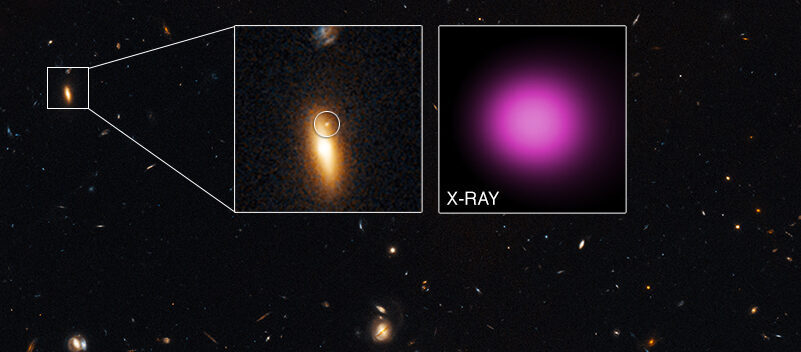
Most galaxies are thought to contain at least one massive black hole, but how absolute is this association, really — and what can it tell us about galactic evolution?
Is There Anybody Home?
Massive black holes are everywhere. Well, not quite everywhere — but they are almost always found lurking deep within galaxies. The reason for this is somewhat straightforward: black holes can form in the early universe, and the repeated black hole mergers that occur as galaxies collide and grow over billions of years inevitably lead to some of these black holes ballooning to massive or supermassive status.
The ubiquity of massive black holes is quantified by the black hole occupation fraction (BHOF), a number that represents the fraction of all galaxies that contain at least one such object. For high-mass galaxies, determining the BHOF is relatively straightforward. In these systems, central black holes can have significant dynamical effects that enable direct detections, and observational evidence suggests that the BHOF is close to 1. When it comes to lower-mass galaxies, however, the BHOF is harder to measure. Black holes in lower-mass galaxies often cannot accrete enough material to form bright accretion disks or noticeably disrupt visible matter and stars, making it difficult to determine whether the BHOF stays close to unity across all galaxy masses.
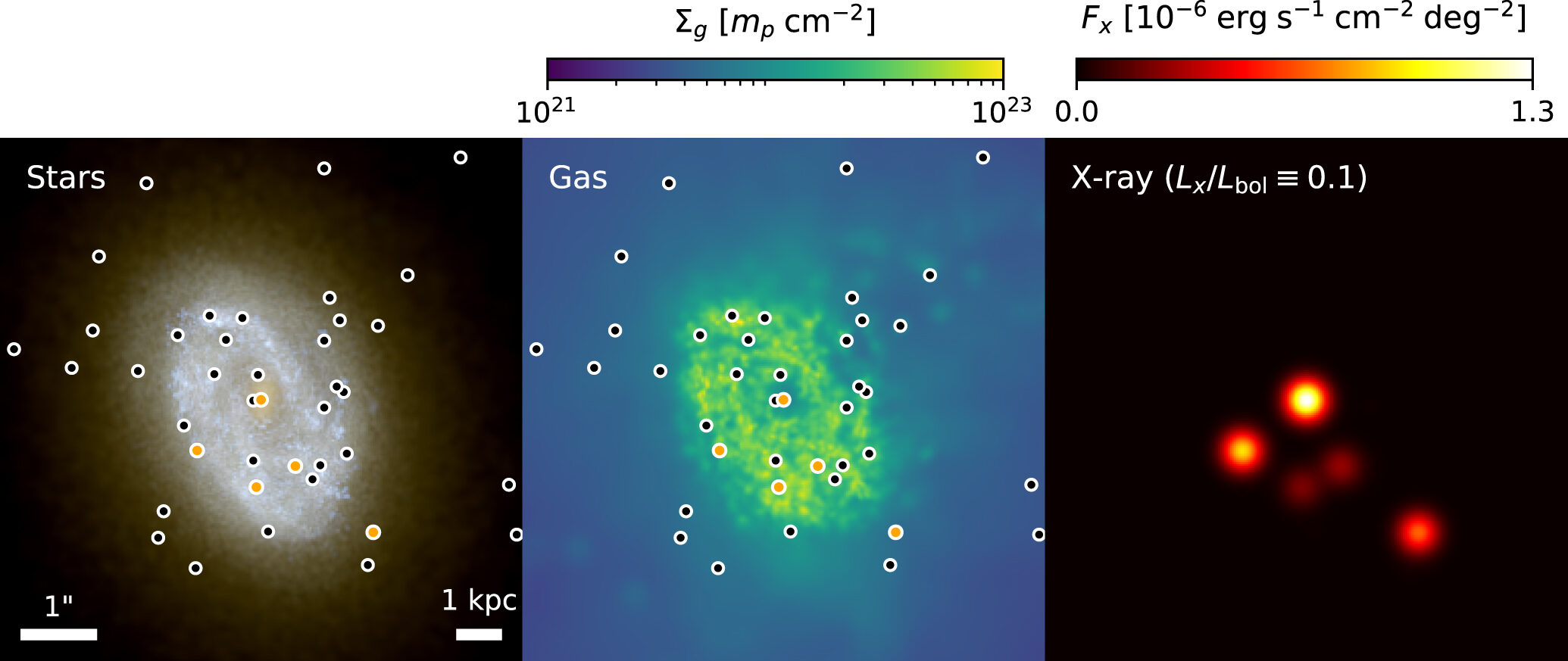
Galaxies are typically expected to contain at least one if not dozens of massive black holes (black and yellow circles). Their individual positions and electromagnetic signatures can vary greatly in different galaxies, however, as demonstrated by this simulated galaxy. [Ricarte et al. 2021]
Location, Location, Location!
Weller and collaborators utilized ASTRID, a high-resolution cosmological simulation that includes a sophisticated prescription for seeding and evolving black holes. Unlike in some other cosmological simulations, when massive black holes are formed they are not simply forced to sit at the centers of their host galaxies. Rather, perturbations from mergers and interactions with other black holes can displace them, creating two classes of massive black holes: central and wandering — where wandering black holes are any that sit in the outer half of their host galaxies. The simulation is also able to determine when a black hole undergoes significant accretion.
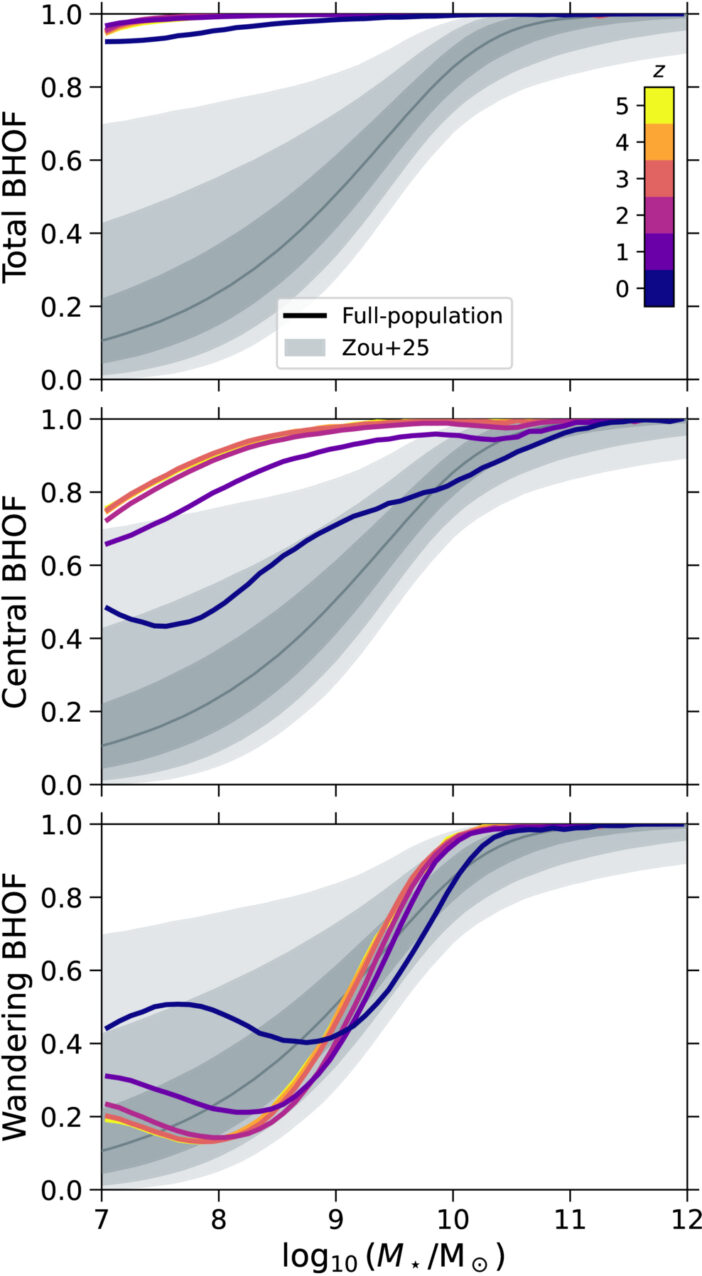
The total, central, and wandering BHOF (colored lines) for galaxies of various masses found in the ASTRID simulation. Recent constraints on the BHOF from Zou et al. 2025 are overlaid in gray. [Weller et al. 2026]
Weller and collaborators additionally found that the BHOF for strongly accreting black holes was much smaller than the total BHOF, especially after cosmic noon where galactic growth slows. As with the trends in wandering versus central black holes, this finding highlights the need for nuanced interpretations of observational constraints on the BHOF, as the location, activity, and overall observability of massive black holes can vary significantly depending on their galactic environment, merger history, and age.
Citation
“The Black Hole Occupation Fraction as a Fossil Record of Seeding, Dynamics, and Galaxy Assembly,” Emma Jane Weller et al 2026 ApJL 1008 L54. https://doi.org/10.3847/2041-8213/ae9c38