
Editor’s Note: Astrobites is a graduate-student-run organization that digests astrophysical literature for undergraduate students. As part of the partnership between the AAS and astrobites, we occasionally repost astrobites content here at AAS Nova. We hope you enjoy this post from astrobites; the original can be viewed at astrobites.org.
Title: Tracing Black Hole and Galaxy Growth Across Environments Since Cosmic Noon
Authors: Emma Jane Weller et al.
First Author’s Institution: Yale University
Status: Published in ApJ
They say you can’t choose your hometown, but it still ends up shaping who you become. Turns out the same is true for black holes. The galaxy a black hole grows up in will have a major impact on how it will live out the rest of its life. Similarly, the black hole can leave a lasting impression on its galaxy!
Astronomers have long known that a galaxy’s stellar mass (the combined mass of all its stars) tracks pretty tightly with the mass of the black hole sitting at its centre: bigger galaxy, bigger black hole. This is one pillar of the idea that galaxies and their central black holes coevolve; that is, their life stories are tangled up with one another from early on. But ever since JWST started spotting suspiciously large black holes in the early universe, astronomers have been debating whether this relationship holds steady across cosmic time, or whether the rules were different when the universe and everything in it was younger.
Not Everyone Stays in the Town Centre
Most previous studies of the relationship between black holes and their galaxies have focused only on the central black hole: the biggest, most famous resident of a galaxy, sitting right downtown at its centre. That’s a reasonable place to start, since the central black hole is usually the most massive one around and tends to dominate the story. But this article’s authors wanted to know what happens to everyone else in town, too!
That includes satellite black holes, which are the central black holes of smaller “satellite” galaxies that orbit a bigger “primary” galaxy, a bit like a small town around a big city. It also includes a stranger, more recently discovered population: wandering black holes. These are the black hole equivalent of someone whose hometown got swallowed up by an expanding metropolis, and who never quite settled into their new surroundings.
Here’s how it happens: when a small satellite galaxy merges with a larger one, the satellite gets torn apart by tidal forces and its gas and stars are stripped away. However, its central black hole is often left behind, drifting through the new, much bigger galaxy on a wide orbit. The process that would normally drag a black hole down to the centre of a galaxy, called dynamical friction, is painfully slow, so wanderers can spend billions of years roaming the outskirts.
Two Cities, Two Sets of Rules
To study how these different black hole “life paths” shape, and are shaped by, their host galaxies, the authors turned to two cosmological simulations, ASTRID and TNG300, which handle black hole physics quite differently.
In TNG300, black holes are assumed to start fairly massive and are snapped straight to the centre of their host galaxy at every timestep. This makes mergers happen quickly and often, but it also means there’s no such thing as a wandering black hole in TNG300.
ASTRID, on the other hand, seeds smaller black holes and lets them move more realistically through their galaxy using a subgrid dynamical friction model. This is what allows wandering black holes, with their slow, aimless orbits, to exist and be studied in the first place.
Figure 1 reveals a lot at once. First, ASTRID (the simulation that allows wandering black holes and tidally stripped satellites) has whole new neighbourhoods on the map that simply don’t exist in TNG300. Those populations clearly aren’t following the same tidy, linear coevolution that central black holes enjoy with their galaxies. Second, the most massive black holes tend to be the most yellow, meaning mergers did the heavy lifting for their growth. This is especially pronounced in TNG300, where roughly 80–90% of the growth of the most massive black holes comes from mergers. Meanwhile, the wanderers and stripped satellites sit at the deep-purple end: these black holes have barely merged with anyone at all.
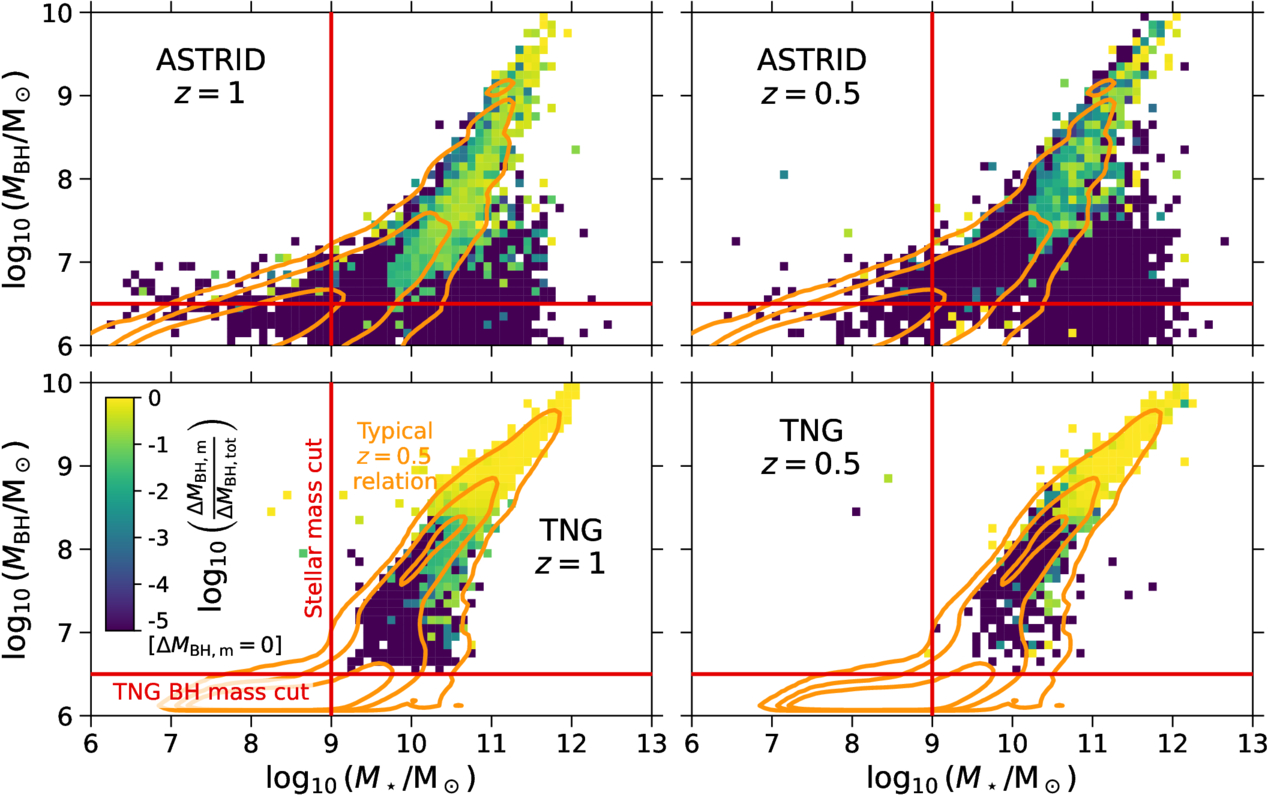
Figure 1: How black hole mass relates to host galaxy stellar mass, shown at two snapshots in cosmic history, 8 and 5 billion years ago, for both simulations (ASTRID: top row; TNG300: bottom row). Colour shows what fraction of each black hole’s growth since the last snapshot came from mergers, from purple (grown almost entirely by slowly swallowing gas) to yellow (grown mostly by swallowing other black holes). [Weller et al. 2026]
Four Kinds of Black Hole Life Stories
Pulling all of this together, the authors sketch out a kind of “neighborhood map” of black hole fates, sorted by where a black hole ends up on the mass-relation plot and how it got there (see Figure 2).
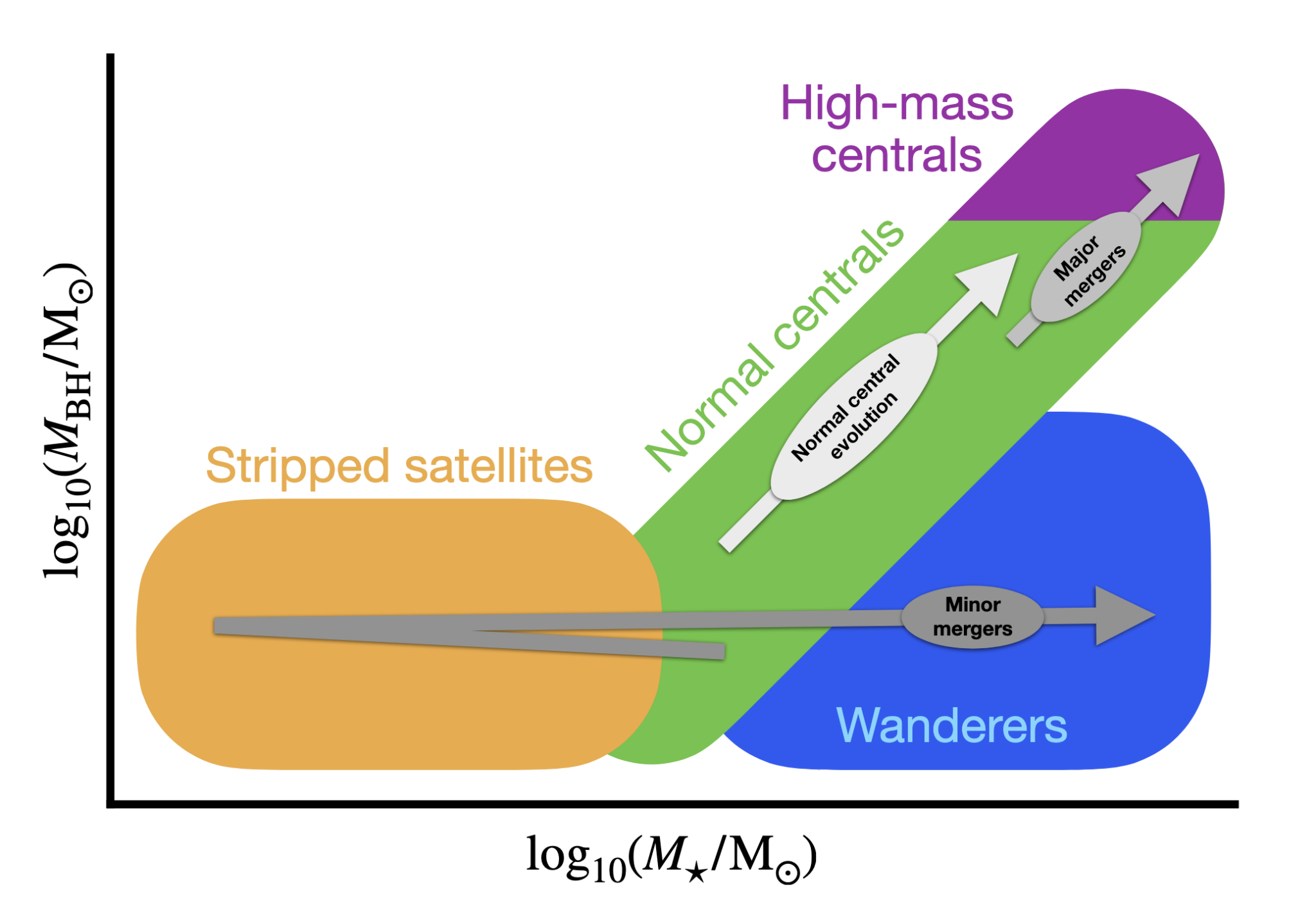
Figure 2: The distinct black hole populations revealed by the black hole mass–stellar mass relation, and the evolutionary path that lands each population in its corner of the map. [Weller et al. 2026]
- Normal centrals are the homebodies. They sit at the centre of primary or satellite galaxies and grow up steadily alongside their hometown, climbing the mass relation together through a healthy mix of accretion and the occasional merger. Their galaxies keep forming stars the whole time in a functional, unremarkable, thoroughly nice place to live.
- High-mass centrals are the ones who “made it.” These are central black holes in big primary galaxies, and their growth comes overwhelmingly from mergers with other black holes. Once they get big enough, they start throwing their weight around: their jets blast gas out of the galaxy, shutting down both star formation and their own further growth.
- Stripped satellites are the annexed suburbs. They start out on the normal mass relation, but a merger with a bigger galaxy tears away their gas and stars, shrinking their stellar mass while their black hole is left comparatively overweight for its new, smaller home. With their gas reserves gone, star formation grinds to a halt, and their black holes, starved of fuel, barely grow either.
- Wanderers are the ones who moved to the big city and never quite settled in. They start out on the normal relation inside a satellite galaxy, but when that galaxy merges into something much bigger, they’re left drifting through unfamiliar, low-density territory. With little gas around to feed on and almost no chance of merging with anyone else, their growth basically stalls.
This four-way map is a genuinely useful new way to read the black hole–galaxy relation: a black hole’s exact position on the plot isn’t just a number, it’s a fossil record of everywhere it’s ever “lived.”
There’s plenty more in the article we haven’t covered here, including how quenching plays out over time, how these results stack up against the local universe, and a closer look at how star formation rates and black hole accretion rates track each other across all four populations. If any of this piqued your interest, the full article is well worth a read.
Original astrobite edited by Ryan White and Chloe Klare.
About the author, Jayde Willingham:
I am a first-year PhD student at Swinburne University of Technology studying the early universe and how the first galaxies came to be. My work combines observations and theoretical modelling to explore how galaxies form, evolve, and shape the universe we see today. When I’m not at my desk or doing SciComm, I’m probably reading a good book with a hot beverage under a cozy blanket.