
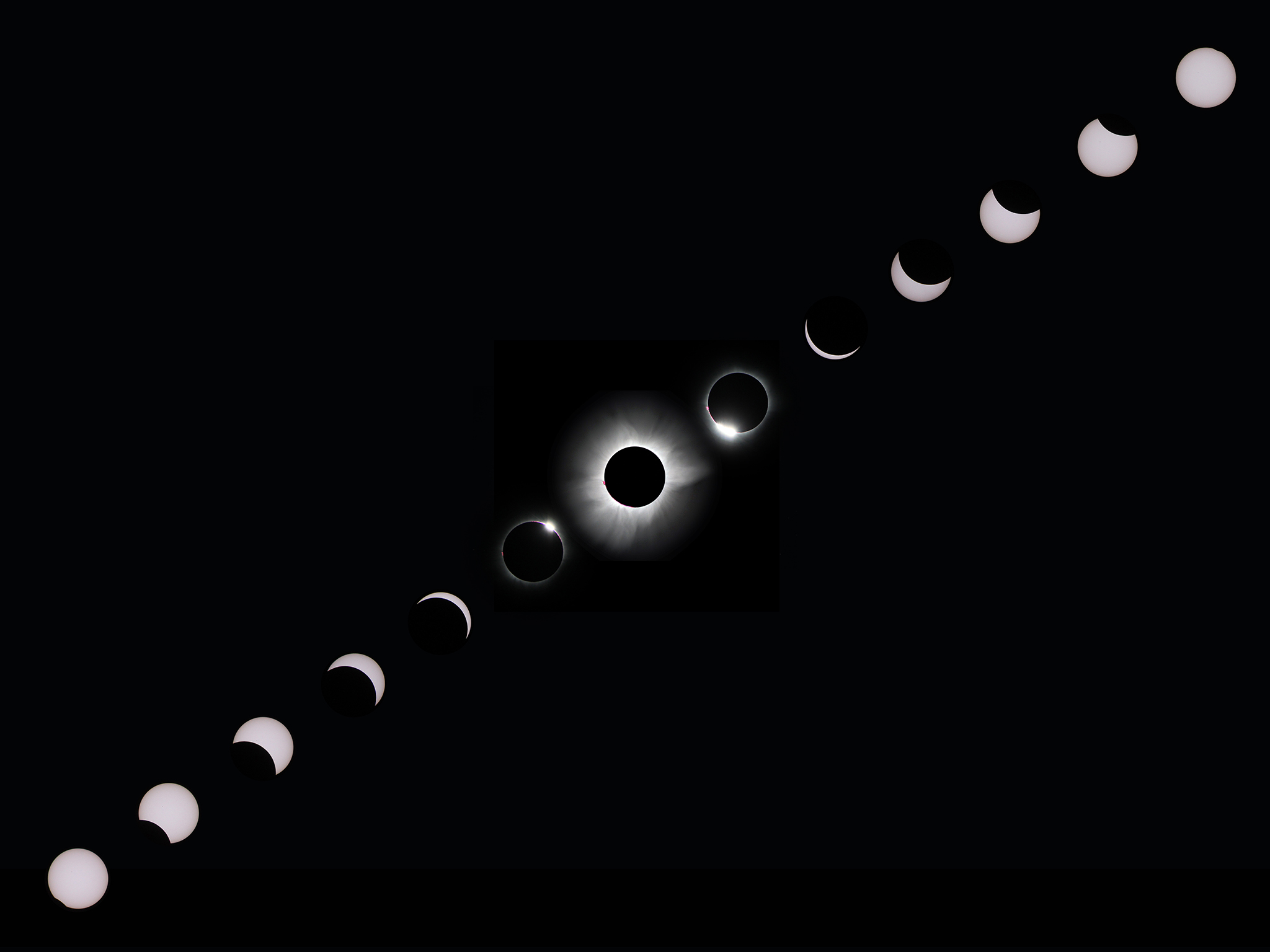
Humans have recorded solar eclipses for thousands of years. Recently, researchers translated and analyzed solar eclipse observations from 18th-century Sweden to determine the Sun’s radius at that time and study the first confirmed record of solar prominences.
Looking Back Nearly 300 Years
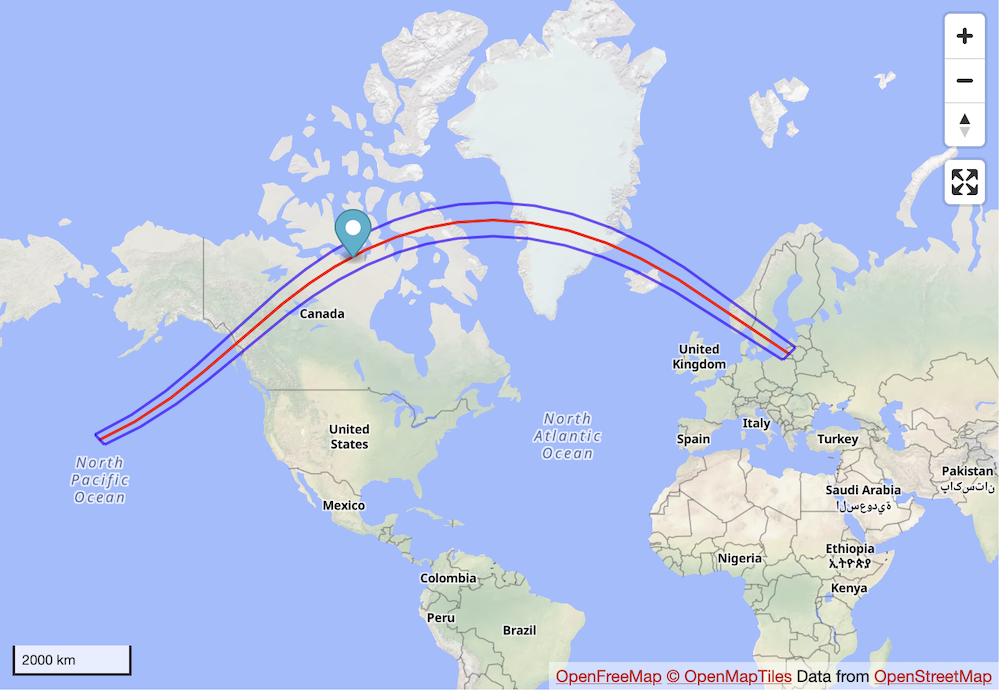
The path of the 13 May 1733 total solar eclipse. Click to enlarge. [Eclipse Predictions by Fred Espenak (NASA’s GSFC)]
Wassenius penned a short account of his observations in Latin for Philosophical Transactions of the Royal Society (the longest-running scientific journal in the world!). His drawings of the event, which include the first robust record of solar prominences, were never officially published, but were housed in the Royal Academy Archives of Sweden. Now, researchers have translated Wassenius’s full report from Swedish to English and analyzed his sketches, helping to fill an important gap in the historical record of solar activity.
Drawing from Observations
Hisashi Hayakawa (Nagoya University; Rutherford Appleton Laboratory) and collaborators translated Wassenius’s notes, which describe how he viewed the eclipsed Sun through a 21-foot-long telescope during just over two minutes of totality. From Wassenius’s measurements, Hayakawa and coauthors calculated the solar radius to be 696,250 ± 170 km; this is larger than the modern accepted radius, but it’s in line with what has been calculated from solar eclipse measurements two decades earlier, in 1715.
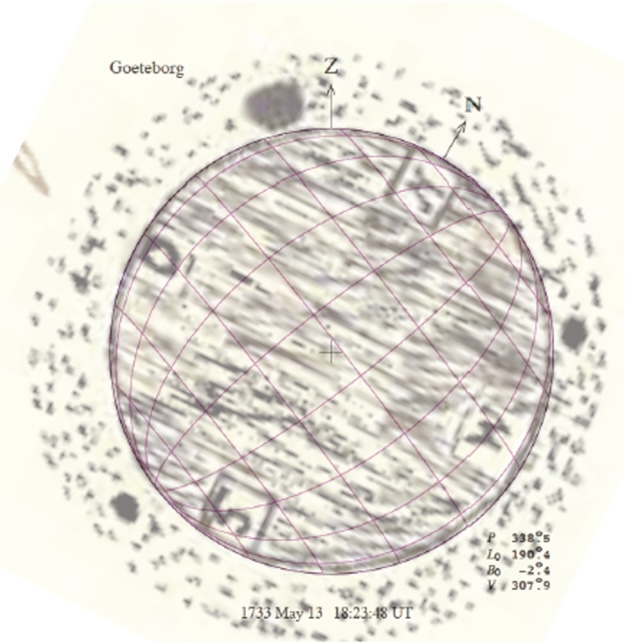
Wassenius’s sketch of the solar eclipse, showing three prominences as filled circles emerging from behind the disk of the Moon. [Adapted from Hayakawa et al. 2026]
Prominent Features
High-latitude prominences like the one (or more) seen by Wassenius are most common during what’s known as the “polar rush,” which occurs as solar activity rises toward a maximum. If these prominences are related to the polar rush, that would mean that in 1733, the Sun was not in an activity minimum as previously thought. However, it’s also possible for prominences to pop up at high latitudes during other times in the solar cycle; the authors estimated the likelihood of this happening at 20%.
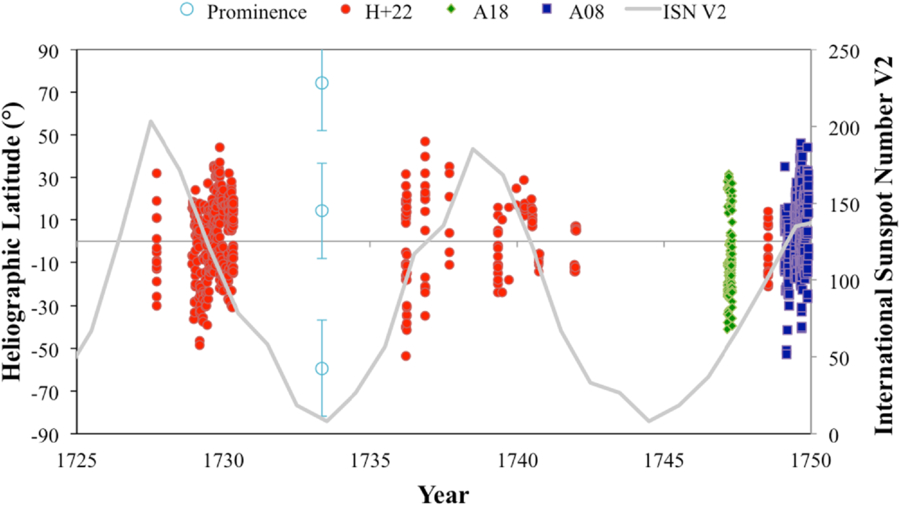
Heliographic latitude of solar prominences estimated from Wassenius’s drawings (light blue circles), compared to the positions (filled symbols) and number (gray line) of sunspots. Note that sunspot data around this time were scarce, and some researchers have suggested that revisions to the sunspot number are needed. Click to enlarge. [Hayakawa et al. 2026]
Citation
“Analyses on Wassenius’s Report for Total Solar Eclipse in 1733: Quantifications of the Solar Radius and the Earliest Reported Prominences,” Hisashi Hayakawa et al 2026 ApJ 1007 189. doi:10.3847/1538-4357/ae6451