
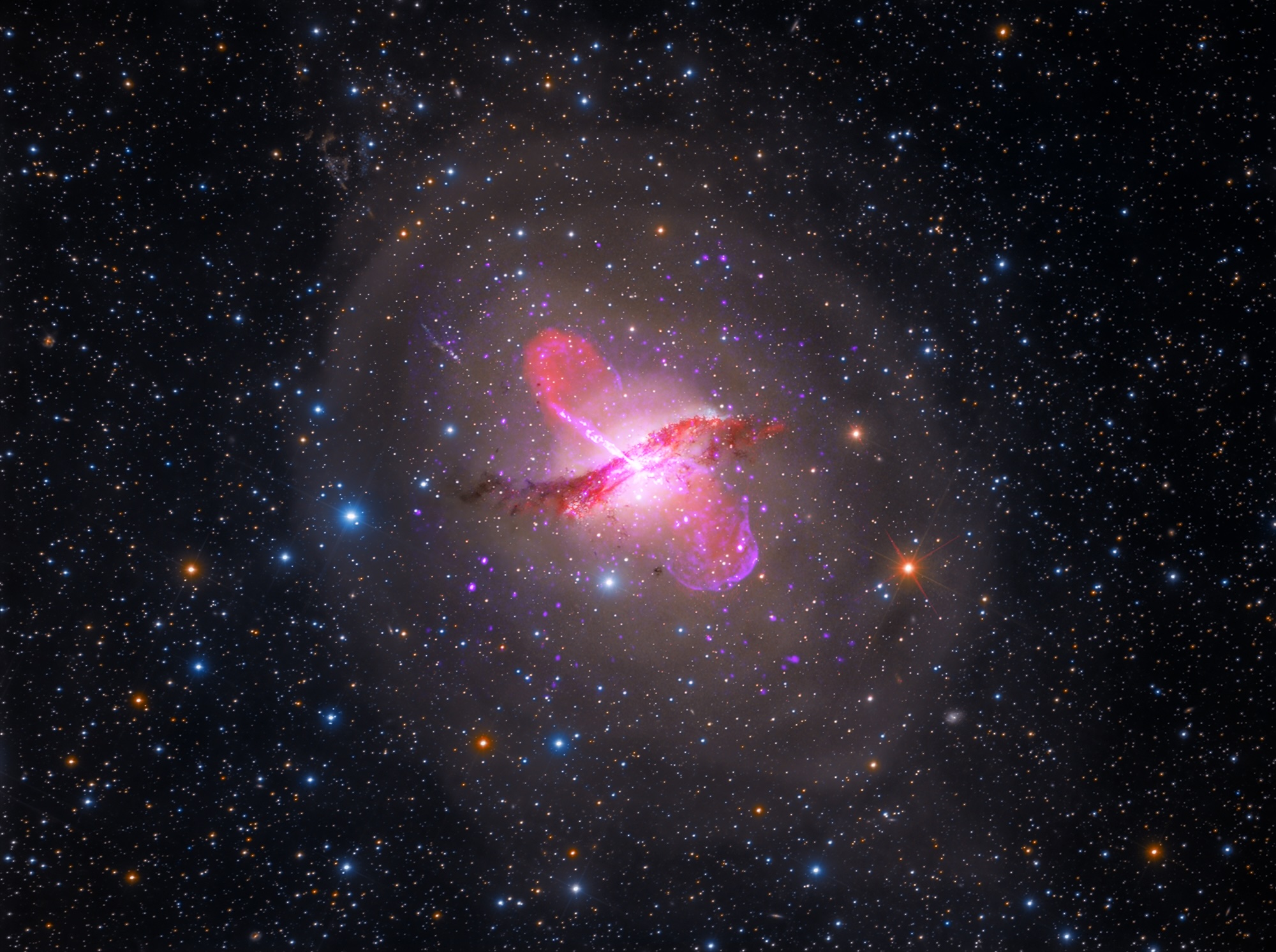
New observations of ESP 39607, a galaxy harboring an active supermassive black hole, show evidence for a sustained ultra-fast inflow over multiple years. This discovery has implications for how black holes accrete material from their host galaxies.
Outflows and Inflows
Across the universe, luminous galactic centers called active galactic nuclei are powered by growing supermassive black holes. These black holes are generally thought to be fed by orderly accretion disks. As a black hole accretes from its disk, some of the material gets flung away in narrow jets or broad winds. These powerful outflows enable an active galactic nucleus to influence its host galaxy on a massive scale, swaying the tides of star formation by heating, stirring, and expelling star-forming material.
About 30–40% of active galactic nuclei show signs of ultra-fast outflows, which speed outward at 30–50% of the speed of light (0.3–0.5c). While many active galactic nuclei spew out fast gas, only a small handful show evidence of ultra-fast inflows; these features are often identified at low statistical significance, and they’re rarely seen more than once for a given galaxy. Ultra-fast inflows are of interest to astronomers because they may provide evidence for accretion alternatives that lie outside the typical picture of disk-fed accretion.
Feature Follow-Up
In a recent article, Alessandro Peca (Eureka Scientific; Yale University; Diego Portales University) and collaborators described their observations of ESP 39607, one of the best ultra-fast inflow candidates identified to date. The team reported the discovery of an ultra-fast inflow onto ESP 39607 in 2025, based on observations in May 2023 and August 2024 that showed gas flowing inward at 0.15c.
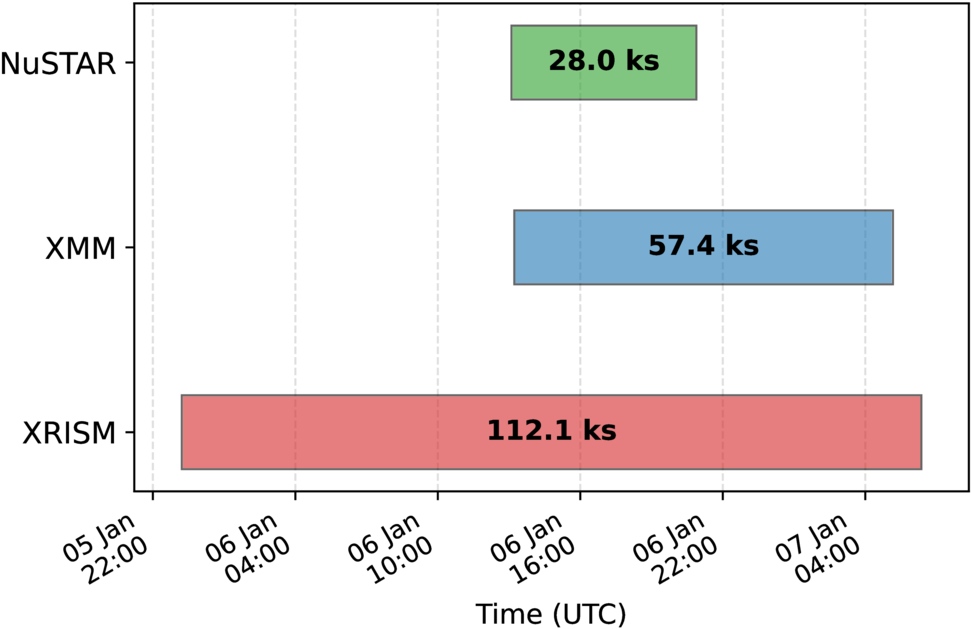
Visualization of the timelines of the NuSTAR, XMM-Newton, and XRISM observations of ESP 39607. [Peca et al. 2026]
The team found absorption features at 4.7 and 4.9 keV that appear to correspond to an ultra-fast inflow moving at 0.16c, which they estimate is transporting 0.3–1.4 solar masses of material inward each year. This rate is between 20% and 100% of the galaxy’s estimated accretion rate, suggesting that the material supplied by the ultra-fast inflow could power a substantial fraction of the active galactic nucleus’s luminosity.
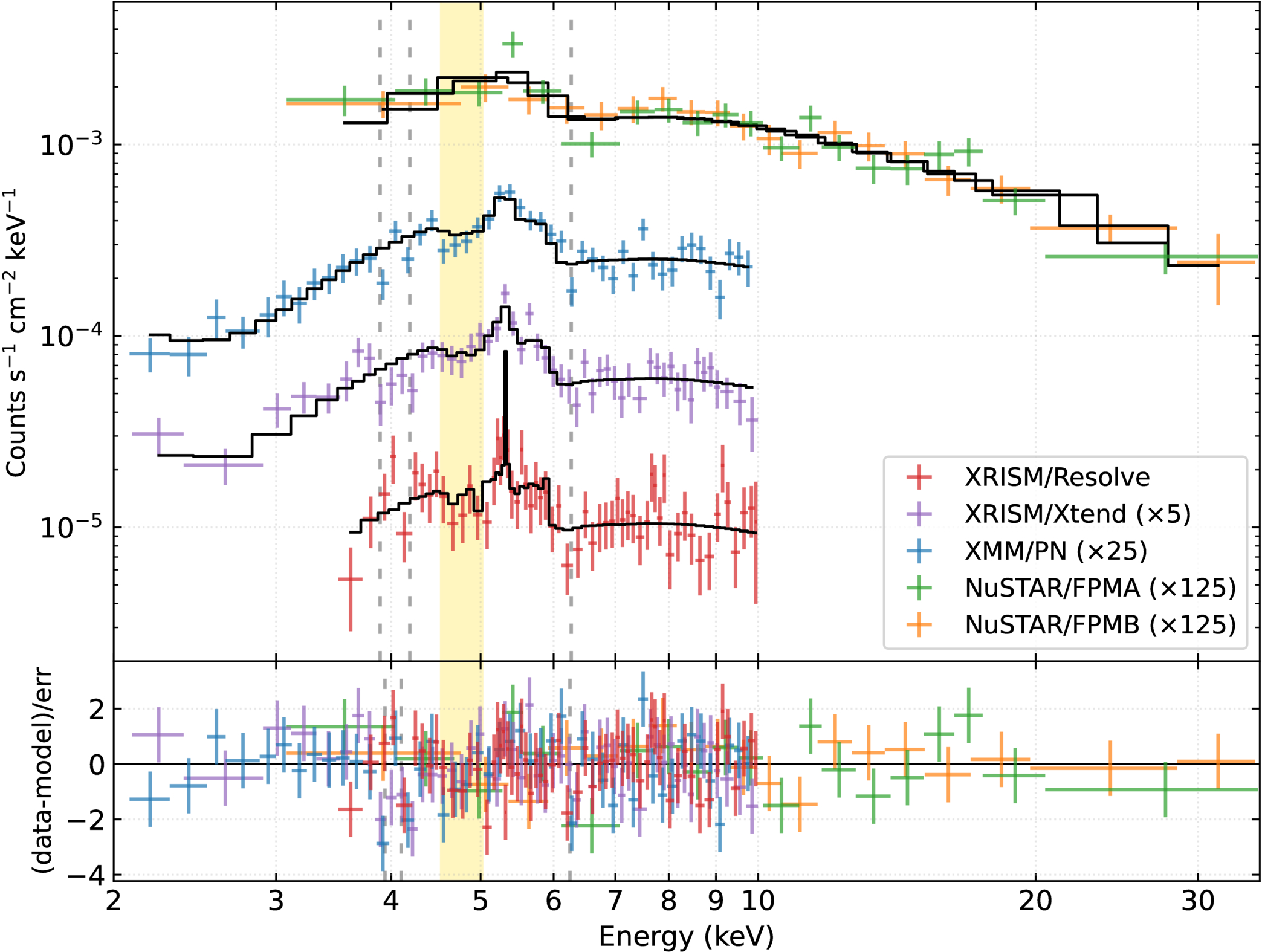
The spectrum of ESP 39607 as observed by NuSTAR, XMM-Newton, and XRISM. The spectra are offset vertically for clarity. The yellow area indicates the confirmed ultra-fast inflow, while the gray dashed lines show the potential second ultra-fast inflow and the candidate ultra-fast outflow. The black lines show model fits, and the bottom panel shows the residuals. [Peca et al. 2026]
Accretion Alternative
Peca and collaborators have now observed an ultra-fast inflow in ESP 39607 across multiple years. But is it the same inflow in each observation, or could these be separate transient features? By assessing the energies of each inflow, the team found little chance that the features are unrelated. Combining the observations from 2023 to 2026 results in a detection significance of 5.3σ.
Because the inflow is so rapid, material should zip across the region where it’s observed in a matter of days. The persistence of the inflow across multiple years, then, implies that the inflow may be continuously replenished by a large reservoir of material. This could be evidence for a non-standard type of accretion in which massive clouds of molecular gas condense out of the galaxy’s extended halo and “rain” upon the galactic center.
In addition to expanding their observations of the previously identified inflow, Peca and coauthors also found possible evidence for two more gas flows: a second inflow at 0.31c and an outflow at 0.08–0.12c. These findings, though still tentative, suggest that ESP 39607’s ultra-fast inflow is just one piece of a complex accretion puzzle.
Citation
“Multiepoch Detection of an Ultrafast Inflow in ESP 39607: Evidence for an Accretion Cascade,” Alessandro Peca et al 2026 ApJ 1011 25. doi:10.3847/1538-4357/aea573