
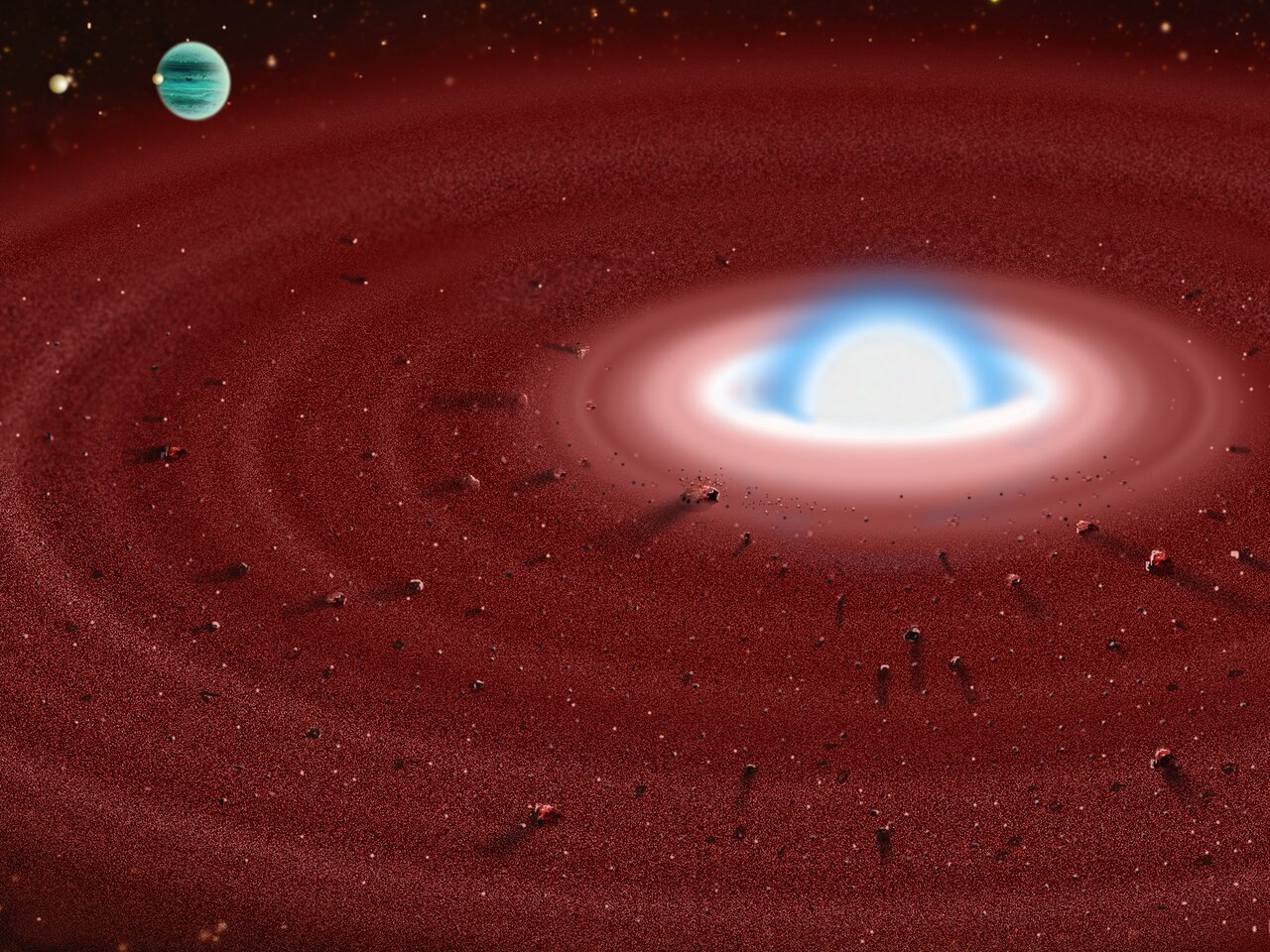
Roughly 25–50% of the white dwarfs in the solar neighborhood are “polluted,” showing signs of accretion of metal-rich planetary material. New JWST observations reveal the contents of the debris disk surrounding one of the most polluted white dwarfs in the solar neighborhood.
Heavy-Metal Pollution
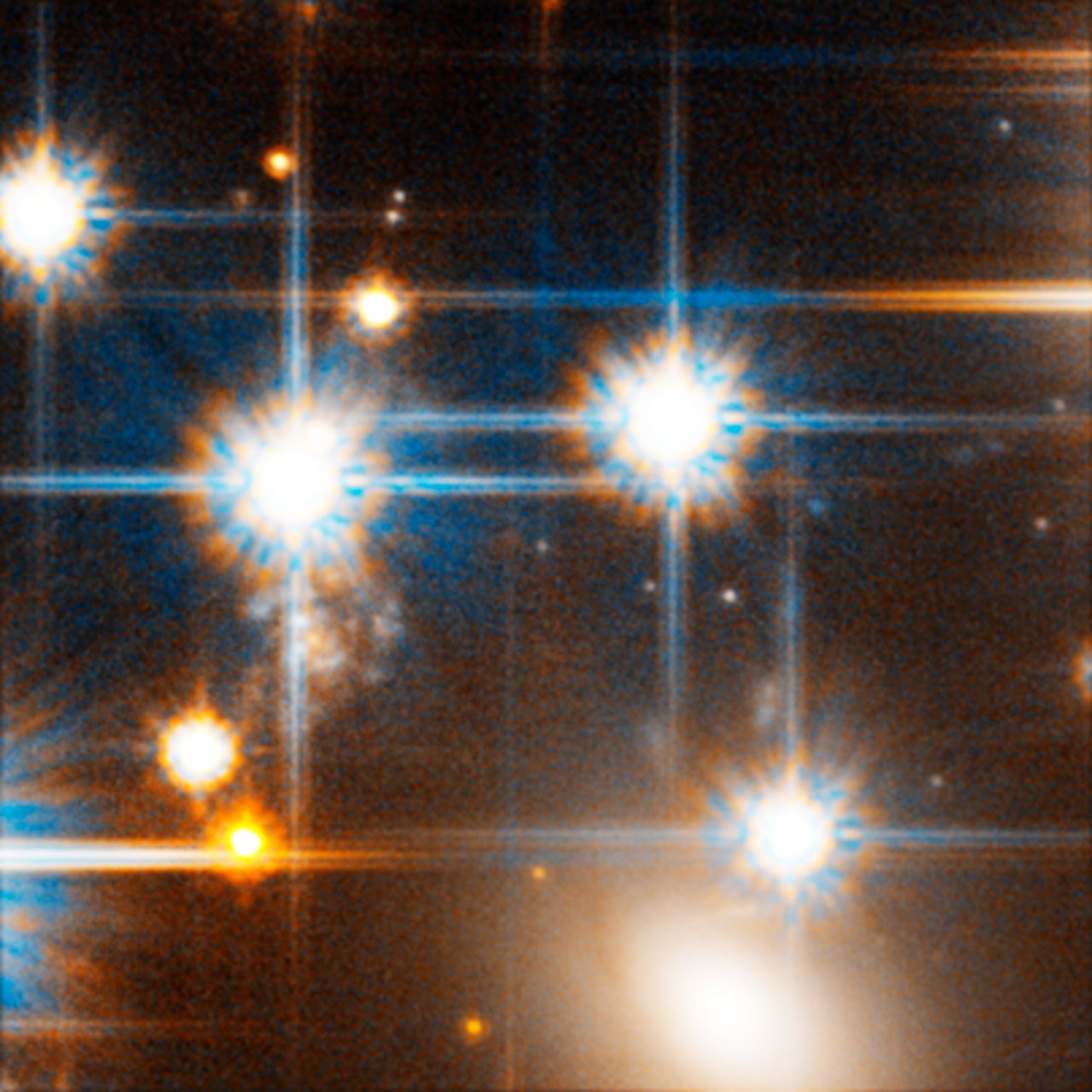
A white dwarf is faintly visible at the center of this Hubble Space Telescope image, tucked between the two brightest stars. [NASA, ESA and H. Richer (University of British Columbia); CC BY 4.0]
One of the most impressively metal-polluted white dwarfs known is GD 362, which is surrounded by a dusty debris disk and shows evidence for at least 16 accreted elements. GD 362 is a helium-atmosphere white dwarf, but previous observations have also shown that it has an unusually large amount of hydrogen in its atmosphere — a possible sign that the star has consumed one or more bodies containing water or ice.
Disk Investigation
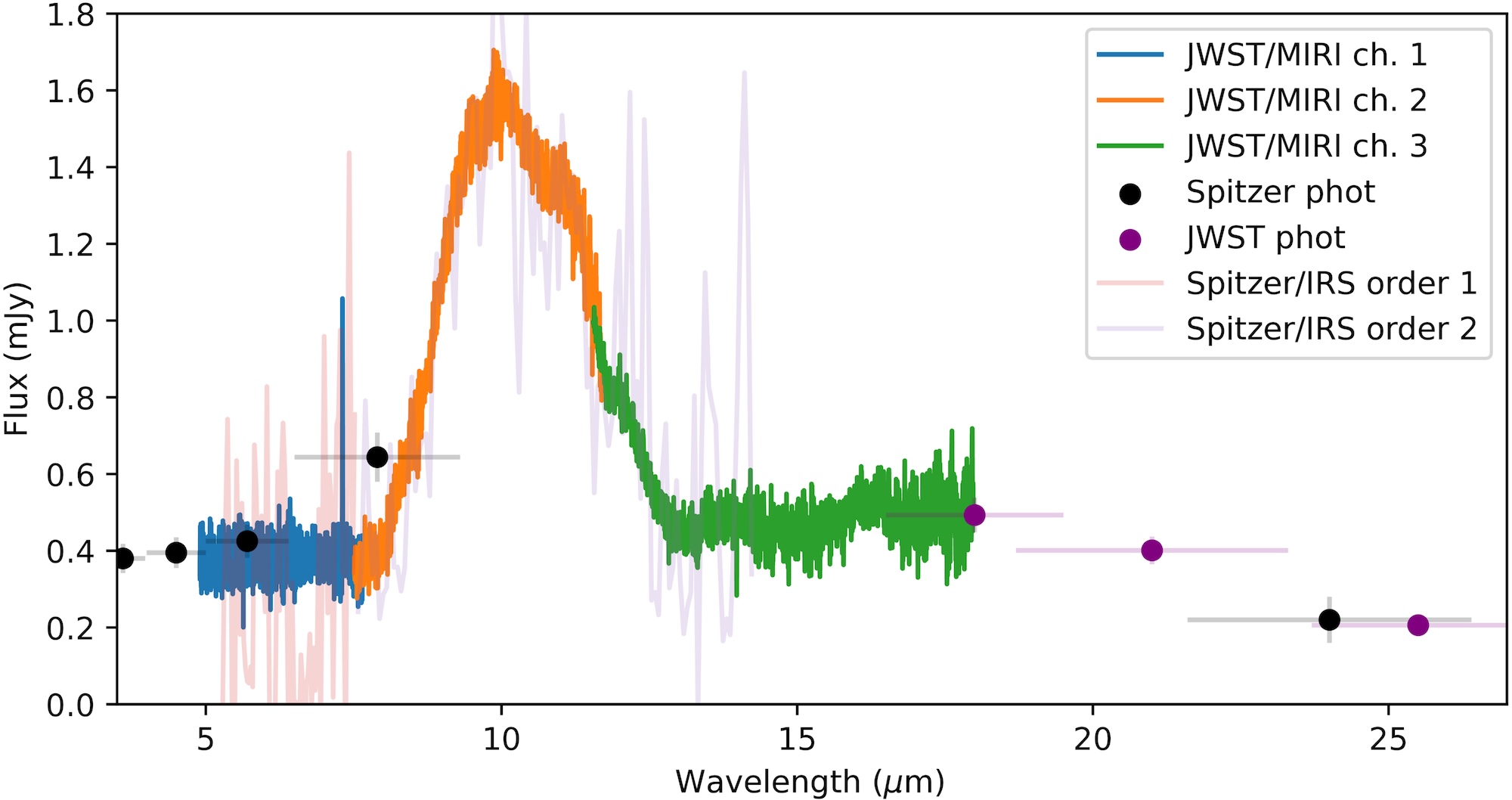
Mid-infrared JWST spectrum and photometry of GD 362, with additional spectral and photometric data from the Spitzer Space Telescope. Click to enlarge. [Reach et al. 2025]
Reach’s team modeled the JWST spectra to constrain the mineralogy of the disk and its physical attributes. They found that the disk likely stretches from 140 to 1,400 times the white dwarf’s radius and contains both silicates and carbon, with the prominent emission feature pointing to olivine and pyroxene silicate minerals. The elements seen in the white dwarf’s atmosphere are generally similar to those observed in the disk, strengthening the connection between accretion from the disk and the metals present in the white dwarf’s spectrum.
Hydrogen Mismatch
The new JWST data furthered the investigation of GD 362’s atmospheric hydrogen and the possibility that it’s accreting water- or ice-rich material. Though water molecules have spectral features in the range studied, none of these features appeared in the JWST spectra of GD 362. This isn’t necessarily a surprise; the team showed that water molecules in the disk would quickly be split apart by GD 362’s high-energy radiation.
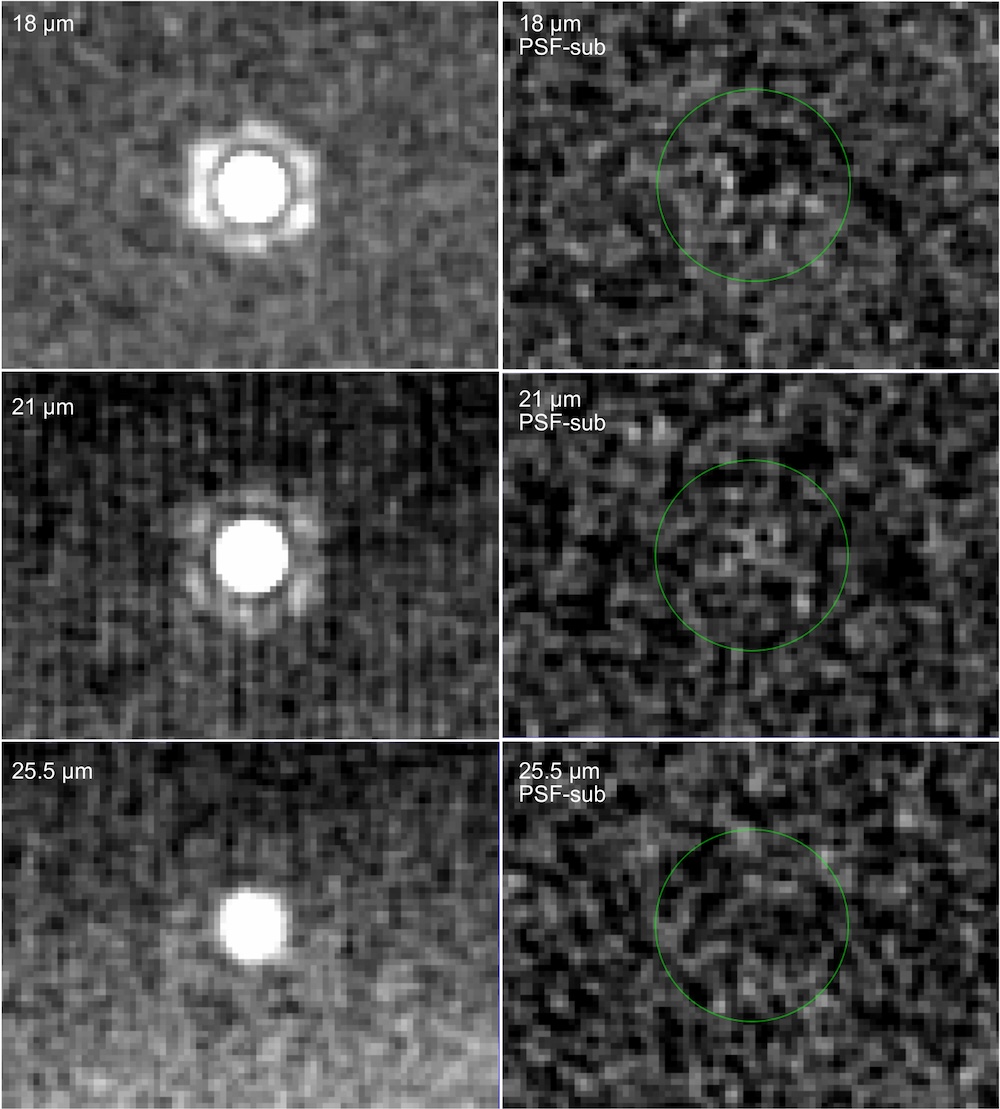
Left column: Three JWST images of GD 362. Right: The same images with the white dwarf’s point spread function subtracted. [Reach et al. 2025]
In addition to investigating GD 362’s disk, Reach and collaborators searched for planets orbiting the white dwarf. Though they found none, they were able to rule out the presence of companions with masses greater than 25 times the mass of Jupiter.
Citation
“Composition of Planetary Debris Around the White Dwarf GD 362,” William T. Reach et al 2025 ApJ 994 195. doi:10.3847/1538-4357/ae11a9