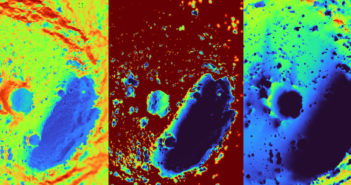
Featured Image: Ice in the Shadow of Mercury’s Craters
Modeling of spacecraft images suggests that a permanently shadowed crater on Mercury could contain a thick layer of water ice.

Modeling of spacecraft images suggests that a permanently shadowed crater on Mercury could contain a thick layer of water ice.
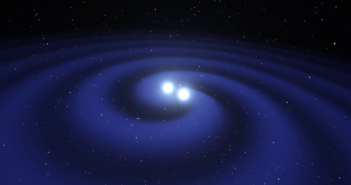
Researchers explore a new way to schedule observations in the hopes that we can make the most of limited telescope time when a new gravitational wave signal is detected.

Were the first stars in the universe all massive, or did low-mass stars form in their midst? New research suggests that magnetic fields might have been the deciding factor.

Please join us in saying farewell to our 2021–2022 AAS Media Fellow and welcoming our new Fellow to the team!
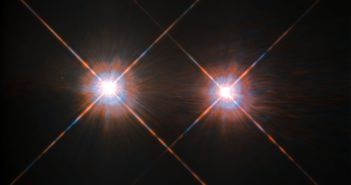
The Milky Way hosts a large number of binary stars with equal masses and wide orbits. A new analysis of data from the Gaia spacecraft may help researchers understand how these systems formed.
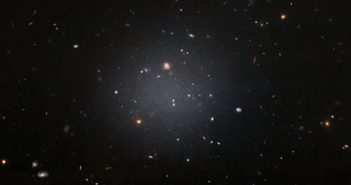
What’s responsible for the arrangement of ultra-diffuse galaxy NGC5846-UDG1’s (many!) globular clusters?
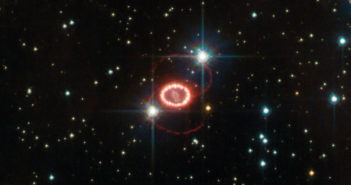
Astrobites reports on new simulations of pre-supernova outbursts and they affect the final supernova explosion as seen from Earth.
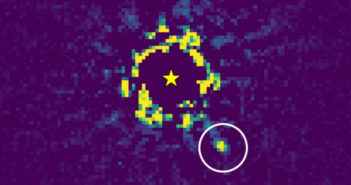
A directly imaged object in the nearest star cluster to Earth may help researchers understand how substellar objects evolve over time.
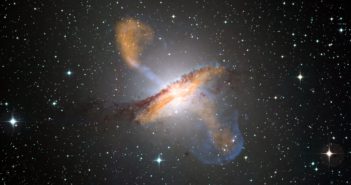
What can the polarization of light around the core of Centaurus A tell us about the physics at play in such a high-energy environment?
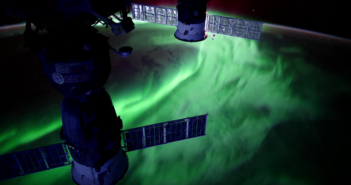
In the Sun’s atmosphere, a massive eruption of plasma is brewing — how can we predict if a coronal mass ejection will cause a damaging geomagnetic storm?
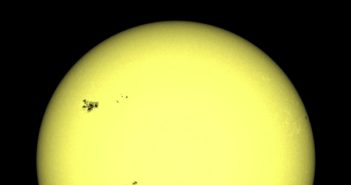
Astrobites reports on a search for polka dots of concentrated magnetic flux on the surface of a subgiant star.
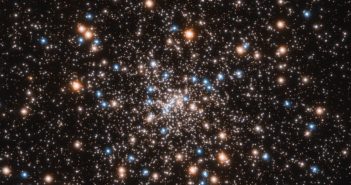
Astronomers have tracked down a second millisecond pulsar in a nearby globular cluster. Can this discovery help us understand why these systems are so hard to find?