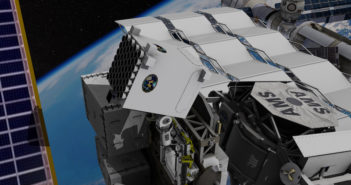
NICER Eyes on Bursting Stars
A new instrument recently deployed at the International Space Station is examining X-ray explosions on neutron-star surfaces.

A new instrument recently deployed at the International Space Station is examining X-ray explosions on neutron-star surfaces.
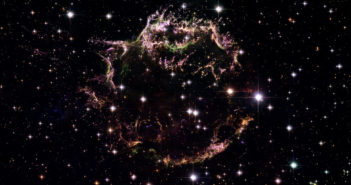
How can we use observations to learn more about the morphology of supernova remnants?
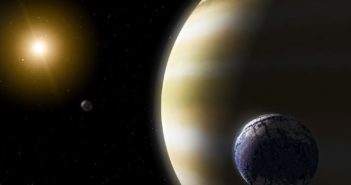
Planet interactions are thought to be common as solar systems are first forming and settling down. But what impact do these close encounters have on the moons of these planets?
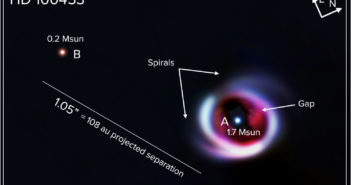
Astrobites reports on the spiral arms seen in the protoplanetary disk around HD 100453 A, which appear to be caused by the star’s M-dwarf companion.
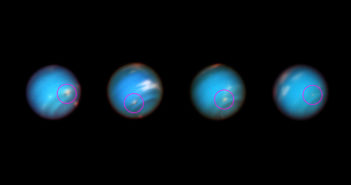
These Hubble images track a rare dark vortex in Neptune’s atmosphere as it evolves over the span of two years.
AAS Nova is celebrating the publication of its 500th Highlight since its launch in August of 2015.
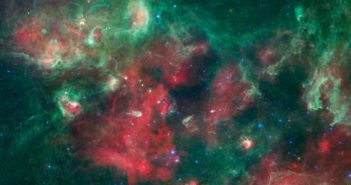
Young stars often reveal their presence with energetic outflows and jets. A new study has now discovered hundreds of these signatures in the Cygnus-X star-forming region.
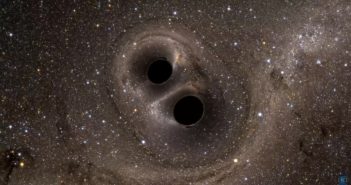
Astrobites explores the process through which a number of “strangers” — unassociated black holes — might interact and eventually merge.

A pair of neutron stars has been found orbiting each other once every 1.88 hours! What can this extremely relativistic binary teach us?

The low-metallicity environment of the Large Magellanic Cloud doesn’t deter the formation of complex organic molecules.

What launches powerful eruptions from the Sun’s surface? New simulations explore how reconfiguring magnetic fields can lead to explosions of energy.
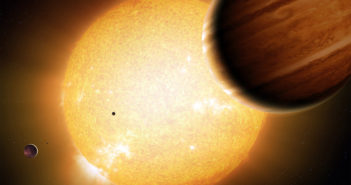
Astrobites explores whether we’ll be able to observe seasons on warm-Jupiter exoplanets with the James Webb Space Telescope.