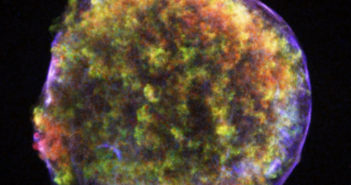
Probing the Surroundings of Tycho’s Supernova
Astrobites reports on how a supernova that Tycho Brahe studied in 1572 may yet have something to tell us about what causes these dramatic explosions.

Astrobites reports on how a supernova that Tycho Brahe studied in 1572 may yet have something to tell us about what causes these dramatic explosions.

This Hubble image hints at a pair of accreting supermassive black holes likely headed for a merger after the collision of their host galaxies.
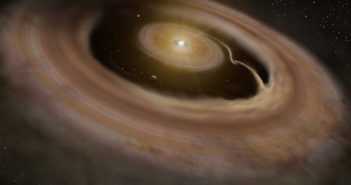
Scientists have caught a planet in the act of forming within a protoplanetary disk. What can we learn as we watch it grow?
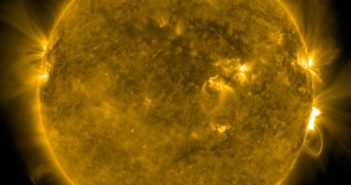
A new view of the Sun in microwaves has revealed fresh details of what happens when a powerful flare erupts from the Sun into space.
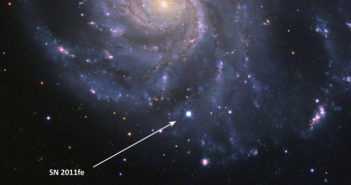
Astrobites reports on the discovery that Type Ia supernovae may fall into two distinct sub-populations.
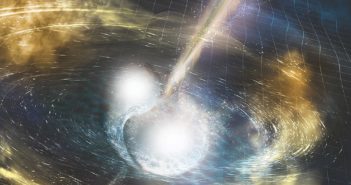
A new study explores how we can optimize the hunt for advanced extraterrestrial civilizations — by targeting galaxies that host observable neutron-star mergers.
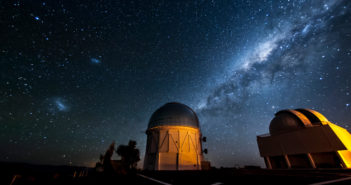
Three years of optical survey data have revealed delicate stellar trails that may help us understand how the Milky Way halo was constructed.
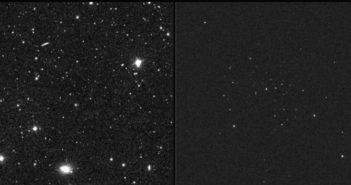
A new study has measured the first proper motions for our mysterious neighboring galaxy Segue 1, providing clues to its origins.
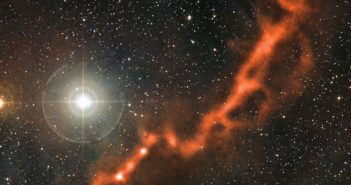
Astrobites reports on the stellar membership roster for Taurus-Auriga, the nearest large star-forming region.
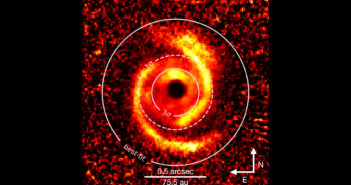
A new study hunts for a planetary-mass companion that may be driving the creation of these large-scale spiral arms.
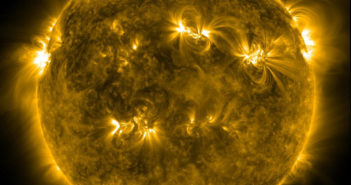
What causes the variability in the Sun’s mean magnetic field — the imbalance left over after averaging out all the magnetic flux regions on the Sun’s disk?
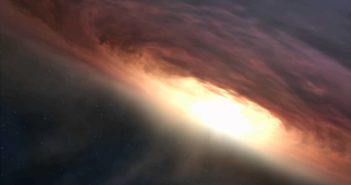
How can stellar-mass black holes attain the large sizes we’ve recently observed in merging binaries? The accretion disks surrounding supermassive black holes may help out!