Images RSS

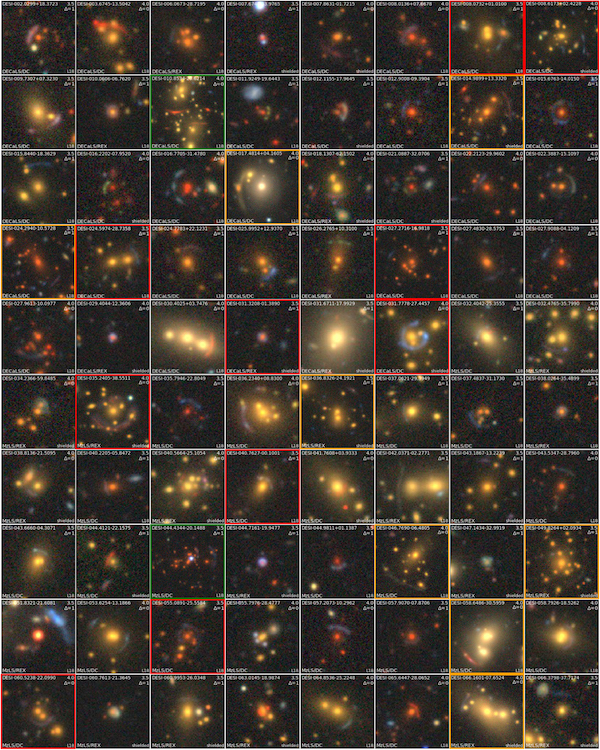
mosaic of small images of newly discovered gravitational lens systems

You’re looking at just a handful (click here to see a few more!) of the 1,210 strong gravitational lens candidates newly discovered in a recent study that analyzed data from the Dark Energy Spectroscopic Instrument (DESI) Legacy Surveys. Strong gravitational lensing occurs when light from a background source bends around a massive foreground object (like a galaxy). This bending smears the light from the background source into arcs, rings, and multiple images. In a study led by Xiaosheng Huang (University of San Francisco), scientists have now used trained neural networks to search the DESI data for new strong gravitational lensing systems, finding a treasure trove of candidates. The new discoveries dramatically extend our set of known strong lens systems — in 2018, when the first iteration of this project began, there were only a few hundred confirmed strong lenses. To read more about the project and its results, check out the original article below.

Citation

“Discovering New Strong Gravitational Lenses in the DESI Legacy Imaging Surveys,” X. Huang et al 2021 ApJ 909 27. doi:10.3847/1538-4357/abd62b
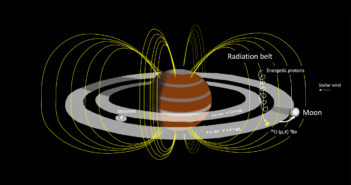
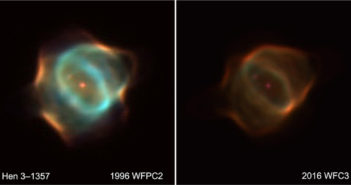
Diagram illustrating formation of icy exomoons in the radiation belt surrounding a giant planet.

This schematic shows one possible solution to an intriguing white-dwarf mystery, in which two white dwarfs have been observed to contain an overabundance of the rare element beryllium. Unlike many heavy elements, beryllium isn’t formed in stars; instead, it’s produced by spallation, in which larger atomic nuclei break up after being bombarded by high-energy protons. So how did this unexpected element end up in the atmospheres of white dwarfs? A new publication led by Alexandra Doyle (UC Los Angeles) proposes a path: white dwarfs may become polluted by beryllium after accreting the icy exomoons of giant planets orbiting the dwarf. If these exomoons formed within the radiation belts of their planets, their composition could include spallogenic nuclides like beryllium. When the moons accrete onto the white dwarf, that beryllium then pollutes the white dwarf’s atmosphere. Doyle and collaborators illustrate the extreme environment in which these beryllium-enriched ices form in the image above. To learn more, check out the original article below.

Citation

“Icy Exomoons Evidenced by Spallogenic Nuclides in Polluted White Dwarfs,” Alexandra E. Doyle et al 2021 ApJL 907 L35. doi:10.3847/2041-8213/abd9ba

Two photographs of the Stingray Nebula taken in 1996 and 2016. The more recent one shows a much dimmer, less crisp, smaller nebula.

These two Hubble Space Telescope images of the Stingray Nebula (click to enlarge), spaced 20 years apart, show the remarkably rapid evolution of this unique planetary nebula. Planetary nebulae are formed when the outer layers of a dying intermediate-mass star are expelled and subsequently ionized by radiation from the star’s hot core. This ionized gas then glows until it eventually recombines and fades. While typical planetary nebulae arise and decline on timescales of thousands of years, observations of the Stingray Nebula show this same evolution occurring over about 40 years — it first became visibly ionized in the 1980s, and it has already dramatically faded and changed shape, structure, and size. It will likely be barely detectable within a couple decades. The Hubble observations showing the rapid changes in this youngest known planetary nebula are reported on in a new publication led by Bruce Balick (University of Washington).

Citation

“The Decline and Fall of the Youngest Planetary Nebula,” Bruce Balick et al 2021 ApJ 907 104. doi:10.3847/1538-4357/abcc61

Direct image of a bright, blue swirl of material forming a spiral disk with long streamers.

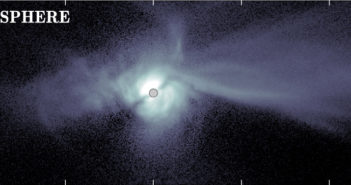
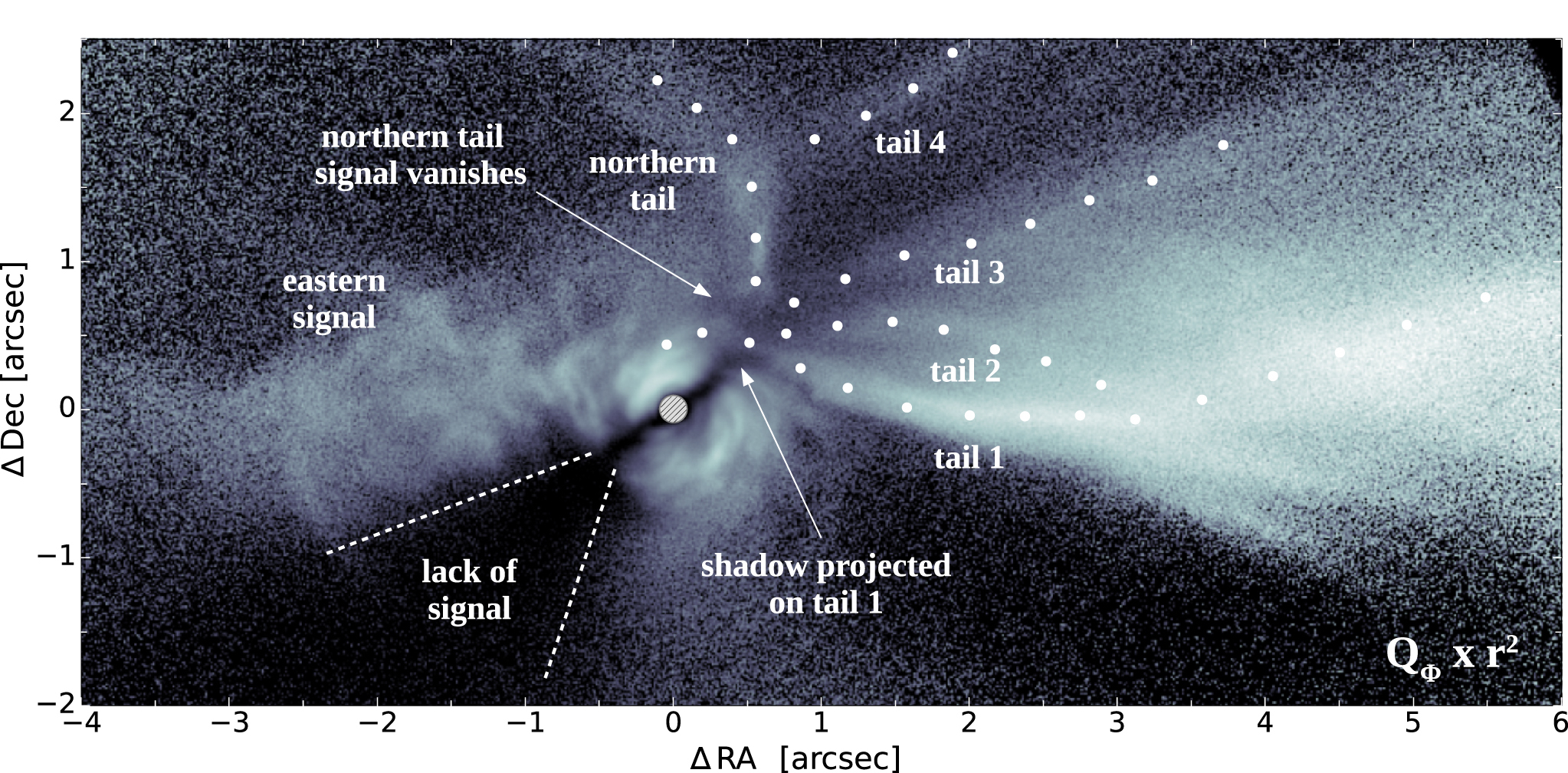
You’re looking at a photograph of a swirling disk of gas and dust that surrounds a star more than 500 light-years away. This stunning image (click for the full view!) of SU Aurigae’s circumstellar disk was brought to you by the ESO Very Large Telescope’s SPHERE instrument, which is working to capture up-close looks at planetary birthplaces like this one as part of the DESTINYS program. The results for SU Aur are presented in a recent publication led by Christian Ginski (University of Amsterdam and Leiden Observatory, the Netherlands). Here, the disk of SU Aur is resolved down to scales of just ~7 au, showing the extended dust structures around the young star in unprecedented detail. The image reveals the spiral structure of the disk and a shadow lane cast by an inner, misaligned disk component. These observations provide evidence that accretion can shape the disks around stars even in later stages of a star’s formation, possibly leading to planetary systems that have their spins and orbits misaligned. For more information, check out the annotated image and the authors’ original article below.

annotated version of the cover image marks the shadowed region and tails of dust.

Annotated VLT/SPHERE image of SU Aur. [Ginski et al. 2021]

Citation

“Disk Evolution Study Through Imaging of Nearby Young Stars (DESTINYS): Late Infall Causing Disk Misalignment and Dynamic Structures in SU Aur,” Christian Ginski et al 2021 ApJL 908 L25. doi:10.3847/2041-8213/abdf57

Two plots, one with a wireframe model overlaid, show a white-light image of a coronal mass ejection erupting from the sun.

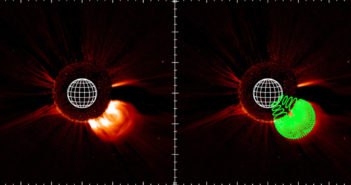
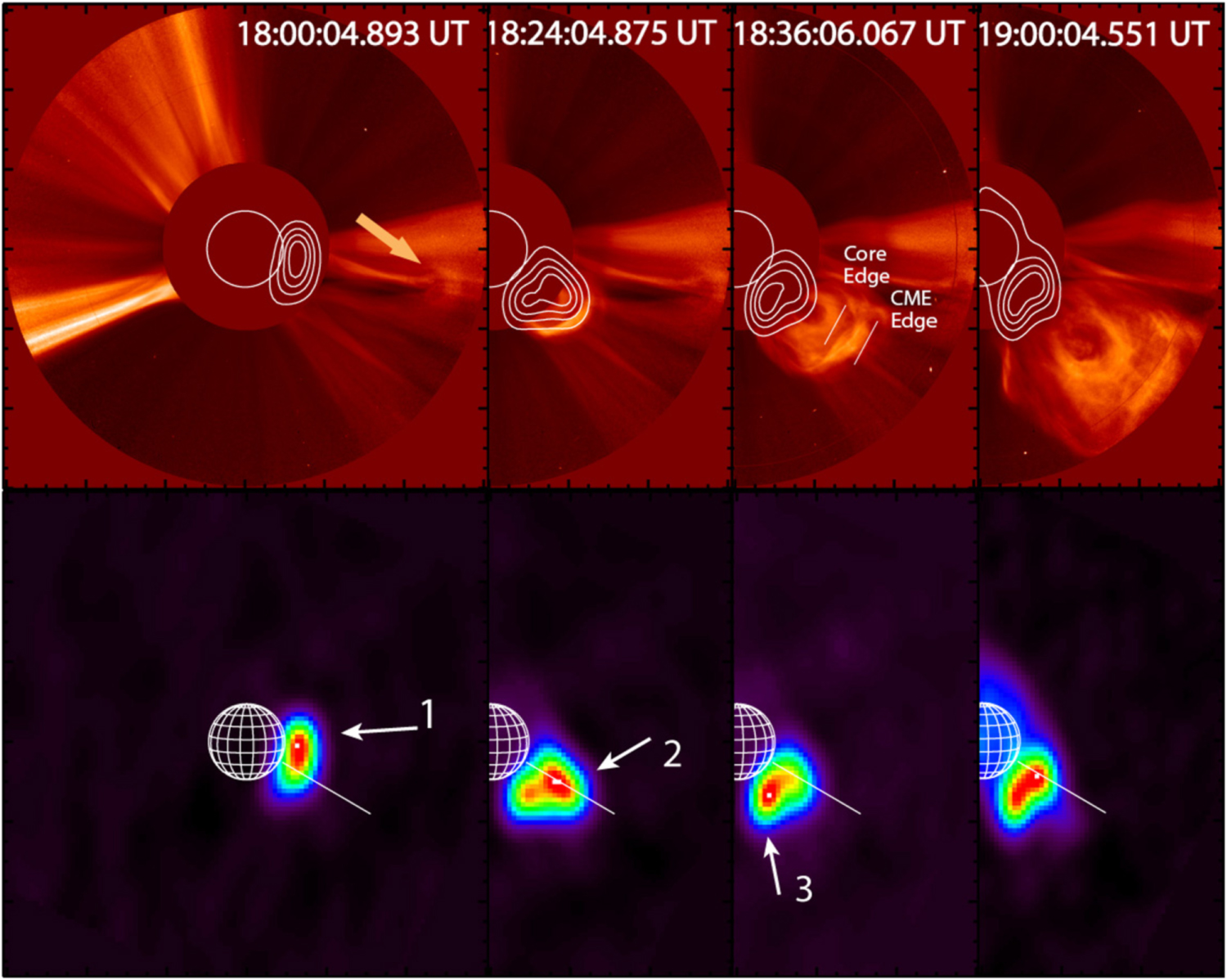
Learning about enormous solar explosions requires both observations that span the electromagnetic spectrum and careful modeling. The figure above shows a white-light image taken during a radio burst that was accompanied by a coronal mass ejection — a rapid release of plasma and radiation from the Sun’s outer atmosphere — in 2015. A new study led by Sherry Chhabra (New Jersey Institute of Technology and NASA Goddard SFC) presents long-wavelength radio images of this burst captured with the Owens Valley Radio Observatory. The team then uses the radio observations and white-light images from SOHO/LASCO to reconstruct the coronal mass ejection as it is released from the Sun; the model is shown above in the right panel as the green wireframe overlaid on the LASCO image (which is roughly 3° x 3°). The combined information about this burst tells us more about its properties and emission mechanisms, helping us to understand how energy is released from the Sun. For more information, check out the original article below.

8 panel plot showing 4 stages of eruption in both white light and radio light.

The different stages of eruption can be seen from left to right in these white-light (top) and radio (contours and bottom) images tracking the radio burst and associated CME. [Chhabra et al. 2020]

Citation

“Imaging Spectroscopy of CME-associated Solar Radio Bursts using OVRO-LWA,” Sherry Chhabra et al 2021 ApJ 906 132. doi:10.3847/1538-4357/abc94b

ALMA image of two protostellar systems, one a triple with a disk and the other a wide companion.

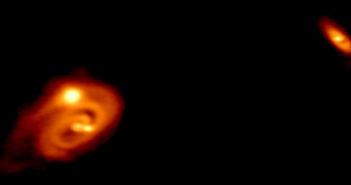
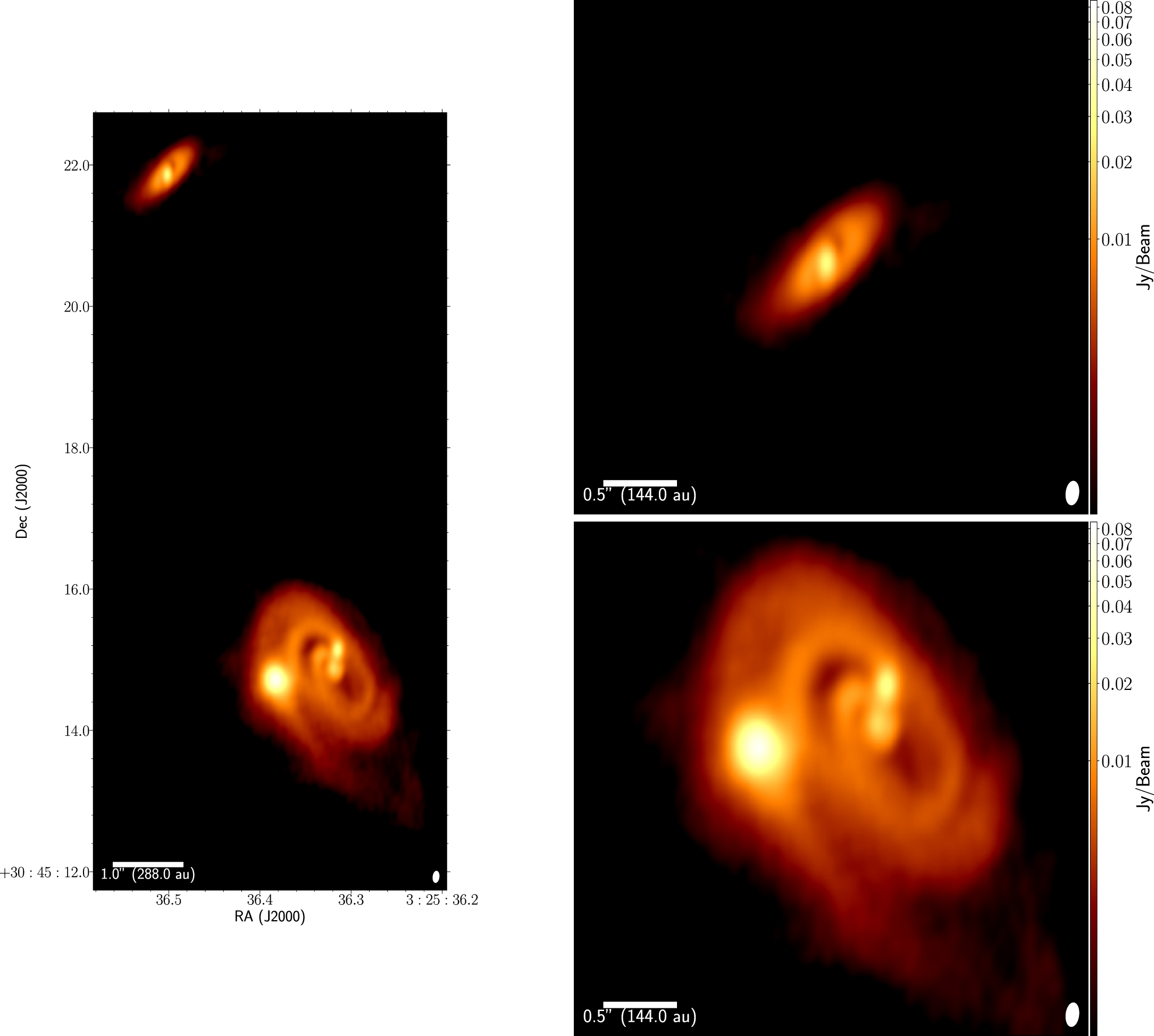
How do systems of multiple stars form in the dense cores inside molecular clouds? Systems like the one captured above, L1448 IRS3B and A, may help us to better understand this process. In the image shown above (and again below, with scales and color bars), the triple protostar system IRS3B is seen in the process of forming from a surrounding (circum-triple) disk of molecular gas and dust. An additional disk can be seen at the opposite end of the image: IRS3A, a wide companion that lies 2,300 au away. In a recent study led by Nickalas Reynolds (University of Oklahoma), a team of scientists peered deep into the Perseus molecular cloud with the Atacama Large Millimeter/submillimeter Array (ALMA) to produce these images and study IRS3B and A. Reynolds and collaborators determine from their observations that the disk of IRS3B is gravitationally unstable at radii of 200–500 au, and its fragmentation may have recently produced the third protostar in IRS3B (visible as the outer bright spot in the circum-triple disk), which lies at 230 au. For more information, check out the full figure and the article below.

ALMA image of a triple star system with a wide companion, each surrounded by a disk.

Left: ALMA 879 μm continuum observation of L1448 IRS3B (bottom) and A (top). Right: zoomed-in view of each of the two sources. Both protostellar systems are surrounded by disks, and the images of IRS3B reveal three bright sources forming within the circum-triple disk. [Reynolds et al. 2021]

Citation

“Kinematic Analysis of a Protostellar Multiple System: Measuring the Protostar Masses and Assessing Gravitational Instability in the Disks of L1448 IRS3B and L1448 IRS3A,” Nickalas K. Reynolds et al 2021 ApJL 907 L10. doi:10.3847/2041-8213/abcc02

Oph 98AB

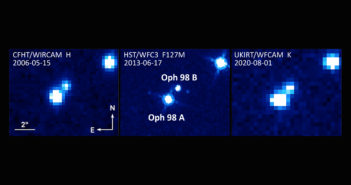
A new pair of free-floating planetary-mass objects has recently been identified via direct imaging: Oph 98 AB. In a study led by Clémence Fontanive (University of Bern, Switzerland), a team of scientists presents their observations of this set of two bodies locked in an exceptionally wide orbit. In the three views above (click for a closer look), captured at different times with different telescopes, you can see Oph 98 A and B as the two bright objects at the centers of the images. The additional source at the top right is a background star. Fontanive and collaborators show that this binary system consists of two bodies of perhaps 15 and 8 Jupiter masses, separated by around 200 au (for reference, Pluto’s semimajor axis is just 39 au!). The low masses and wide separation of Oph 98 AB make it the lowest binding energy system imaged to date, and it’s sure to offer us new insight into young, free-floating planetary-mass objects. To learn more, check out the original article below.

Citation

“A Wide Planetary-mass Companion to a Young Low-mass Brown Dwarf in Ophiuchus,” Clémence Fontanive et al 2020 ApJL 905 L14. doi:10.3847/2041-8213/abcaf8

star cluster locations

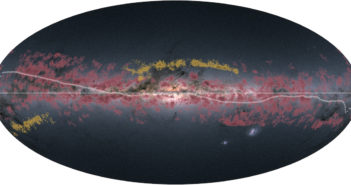
Did you know that the stars around us are organized into a tangle of threads and strings? The unprecedented precision and sensitivity of the Gaia second data release has given us the ability to map the precise locations of and distances to the stars around us, allowing us to piece together these clusters and structures. In a new study led by Marina Kounkel (Western Washington University), a team of scientists has conducted clustering analysis to identify a total of 8,292 structures of stars within about 10,000 light-years of us. These threads have a typical length of ~650 light-years and width of ~30 light-years, and they likely trace the shape of the filamentary giant molecular clouds from which they formed. The image above shows the 2D projection of the locations of some of these clustered stars, but to really dive into the data, you need to see it in 3D. For that, you can check out the authors’ interactive figure, which allows you to manipulate their data and view the strings from your angle of choice. We’ll be discussing interactive figures further on this site soon! In the meantime, you can check out the authors’ work (and their figures) in the article below.

Citation

“Untangling the Galaxy. II. Structure within 3 kpc,” Marina Kounkel et al 2020 AJ 160 279. doi:10.3847/1538-3881/abc0e6

neon microcrystal

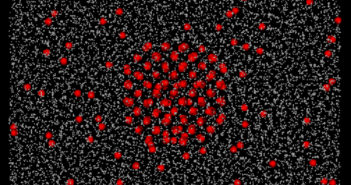
Some astronomical mysteries are found deep in the interiors of stars. Such is the case with the puzzle of Q-branch white dwarfs, a population of these evolved, dense stars that seems to have an unexpected heat source, causing them to cool more slowly than a typical white dwarf. One hypothesis proposes that Q-branch white dwarfs gain extra heat from the rapid sedimentation — sinking to the center of the star — of neutron rich neon, 22Ne. But recent molecular dynamics simulations conducted by Matt Caplan (Illinois State U.), Charles Horowitz (Indiana U.), and Andrew Cumming (McGill U., Canada) show that the tiny crystals of neon needed to speed up this sedimentation can’t exist in a stable state in the interior of a typical white dwarf — which means there must be some other mechanism at work heating Q-branch white dwarfs. The image above shows the initial state of the authors’ simulations, in which a 22Ne microcrystal (red) lies within a soup of carbon and oxygen (white) under the dense, high-pressure conditions that exist inside a white dwarf. To read more about the authors’ work, check out the article below.

Citation

“Neon Cluster Formation and Phase Separation during White Dwarf Cooling,” M. E. Caplan et al 2020 ApJL 902 L44. doi:110.3847/2041-8213/abbda0

giant impact

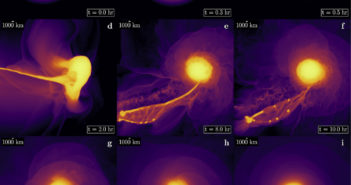
The panels in the image above (click the cover image for the full view, or click the video below to watch the animated version) show frames from a dramatic simulation of the collision of a planetary-mass impactor with the proto-Earth in the early solar system. In the chaos that follows the collision, the debris that doesn’t escape settles into a disk around the young Earth — a disk that will later form into our Moon. While the giant impact described here has been simulated in detail in the past, most models have yet to incorporate the effects of magnetic fields into the giant impact and the subsequent evolution of the protolunar disk. In a new study, scientists Patrick Mullen and Charles Gammie (University of Illinois at Urbana-Champaign) develop state-of-the-art simulations that include weak initial magnetic fields. The authors show how these fields are amplified by turbulence in the collision, impacting the how the disk — and, ultimately, the Moon — evolves. To read more about their results, check out the original article below.

Citation

“A Magnetized, Moon-forming Giant Impact,” P. D. Mullen and C. F. Gammie 2020 ApJL 903 L15. doi:10.3847/2041-8213/abbffd

1 9 10 11 12 13 23