Features RSS

black hole binary

The tally of merging black holes detected by the LIGO-Virgo gravitational-wave detectors continues to grow; the most recent data release brings the total to nearly 50 collisions! But how do these black-hole binaries form in the first place?

Two Formation Channels

black holes in a globular cluster

Still from a simulation showing how black holes might dynamically form as they interact in the chaotic cores of globular clusters. [Carl Rodriguez/Northwestern Visualization]

Before two black holes can collide in a burst of gravitational waves, they must first be bound together in an inspiraling binary pair.

There are two leading theories for how such pairs of black holes might arise in our universe. In isolated binary evolution, two massive stars of a stellar binary independently evolve into black holes. In dynamical encounters, single black holes pair up into binaries through gravitational interactions in the center of a dense, crowded star cluster.

Two Observational Clues

How can we determine which formation channel produced the black-hole binaries we’ve detected so far? Two observational signatures, in particular, could point to a dynamical merger:

  1. Spin misalignment
    Due to conservation of angular momentum, black holes in isolated binaries are expected to have aligned spins. Black holes that pair up via dynamical encounters, on the other hand, are likely to have random, misaligned spins.
  2. Orbital eccentricity
    If a binary evolves in isolation, any initial eccentricity is damped long before the black holes merge. In the dynamical scenario, however, the abruptly formed binaries can merge before their orbits have time to circularize.
Stellar graveyard Nov 2020

The most recent version of the rapidly expanding “stellar graveyard”, a plot that shows the masses of the different components of observed compact binary mergers. GW190521, seen at the top center, is more massive than any other binary merger we’ve observed. Click to enlarge. [LIGO-Virgo/Northwestern U./Frank Elavsky & Aaron Geller]

The vast majority of mergers we’ve detected so far have had gravitational-wave signals consistent with low-mass, spin-aligned binaries with circular orbits — preventing us from differentiating between the two formation channels. One recent merger, however, is a promising candidate for further study: GW190521.

One Intriguing Collision

GW190521 has set records as a heavyweight: the merging components were ~85 and ~66 solar masses. These unusually large black holes already hint at a dynamical formation for the binary: it’s easier to explain black holes of this mass if they grew via successive mergers in a dense stellar environment.

Now, a team of scientists led by Isobel Romero-Shaw (Monash University and OzGrav, Australia) has followed up on this clue, modeling the GW190521 signal with a variety of waveforms to explore the binary’s eccentricity and spin alignment.

GW190521

To extract information like black-hole masses, spin alignments, and orbital eccentricities, scientists fit model waveforms to the gravitational-wave signal. Here, the orange, purple, and black lines represent different waveforms that are plotted over the blue LIGO Livingston data for GW190521. [Adapted from R. Abbott et al. (LIGO Scientific Collaboration and Virgo Collaboration)]

Romero-Shaw and collaborators show that we can’t currently differentiate between two models: one with non-zero eccentricity and aligned spins, and the other with a circular orbit but misaligned spins. Both models, however, are highly favored over models with circular orbits and aligned spins — which means that a dynamical formation channel is likely for GW190521.

As LIGO-Virgo continues to amass detections, we may soon be able to build a statistical picture of how these black-hole binaries formed. But in the meantime, careful modeling of individual collisions like GW190521 are providing valuable insight.

Citation

“GW190521: Orbital Eccentricity and Signatures of Dynamical Formation in a Binary Black Hole Merger Signal,” Isobel Romero-Shaw et al 2020 ApJL 903 L5. doi:10.3847/2041-8213/abbe26

early quasar

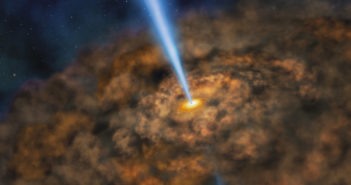
Hungry supermassive black holes in the distant cosmos can help us understand what happened shortly after our universe lit up with its first stars and galaxies. New work now probes the most distant supermassive black hole we’ve seen, searching for more clues.

Our Hazy Past

epoch of reionization

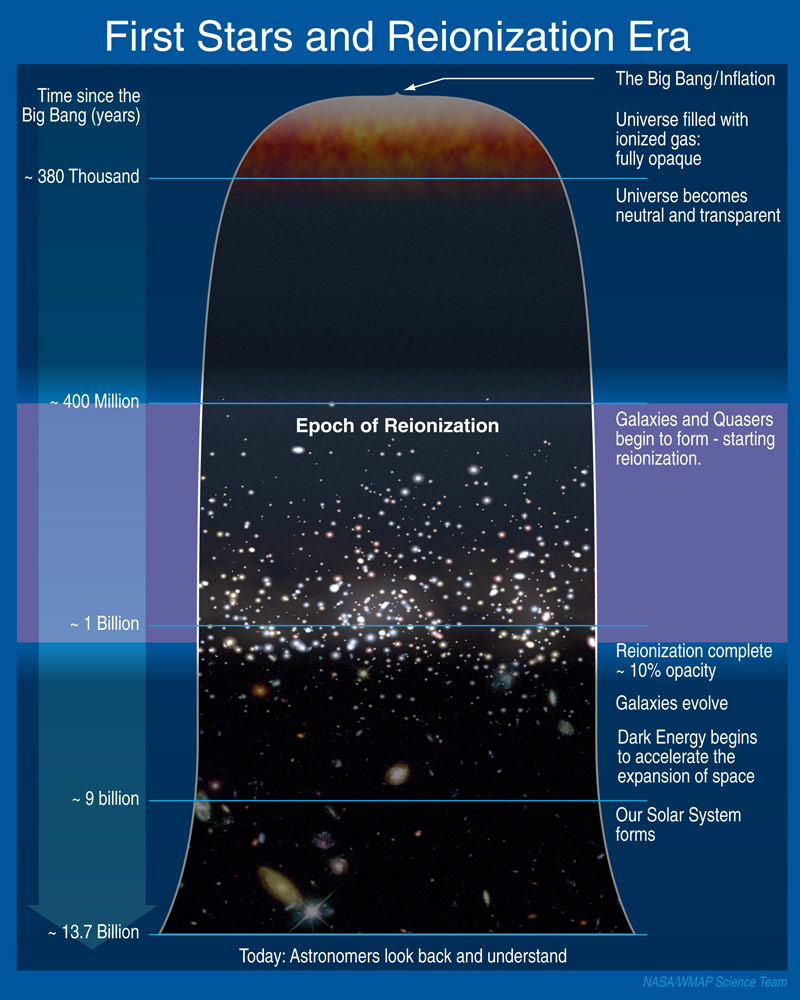
In the schematic timeline of the universe, the epoch of reionization is when the first galaxies and quasars began to form and evolve. Click to enlarge. [NASA]

Our early universe, starting just a few million years after the Big Bang, was a dark place. Space was filled with clouds of neutral hydrogen, but there were no sources of visible light.

At some point a few hundred million years after the birth of the universe, the earliest stars began to form, as well as the first large-scale structures like galaxies. Supermassive black holes grew in the centers of those galaxies, and as the black holes accreted mass, they produced powerful radiation, appearing to us now as distant quasars. Within a billion years of the Big Bang, quasars and stars lit the universe and shaped it into its current form.

The details and precise timeline of these critical evolutionary stages, however, remain uncertain.

Let’s Turn Back Time

One way we can further understand this evolution is by using quasars as cosmic clocks. By peering back in time and exploring the earliest known quasars, we learn about the metallicity of gas at the centers of early galaxies — which reveals when this gas first became enriched with the metals formed by early stars.

In a recent study, a team of scientists led by Masafusa Onoue (Max Planck Institute for Astronomy, Germany) has probed this crucial time using one particularly early clock: quasar ULAS J1342+0928.

AGN model

This schematic of a quasar includes the broad line region, orbiting clouds located very close to the central supermassive black hole. [Urry & Padovani 1995]

Peering into a Galaxy’s Center

ULAS J1342+0928 is the most distant, oldest known quasar; it’s located at a redshift of z = 7.54, which corresponds to a time just 680 million years after the Big Bang. Onoue and collaborators obtained deep near-infrared spectra of this distant source using the Gemini North telescope in Hawaii.

By modeling the spectra, Onoue and collaborators were able to measure the ratios of certain emission lines produced within the broad line region (BLR) of the quasar, a region of clouds that orbit very close to the central black hole.

The ratios of these emission lines can serve as a proxy for the clouds’ metallicity. Since this gas is thought to have originated from the interstellar medium of the host galaxy, the metallicity of BLR gas traces the galaxy’s star formation history, telling us when stars formed and enriched this gas with metals.

Early Metal Pollution

iron enrichment

The Fe II/Mg II line ratio, which traces the iron enrichment of the gas, is very similar for ULAS J1342+0928 (red diamonds, showing two different models) and other, closer quasars. Click to enlarge. [Onoue et al. 2020]

Onoue and collaborators found that ULAS J1342+0928’s BLR gas has similar metallicity to the BLR gas of other quasars located at lower redshifts. This result suggests that the enrichment of gas at the centers of galaxies is already largely completed within just 680 million years of the Big Bang — which constrains our understanding of when and how stars form and evolve in the early universe.

What’s next? We need observations of even more distant quasars to push this limit even farther back in time; while we’ve spotted a handful of galaxies at redshifts above z = 8, we’ll need to keep hunting to find quasars at these larger distances so that we can measure their metallicity.

Citation

“No Redshift Evolution in the Broad-line-region Metallicity up to z = 7.54: Deep Near-infrared Spectroscopy of ULAS J1342+0928,” Masafusa Onoue et al 2020 ApJ 898 105. doi:10.3847/1538-4357/aba193

MWC 758

It’s an old debate: gravity or companions? The spectacular spiral arms we see in some protoplanetary disks are likely caused by one or the other — and a recent study has taken a speedy approach to figuring out which.

What’s Driving Patterns?

Among the many swirling disks of gas and dust we’ve spotted around young, newly formed stars, more than a dozen contain a notable feature: large-scale spiral arms that can span tens to hundreds of astronomical units in size.

spiral disk

Artist’s impression of spiral arms in the disk surrounding a young star. [Institute of Astronomy, University of Cambridge — Amanda Smith & Farzana Meru]

The formation of these arms remains an open question. Are they caused by a gravitational instability that drives a spiral pileup of disk material? Or are they induced by the presence of a hidden planetary companion orbiting within the disk?

Either way, the answer will reveal valuable information about the system. If the spirals are driven by a gravitational instability, then we can constrain the mass of the disk. If they’re caused by the interaction of the disk with a planetary companion, we can infer the mass and location of the planet.

Past explorations of spiral arms have focused on examining static observations of disks. But a team of scientists led by Bin Ren (California Institute of Technology) has now taken a different approach, instead looking at how the arms of one disk move over time.

A Need for Speed … Measurements

Ren and collaborators gathered Very Large Telescope SPHERE observations of MWC 758, a young star and spiral-armed disk located just over 500 light-years away, spanning a baseline of nearly five years. They then fit models to MWC 758’s spiral arms to establish their pattern speeds — the angular speeds at which the arms are rotating.

The authors were looking for one of two potential outcomes linked to the origin of the arms:

  1. If driven by a gravitational instability, the material of the arms will move at the local Keplerian speed, set by the mass of the central star. This means the inner parts of the arms will move quickly and the outer parts more slowly, winding the arms up ever more over time.
  2. If driven by a planetary companion, the arms will move as a solid structure that matches the speed of the companion.

Time for Planet Hunting

MWC 758 driver orbit

The best-fit circular orbit of a planetary companion driving MWC 758’s spiral arms lies at ~170 au for a 1.9-solar-mass central star. [Ren et al. 2020]

Ren and collaborators find that the motions of the arms are not consistent with a gravitational-instability origin — the pattern speed is roughly a factor of 5 too slow for that! Instead, the spiral’s motion is well-fit by a model in which a planetary companion at ~170 au has created and maintains the arms.

Based on imaging of the disk, the authors set upper limits of about 5 Jupiter masses for the hidden planetary companion that’s driving the arms. The MWC 758 system makes an ideal target for future observations with current and upcoming telescopes to try to spot the planet driving its arms — especially now that we know where to look!

Citation

“Dynamical Evidence of a Spiral Arm–driving Planet in the MWC 758 Protoplanetary Disk,” Bin Ren et al 2020 ApJL 898 L38. doi:10.3847/2041-8213/aba43e

ALMA

The incredible power of ALMA, an array of telescopes located in the high deserts of Chile, has revolutionized our understanding of the structures built from gas and dust within our own galaxy. But ALMA can do more than that: it can also catalog the molecular gas and dust of galaxies located in the distant depths of our universe.

HUDF

Hubble Ultra-Deep Field image, a composite of exposures taken 2003-2012 that reveals roughly 10,000 galaxies in just a small section of space. Click to enlarge. [NASA/ESA/H. Teplitz & M. Rafelski (IPAC/Caltech)/A. Koekemoer (STScI)/R. Windhorst (Arizona State University)/Z. Levay (STScI)]

To better understand how galaxies evolve and form stars over time, scientists recently gathered the deepest ALMA observations yet, aiming the array at what is perhaps the most famous field of galaxies in astronomy: the Hubble Ultra-Deep Field (HUDF). This region of sky has been studied via more than a thousand hours of observations using a variety of telescopes, but ALMA provides a new view.

With ALMA, we can gain insight into the cold molecular gas and dust content of galaxies over time — and the remarkable sensitivity of this observatory has been harnessed in a recent, ambitious project called The ALMA Spectroscopic Survey in the Hubble Ultra-Deep Field, or ASPECS.

The newest results from ASPECS are now published in a set of articles in the Astrophysical Journal. Below, we take a brief look at some of the main outcomes of the set, but you can find more details in the original articles and in the press releases linked at the end of the post.

Hidden Star Formation

A first step toward understanding star formation in the distant universe is to figure out which galaxies are forming stars, and at what rates. This is relatively straightforward when the star formation is visible — but often it’s obscured by dust, preventing us from getting clear measurements.

The high sensitivity ALMA is ideal for this situation, however, and ASPECS observations were used to probe the dust-enshrouded star formation in 1,362 galaxies in the HUDF that are located in the redshift range of z = 1.5–10.

Exploring Fuel for Stars

With a clearer picture of star formation over time, it next makes sense to examine the raw material used to make stars.

ALMA HUDF

ASPECS detections within the HUDF. Pink circles denote molecular gas detections, blue squares denote dust, and green diamonds denote faint dust. Click to enlarge. [Aravena et al. 2020]

To do this, ALMA hunted for distant, cold gas and dust, revealing reservoirs in dozens of galaxies — including some unexpected sources with low star formation rates and stellar masses. The unprecedented depth of the ASPECS observations allowed the team to identify nearly all of the cold dust reservoirs from present day out to early cosmic times within the HUDF.

It’s generally understood that once the first stars started forming, star formation activity increased over time until it reached a peak at around z ~ 1–3, or “cosmic noon”. After that point, star formation activity substantially slowed to present day. The ASPECS observations now help us to better understand why.

ASPECS data show that the total amount of molecular gas in the universe increased until cosmic noon, when it began steadily declining. Today, the amount of molecular gas available for star formation is only around a tenth of what was available at cosmic noon! This is neatly consistent with that known cosmic history of star formation: star formation peaked at the same time as the molecular gas density peaked and has declined to present day — and will probably continue to decline until it ceases altogether.

What’s Next?

The ASPECS data is now being used to constrain cosmological models, helping us to better understand how galaxies evolve and stars are born. There’s still a lot of science to be done with the ASPECS observations, and today’s release of publications is just a start! Keep an eye out for more to come.

Bonus

Check out this video that demonstrates the locations of the dusty galaxies examined by ALMA, placed into context within the Hubble Ultra Deep Field.

[STScI, ASPECS Collaboration, Thomas Müller (HdA)]

Read More

ASPECS website
ALMA press release
MPIA press release

Citation

“The ALMA Spectroscopic Survey in the Hubble Ultra Deep Field: The nature of the faintest dusty star-forming galaxies,” Manuel Aravena et al 2020 ApJ 901 79. doi:10.3847/1538-4357/ab99a2
“The ALMA Spectroscopic Survey in the HUDF: CO Excitation and Atomic Carbon in Star-Forming Galaxies at z=1–3,” Leindert A. Boogaard et al 2020 ApJ 902 109. doi:10.3847/1538-4357/abb82f
“The ALMA Spectroscopic Survey in the HUDF: Multiband constraints on line–luminosity functions and the cosmic density of molecular gas,” Roberto Decarli et al 2020 ApJ 902 110. doi:10.3847/1538-4357/abaa3b
“The Evolution of the Baryons Associated with Galaxies Averaged over Cosmic Time and Space,” Fabian Walter et al 2020 ApJ 902 111. doi:10.3847/1538-4357/abb82e
“The ALMA Spectroscopic Survey Large Program: The Infrared Excess of z=1.5–10 UV-selected Galaxies and the Implied High-Redshift Star Formation History,” Rychard Bouwens et al 2020 ApJ 902 112. doi:10.3847/1538-4357/abb830
“The ALMA Spectroscopic Survey in the Hubble Ultra Deep Field: Constraining the Molecular Content at log(M*/M⊙) ~ 9.5 with CO Stacking of MUSE-detected z ~ 1.5 Galaxies,” Hanae Inami et al 2020 ApJ 902 113. doi:10.3847/1538-4357/abba2f

HR 6819 wide-field view

A few months ago, scientists announced the indirect detection of the nearest black hole to Earth. But another team is now suggesting a different explanation for this stellar puzzle.

HR 6819: History of a Mystery

From the earliest spectra of HR 6819, scientists identified this source as a bright, early-type Be star — a hot star with emission lines, likely due to the accretion of a circumstellar disk of material. As our ability to resolve detail in stellar spectra has advanced, however, a more complicated picture has emerged.

Studies in the 1980s revealed unexpected narrow absorption lines in HR 6819’s spectra, and a 2003 study showed that these lines were moving over time. This indicated that, though we couldn’t optically resolve them, there were two components of HR 6819: a Be star exhibiting no obvious motion, and a B3 III star on a 40-day orbit.

HR 6819 triple

Artist’s impression of HR 6819 as a triple system. Here, an inner binary consists of a star (blue orbit) and a black hole (red orbit). A third star (blue) circles the inner pair on a wider orbit. [ESO/L. Calçada]

But what was the B3 III star orbiting? In May 2020, scientists announced an answer to the puzzle: HR 6819 must actually be a triple system. The B3 III star, they argued, is orbiting a black hole (which is why we don’t see evidence of it in the spectra), and the Be star is a distant tertiary companion, orbiting too slowly to have detectable motion.

Based on the B3 III star’s orbit, the black hole would need to weigh more than 4 solar masses — and at just 1,120 light-years distance from Earth, this object would be the closest black hole known. But could there be another explanation for HR 6819’s spectra?

Just the Two of Us

In a new study, Georgia State University scientists Douglas Gies and Luqian Wang argue that HR 6819 isn’t a triple system after all. Instead, it’s a simple binary, consisting only of the two known components: the Be star, and the B3 III star.

If HR 6819 is merely a binary, then the Be star should show reflex orbital motion with the same period of 40 days — but this motion could be small, and hard to detect in the complex spectra of the system.

HR 6819 radial velocity

Observed and fitted radial velocity curves for the B3 III star (filled circles) and the disk surrounding the Be star (open circles). The evident orbital motion suggests the two stars comprise a binary system. [Gies & Wang 2020]

To look for it, Gies and Wang analyzed the Hα emission from the accretion disk surrounding the Be star. Using careful spectral modeling, they show that the entire disk can be seen to wiggle back and forth with a period of 40 days, exactly as expected for reflex orbital motion. This motion is roughly an order of magnitude less than that of the B3 III star, which is why it wasn’t previously spotted.

An Unequal Pair

So why is the Be star’s orbital motion so much smaller than that of its B3 III companion? If the Be star has a typical mass of ~6 solar masses, the companion must be only a fraction of a solar mass in size. It may be in a stage of evolution where it’s already donated a significant amount of mass to its companion, and now only the stripped-down remnant remains.

Is the case closed on HR 6819? Far from it! This system continues to challenge our assumptions and gives us the opportunity to practice the process of science as we work to explain our observations.

Citation

“The Hα Emission Line Variations of HR 6819,” Douglas R. Gies and Luqian Wang 2020 ApJL 898 L44. doi:10.3847/2041-8213/aba51c

K2-132b

A star like our Sun is destined to end its main-sequence lifetime by expanding to hundreds of times its current size, evolving into a red giant. But when this apocalypse comes, not all of the star’s planets are doomed! A new study shows how some planets can influence the fates of their siblings.

Surviving the Apocalypse

Six billion years into our future, the Sun will grow in size until its scalding surface reaches roughly the orbit of Earth, engulfing Mercury and Venus in the process. And our own inner planets aren’t the only ones under such a threat — close-in planets around Sun-like stars throughout the universe share this apocalyptic fate.

evolving star

Artist’s illustration of a red-giant star ejecting gas and dust. [JAXA]

But while the innermost planets of such systems will certainly be swallowed or vaporized, and the outermost planets will be largely unfazed by the drama in the distant inner solar system, the planets in between these extremes — at orbital distances of a few au — face a more uncertain future.

Now, new research led by María Ronco (Millennium Nucleus for Planet Formation and Pontifical Catholic University of Chile) suggests that the fate of these middle-ground planets depends strongly on their siblings.

Sibling Rivalry

A number of previous studies have explored the conditions under which planets can survive their hosts’ evolution through the red-giant phase to a white dwarf, but these studies have primarily focused on the outcomes for a single planet trying to ride out the apocalypse.

Ronco and collaborators instead explore how two planets — an inner Neptune-mass planet and an outer Jupiter-mass planet, both orbiting within a system at distances of a few au — might affect each other during their host star’s evolution.

With a Little Help

planet orbit outcomes

Want to test your luck in different scenarios? This grid outlines the fate of the Jupiter-mass planet (large squares) and Neptune-mass planet (small inner squares) as a function of their initial semi-major axes in the authors’ simulations. The dashed lines show mean motion resonances. Two particular cases are circled, wherein the presence of the outer planet changes the fate of the inner Neptune-mass planet. Click to enlarge. [Ronco et al. 2020]

When a star expands to red-giant size, there are two primary effects that can impact planetary orbits: tides induced on the star, which can reduce and circularize the planet orbits, and mass loss from the star, which can expand the planet orbits. But Ronco and collaborators’ models show that when more than one planet is present in the system, the interactions between these planets can have equally important effects on their eventual orbits.

In particular, when both planet orbits are near a mean-motion resonance (i.e., when their orbits have integer ratios, like when one planet orbits twice for every three orbits of its sibling), the Neptune-mass planet is excited to a more eccentric orbit. This has dramatic consequences: for Neptunes that, alone, might have survived the red-giant evolution of their host, the presence of the outer Jupiter can cause them to be engulfed. Similarly, for Neptunes that might have been engulfed alone, the presence of the Jupiter can save them from being swallowed.

Ronco and collaborators’ work demonstrates that when a star evolves through the red-giant phase, the gravitational interactions between its middle-distance planets play an important role in the planets’ survival or destruction. As we continue to explore these influences, we’ll be able to better understand the fates of solar systems like ours and what to expect for planetary architecture around evolved stars.

Citation

“How Jupiters Save or Destroy Inner Neptunes around Evolved Stars,” María Paula Ronco et al 2020 ApJL 898 L23. doi:10.3847/2041-8213/aba35f

turbulent disk

Planets begin their lives shrouded in mystery, embedded in the swirling disks of gas and dust that surround newly born stars. As we try to understand the physical processes at play in these obscured environments, one stands out as a particular unknown: turbulence. New observations have now given us a look at the presence — and absence — of turbulence in planet-forming disks.

A (Theoretical?) Disruption

turbulence

This image captures the transition between laminar and turbulent flow in the convection plume above a candle flame. [Gary Settles]

Turbulence — the same phenomenon that coaxes candle smoke into elaborate swirls, or causes a bumpy airplane ride — can theoretically influence just about every aspect of planet formation and evolution. Models indicate that these unpredictable fluid motions can affect the growth of grains and clumps, the evolution of a protoplanetary disk’s chemistry over time, and even the eventual orbital motion of fully-formed planets.

But are real planet-forming disks actually turbulent? This question is surprisingly difficult to answer, and we’ve managed only a handful of indirect measurements of turbulence in protoplanetary disks so far. A new study led by Kevin Flaherty (Williams College) uses the high resolution of the Atacama Large Millimeter/Submillimeter Array (ALMA) to add a few more data points to the collection, exploring gas motions in the outer regions of three different protoplanetary disks.

DM Tau spectra

ALMA spectrum of the DM Tau CO (2–1) emission (black line). The model that includes turbulence (red) is a significantly better fit to the data than the model with no turbulence (blue). [Adapted from Flaherty et al. 2020]

Smooth Sailing or Rough Seas

By using models to interpret the ALMA observations of carbon monoxide emission from the disks, Flaherty and collaborators were able to place constraints on the amount of turbulence in each of these three planet-forming environments.

The authors show that the disks MWC 480 and V4046 Sgr both have only weak — if any — turbulence. The disk DM Tau, on the other hand, is a different story: it shows gas speeds indicative of significant turbulent motion.

This dichotomy of results is convenient: it gives us an excellent opportunity to explore the similarities and differences between these disks to try to understand what factors lead to a turbulent planet-forming environment instead of a calm one.

Exploring Potential Factors

DM Tau

ALMA image of the dusty disk around the young star DM Tau. [ALMA]

One factor proposed to influence turbulence is the strength of ionizing radiation that reaches the outer disk. DM Tau is the only one of the three systems that doesn’t show evidence of a radiation-blocking inner disk wind, which could mean that more ionizing radiation reaches the disk’s outer edges in DM Tau, driving the turbulence we’ve observed.

Another option is that DM Tau might have stronger magnetic fields than the other systems. It’s also possible that the system’s age — at just a few million years old, DM Tau one of the youngest targets in the sample — could be a factor affecting turbulence strength.

Overall, Flaherty and collaborators suggest that weak turbulence may be a common feature in planet-forming disks — but it’s clear that some outliers like DM Tau exist. More observations like the ones presented here will help us to further understand these mysterious, shrouded planetary nurseries.

Citation

“Measuring Turbulent Motion in Planet-forming Disks with ALMA: A Detection around DM Tau and Nondetections around MWC 480 and V4046 Sgr,” Kevin Flaherty et al 2020 ApJ 895 109. doi:10.3847/1538-4357/ab8cc5

Voyager spacecraft

In 1977, two space probes were launched from Earth, flung out toward the farthest reaches of our solar system. Now, 43 years later, Voyager 1 and Voyager 2 are journeying through interstellar space — and they’re still providing new insights.

Voyaging to the Outer Edge

The original mission of the Voyager spacecraft was to study the giant planets in our outer solar system. But across 43 years and three mission extensions, these little probes have gone on to do so much more — most recently crossing out of the heliosphere and providing our first up-close look at interstellar space.

heliosphere

Artist’s conception of the heliosphere (shown in the opposite orientation as in the cover image above). The heliospheric nose is on the left here, and the tail is on the right. Click to enlarge. [NASA/Goddard/Walt Feimer]

What’s the heliosphere? As the solar wind streams from the Sun, it carries magnetic fields outward, inflating a bubble around the solar system that separates us from the surrounding interstellar medium (ISM). As the Sun orbits through the galaxy, the heliosphere is compressed on one side and elongated on the other, forming a blunt “nose” and a streaming “tail”.

Into the Unknown

When Voyagers 1 and 2 were launched, they were sent in slightly different directions — so they’re now exploring two different regions of the interface between the heliosphere and the interstellar medium. In 2012, Voyager 1 crossed the boundary of the heliosphere on one side of the nose, at a distance of ~122 au from the Sun. Voyager 2 followed suit in 2018, crossing the other side of the nose at a distance of ~119 au.

Voyager Antennae

This artist’s impression of one of the Voyager spacecraft shows, on the left, the V-shaped pair of antennae used to detect plasma oscillations. [NASA/JPL]

Now, both spacecraft are traveling through the very local ISM beyond the heliosphere. But despite their distance (the one-way light travel time to Voyager 1 is ~21 hours!), the probes are still reporting back data — including from the Plasma Wave Science (PWS) instrument on each craft, which uses the long, V-shaped pair of antennae to measure oscillations in the surrounding plasma. From these oscillations, we can infer the electron density of the ISM that the Voyager spacecraft are traveling through.

Denser and Denser

In a new publication, University of Iowa scientists William Kurth and Donald Gurnett report the latest PWS measurement from Voyager 2, which indicates that the electron density of the ISM is currently increasing as the probe travels away from the Sun. This discovery is neatly consistent with the data from Voyager 1, which has also been reporting an increasing radial density gradient since crossing the boundary of the heliosphere and entering interstellar space.

electron density

Electron density vs. radial distance from the Sun, as measured by the Voyager 1 (black) and Voyager 2 (red) spacecraft. The radial density gradient in the ISM can be seen in the data from both probes at distances above ~120 au. Click to enlarge. [Kurth & Gurnett 2020]

Voyagers 1 and 2 have trajectories that differ by 67° in latitude and 43° in longitude — so with the new Voyager 2 data published by Kurth and Gurnett, we now have confirmation that the radial density gradient first measured by Voyager 1 is a large-scale feature around the heliospheric nose.

Still More to Learn

What’s causing the gradient? Two theories have been put forward:

  1. the interaction of the solar wind with the very local ISM creates a pile-up region outside of the heliosphere, or
  2. draping of magnetic field lines over the outer boundary of the heliosphere depletes the plasma just inside the heliosphere.

We’ll potentially be able to differentiate between these two models once we have density measurements from even farther out in the ISM — so we’ll have to see if the Voyager probes last long enough to provide them!

Citation

“Observations of a Radial Density Gradient in the Very Local Interstellar Medium by Voyager 2,” W. S. Kurth and D. A. Gurnett 2020 ApJL 900 L1. doi:10.3847/2041-8213/abae58

BH-NS merger

On August 16, 2019, both the Fermi Gamma-ray Burst Monitor (GBM) and the Laser Interferometer Gravitational-wave Observatory (LIGO) detected faint blips that didn’t quite register as events. But could these ghost signals actually correspond to the first collision we’ve detected of a black hole with a neutron star?

Neutron Stars and Black Holes: Mix and Match

LIGO’s first detection of gravitational waves was GW150914, the collision of a pair of black holes. In the years since, LIGO has partnered with its European counterpart, Virgo, to make another dozen confirmed detections of binary black holes merging. The collaboration also spotted two instances of binary neutron stars colliding — one of which, GW170817, was accompanied by a short gamma-ray burst and emission spanning the electromagnetic spectrum.

Stellar Graveyard GW190521

A recent version of the “stellar graveyard”, a plot that shows the masses of the different components of confirmed compact binary mergers. No definite NS–BH mergers have been detected yet. Click to enlarge. [LIGO-Virgo/Northwestern U./Frank Elavsky & Aaron Geller]

But LIGO/Virgo’s mix-and-match collection is incomplete: we’re still waiting to detect a definite neutron-star–black-hole collision. In particular, we’d like to spot a merger in which the neutron star is tidally destroyed by the black hole, lighting up the sky with accompanying electromagnetic emission.

Could it be that such an event is actually hidden in the reject data from LIGO/Virgo and Fermi?

A Pair of Intriguing (Non-?)Events

The results from LIGO-Virgo’s third observing run, cut short by the pandemic in March 2020, are still being carefully analyzed by the collaboration. The O3 alert data, however, is publicly available — and a team of scientists have taken advantage of this to do some independent analysis, recently detailed in a publication led by Yi-Si Yang (Nanjing University, China).

Yang and collaborators take note of two faint signals that occurred on August 16, 2020:

Fermi light curve

The accumulated light curve for GBM-190816 shows the duration of the gamma-ray burst, roughly 0.1 seconds. [Adapted from Yang et al. 2020]

  1. A subthreshold gravitational-wave event in the LIGO/Virgo data — i.e., an event with a signal-to-noise ratio below 12, the threshold to qualify as a significant candidate.
  2. A subthreshold gamma-ray burst, GBM-190816, that was picked up by Fermi/GBM just 1.57 seconds after the gravitational-wave event.

If these two signals are both real and related, then GBM-190816 represents a short gamma-ray burst emitted from the merger of two compact objects — and Yang and collaborators’ analysis shows that, with a mass ratio of q ~ 2.26, the system is most likely a neutron-star–black-hole binary. In the simplest explanation, the neutron star was torn apart before the bodies ultimately merged, producing the pair of signals.

Identifying What’s Real

So are these subthreshold events real? We can’t say, yet! The public alerts from LIGO/Virgo only contain a portion of the signal information, so Yang and collaborators had to make a number of assumptions to analyze the event.

short vs. long GRBs

The parameters of GBM-190816 (marked by a red star), like the peak-to-background flux ratio vs. duration shown here, are consistent with typical short gamma-ray bursts (blue triangles). [Adapted from Yang et al. 2020]

That said, the faintness of both signals is reasonable given the parameters of this potential merger: if real, it took place at a distance of 1.4 billion light-years, roughly nine times farther away than GW170817. The gamma-ray spike was also extremely short — just ~0.1 seconds, compared to the ~2 second duration of GW170817 — which is what caused it to register below the Fermi/GBM trigger threshold.

If confirmed, this event could provide interesting insight into how the light emitted by such a merger escapes and travels to us. Now we just have to wait for the official joint analysis from the LIGO/Virgo/Fermi team!

Citation

“Physical Implications of the Subthreshold GRB GBM-190816 and Its Associated Subthreshold Gravitational-wave Event,” Yi-Si Yang et al 2020 ApJ 899 60. doi:10.3847/1538-4357/ab9ff5

Artist's impression of an M dwarf planetary system

Indirect detections of exoplanets rely heavily on the properties of their host stars. However, stellar features can sometimes masquerade as planetary signals. This issue is especially prominent for M dwarfs. So how do we know for sure if we’ve found a planet around an M dwarf?

Starring M Dwarfs

Despite the observational challenges they pose, M dwarfs present exciting prospects for exoplanet science. With their low masses, they are especially susceptible to the gravitational influence of any orbiting planets. When an M dwarf is tugged on by an orbiting planet, this affects the star’s radial velocity, creating a strong Doppler signal that we can detect in its spectrum.

Habitable Zones of A, G, and M stars

The extent of the habitable zone (highlighted in green) for A stars, G stars, and M stars. As indicated in the figure, the Sun is a G star. [NASA]

In addition, the habitable zone of an M dwarf is located very close to the star. This means that planets in the habitable zone of an M dwarf would produce a stronger Doppler signal than planets in the habitable zone of a higher mass, hotter A star.

But there’s a catch! While planets can produce detectable Doppler signals, so can M dwarfs themselves. Starspots, or cool regions on the surface of stars, can be prominent in the stellar spectra, and as an M dwarf rotates, starspots can mimic the effects of a planet.

So what’s to be done? M dwarfs are complicated beasts, so astronomers have been attempting to characterize them in more detail. In a new study, a group of researchers led by Paul Robertson (The University of California, Irvine) used optical and near-infrared observations of M dwarfs to understand the effects of starspots and other surface features.

Artist's impression of an M dwarf flaring

An artist’s impression of an M dwarf flaring like AD Leo was observed to do so earlier this year. However, AP Leo is not confirmed to host any planets. [National Astronomical Observatory of Japan]

Spinning Around and Around

For their study, Robertson and collaborators selected four rapidly-rotating M dwarfs. Here, “rapid” means the rotational speed at the surface of the star is about 3 to 11 kilometers per second. Three of the stars in the sample were chosen because they were similar to the fourth, AD Leo. AD Leo is only 16 light-years from the Earth and has been studied extensively in the context of its magnetic activity, flares, and starspots.

Robertson and collaborators pulled observations from a number of instruments, including the Transiting Exoplanet Survey Satellite and the HARPS Spectrograph. They also used data taken by the Habitable-zone Planet Finder on the Hobby-Eberly Telescope, which was built especially for finding low-mass planets around M dwarfs.

Separating Out Planetary Signals

RV Observations of GJ 3959

The phased radial-velocity/Doppler signals from the M dwarf GJ 3959 as observed by the Habitable-zone Planet Finder (HPF) and the High Resolution Echelle Spectrometer (HIRES). The phased signal represents a stacking of the observations based on the rotational period of GJ 3959, which is about half a day. [Robertson et al. 2020]

All four M dwarfs showed prominent Doppler signals that persisted for longer than expected — hundreds of stellar rotations! — and also synced up with the stars’ rotational periods. Since the stars in this sample aren’t known exoplanet hosts, these stable Doppler signals are likely caused by surprisingly persistent surface features like starspots.

These findings contain a blessing and a curse for exoplanet searchers. Any planets whose orbital period is similar to the rotational period of the star will be very hard to distinguish. The longevity of the signals means it’ll likely be a long wait for the surface features to die out so we can verify if a planet was contributing to the signal. However, since the Doppler signals are stable and fairly predictable, they could be modeled and removed.

This study highlights the challenges of searching for planets around M dwarfs. But the finds would definitely be worth the trouble!

Citation:

“Persistent Starspot Signals on M Dwarfs: Multiwavelength Doppler Observations with the Habitable-zone Planet Finder and Keck/HIRES,” Paul Robertson et al 2020 ApJ 897 125. doi:10.3847/1538-4357/ab989f

1 54 55 56 57 58 114