
Measuring a Black Hole’s Mass with Robotic Telescopes
Who needs humans? Robotic observations have been used to measure the mass of a supermassive black hole at the center of an active galaxy.

Who needs humans? Robotic observations have been used to measure the mass of a supermassive black hole at the center of an active galaxy.
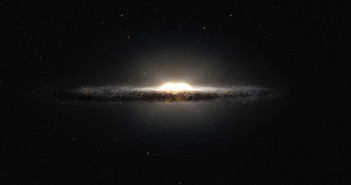
A new study has discovered a population of very young stars in a thin disk through the galactic center, providing clues to the star formation history of the Milky Way over the last 100 million years.
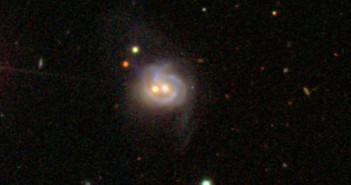
Dual active galactic nuclei are often produced when two galaxies collide, but they’re difficult to identify because the nuclei are so close together. Now, a team of authors has found a new way of confirming these objects.
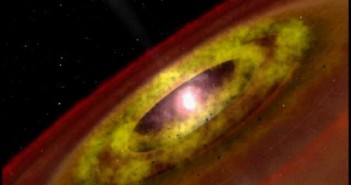
The T Tauri star PTFO 8-8695 has been suspected of harboring a close-in giant planet, but a recent study has cast doubt on this theory.
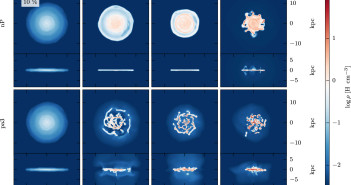
Could high rates of star formation, observed in galaxies at high redshifts, be explained by feedback from active nuclei at the centers of the galaxies?
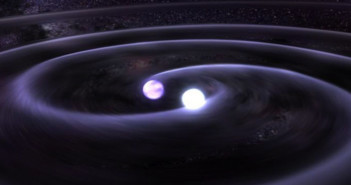
What remnant is formed by a neutron-star merger: another neutron star? Or a black hole? The answer determines whether or not an explosion of energy is released in the form of a gamma-ray burst.
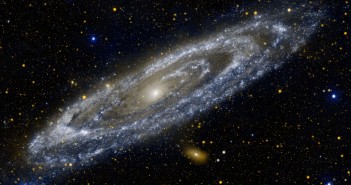
Usually stars that are born together tend to move together — but sometimes stars can go rogue and “run away” from their original birthplace. A pair of astronomers have now discovered the first runaway red supergiant ever identified in another galaxy.
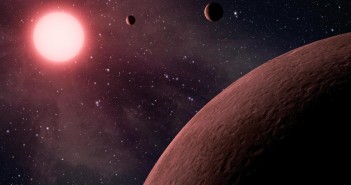
Kepler’s K2 mission has recently discovered two Earth-sized planets transiting a small, cool star only ~200 light-years away.
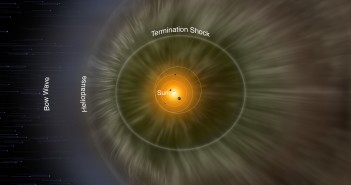
The Interstellar Boundary Explorer (IBEX) is a mission designed to map the boundary between our solar system and interstellar space. A series of results from the first six years of the IBEX mission have just been released.
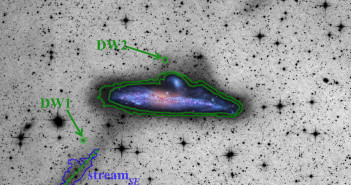
A recent study argues that an enormous stellar stream extending from NGC 4631, the “Whale” galaxy, is evidence that this galaxy has grown by tearing apart and absorbing smaller satellite galaxies nearby.