Features RSS

hot Jupiter

Two researchers at the University of Chicago have recently developed a new theory to explain an apparent dichotomy in the orbits of planets around cool vs. hot stars. Their model proposes that the spins of cool stars are affected when they ingest hot Jupiters (HJs) early in their stellar lifetimes.

A Puzzling Dichotomy

In exoplanet studies, there is a puzzling difference observed between planet orbits around cool and hot (those with Teff ≥ 6250 K) stars: the orbital planes of planets around cool stars are primarily aligned with the host star’s spin, whereas the orbital planes of planets around hot stars seem to be randomly distributed.

Previous attempts to explain this dichotomy have focused on tidal interactions between the host star and the planets observed in the system. Now Titos Matsakos and Arieh Königl have taken these models a step further — by including in their calculations not only the effects of observed planets, but also those of HJs that may have been swallowed by the star long before we observed the systems.

Modeling Meals

Plots of the distribution of the obliquity λ for hot Jupiters around cool hosts (upper plot) and hot hosts (lower plot). The dashed line shows the initial distribution, the bins show the model prediction for the final distribution after the systems evolve, and the black dots show the current observational data. [Matsakos & Königl, 2015]

Plots of the distribution of the obliquity λ for hot Jupiters around cool hosts (upper plot) and hot hosts (lower plot). The dashed line shows the initial distribution, the bins show the model prediction for the final distribution after the systems evolve, and the black dots show the current observational data. [Matsakos & Königl, 2015]

The authors’ model assumes that as HJs are formed and migrate inward through the protoplanetary disk, they stall out near the star (where they have periods of ~2 days) and get stranded as the gas disk evaporates around them. Tidal interactions can cause these planets to become ingested by the host star within 1 Gyr.

Using Monte Carlo simulations, the authors model these star-planet tidal interactions and evolve a total of 10^6 systems: half with hot (Teff = 6400 K), main-sequence hosts, and half with cool (Teff = 5500 K), solar-type hosts. The initial obliquities — the angle between the stellar spin and the planets’ orbital angular momentum vectors — are randomly distributed between 0° and 180°.

The authors find that early stellar ingestion of planets might be very common: to match observations, roughly half of all stellar hosts must ingest an HJ early in their lifetimes!

This scenario results in a good match with observational data: about 50% of cool hosts’ spins become roughly aligned with the orbital plane of their planets after they absorb the orbital angular momentum of the HJ they ingest. Hot stars, on the other hand, generally retain their random distributions of obliquity, because their angular momentum is typically higher than the orbital angular momentum of the ingested planet.


Citation

Titos Matsakos and Arieh Königl 2015 ApJ 809 L20 doi:10.1088/2041-8205/809/2/L20

Local Group

When a dwarf galaxy falls into the halo of a large galaxy like the Milky Way, how is star formation in the dwarf affected? A collaboration led by Andrew Wetzel (California Institute of Technology and Carnegie Observatories) recently set out to answer this question using observations of nearby galaxies and simulations of the infall process.

Observed Quenching

Isolated dwarf galaxies tend to be gas-rich and very actively star-forming. In contrast, most dwarf galaxies within 300 kpc of us (the Milky Way’s virial radius) contain little or no cold gas, and they’re quiescent: there’s not much star formation happening.

And this isn’t just true of the Milky Way; we observe the same difference in the satellite galaxies surrounding Andromeda galaxy. Once a dwarf galaxy has moved into the gravitational realm of a larger galaxy, the satellite’s gas vanishes rapidly and its star formation is shut off — but how, and on what timescale?

Known dwarf galaxies

The known dwarf galaxies in the Local Group (out to 1.6 Mpc) are plotted by their distance from their host vs. their stellar mass. Blue stars indicate actively star-forming dwarfs and red circles indicate quiescent ones. Credit: Wetzel et al. 2015.

Timescales for Quiescence

To answer these questions, the authors explored the process of galaxy infall using Exploring the Local Volume in Simulations (ELVIS), a suite of cosmological N-body simulations intended to explore the Local Group. They combined the infall times from the simulations with observational knowledge of the fraction of nearby galaxies that are currently quiescent, in order to determine what timescales are required for different processes to deplete the gas in the dwarf galaxies and quench star formation.

Based on their results, two types of quenching culprits are at work: gas consumption (where a galaxy simply uses up its immediate gas supply and doesn’t have access to more) and gas stripping (where external forces like ram pressure remove gas from the galaxy).

These processes operate at different rates for different sizes of galaxies. The authors argue that for galaxies with stellar mass larger than 109 solar masses, the primary means of quenching is gas consumption. The timescale for this mechanism to quench the largest galaxies is roughly 5 Gyr. For galaxies with stellar mass smaller than 109 solar masses, gas stripping takes over, and star-formation is quenched within 1 Gyr for the smallest galaxies.

Neither quenching mechanisms operates efficiently for galaxies with stellar mass right around 109 solar masses, though, so these galaxies can sustain star formation for much longer. This could explain why the Magellanic clouds (which both have stellar mass of roughly 109 solar masses) are still star-forming despite being within the Milky Way’s halo!


Citation

Andrew R. Wetzel et al. 2015 ApJ 808 L27 doi:10.1088/2041-8205/808/1/L27

RGG 118

A team of astronomers have reported the detection of the smallest black hole (BH) ever observed in a galactic nucleus. The BH is hosted in the center of dwarf galaxy RGG 118, and it weighs in at 50,000 solar masses, according to observations made by Vivienne Baldassare of University of Michigan and her collaborators.

Small Discoveries

Why is the discovery of a small nuclear BH important? Some open questions that this could help answer are:

  • Do the very smallest dwarf galaxies have BHs at their centers too?
    Though we believe that there’s a giant BH at the center of every galaxy, we aren’t sure how far down the size scale this holds true.
  • What is the formation mechanism for BHs at the center of galaxies?
  • What’s the behavior of the M-sigma relation at the low-mass end?
    The M-sigma relation is an observed correlation between the mass of a galaxy’s central BH and the velocity dispersion of the stars in the galaxy. This relation is incredibly useful for determining properties of distant BHs and their galaxies empirically, but little data is available to constrain the low-mass end of the relation.
M-sigma relation

M-sigma relation, plotting systems with dynamically-measured black hole masses. RGG 118 is plotted as the pink star. The solid and dashed lines represent various determinations of scaling relations. Credit: Baldassare et al. 2015.

Identifying a Black Hole

RGG 118 was identified as a candidate host for an accreting, nuclear BH from the catalog of dwarf galaxies observed in the Sloan Digital Sky Survey. Baldassare and her team followed up with high-resolution spectroscopy from the Clay telescope in Chile and Chandra x-ray observations.

Using these observations, the team determined that RGG 118 plays host to a massive BH at its center based on three clues: 1) narrow emission line ratios, which is a signature of accretion onto a massive BH, 2) the presence of broad emission lines, indicating that gas is rotating around a central BH, and 3) the existence of an X-ray point source at the nucleus of the galaxy.

The spread in the broad emission lines was what allowed Baldassare and collaborators to estimate the mass of the BH, placing it firmly on the extrapolation of the M-sigma relation. In addition to helping us further understand this relation, this unique BH also constrains nuclear BH formation: we know that pathways must produce seeds at least this large! The group hopes that continued analysis of Sloan candidates might allow for the discovery of more such BHs at the centers of dwarf galaxies.


Citation

Vivienne F. Baldassare et al. 2015 ApJ 809 L14 doi:10.1088/2041-8205/809/1/L14

IR Galactic Center

Could stars be forming in the inhospitable environment near Sagittarius A* in the heart of the Milky Way? A possible signature of low-mass star formation has recently been found just two light-years from the black hole at the center of our galaxy — a region that was previously thought to be too hostile for such activity.

Searching for Signatures

Previous observations of the central few light-years of the Milky Way had focused on a population of about 200 massive, young and very bright stars in tight orbits around Sgr A*. These stars are only a few million years old and prompted scientists to wonder: have they somehow managed to form in situ, in spite of their close proximity to the black hole, or did they form further out and then migrate in?
Motivated by this mystery, Farhad Yusef-Zadeh of Northwestern University and collaborators looked for evidence of even younger stars close to Sagittarius A*, which would demonstrate that star formation in the area is an ongoing process. Using the Very Large Array (VLA), the collaboration discovered several small sources in one arm of activity near Sgr A*.

Proplyds

This 34-GHz image provides a close-up view of two protoplanetary disk candidates (labeled P26 and P8) located near Sgr A*. These objects are outlined on the right side by a bow shock caused by impacting stellar wind that streams from the young, hot stars closer to the Galactic center. The disks are thought to contain recently-formed, low-mass stars. (Credit: Yusef-Zadeh et al., 2015)

Heated Disks

The team identified these sources as candidate photoevaporative protoplanetary disks, or “proplyds” — areas of dense, ionized gas and dust surrounding young, newly formed stars. The proplyd candidates are between 10,000 and 100,000 years old, and they lie along the edge of a large molecular cloud. It is likely that this cloud produced the disks by providing a reservoir of gas to feed the star-formation activity.
The region surrounding these proplyds is blasted with harsh ultraviolet radiation streaming from hot stars orbiting close to Sgr A*. The gas of the proplyds is heated and stripped away by this radiation, forming bow shocks around the disks. Both the proplyds themselves and the bow shocks surrounding them are visible in Yusef-Zadeh’s observations.

Potential for Planet Formation

Unlike the young massive stars that have previously been identified in the galactic center, the proplyd candidates in this study are associated with low-mass stars. This has led to speculation that it may in fact be easier for low-mass stars to form in the hostile surroundings of the black hole than it is for them to form elsewhere in the Milky Way. In addition, the rate at which material is lost from such proplyds is expected to be low, so there is a chance for the disk to eventually form planets. With that comes the tantalizing possibility that as telescope resolution and data-analysis techniques improve, we may even be able to watch planet formation occur near Sgr A*.

Citation

F. Yusef-Zadeh et al. 2015 ApJ 801 L26 doi:10.1088/2041-8205/801/2/L26

Bonus:

Check out the authors’ video abstract below, which shows the locations of the proplyd candidates relative to Sgr A* and provides more information about how the observations were made and analyzed.

CR7

Elusive Population

Population III stars — the theoretical generation of extremely metal-poor stars that should have been formed in the early universe before metals existed — have been conspicuously absent in observations. But a team led by David Sobral (Institute of Astrophysics and Space Sciences, University of Lisbon, and Leiden Observatory) may have changed this paradigm with their recent detection of an extremely bright galaxy in the early universe.

The team’s broad survey of distant galaxies using ESO’s Very Large Telescope provides a glimpse of the universe as it was only 800 million years after the Big Bang. The survey uncovered several unusually bright galaxies — including the brightest galaxy ever seen at this distance, an important discovery by itself.

But further scrutiny of this galaxy, named CR7, produced an even more exciting find: a bright pocket of the galaxy contained no sign of any metals. Follow-up with other telescopes confirmed this initial detection.

Formation Waves

Sobral and his team postulate that we are observing this galaxy at just the right time to have caught a cluster of Population III stars — the bright, metal-free region of the galaxy — at the end of a wave of early star formation. The observations of CR7 also suggest the presence of regular stars in clumps around the metal-free pocket. These older, surrounding clusters may have formed stars first, helping to ionize a local bubble in the galaxy and allowing us to now observe the light from CR7.

It was previously thought that Population III stars might only be found in small, dim galaxies, making them impossible for us to detect. But CR7 provides an interesting alternative: this galaxy is bright, and the candidate Population III stars are surrounded by clusters of normal stars. This suggests that these first-generation stars might in fact be easier to detect than was originally thought.

Additional follow-up observations with other telescopes will help to confirm the identity of these stars. In particular, the James Webb Space Telescope is expected to further advance the pursuit of the earliest galaxies and stars in the universe.

Citation

David Sobral et al. 2015 ApJ 808 139 doi:10.1088/0004-637X/808/2/139


Disk galaxies

What were galaxies like in the first 500 million years of the universe? According to simulations by Yu Feng (UC Berkeley) and collaborators, the earliest massive galaxies to form were mostly disk-shaped, rather than the compact clumps previously predicted.

Early-Galaxy Models

Current models for galaxy formation predict that small perturbations in the distribution of matter in the early universe collapsed to form very compact, irregular, clumpy first galaxies. Observations support this: the furthest out that we’ve spotted disk-shaped galaxies is at z=3, whereas the galaxies we’ve observed from earlier times — up to redshifts of z=8–10 — are very compact.

But could this be a selection effect, arising from the rarity of large galaxies in the early universe? Current surveys at high redshift have thus far only covered relatively small volumes of space, so it’s not necessarily surprising that we haven’t yet spotted any large disk galaxies. Similarly, numerical simulations of galaxy formation are limited in the size of the volume they can evolve, so resulting models of early galaxy formation also tend to favor compact clumpy galaxies over large disks.

An Enormous Simulation

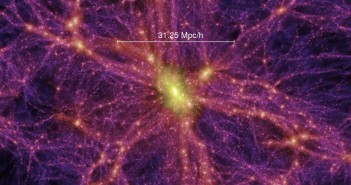
Pushing at these limitations, Feng and his collaborators used the Blue Waters supercomputer to carry out an enormous cosmological hydrodynamic simulation called BlueTides. In this simulation, they track 700 billion particles as they evolve in a volume of 400 comoving Mpc/h — 40 times the volume of the largest previous simulation and 300 times the volume of the largest observational survey at these redshifts.

What they find is that by z=8, a whopping 70% of the most massive galaxies (over 7 billion solar masses each) were disk-shaped, though they are more compact, gas-rich, and turbulent than present-day disk galaxies like the Milky Way. The way the most massive galaxies formed in the simulation also wasn’t expected: rather than resulting from major mergers, they were built from smooth accretion onto the disks from nearby filaments.

These simulations suggest we still have a lot to learn about the structure of galaxies in the early universe and how they formed. Luckily, future telescope projects should help us out: Feng and collaborators estimate that the WFIRST satellite, for instance, should have the capability to detect 8000 disk galaxies of the type BlueTides predicts — compared to the weak 30% chance of finding a single one in the current largest-area Hubble survey!


BlueTides

This graphic shows the scope of the BlueTides simulation; click to get a better look! The insets show the environment of the most massive black hole and the most massive disk galaxy at different scales. Crosses mark the positions of supermassive black holes. Credit: bluetides-project.org

Citation

Yu Feng et al. 2015 ApJ 808 L17. doi:10.1088/2041-8205/808/1/L17

Pluto geologic activity

New Horizons scientists Kelsi Singer and Alan Stern predicted that Pluto may have subsurface activity, in this study published even before New Horizon’s recent observations of Pluto’s strangely uncratered surface areas.

Where Does the Nitrogen Come From?

Pluto’s surface and atmosphere contain a significant amount of nitrogen, but the gas leaks out of Pluto’s atmosphere at an tremendous rate — estimated at about 1.5 × 1012-13 grams per year (roughly 200-2000 tons/hr!). But if the nitrogen has been escaping at this rate since the solar system was formed, the entire atmospheric reservoir of would have been lost long before now. So what is resupplying Pluto’s nitrogen?

Singer and Stern explore several possible sources:

  1. Delivery by comet impact
    The authors calculate that over the 4-billion-year span since Pluto’s formation, it has been impacted by a total of 600 million comets of varying sizes, all likely containing nitrogen. But their estimates show that the amount of nitrogen this would supply falls several orders of magnitude shy of explaining the escape rate.
  2. Excavation by cratering
    Could comet impacts simply expose nitrogen buried in reservoirs just beneath Pluto’s surface? That method, too, falls short of resupplying atmospheric nitrogen escape by at least an order of magnitude, even using the most generous estimates.
  3. Internal activity
    Unless the believed atmospheric loss rate of Pluto is overestimated, the authors conclude that Pluto must experience some sort of internal activity such as cryovolcanism that brings nitrogen from below its surface up and into the atmosphere.

The Study in Context of Current Events

Singer and Stern wrote and submitted this paper before the New Horizons spacecraft’s recent flyby of Pluto. Data from this mission has recently provided surprise after surprise — from images of smooth, crater-free regions on Pluto’s surface to evidence of sheets of carbon monoxide, methane, and nitrogen ices flowing like glaciers.

These clues support Singer and Stern’s theories of internal activity, but raise new questions about the nature of that activity! As data from New Horizons keeps streaming in (in fact, atmospheric data from the Alice instrument is expected to pin down the atmospheric loss rate very soon), we can hope to continue to piece this picture together.


Citation:

Kelsi N. Singer and S. Alan Stern 2015 ApJ 808 L50 doi:10.1088/2041-8205/808/2/L50

BH-NS eccentric merger

When a neutron star (NS) has a glancing encounter with a black hole (BH), its spin has a significant effect on the outcome, according to new simulations run by William East of Stanford University and his collaborators.

Spotting an Eccentric Merger

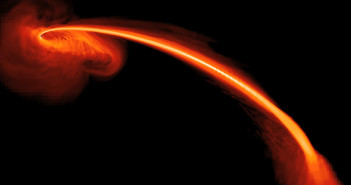
In a traditional BH-NS merger, the two objects orbit each other quasi-circularly as they spiral in. But there’s another kind of merger that’s possible in high-density environments like galactic nuclei or globular clusters: a dynamical capture merger, in which a NS and BH pass each other just close enough that the gravity of the black hole “catches” the NS, leading the two objects to merge with very eccentric orbits.

During an eccentric merger, the NS can be torn apart — at which point some fraction of the tidally-disrupted material will escape the system, while some fraction instead accretes back onto the BH. Knowing these fractions is important for being able to model the expected electromagnetic signatures for the merger: the unbound material can power transients like kilonovae, whereas the accreting material may be the cause of short gamma-ray bursts. The amount of material available for events like these would change their observable strengths.

Testing the Effects of Spin

To see whether NS spin has an impact on the behavior of the merger, East and collaborators use a general-relativistic hydrodynamic code to simulate the glancing encounter of a BH and a NS with dimensionless spin between a=0 (non-spinning) and a=0.756 (rotation period of 1 ms). They also vary the separation of the first encounter.

The group finds that changing the NS’s spin can change a number of outcomes of the merger. To start with, it can affect whether the NS is captured by the BH, or if the encounter is glancing and then both objects carry on their merry way. And if the NS is trapped by the BH and torn apart, then the higher the NS’s spin, the more matter outside of the BH ends up unbound, instead of getting trapped into an accretion disk around the BH.

As a result of these simulations, the authors argue that the spin of NSs in dynamical capture mergers is crucially important for correctly modeling the observational signatures that might come out of them.


Citation:

William E. East et al. 2015 ApJ 807 L3 doi:10.1088/2041-8205/807/1/L3

Kuiper belt analog

A debris disk just discovered around a nearby star is the closest thing yet seen to a young version of the Kuiper belt. This disk could be a key to better understanding the interactions between debris disks and planets, as well as how our solar system evolved early on in its lifetime.

Hunting for an analog

The best way to understand how the Kuiper belt — home to Pluto and thousands of other remnants of early icy planet formation in our solar system — developed would be to witness a similar debris disk in an earlier stage of its life. But before now, none of the disks we’ve discovered have been similar to our own: the rings are typically too large, the central star too massive, or the stars exist in regions very unlike what we think our Sun’s birthplace was like.

A collaboration led by Thayne Currie (National Astronomical Observatory of Japan) has changed this using the Gemini Planet Imager (GPI), part of a new generation of extreme adaptive-optics systems. The team discovered a debris disk of roughly the same size as the Kuiper belt orbiting the star HD 115600, located in the nearest OB association. The star is only slightly more massive than our Sun, and it lives in a star-forming region similar to the early Sun’s environment. HD 115600 is different in one key way, however: it is only 15 million years old. This means that observing it gives us the perfect opportunity to observe how our solar system might have behaved when it was much younger.

A promising future

GPI’s spatially-resolved spectroscopy, combined with measurements of the reflectivity of the disk, have led the team to suspect that the disk might be composed partly of water ice, just as the Kuiper belt is. The disk also shows evidence of having been sculpted by the motions of giant planets orbiting the central star, in much the same way as the outer planets of our solar system may have shaped the Kuiper belt.

The observations of HD 115600 are some of the very first to emerge from GPI and the new generation of planet-hunting instruments. The detection of this disk provides a promising outlook on what we can expect to discover in the future with these systems.

Citation:

Thayne Currie et al. 2015 ApJ 807 L7 doi:10.1088/2041-8205/807/1/L7

M85

Two surprisingly small heavy-weights have been discovered around galaxies in the nearby Virgo cluster by a team led by undergrads Michael Sandoval and Richard Vo and their advisor Aaron Romanowsky of San Jose State University. Setting a new record, these two objects now hold the title of the densest galaxy and the densest free-floating stellar system ever observed.

Classification Difficulties

What is the difference between large star clusters and small galaxies? Once thought to be distinct categories, the decade-old discovery of a new class of object, ultracompact dwarfs (UCDs), blurred the line between them somewhat: UCDs sit awkwardly between the two categories in size, mass and luminosity. So what are UCDs? It’s hard to say — in part because their full range of possible parameters has yet to be carefully explored.

Sandoval and his team set out to address this problem by combing through archival data from the Sloan Digital Sky Survey, searching for objects that display properties between those of star clusters and galaxies. Their search yielded two especially interesting objects: one around the galaxy M59, and the other around M85 (see figure 2). Follow-up observations with Subaru Telescope and the Southern Astrophysical Research telescope provided additional imaging and spectroscopic information.

Density plot

Plot of stellar surface mass density vs. mass of known stellar systems. The data include the two new objects (M85-HCC1 and M59-UCD3) as well as globular clusters, UCDs, and compact elliptical galaxies. Credit: Sandoval et al. 2015

Record-Breakers

What makes these two discoveries so unusual? Both are remarkably dense compared to similar objects! The first, M59-UCD3, was categorized as an ultracompact dwarf galaxy — but it’s significantly more dense than any other galaxy discovered. The night sky in M59-UCD3 would appear to contain roughly a million stars, compared to the few thousand we see overhead here in the Solar neighborhood.

M85-HCC1 is another ten times denser than even that! It’s such an unusual stellar system that it defies classification in the usual categories, which is why Sandoval and collaborators created a new name for this type of object: hypercompact cluster.

In spite of the differences between these two stellar systems, the team argues that there is evidence that they were formed the same way. They believe that both objects are galactic centers that have been tidally stripped of all of the outlying stars and gas, leaving only the dense cores behind. They argue that this could be caused by mergers of M59 and M85 with intermediate mass galaxies. If true, searching for more of these unique objects could provide us with clues to how galaxies were assembled.

Citation:

Michael Sandoval et al. 2015 ApJ 808 L32 doi:10.1088/2041-8205/808/1/L32

Bonus:

Check out this cool visualization from the authors of how tidal stripping of a small galaxy might happen. This is one theory of how UCDs are formed.

1 119 120 121 122