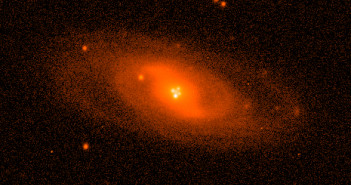
Supermassive Black Hole Through a Magnifying Glass
Gravitational microlensing of quasar Q2237+0305 has provided us with a close look at the structure within the innermost region surrounding its central black hole.

Gravitational microlensing of quasar Q2237+0305 has provided us with a close look at the structure within the innermost region surrounding its central black hole.
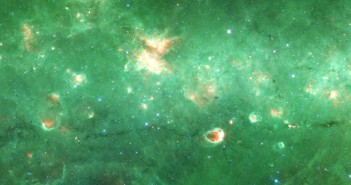
A recently discovered dark cloud nicknamed “Nessie” may have companions that make up a skeleton of the Milky Way, tracing out the densest parts of our galaxy’s spiral arms.
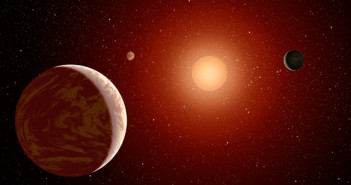
How did short-period Super-Earths come to exist so close to their host star? To address this question, a new study examines what the preferred hosts are for short-period exoplanets.
An isolated white dwarf was recently discovered to dim periodically, prompting a search for the cause of its variability.
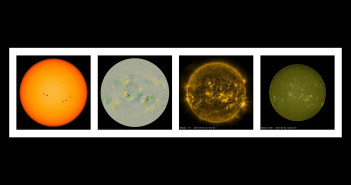
Looking for “wobbling” stars is a useful way to detect exoplanets, but stellar noise prevents us from reaching the precision needed to find Earth-twin planets. The key to solving this problem may be to examine our own star.
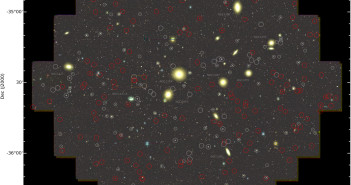
The recent discovery of 158 previously undetected dwarf galaxies in the Fornax cluster may help to solve a long-standing puzzle in galaxy formation and evolution.
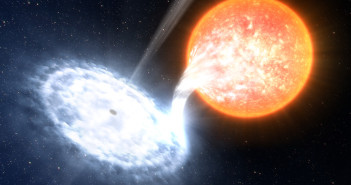
In June of this year, the black hole V404 Cygni woke up after nearly three decades of sleep. Now we’re getting the first descriptions of what we’ve learned from its awakening!
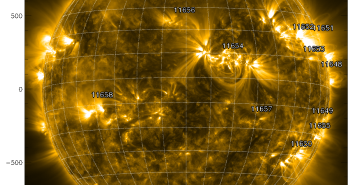
Recent analysis of a powerful solar outburst — captured on video by several Sun-monitoring spacecraft — may help us to understand how it was launched.
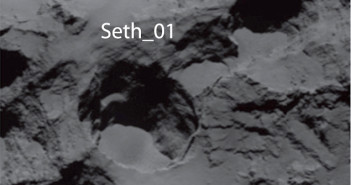
The surface of comet 67P Churyumov–Gerasimenko is covered in active pits — some measuring hundreds of meters both wide and deep! But what processes caused these pits to form?
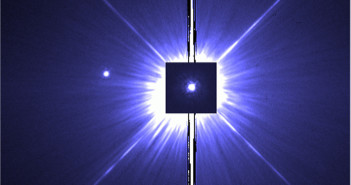
The subgiant and white dwarf of the Procyon binary system orbit each other with a tiny angular separation, creating a distinct challenge for astronomers to observe. Two decades of Hubble observations have now finally revealed some of its secrets.