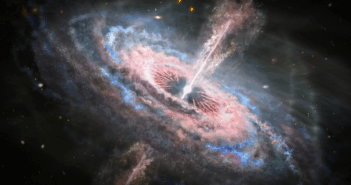
Intergalactic Impacts of Quasars During the Epoch of Reionization
A recent study with JWST has unveiled how a reionization-era quasar has suppressed star formation in its galactic neighbors.

A recent study with JWST has unveiled how a reionization-era quasar has suppressed star formation in its galactic neighbors.
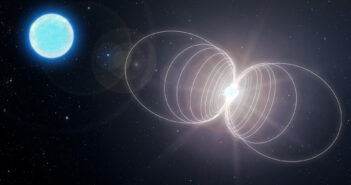
Researchers examine the possibility that one-off and repeating fast radio bursts could both arise from magnetars.
AT2024wpp is the most powerful fast blue optical transient spotted so far. What do extensive X-ray and radio observations tell us about this event?
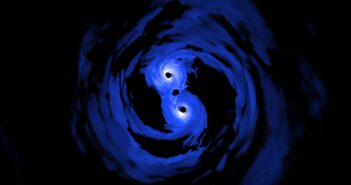
Researchers show how preferential accretion in a merging pair of supermassive black holes can explain the unexpectedly large amplitude of the gravitational wave background.
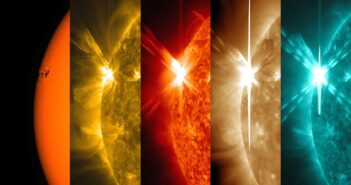
Researchers have investigated how solar flares might signal that they’re about to occur and whether they’ll be accompanied by an explosion of plasma.
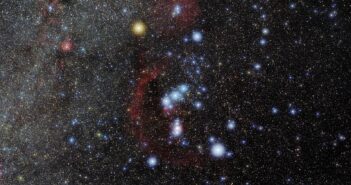
What can ultraviolet observations from Hubble tell us about the identity of Betelgeuse’s likely companion star?
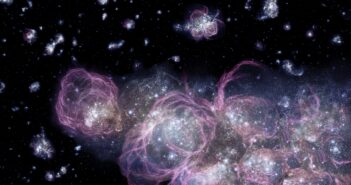
JWST discovered a distant galaxy with too much nitrogen, which has led to evidence of the universe’s first stars.
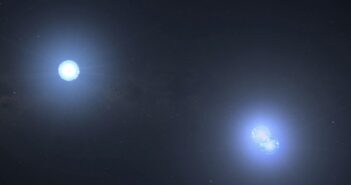
New research suggests that triplet stars might be able to evolve into every observable type of stellar-mass black hole system.

By studying the orbits of rare outer solar system objects, astronomers have estimated how long it took for the Sun to leave its birth cluster.
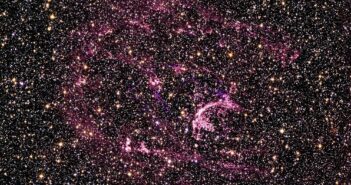
When supernovae explode, they send a fast-moving shock wave into the interstellar medium, changing the local landscape significantly. A recent publication hones in on one supernova remnant to determine how fast it’s expanding and where it may have come from.