AAS News RSS

Sculptor dwarf galaxy

Editor’s Note: This week we’re at the 232nd AAS Meeting in Denver, CO. Along with a team of authors from Astrobites, we will be writing updates on selected events at the meeting and posting each day. Follow along here or at astrobites.com. The usual posting schedule for AAS Nova will resume next week.

Plenary Lecture: Small Interstellar Molecules and What They Tell Us (by Kerry Hensley)

The first talk of the day was the Laboratory Astrophysics Division plenary given by Dr. David Neufeld (Johns Hopkins University). While biologists and chemists can poke and prod some of the substances they study, astrophysicists aren’t so lucky. Other than rocks from the Moon and a puff of cometary dust captured in aerogel, we get most of our information about the universe from photons and gravitational waves (other than solar system missions, through which we can directly probe magnetic fields and plasma — but we don’t get to bring those home with us!). Laboratory astrophysics is a powerful tool to help us interpret the messages those photons are sending, giving us a better idea of the physics at work in the universe.

Dr. Neufeld specializes in laboratory studies of small molecules, the kind that might be found in the interstellar medium or the material surrounding young stars. In particular, Dr. Neufeld studies a class of small molecules called hydrides — molecules made up of just one heavy element (typically one that is happy to donate electrons) and any number of hydrogen atoms. So, for example, ammonia is a hydride since it contains only one “heavy” element (nitrogen).

These tiny molecules are particularly helpful in three situations:

  1. Tracing cold molecular hydrogen gas
    Take hydrogen fluoride (HF) as an example. Laboratory studies showed that HF should form readily in cold environments from molecular hydrogen and fluorine, so even though fluorine isn’t extremely abundant in the universe, it should form HF whenever it’s in a cold environment with abundant molecular hydrogen — like the interstellar medium. Observations of diffuse interstellar clouds showed that HF was present — and could be used to trace more diffuse clouds than carbon monoxide could. Just one example of how laboratory astrophysics can guide observational astrophysics!
  2. Tracing gas that has been warmed by shocks or turbulence
    Warm interstellar gas can also be traced by hydrides, in this case SH, SH+, and CH+. These molecules react endothermically with H2, and the amount of heat needed for the reaction differs between the three molecules. Determining the amount of each of the three compounds in an interstellar cloud can help us figure out the temperature of the cloud.
  3. Helping to measure the cosmic ray ionization rate in the galaxy
    Cosmic rays, which aren’t “rays” at all but instead extremely relativistic particles, ionize gas everywhere from Earth’s atmosphere to the most distant interstellar clouds. Dr. Neufeld highlighted two ways in which interstellar molecules can be used to measure cosmic ray ionization rates: observing H3+ ions in diffuse molecular gas and observing ArH+ in diffuse atomic gas.
    In order to use molecules to infer the properties of interstellar gas, we need to know how those molecules behave under different conditions (temperature, density, etc.). That’s where laboratory astrophysics is hugely helpful! In the future, expect to see astronomers pair more laboratory determinations of molecular properties with observations to learn more about the interstellar medium.

Press Conference: Stars that Make You Say “WTF?” (by Mara Zimmerman, Gourav Khullar, and Susanna Kohler)

What’s the latest news regarding the mysterious Boyajian’s star? This strange object and another odd star, Epsilon Aurigae, were the subject of the talks at today’s morning press conference.

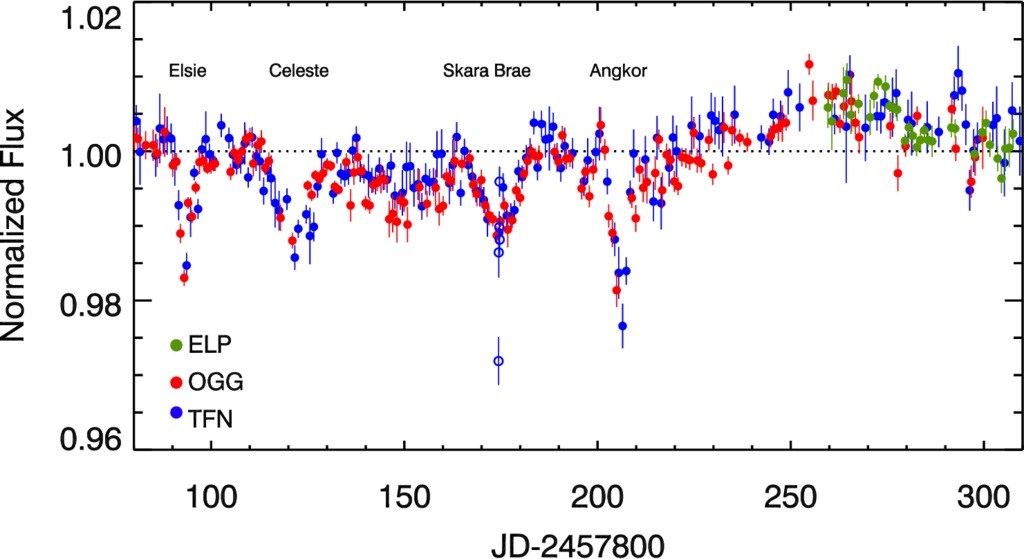
The first presentation was given by two high school students, Yao Yin and Alejandro Wilcox of the Thacher School! These intrepid students presented their research monitoring Boyajian’s star since April of 2017 using the Thatcher Observatory. Yin and Wilcox found that Boyajian’s star’s bizarre flux dips have a dependence on the wavelength of light observed, suggesting that the dimming may be due to dust that differs in composition or size distribution.
Boyajian's star

Bizarre recent dips in the light curve of Boyajian’s star. [Boyajian et al. 2018]

Eva Bodman, a postdoc at Arizona State University, backed these findings with the results from a Kickstarter-backed study of Boyajian’s star using LCOGT. An endearing quality of this campaign is that funders get to vote on the names of the weird dips in Boyajian’s star’s light curves! Bodman’s work focused on four dips in particular: Elsie, Celeste, Skara Brae, and Angkor. This study agrees that dust is the most likely conclusion for the dips — and it appears to be an extremely complex dust cloud that is likely clumpy and amorphous, with ephemeral fine grains and longer-lasting large grains. We still have a lot to learn about this strange star!

Switching up the topic, Dr. Robert Stencel from the University of Denver presented work completed with his graduate student Justus Gibson on Epsilon Aurigae, which belongs to a class of ‘disk-eclipsed’ binary stars. This is a very bright star, often associated with a hidden companion that is grabbing material and creating an accretion disk that produces irregular variability in its flux. When given the opportunity to interferometrically image the disk, observers found an opaque accretion disk, with the data characterizing the star as a pre-asymptotic giant branch star that may be obstructed by this disk.

A question raised during the Q&A led to interesting discussions — what can comparing these two stars tell us? The participants felt that any oddities in stellar observations can help provide us with more insight in the science of stars, pushing the limit of what is possible with the observations of stellar-type objects.


The Dynamics of the Local Group in the Era of Precision Astrometry (by Mia de los Reyes)

Dr. Gurtina Besla from the University of Arizona started today’s lunch plenary talk with a reminder: although textbooks might suggest that we’ve known everything about the Local Group for a long time, it’s only over the last decade or so that we’ve gotten precise positions and motions of these nearby systems! This has led to a lot of new and exciting science; as Besla said, “With every measurement, we have challenged conventional wisdom.”

The “Local Group” refers to the Milky Way, M31 (the Andromeda Galaxy), and about 50 nearby dwarf satellites. By studying the kinematics of these satellites, we can better understand all kinds of science. The recent data release from the European Space Agency’s Gaia mission has revolutionized our ability to do this by measuring the proper motions of over a billion stars to incredible precision — the accuracy involved in these measurements is equivalent to measuring the speed of human hair growth at the distance of the moon!

Besla gave us the run-down on several of the exciting results made possible with data from Gaia and the Hubble Space Telescope:

  • The orbits of Milky Way satellites: Besla started by noting the historical importance of the Magellanic Clouds to indigenous cultures around the world (see the figure below). The new Gaia data can tell us about how these galaxies, which are the Milky Way’s nearest satellites, orbit the Milky Way. It suggests that these satellites are “new neighbors” that only recently fell into the Milky Way’s gravitational potential for the first time!

  • The Large Magellanic Cloud (LMC): The LMC seems to be moving much faster and is about 10 times more massive than was previously thought. In fact, the LMC is so massive that it dragged five other satellite galaxies along with it when it fell into the Milky Way. It’s even massive enough to perturb the Milky Way’s halo and change its shape!
  • Andromeda and its satellites: In 2012, the Hubble Space Telescope delivered a (very) early collision warning: in a few billion years, the Andromeda galaxy (M31) will irrevocably change our view of the night sky. It’ll collide with our Milky Way, destroying the galactic disk and leaving us sitting in a giant elliptical galaxy (see the figure below).

Now, with Gaia DR2, we can look directly at internal motions of M31 and its largest satellite M33! We can confirm the earlier result that Andromeda will in fact collide with our galaxy — but beyond that, we can watch how M31 and M33 are rotating and interacting with each other. Besla’s group has found that, like the LMC in our Milky Way, M33 may be on its first infall into Andromeda now! The James Webb Space Telescope will look more at M31’s satellites in the future.

Besla concluded by noting that we still haven’t fully understood the dynamics of the Local Group. She also spoke to the young people in the room, reminding them that the gut reaction to a new and exciting result is often “no.” “But look at what the new data is telling you,” she said, “and continue onwards.”


Talk: Astrobites as a Pedagogical Tool in Classrooms (by Susanna Kohler)

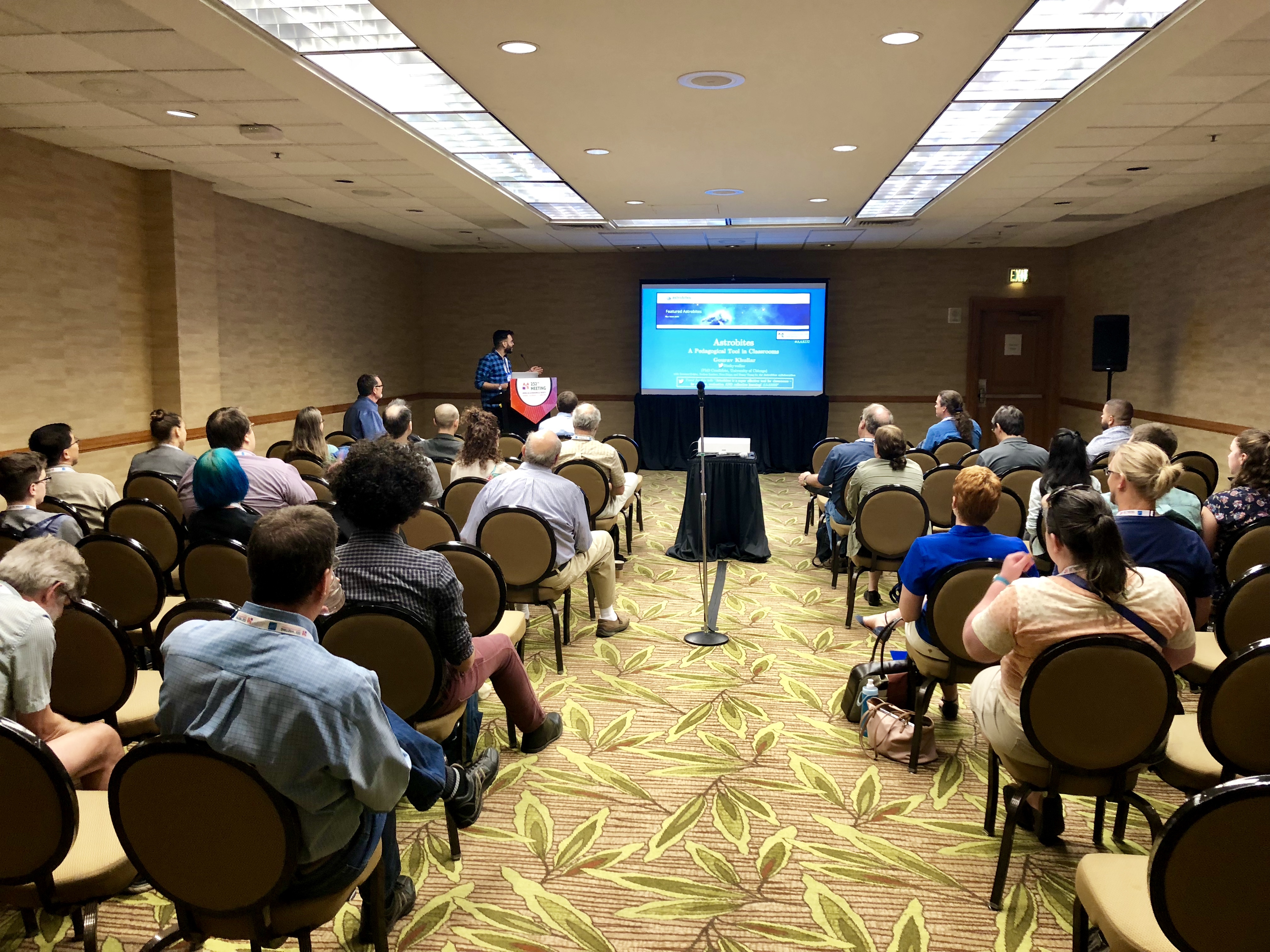
Astrobiter Gourav Khullar presented today in the “College-Level Astronomy Education: Research and Resources” session. At two past AAS meetings (AAS229 and AAS231), Astrobites hosted workshops on how to introduce modern research into undergraduate and graduate classrooms using astrobites.com as a resource. Today, Khullar provided a speed-introduction to the idea for educators and outreach practitioners who may not yet have considered the idea, or who may not know where to start!
astrobites in the classroom talk

Gourav Khullar presents on using Astrobites to bring current astronomy research into the classroom.

Khullar opened his talk with a brief overview of the site. Astrobites recently celebrated publishing its 2,000th article (!), so the site, at this point, provides an extensive archive of brief summaries of astronomy research conducted over the past 7 years. Have a topic in mind that you’d like your students to learn about? We’ve almost certainly covered it!

Khullar then briefly introduced the three full lesson plans that we’ve written up as suggestions of how to use Astrobites in the classroom — which come complete with student handouts, online form templates for collecting student work, grading rubrics, adaptations for different learning levels, and more.

He rounded out the talk by introducing the research study we are currently conducting — with the aid of an AAS Education & Professional Development (EPD) mini-grant — to explore how Astrobites has been used in classes and the impacts that it has had. If you’ve used Astrobites in your class or journal club or plan to in the future, and you’d be interested in being a part of our study, please don’t hesitate to reach out! Email us at astrobites@gmail.com.


Press Conference: Metal-Poor Stars & Dwarf Galaxies (by Susanna Kohler and Mia de los Reyes)

The second press conference of #AAS232 started off with Timothy Beers, a professor from the University of Notre Dame. Beers explained that while we may never directly see the first generation of stars, we can see their “fingerprints.” This is because the first stars distributed their nucleosynthetic products when they died, and these elements were then incorporated into the second generation of stars. These second-gen stars have a characteristic abundance pattern: lots of carbon, and not much of any other heavy elements (“metals”). They probably formed in ultra-faint dwarf galaxies and were then accreted onto the Milky Way halo, so we can actually look for these stars in our own galaxy! (Press release)
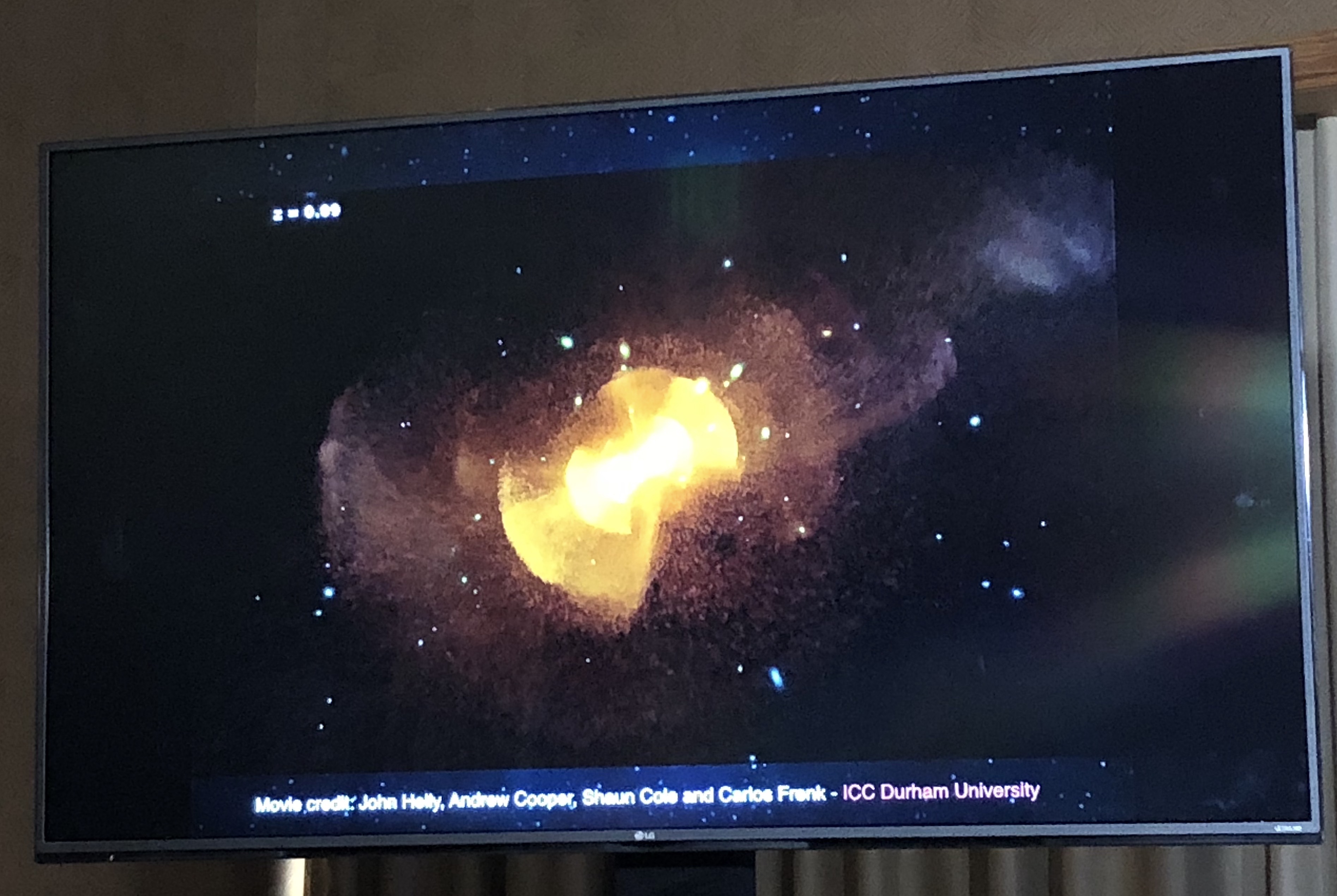
galaxy accretion simulation

A simulation showing the process of galaxy accretion. It’s a messy business! [J. Helly, A. Cooper, S. Cole and C. Frenk (ICC)]

Kris Youakim from the Leibniz Institute for Astrophysics in Germany then continued on this theme. He started with some beautiful simulation videos of dwarf galaxies being accreted onto the Milky Way, and then showed that we can actually use stars with very low metal abundances to trace this accretion. In particular, he found that the most metal-poor stars are the most strongly clustered. This implies that not only are there a lot of small metal-poor dwarf galaxies, but also that these satellites haven’t yet been tidally disrupted by the Milky Way.

Next up, Gina Duggan from Caltech spoke about using the metal abundances to track how elements were produced in dwarf galaxies over time. In particular, she uses barium as a proxy for elements that are produced by a nucleosynthetic mechanism called the r-process (see our summary of Enrico Ramirez-Ruiz’s talk yesterday for more details). It’s not clear where the r-process happens; it could occur either in a special class of supernovae or in neutron star mergers. The pattern of barium abundances that Duggan observes suggests that neutron star mergers are the culprit in dwarf galaxies! (Press release)
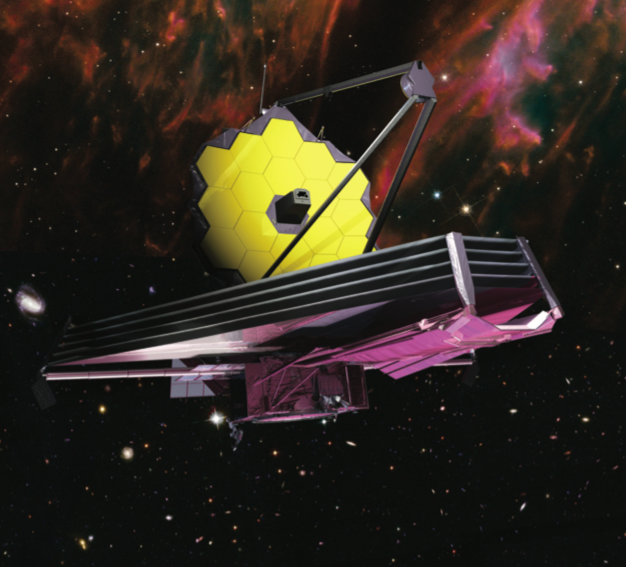
JWST

One of the goals of the James Webb Space Telescope is to explore the most distant objects in the universe, including the first stars and galaxies. [NASA]

Aparna Venkatesan (University of San Francisco) next discussed how we might be able to use nearby galaxies as a tool to answer questions about much more distant objects, such as the very first stars in the universe. She argues that nearby low-mass, star-forming galaxies are ideal analogs for the first galaxies that formed in the universe. Studying these convenient nearby dwarfs can therefore advance our understanding of early star clusters and the physical conditions of early galaxies, providing context for when we start to get results from JWST’s planned observations of distant galaxies in the universe.

The final presentation of the conference was by Mustapha Ishak-Boushaki (University of Texas, Dallas), who introduced an intriguing prospect: discrepancies between data sets (normal a source of concern for astronomers!) may actually be useful for informing our understanding of the universe. Ishak-Boushaki’s work addresses an age-old problem: what happens when different missions take measurements that imply different values for cosmological parameters — for instance, the age of the universe, or how quickly it’s expanding? There are two possible resolutions: either there are errors in one or more of the data sets, or the models we’re using are missing new physics! Ishak-Boushaki and collaborators developed a new mathematical tool to quantify these inconsistencies between different data sets. The goal of this tool is to help us better explore issues like tensions between local and large-scale measurements, to evaluate whether we need to reconsider our models (Press release)


Plenary Lecture: An Era of Precision Astrophysics for Exoplanets, Stars, and the Milky Way (by Kerry Hensley)

It’s a great time to be an astronomer! In the final plenary session of the day, Dr. Keivan Stassun (Vanderbilt University) highlighted the many (many!) exciting advances in the field of high-precision astrophysics. In this talk, Dr. Stassun focused on the importance of precisely determining the properties of stars. After all, you need to first understand stars in order to understand the planets that orbit them, the galaxies that are composed of them, and how those galaxies have evolved over time.

Dr. Stassun focused on three categories of advances in high-precision astrophysics: astrometry, photometry, and spectroscopy. He covered a lot of cool techniques, but here I’ll summarize just a few.

Astrometry
Astrometry is one of the oldest astronomical techniques, but this simple act of plotting the positions of stars and tracing their motions is still valid today. Highly precise parallaxes (the kind you might get from Gaia or Hubble) enable a technique that Dr. Stassun calls “pseudo-interferometry,” which allow us to make careful measurements of stellar radii. Advances in astrometry may soon allow us to determine stellar radii to within a few percent at a distance of three hundred light-years! Precisely measuring the radii of stars is critical for studying exoplanets (since uncertainty in the radius of the star translates to uncertainty in the radius of the planet… and its density, composition, surface gravity…) and can also help us better understand stellar activity and stellar structure.

Photometry
One of the coolest techniques that Dr. Stassun covered in his talk was the use of highly precise photometry (measuring the light from an object in wide wavelength ranges) to obtain stellar masses. This technique works by analyzing the change in the light emitted by the star due to granulation — the motion of individual convective cells bubbling up to the surface of the star. The amplitude of the modulation tells us about the surface gravity of the star. If you know the radius of the star (say, from some precise astrometry), this gives you the mass. The most exciting part of this technique is that it works for individual isolated stars, which have long been a challenge to weigh! Dr. Stassun estimated that this technique will yield masses to within 10% accuracy for hundreds of thousands of stars.

Spectroscopy
While highly precise spectroscopy is exciting in and of itself, it’s best when paired with machine learning. Using machine learning, we can amass thousands of stellar spectra and extract temperatures, gravities, bulk metallicities, and abundances of individual chemical elements for the individual stars. This means large-scale chemical forensics, allowing us to piece together the formation histories of everything from galaxies to planetary systems and track down the Sun’s long-lost siblings!

While astronomers have already achieved amazing advances with the help of precise astrophysical techniques, more discoveries are headed our way. So sit back, relax, and enjoy the show (or get some data and get crunching!).

Sedna

Editor’s Note: This week we’re at the 232nd AAS Meeting in Denver, CO. Along with a team of authors from Astrobites, we will be writing updates on selected events at the meeting and posting each day. Follow along here or at astrobites.com. The usual posting schedule for AAS Nova will resume next week.


 Sunday, 3 June


Using Python to Search NASA’s Astrophysics Archives (by Gourav Khullar)

The sessions for this AAS meeting began with a workshop on using python to parse NASA data archives, organized by Vandana Desai (IPAC/Caltech) and the team at NASA Astronomical Virtual Observatory (NAVO).

To quote the workshop organizers, “NASA missions have collected a huge amount of data spanning a large range in wavelengths. These data are housed in four different archives: the HEASARC, MAST, IRSA, NED…..The archives have been working together…to assemble the data you need to get your research done. We’ve done this by standardizing the way that programs can access the data we house. Since Python is a very popular programming language, we are going to use it to show you how you can take advantage of this standardization..

The resources are available at the following link: “https://github.com/NASA-NAVO/aas_workshop_2018_summer”. We would like to encourage all our readers to start retrieving multi-wavelength information from these rich exquisite datasets!


Using Anchored Inquiry to Teach Astronomy and Physics (by Gourav Khullar)

This session, organized by Zoe Buck Bracey, PhD (BSCS Science Learning), focused around pedagogical techniques to be used in classrooms about concepts. This 4-hour workshop was full of mini-experiments, tasks and group work (along the ideas of “Think, Pair, Share!”), to encourage instructors towards building classes around concept “anchors”. The example studied throughout this amazing workshop attempted to teach the model of the Earth-Sun system and encourage understanding of seasons on our planet. We used average planetary temperature datasets as anchors, which allowed us participants to put student engagement at the forefront, encouraging students to come up with a model that explains why seasons occur. Throughout the activities, the emphasis was on students bringing prior knowledge into a class and how an instructor can enable them cross the bridge from having a partial idea of concepts to a complete understanding.


Monday, 4 June


poster sessions

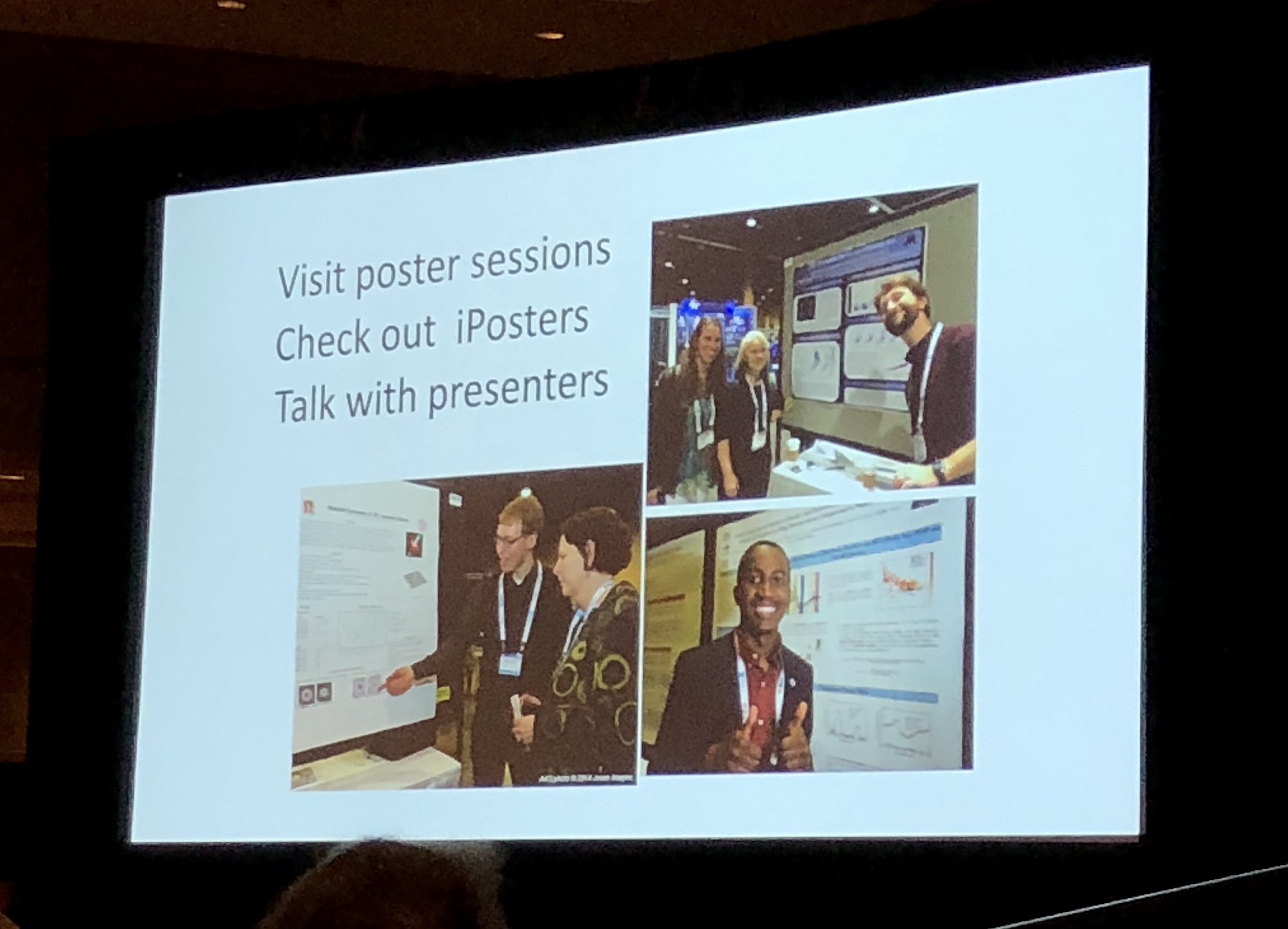
Don’t forget to check out poster sessions at AAS 232 and talk with presenters!

Plenary Lecture: Welcome Address (by Susanna Kohler)

AAS President Christine Jones opened the day with a brief session welcoming attendees to this meeting and outlining some of the highlights that we can look forward to at AAS 232 in the coming week. She especially drew attention to the plenary sessions (don’t forget to check out our interviews with keynote speakers!), the town halls, and a few special sessions such as this morning’s AAS Taskforce on Diversity and Inclusion in Astronomy Graduate Education, which Gourav reported on below. She also pointed out the value of visiting posters and talking with presenters — we appreciated the photos of students presenting their work at past meetings!


Kavli Foundation Lecture: From Extrasolar Planets to Exo-Earths (by Susanna Kohler)

Dr. Debra Fischer (Yale University) kicked off the plenary talks of this meeting by giving the Kavli Foundation Plenary Lectureship, an invited talk on “recent research of great importance.” Fischer’s opening comment — “It’s tough to give a lecture on exoplanets these days, because I know there are so many experts in the audience!” — acknowledged the huge boom that exoplanet research has undergone since its inception. Fischer, however, is a highly qualified expert herself: she’s spent more than two decades in the field, developing techniques for detecting exoplanets.

Fischer gave a broad overview of the past and current state of exoplanetary studies, discussing the types of planets we’ve discovered and how we’ve found them. There are several approaches that have been used to discover and characterize the ~4,000 exoplanets known at this time:

  1. Transits, in which a dip in a star’s light reveals the presence of a planet passing in front of its host;
  2. Direct detection, in which exoplanets are actually imaged directly by telescopes;
  3. Gravitational microlensing, in which the planet is never seen, but its gravitational pull bends light from a background star in a telltale way, indicating the planet’s presence;
  4. Astrometry, in which the visible wobbling motion of a star reveals the gravitational tug of an orbiting planet; and
  5. Radial velocity, in which such a stellar wobble is seen in the star’s spectrum, as its spectral lines shift back and forth due to the approaching and receding star.

This last technique, radial velocity, is the approach that Fischer has been working to improve. Thus far, the smallest radial-velocity wobble we’ve been able to detect is around 1–2 m/s, or roughly walking speed; Fischer hopes that in the future we can push this precision down to just 10 cm/s, a signal akin to the wobble that Earth induces in the Sun. This requires remarkable advancements in both technology of spectrographs and modeling of things like contamination of stellar spectra by Earth’s atmosphere — but Fischer and other members of the field are making significant progress in these directions!

Fischer concluded by mentioning the many new and upcoming missions that will advance the field of exoplanet studies — like Gaia, TESS, CHEOPS, JWST, and WFIRST — and she threw in a sales pitch for the Large Ultraviolet/Optical/Infrared Surveyor (LUVOIR), a space telescope under consideration as a future NASA project. She also pointed out the broad community and general-public support of exoplanet science. The future of this field is bright!

You can check out Stephanie Hamilton’s interview of Fischer here.

HST vs. LUVOIR

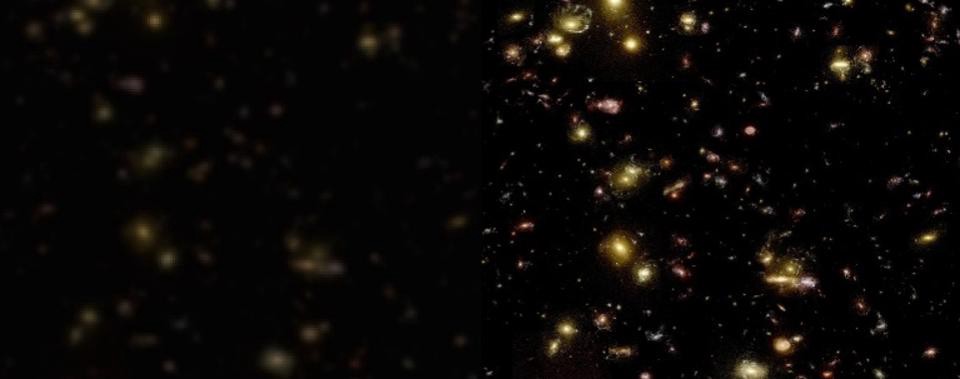
A simulated view of the same part of the sky as observed by Hubble Space Telescope (left) vs. the proposed LUVOIR (right). [G. Snyder, STScI /M. Postman, STScI]


Press Conference: Minor Planets, Dwarf Planets & Exoplanets (by Susanna Kohler)

Sedna

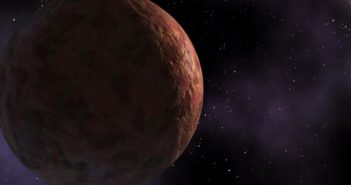
Artist’s rendering of the minor planet Sedna, a distant body in the outer solar system. [NASA/JPL-Caltech]

The first press conference of the meeting kicked off (a little late, due to some technical difficulties) with a presentation by undergrad Jacob Fleisig of University of Colorado Boulder. Fleisig and his advisor, Ann-Marie Madigan, have a proposal that may be disappointing to the many fans of the Planet Nine theory: they argue that the population of detached trans-Neptunian objects (TNOs) — icy bodies like the minor planet Sedna in the outer reaches of our solar system — can be explained by a different theory than Planet Nine, a hypothetical massive planet orbiting beyond Neptune. Fleisig and Madigan instead suggest that the collective gravity of objects like Sedna and other space debris in the outer solar system could explain how the detached TNOs reached their odd orbits. Press release

press conference 1 of aas232

Panelists prepare for the first press conference of AAS 232.

Next up, University of Virginia graduate student Jake Turner presented his and collaborators’ work in the search for exoplanets with magnetic fields. Magnetic fields are of interest in the context of exoplanets and habitability because they can protect their planets from stellar winds and help them to retain their atmospheres. Turner and collaborators hope to be able to use the Low-Frequency Array (LOFAR) to find exoplanet radio signals that would indicate the presence of magnetic fields. To improve their ability to extract such radio signals from background radio noise, the team simulated the expected signals using a real planetary signal — Jupiter’s radio waves, as seen by LOFAR. They hope to soon use these methods to discover magnetic fields of planets beyond our solar system. Press release

Intrigued by Tattooine? In the final presentation of the press conference, graduate student Franco Busetti (University of the Witwatersrand, South Africa) one-ups this sci-fi binary by discussing how planets might orbit around triple star systems. By running a series of orbital integrations — over 45,000 of them! — Busetti and collaborators showed that exoplanets can exist on stable orbits in substantial regions around triple systems. While only 40 or so planets have been found around triple systems thus far, we can hope that the Gaia and TESS missions will find many more.


AAS Taskforce on Diversity and Inclusion in Astronomy Graduate Education (by Gourav Khullar)

This AAS special session aimed to disseminate updates of the AAS Taskforce on Diversity and Inclusion to the membership. Kelle Cruz and Alex Rudolph began the proceedings with a description of the Taskforce, which was empaneled in November 2018, and is in the process of putting together a report on their findings via several of their initiatives.

A description of the Taskforce’s charge is as follows:

  1. To look into retention and recruitment practices along all axes of identity.
  2. To build consensus on evidence-based practices across the community.
  3. To create and collaborate on a statement of best practices.
  4. To develop guidelines that help astro grad programs towards implementation of suggestions coming out of the Taskforce initiatives.
  5. To develop recommendations for ongoing data collection from astro grad programs.

The Taskforce has 3 working groups:

  • Recruiting & Admission
  • Mentoring & Retention
  • Data Collection & Dissemination

Some of the working-group recommendations were discussed, after which we broke out in smaller sessions for direct engagement with the working-group members:

Recruiting and admission

  1. Inclusive Astronomy & Nashville Recommendations were brought up (read more about this here: https://astrobites.org/2017/12/25/building-an-inclusive-astronomy-community/).
  2. Partnering with institutions producing PhD-ready under-represented minorities could go a long way in bringing diversity and representation to departments.
  3. There is a need for implementing evidence-based, holistic approaches to admissions.
  4. Coordinating with campus offices regarding fee waivers, fellowship opportunities, GRE policies, and application contents is a priority.

Mentoring and retention

  1. One of the priorities was facilitating an accessible and welcoming environment, ending harassment in and around astro workplaces, and supporting effective, evidence-based mentorship at all levels of astrophysics research.
  2. The working group is also involved in engaging departments in conversations, conducting assessments in your local environment, incentivizing professional development, taking actions, and monitoring progress on these actions.

Data Collection & Dissemination

  1. This working group’s priorities are built on baselines and progress in demographics and climate, as well as initiatives that provide accountability.
  2. There is a proposal to conduct climate surveys every 2 years, collect and report demographic data, and create a platform to collect data, analysis and decentralize information as soon as is feasible.


Plenary Lecture: Heavy Element Synthesis in the Universe (by Kerry Hensley)

What do gold, krypton, plutonium, and europium have in common? They’re all r-process elements, of course! Elements heavier than iron form through neutron-capture processes; when an atom captures a free-roaming neutron, the neutron will often change into a proton by emitting a beta particle (an electron, in this case). This leads to atoms bulking up into heavier and heavier elements over time. There are two neutron-capture processes: rapid (r-process) and slow (s-process), where the speed refers to the rate of neutron capture compared to the rate of beta decay. While all elements heavier than iron can be formed through both pathways, some elements (like gold and europium) are almost exclusively formed through the r-process.

In today’s lunchtime plenary, Dr. Enrico Ramirez-Ruiz (University of California, Santa Cruz) described the importance of understanding r-process nucleosynthesis in the universe. While the basic understanding of how heavy elements form has long been known, the details are still unclear — especially in terms of what astrophysical objects produce them and in what amounts. In this talk, Dr. Ramirez-Ruiz focused on neutron star mergers as a source of r-process elements. Although neutron star mergers are rare, each collision can produce about a Jupiter-mass worth of gold — equivalent to the gold abundance of a million stars!

R-process enrichment by Type II supernovae (left) and neutron star mergers (right). Cookies are now scientifically relevant! [brandeating.com and handletheheat.com]

Dr. Ramirez-Ruiz used a tasty metaphor to explain the relative contributions of Type II supernovae and neutron star mergers to the cosmic r-process abundance: while Type II supernovae spread a thin layer of r-process elements fairly evenly across a galaxy like a layer of chocolate coating on a cookie, neutron star mergers generate huge amounts of these elements in random locations — like the chocolate chips in a chocolate chip cookie.

This unevenness in heavy-element production helps to explain the huge variation in europium abundance (europium is almost exclusively made through the r-process) relative to iron in old stars. While we still need to know more about how heavy elements get mixed throughout a galaxy, studying and modeling neutron star mergers can help us understand the origins of very heavy elements in the universe.

Be sure to check out Mia de los Reyes’ interview with Dr. Ramirez-Ruiz here!


Plenary Lecture: The Relationship Between Galaxies and the Large-Scale Structure of the Universe (Mia de los Reyes, Mara Zimmerman, and Gourav Khullar)

Dr. Alison Coil (UC San Diego) started off the last plenary lecture of the day with a map of bright galaxies in the sky — a snapshot of the large-scale structure of the universe (see tweet below). This beautiful filamentary structure comes from the evolution of the universe, which is largely driven by what Coil described as a “tug of war between different cosmological parameters.”

These cosmological parameters more or less describe the ingredients that make up our universe:

  • Quantum fluctuations in the early universe produced density perturbations, which collapse into dark matter halos
  • Baryonic matter (that is, “normal” observable matter) then fell into these halos, eventually producing the galaxies we see today
  • At later times in the universe, dark energy became important, pushing apart galaxies and increasing the space between them

This led us to Coil’s main topic: the connection between galaxies and dark-matter halos, and what this can tell us about these cosmological parameters.

The way galaxies cluster can help us do precision cosmology to constrain these parameters. This is because galaxies trace the underlying dark-matter distribution of the universe, sometimes called the “cosmic web” (see tweet below). The challenge is then connecting our observations of galaxies (especially from galaxy surveys like DEEP2, which mapped out the positions of galaxies out to a redshift of z~2) with our theoretical understanding of the cosmic web (particularly cosmological simulations like the Millennium Simulation).

As Coil described, one way we can bridge this theory-observational gap is by using the halo model. This model reasonably assumes that more massive halos host more massive galaxies, so that we can use a technique called abundance matching to match halos with their associated galaxies. “This is a very, very successful model,” Coil pointed out.

We can also figure out what other parameters affect the clustering of galaxies. It turns out that the clustering of galaxies depends on several parameters: more luminous/massive galaxies and redder galaxies are both more strongly clustered than less luminous or bluer galaxies. Also, older halos are more strongly clustered in a phenomenon called assembly bias, which might be required to explain an effect called galactic conformity (how galaxies at the center of a halo appear to influence the star formation rates of galaxies in another halo).

Understanding all of these effects is vital for understanding the close connection between galaxies and halos. Coil concluded that in order to do this, theorists and observers need to work together to do precision cosmology and interpret the results!

aas232

Greetings from the 232nd American Astronomical Society meeting in Denver, Colorado! This week, AAS Media Fellow Kerry Hensley and I will be joined by a team of talented Astrobites authors — Gourav Khullar, Mia de los Reyes, and Mara Zimmerman — writing updates on selected events at the meeting. We’ll post the summary of the day’s events at the end of each day, and you can follow along here or at astrobites.com. The usual posting schedule for AAS Nova will resume next week.

Want to get a head start before the #AAS232 plenaries begin? Astrobites has been conducting brief interviews with the plenary speakers; you can read about them as they come out over at Astrobites.

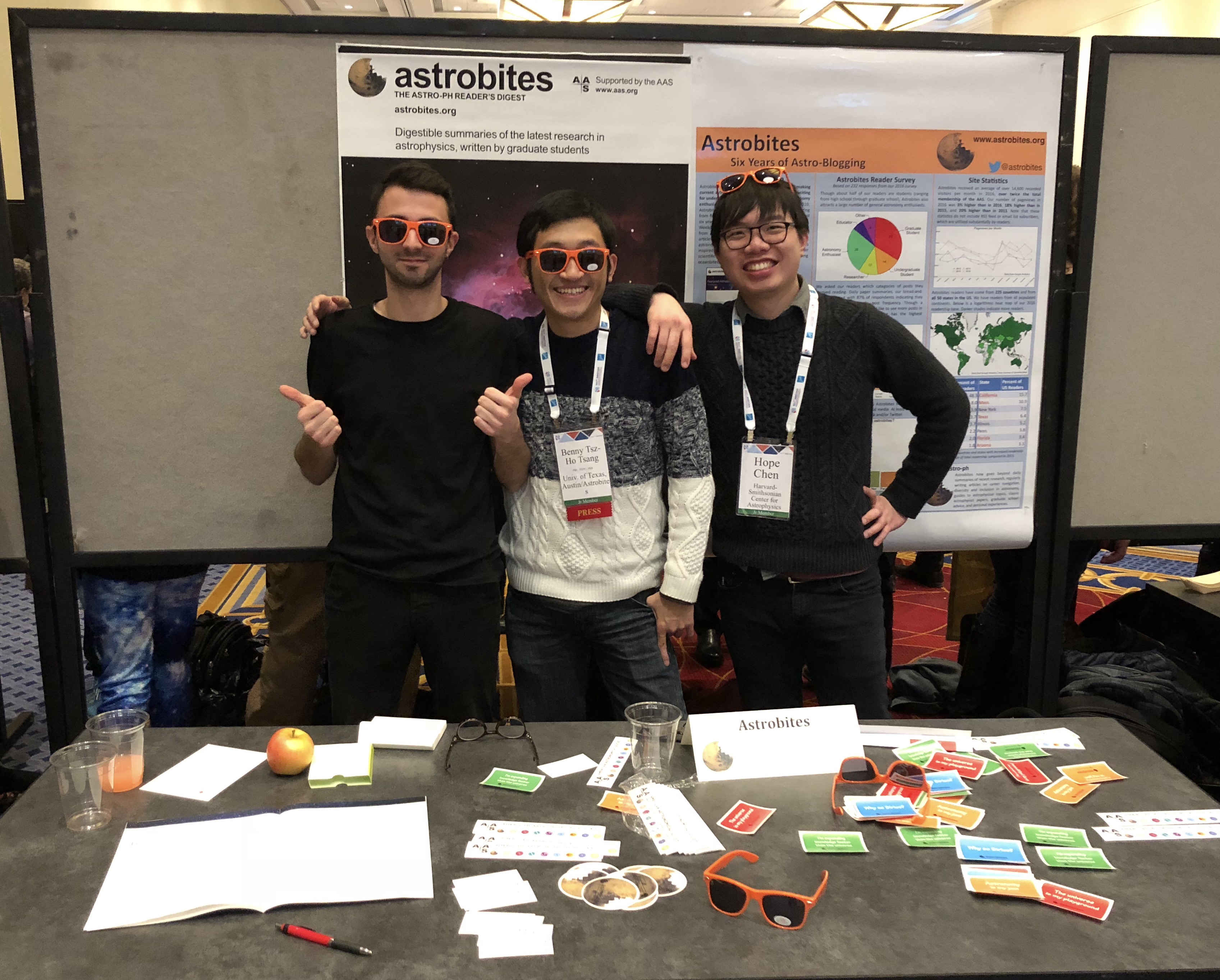
We hope to see you around at Denver! Drop by to visit AAS, AAS Journals, and Astrobites at the AAS booth in the exhibit hall to learn more about AAS’s new publishing endeavors, pick up some Astrobites swag, or grab a badge pin to represent your AAS journals corridor!

corridors

InSight

Atlas-V

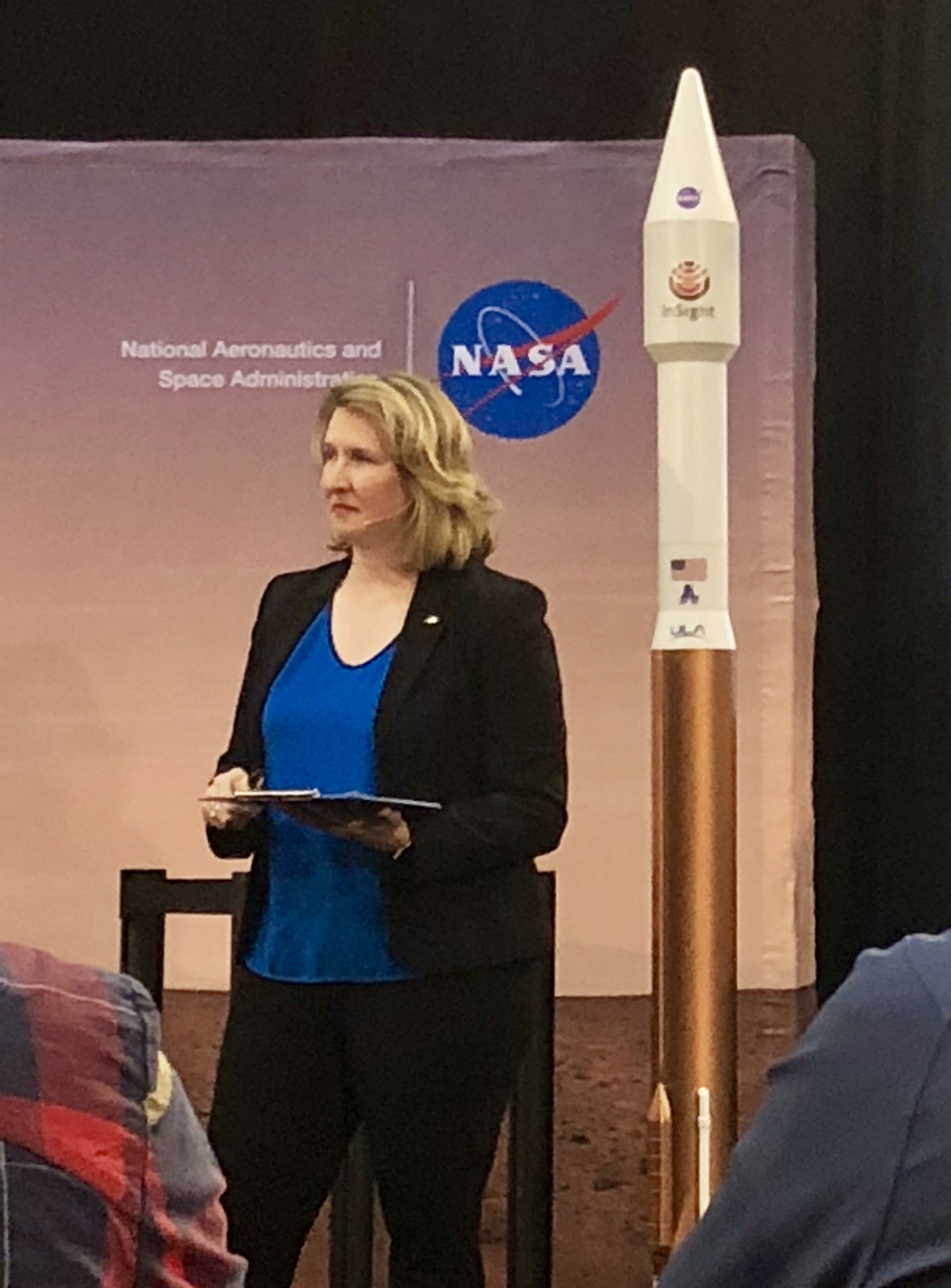
JPL’s Stephanie Smith introduces the InSight prelaunch press briefing next to a model of the Atlas-V rocket. [AAS Nova]

Were you awake at 4 am PDT today? If so, you were in good company — a lot of anxious and excited scientists, engineers, media, and others were wide awake at Vandenberg Air Force Base at 4:05 am PDT, when the NASA InSight spacecraft was lifted on its way to Mars on board an Atlas-V rocket.

A Unique Journey

Today’s launch marked the first interplanetary launch to take off from the west coast. Usually, launches to other planets occur from the east coast; this is because the Earth’s spin gives the rocket an extra boost when it launches east.

But rocket launchpads are crowded, and the wait to get in on the east coast can be extremely inconvenient for an interplanetary mission with a specific timeline for when it needs to launch. InSight had an alternative, however: the Atlas-V rocket was still plenty powerful — even with the southward launch from Vandenberg — to hoist InSight and send it on its way into a parking orbit. After launch, the second stage then boosted InSight out of Earth’s orbit and on its way to Mars.

What Happens Next?

InSight model

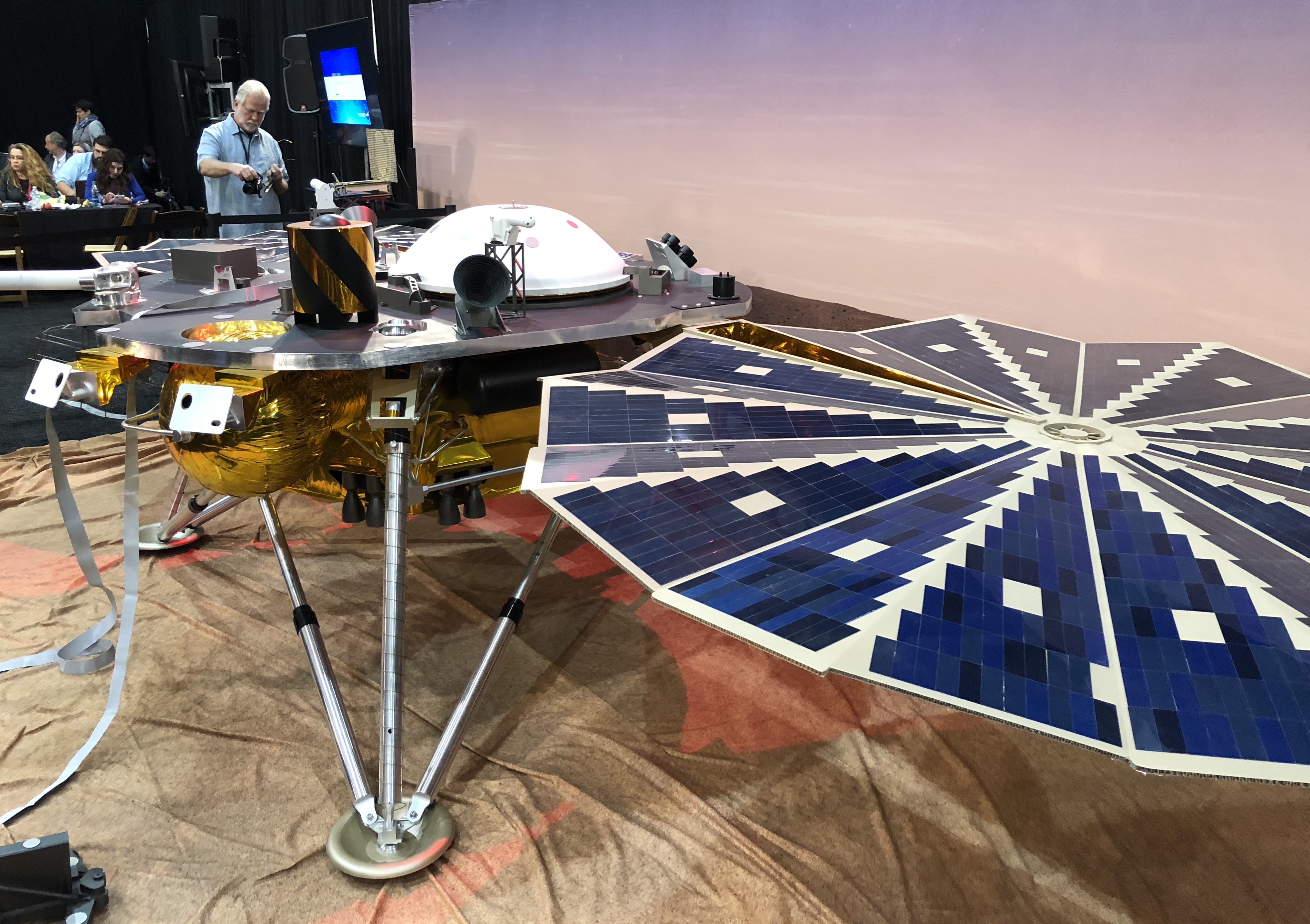
The guest of honor at the pre-launch briefing: a model of the InSight lander. [AAS Nova]

205 days from now, in November of this year, InSight will arrive at Mars and proceed to enter the planet’s atmosphere at more than 13,000 mph. A parachute will then slow it to around ~130 mph before the lander separates and lowers itself to Mars’s surface using 12 descent engines.

So once InSight touches down, it can start doing science, right? Not so fast! The placement of the lander’s instruments on the ground will take 10 weeks after it lands; sinking the heat probe will then take another 7 weeks after that. Impatient? Do try to remember that we’re operating a robot on Mars.

Experiencing InSight’s Launch Firsthand

I had the good fortune of being able to catch the InSight launch in person today, as well as the lead-up to it. At Thursday’s press briefing, the media gathered at the NASA building on Vandenberg AFB to hear from people representing multiple facets of the mission — from those who built it, to those who would be launching it, to those who will manage the science that comes from it.

press in the fog

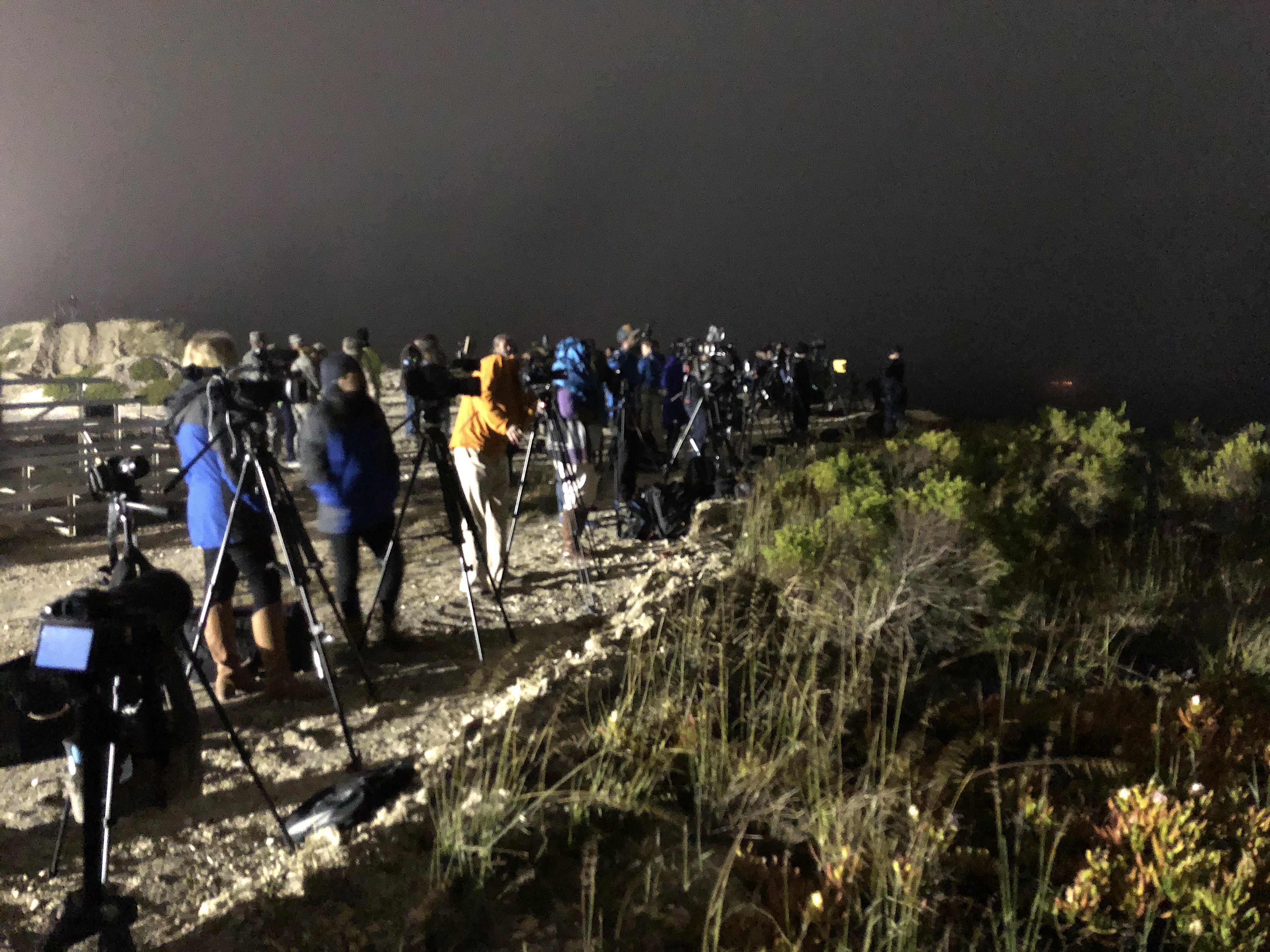
Reporters ready to photograph the InSight launch to Mars, should Vandenberg’s marine layer clear out in time for a view. [AAS Nova]

Seeing the faces behind the mission makes the excitement and tension surrounding launch very real, and occasional comments reminded us that cockiness is never a good attitude for a mission being blasted off into space. Stu Spath, the InSight program manager at Lockheed Martin — a veteran company that has been involved with 20 Mars missions in the past — summed up the sentiment nicely: “There’s nothing ‘routine’ about going to Mars.”

Fortunately, you wouldn’t have known it from the launch itself! Liftoff occurred right on schedule at the start of the first launch window, and the Atlas-V took off without a hitch. For those of us in the press viewing area at Vandenberg, a typical blanket of marine-layer fog enveloped us, hiding the launch from view. But the roar of the engines and tremble of the ground is unmistakable, and we could hear cheers echoing in the distance around us through the fog, alerting us to the success of the first step in InSight’s journey to Mars. Sometimes, being awake at 4 am can be pretty awesome.

Christopher Conselice and M51

We’ve recently welcomed a new face to our team of Lead Editors for the AAS journals: Christopher Conselice. Chris, who joined the AAS journal team in 2010 as a Scientific Editor, is taking over the role of Lead Editor for the Galaxies and Cosmology corridor from AAS Editor in Chief Ethan Vishniac.

Chris is a professor at the University of Nottingham in the United Kingdom, specializing in the formation and evolution of galaxies. Read on to learn more about Chris’s background, his current work, and what he thinks is important in scientific articles.

Getting Started

Chris discovered astrophysics during his undergraduate studies. He originally wanted to be a physicist, but in his first year at University of Chicago, he applied for summer jobs at Fermilab and at the Yerkes Observatory. He got the job at Yerkes Observatory — “and the rest is history.”

M51

M51 (the Whirlpool Galaxy shown above), as imaged from the Yerkes Observatory in 1902. [G.W. Ritchey]

His first real research project was in galaxies, and he’s continued in that field ever since. “I thought of some ideas based on that project, and one thing has led to another, and 20 or so years later I’m still looking into those questions and follow up ones. There’s so much to learn that it is easy to spend a career on even a few questions or mastering a few techniques.”

What Can We Learn From Galaxies?

Chris’s current research focuses on observations of distant galaxies; he uses systems at different redshifts to try to infer how galaxy evolution has occurred. He also studies how the reionization of the universe occurred and examines other basic properties of galaxies such as their number densities, mass functions, and the total number of galaxies in the universe. Looking to the future, Chris is preparing for the James Webb Space Telescope and Euclid space missions, which should both launch in the next few years.

When asked about the biggest open questions in the field of galaxies and cosmology today, Chris goes deep: “Cosmological questions are the biggest questions we have in astronomy. Did inflation occur, and if so how? Is gravity modified in any way? What is the nature of dark energy and dark matter? Very fundamental stuff, but very difficult questions to answer, which many brilliant people have grappled with for decades. Galaxies themselves can tell us quite a bit about these questions, and in many ways they are the ultimate experimental subjects, as they are sensitive to everything — the nature, makeup, and geometry of the universe, dark matter, black hole assembly and feedback, and baryonic gas physics and dynamics.”

An Editor’s Insight into Publishing

Chris argues that a “good, solid paper” is easy to identify. In his view, well-authored papers have clear, specific aims and goals, thorough analyses that include detailed accounting of errors and systematics, and well-made figures.

He offers two additional tips for authors:

  1. Avoid vague, general titles; these type of titles aren’t cited as much as they could be.
  2. Be sure to avoid repeating (and failing to cite) previous work. “Always be sure you know the latest work in a field you are writing a paper in. This is easy to do with ADS searches, but some papers miss some significant work and don’t put their results into the current, up-to-date context.”
Hubble Ultra Deep Field

This Hubble Ultra Deep Field image contains approximately 10,000 galaxies, extending back in time to within a few hundred million years of the big bang. [NASA/ESA/H. Teplitz and M. Rafelski (IPAC/Caltech)/A. Koekemoer (STScI)/R. Windhorst (Arizona State University)/Z. Levay (STScI)]

Chris also emphasizes the importance of referees to the publishing process. “If I can communicate anything to the astronomical community about the publication process, it’s that if you are asked to referee a paper and can’t or don’t want to do it, please let the editor know as soon as you can. There is no judgment here, and keeping communication open is important.” Unsurprisingly, this coordination between multiple people can be one of the slowest parts of the publishing process, and timely referee responses can significantly reduce the turnaround time for article publication.

Go Forth and Create New Knowledge

We hope you enjoyed this opportunity to learn more about Chris Conselice! You can expect hear from him if you submit to the Galaxies and Cosmology corridor in the future.

We’ll leave you with one final thought from Chris, which nicely sums up why we do what we do: “I was always impressed with my professors as an undergraduate, and I can recall seeing research papers being produced and thinking that was the most magical thing possible — creating new knowledge. That seemed like the most amazing thing one could do.”

AAS Nova

Today’s post marks the 500th highlight published on AAS Nova since our launch in August 2015. To celebrate, we’re taking a moment today to look back at what we’ve published during this time.

What Does AAS Nova Cover?

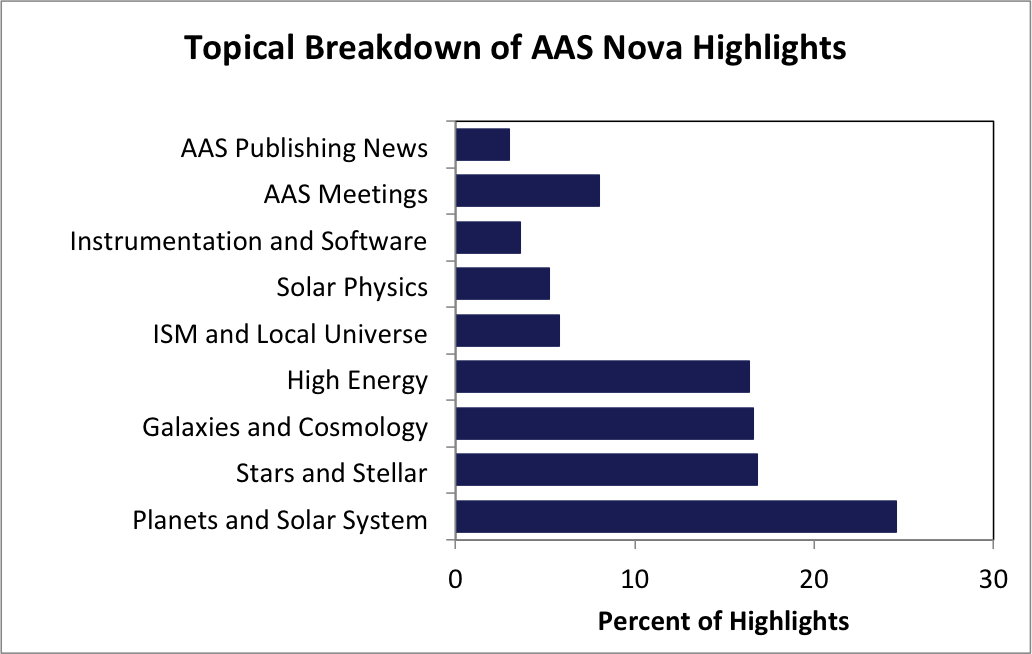
AAS Nova topics

Breakdown of AAS Nova Highlights by topic, including the seven journal corridors and two AAS-related topics. Click for a closer look.

Journal articles featured in AAS Nova Highlights are selected by the lead and scientific editors of the AAS journals in collaboration with the AAS Nova editor, with the goal of identifying research that is of particular importance or of potential interest to a broad community.

Highlighted articles are selected from across all five AAS journals —The Astronomical Journal (AJ), The Astrophysical Journal (ApJ), The Astrophysical Journal Letters (ApJL), The Astrophysical Journal Supplements (ApJS), and Research Notes of the AAS (RNAAS) — and they span all seven journal corridors.

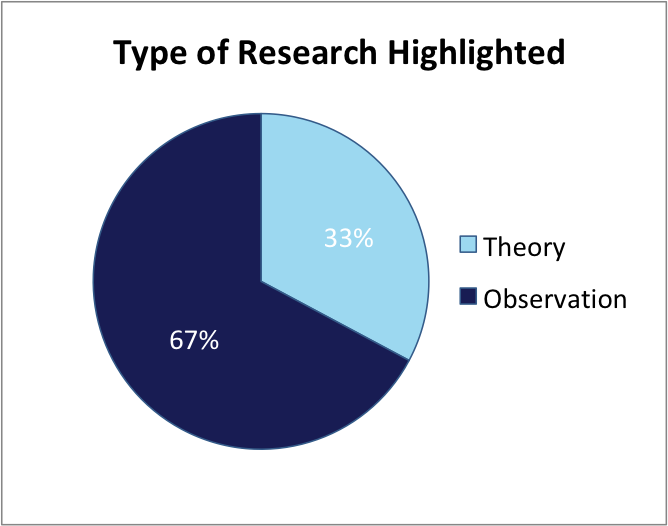
Observation-based AAS Nova Highlights are twice as common as theory-based Highlights.

The first 500 Highlights published on AAS Nova since launch have been distributed across corridor topics; the four most commonly featured corridors are Planets and Solar System, Stars and Stellar, Galaxies and Cosmology, and High Energy.

The breakdown between theory-based and observation-based articles highlighted on AAS Nova is roughly two-thirds observation, one-third theory.

Who Reads What?

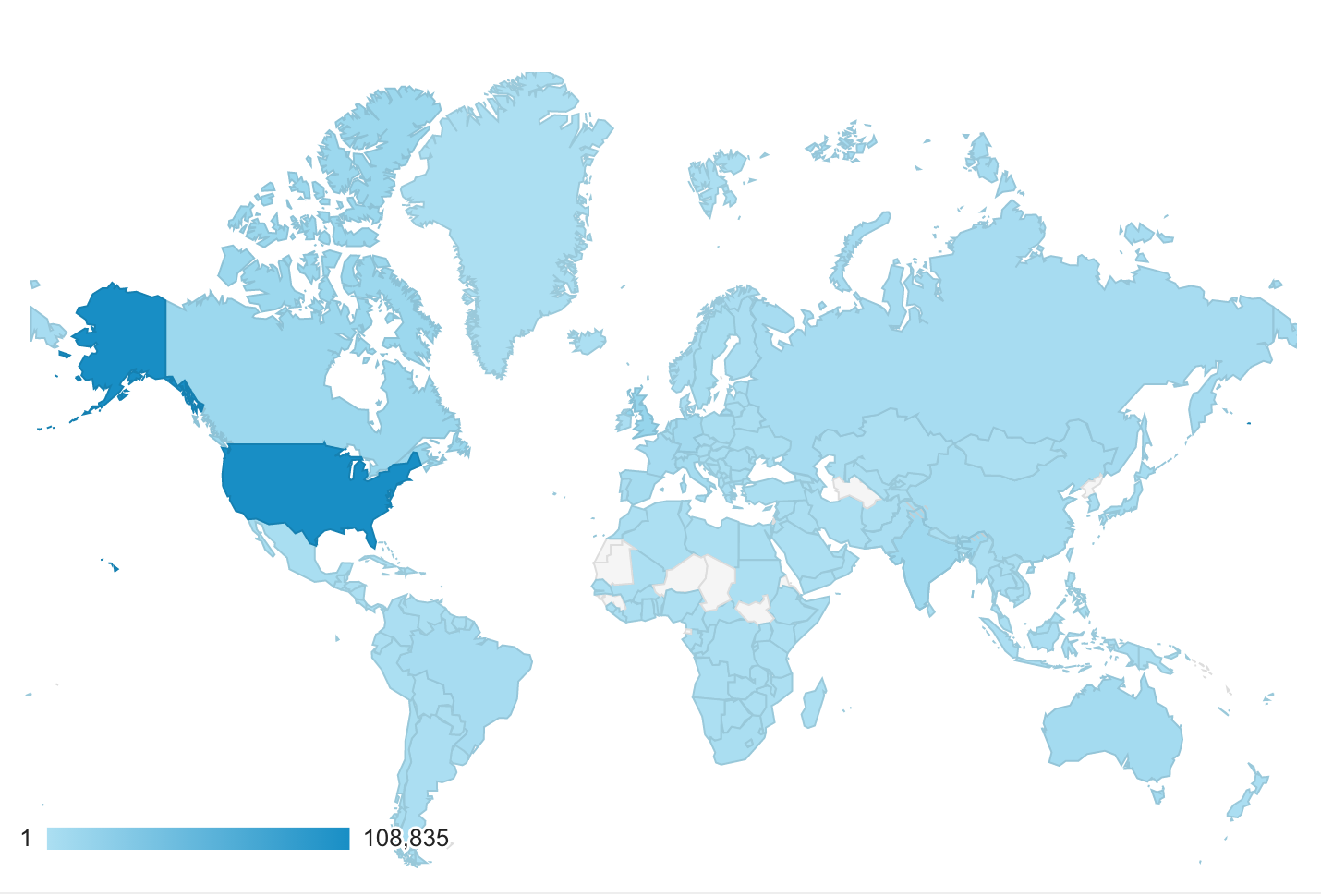
AAS Nova readers come from nearly everywhere in the world, representing over 200 countries and territories. Roughly half of our readers are located in the United States.

AAS Nova readers come from over 200 different countries. [Google Analytics]

Our normal Features posts (i.e., summaries of AAS journal articles) are the most commonly read Highlights.

Do readers go on to explore the original scientific papers that the Highlights summarize? We can’t determine that with certainty, but we have found that articles that have been featured on AAS Nova are, on average, downloaded more than four times more often than typical journal articles.

What Have You Missed?

Wondering what you’ve missed since we first launched? Here’s a list of the ten most popular Highlights published on AAS Nova in the last 500 posts.

  1. An Update on Planet Nine
  2. An Explanation for Saturn’s Hexagon
  3. LIGO Discovers the Merger of Two Black Holes
  4. Update On the Puzzling Boyajian’s Star
  5. A Ninth Planet in Our Solar System?
  6. What Do You Get When Two Neutron Stars Merge?
  7. Featured Image: The Q Continuum Simulation
  8. How Normal is Our Solar System?
  9. Another Possibility for Boyajian’s Star
  10. Explaining the Birth of the Martian Moons

We’ve very much enjoyed covering the amazing work AAS journal authors are producing, and we look forward to seeing the exciting ideas and discoveries that we get to feature on AAS Nova in the coming years!

cocoon

Editor’s Note: This week we’re at the 231st AAS Meeting in National Harbor, MD. Along with a team of authors from Astrobites, we will be writing updates on selected events at the meeting and posting each day. Follow along here or at astrobites.com. The usual posting schedule for AAS Nova will resume next week.

Plenary Talk: Illuminating Gravitational Waves (by Caroline Huang)

Professor Mansi Kasliwal [Mario de Lopez]

The past few months have been exciting ones for Mansi Kasliwal, a professor at the California Institute of Technology (Caltech). She has spent countless sleepless nights working with a team of astronomers (many of them graduate students and postdocs, which she took the time to acknowledge in her talk) that discovered and analyzed the first electromagnetic (EM) counterpart to a gravitational wave (GW) event, GW170817. Details about the GW event itself were a major component of Gabriela González’s talk on Wednesday. In the plenary talk this morning, Kasliwal focused on what we can take away from its EM counterpart.

Kasliwal began by discussing the bright outlook on multi-messenger astronomy — in which we study and coordinate observations between different messenger signals (GW, EM radiation, neutrinos, and cosmic rays). She then gave us an outline of the timeline for the EM detections. A burst of gamma-rays was the first EM counterpart, detected 1.7 seconds after the merger, and after cross-matching galaxy catalogs with the region identified from the two LIGO detectors and VIRGO, infrared telescopes were able to pinpoint the location of the merger.

So what does the EM counterpart tell us? As Kasliwal pointed out, when the neutron star-neutron star (NS-NS) merger was first announced, 84 papers appeared on arXiv — and that number has climbed steadily since. For one, the NS merger has given us insight into where r-process elements are formed. People had theorized that perhaps NS-NS mergers or NS-black hole mergers produced many of the elements heavier than hydrogen, but we had never actually seen one of these events before LIGO, let alone been able to take spectra of the remnant, as they have done with GW170817. The spectra give us a wealth of information about what elements are present and were created after the merger, but a full analysis won’t be finished for months or years from. Still, they have shown us that some r-process elements can be formed in this kind of merger.

cocoon

An artist’s rendition of a “cocoon” surrounding a burst of gamma rays. [NRAO/AUI/NSF: D. Berry]

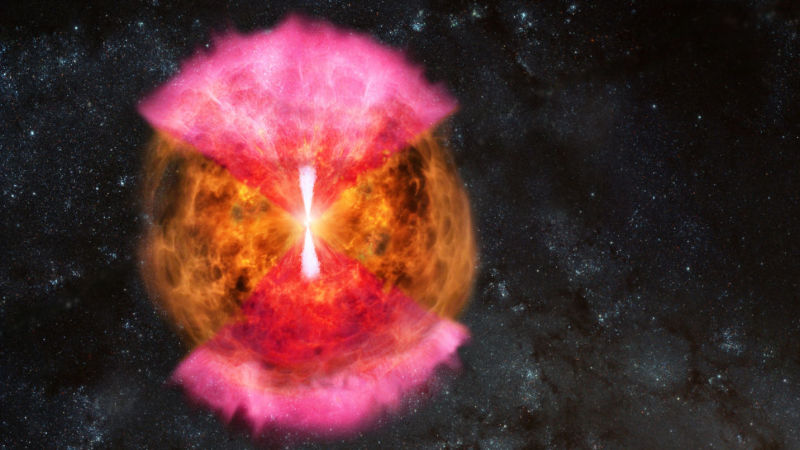
Secondly, the event has also given us new insight into jet physics. While GW170817 was often characterized as a short gamma-ray burst, Kasliwal was careful to refer to it only as a “burst of gamma-rays.” This event hasn’t quite fit the profile of a short, hard-gamma-ray object, in part because its was 10,000 times wimpier than others in this class have been. Our basic picture of an off-axis short, hard gamma-ray burst fails to explain the event and the afterglow, nor does it explain how bright and blue it was for a long time afterwards. It is also what Kasliwal calls “mildly relativistic”, with a Lorentz factor of 2–3 (still ~0.9 the speed of light) instead of 100 (~0.99995 the speed of light!), as we would normally have seen. Instead, Kasliwal discussed the application of the “cocoon” model to explain this burst. In the cocoon model, the merging neutron stars rip off a few hundredths of a solar mass of material from each other as they spiral in, causing the jet to break out into a messy ejecta and creating a wide angle instead of a narrow, 10-degree beam that we might otherwise have expected. This explains the wimpy burst and the bright blue appearance (due to the accelerated ejecta).

Even with all of this new information however, some things — like the ultimate fate of the jet — still remain to be seen. What we can take away from Kasliwal’s talk is that analysis of GW170817 is far from over — there is still much more we can learn from it and other events like it in the bright, multi-messenger astronomy future.


Plenary Talk: The Fate of Exploding White Dwarfs (by Kerry Hensley)

detonation channels

Detonation channels for Type Ia supernovae.

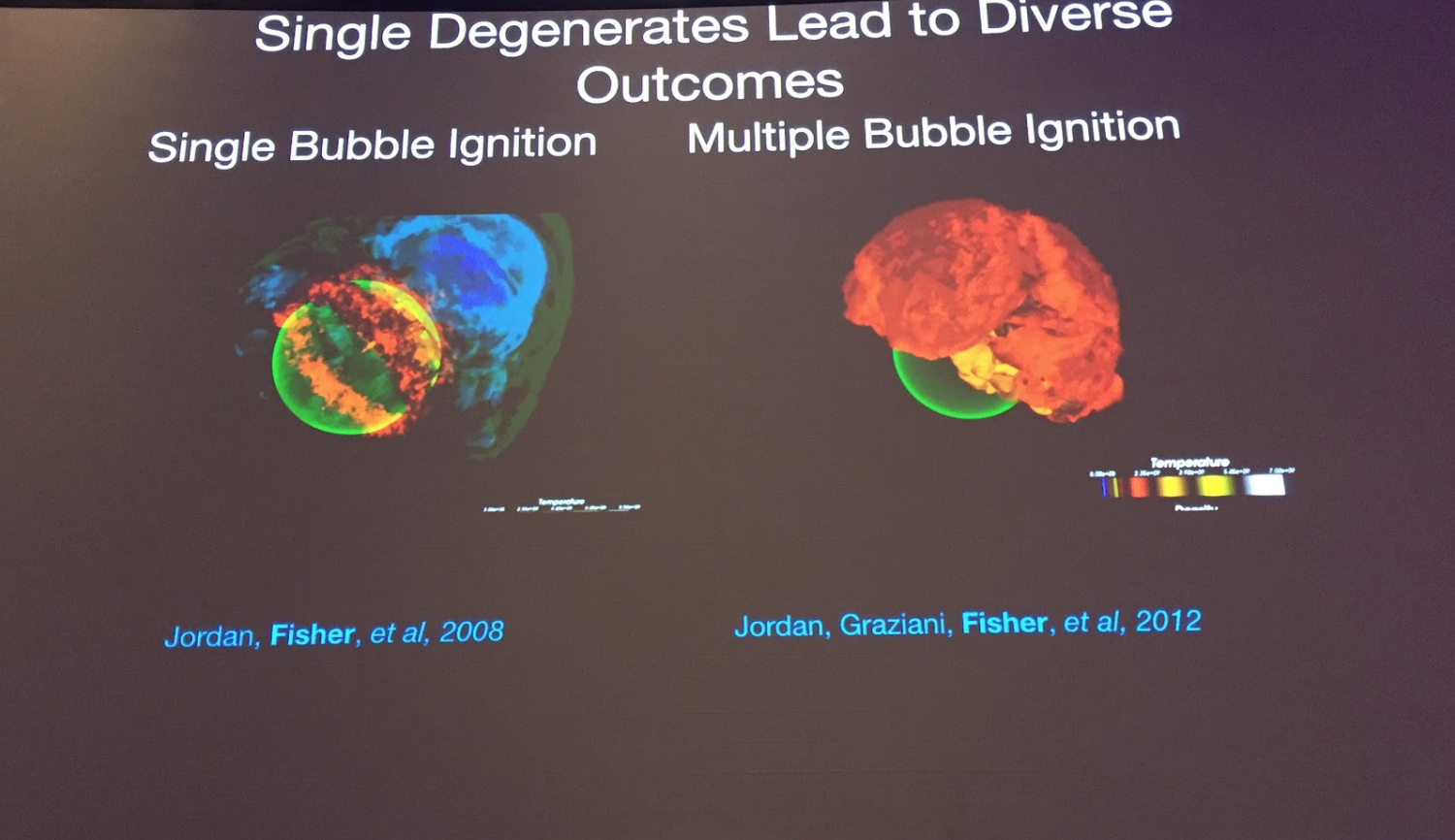
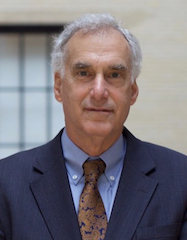
Robert Fisher of the University of Massachusetts at Dartmouth is an expert in complex explosions and uses supercomputers to study how Type Ia supernovae detonate. Dr. Fisher tells a story of competing explanations for the thermonuclear explosions of Type Ia supernovae: single-degenerate and double-degenerate pathways. The single-degenerate pathway is the textbook Type Ia supernova: a white dwarf siphons mass off of its main-sequence or red-giant companion until it exceeds the Chandrasekhar mass and explodes. The double-degenerate pathway requires either a degenerate or helium-rich companion. Dr. Fisher commented that both pathways likely exist in nature, but we need a better understanding of the outcomes of each scenario to fully grasp the observed diversity of supernova light curves.

single-degenerate pathway

Simulations showing that the single-degenerate pathway can lead to a variety of outcomes.

There are many outstanding questions in supernova science: Do all “normal” Ia supernovae detonate the same way, or is it possible to get a typical result through different pathways? What about the atypical (abnormally bright or dim) supernovae — are they just extreme cases or the typical supernovae or do they arise from a different pathway? Most importantly, how can we distinguish between these scenarios?

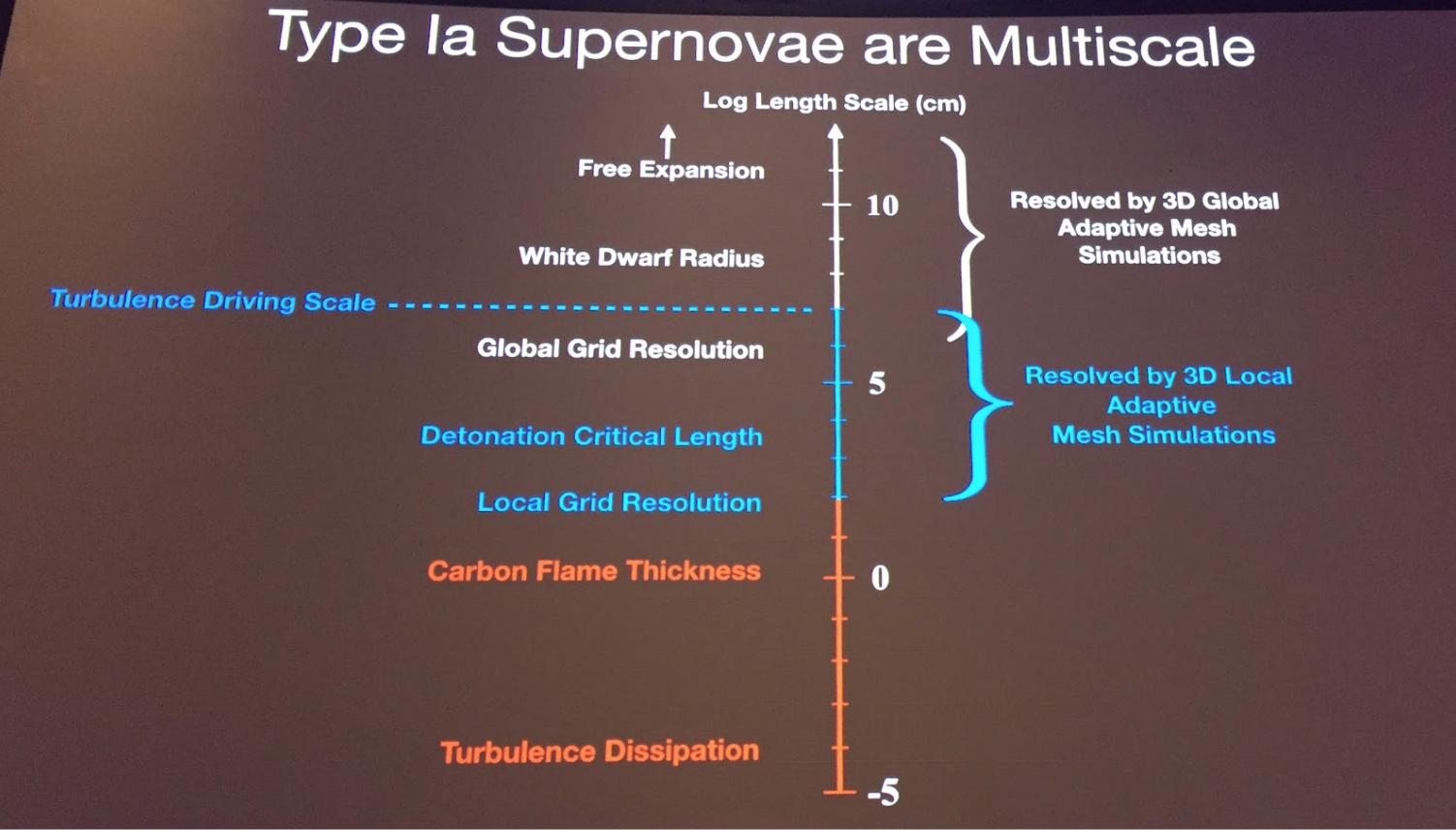
Simulations are an excellent tool for understanding how supernovae detonate and how the resultant light curves will look. Dr. Fisher outlined the shortcomings and successes of supernova simulations. Simulations have been successful in showing that the single-degenerate pathway produces diverse explosions, but there are theorized detonation methods that still haven’t been modeled, such as the “deflagration to detonation” method. Modeling unusual supernovae like SNR 3C 397, which is asymmetrical, could lead to a better understanding of how Type Ia supernovae explode.

length scales

The variety of important length scales in supernovae. The recent advances in modeling will help capture the small-scale physics that can have a big effect on the outcome of a supernova.

For the double-degenerate channel, current simulations fail to capture small-scale physics like turbulence or the size of the carbon flame. This leads to poor agreement between the modeled and observed light curves, which is an ongoing issue. Advances in supernova modeling will capture turbulence-driven detonation, which should help the modeled light curves match the observations more closely.

Observed supernova light curves, when used in tandem with simulations, can also yield information about the origins of the supernova. Looking at the light curves of supernovae well after peak brightness (late-time light curves) can help distinguish between the scenarios. The ratio between iron-55 and cobalt-57, for example, is predicted to be different in the single-degenerate and double-degenerate pathways. The ratio should be reflected in how quickly the luminosity declines since the different isotopes have different half-lives, providing an observational constraint on supernova detonation mechanisms.


Plenary Talk: The Politics of Science Funding: Is the Fault in Our Stars (by Kerry Hensley)

David Goldston of MIT got real with the assembled astronomers about their federal budget woes. He explained that what astronomers sometimes fail to do is put things in context; when the budget numbers are released (and science inevitably gets a disappointingly small piece of the pie), scientists can be quick to attach sinister meaning. Not so fast, said Goldston. Interpreting the budget numbers without first considering the context can be misleading. The single largest determining factor for the annual science budget is the total size of the federal budget. While the amount allocated each year to science varies, the percentage of the budget distributed to science has remained nearly the same for decades.

David Goldston

David Goldston

While this can seem discouraging — what control do individuals have over the federal budget?! — Goldston thinks that this shows that a major fear of scientists is unfounded; if science’s slice of the pie has remained the same for decades, the insidious threat of anti-science sentiment must not have taken hold as firmly as many scientists fear. (A clear exception to this is climate science, where views tend to fall along political lines, with some lawmakers complaining that climate science is carried out by “politicians in lab coats” and pushing for cuts to funding.) He cited yearly polling that shows that scientists consistently rank first or second on the list of people who act most in the public interest and are highly-respected. Plus, people are attracted to the idea of discovery, of having “Wow!” moments, of learning new things. And luckily for astronomers, the appeal of discovery can override the desire for practicality; when lawmakers attempted to surreptitiously slash funding for Hubble, public outcry saved the beloved telescope.

So, what does that mean for scientists? What, if anything, can individuals and organizations like the AAS do to improve budget prospects for science? Goldston reminded the audience that politics begins at home, and small changes can have a big effect. He emphasized the potential impact of higher education institutions and encouraged universities to host government representatives and show them what federal funding pays for — especially the “Gee whiz!” stuff — because they may not know. He added that introducing the representatives to students is especially important, saying, “Education is the most politically attractive aspect of science research.” He shared some advice for conversations with lawmakers: Remember that they’re people — people who are awed and inspired by images from Hubble — but people with a great responsibility that scientists do not have. Connect with them as people and show them that your work is in the public interest — because big changes won’t happen without people committed to bringing them about.


Lancelot M. Berkeley Prize: The Instruments that Launched Gravitational-Wave Astronomy (by Caroline Huang)

Peter Fritschel

Peter Fritschel

The final plenary talk of AAS 231 was given by MIT professor Peter Fritschel, who received the 2017 Lancelot M. Berkeley Prize. His talk was the instrumentional counterpart to Gabriela González’s Wednesday presentation, focusing on the aspects of the LIGO design that allowed them to make their amazing discoveries. Most of the talk was accompanied by pictures of the various parts of the experiment that was being discussed.

LIGO’s basic design can be thought of as an enhanced Michelson interferometer. However the LIGO interferometers have several changes that make them much more powerful than standard Michelson interferometers. To effectively increase the arm length of the interferometer, they add Fabry Perot “cavities” to the arms. Mirrors are placed near the beam splitter to allow the laser light to bounce back and forth 280 times before the light is merged again. For gravitational-wave (GW) experiments, the larger the experiment the better, so this increases LIGO’s effective arm length from 4 km to 1120 km, making it far easier to detect any GW passing through. LIGO also uses power-recycling mirrors to build up the power of the laser and is able to boost the power by 3750 times, ultimately generating an output 750 kW beam. This allows the instrument to produce a sharper interference pattern to make it easier to detect any GWs passing through.

LIGO test masses

Two of LIGO’s test masses. [LIGO]

The LIGO interferometer has four test masses that must be very well isolated from the surrounding environment in order to measure the incredibly tiny distortions from a gravitational wave. They use a combination of both active and passive damping to achieve this. The active damping senses vibrations in the surrounding environment and acts in a way to counteract them. The passive damping holds the test masses still using a four-stage pendulum. These test masses are 40 kg of fused silica, which they chose to minimize infrared absorption. Since LIGO uses an infrared laser, this is especially important. Astonishingly, only one out of every 3.3 million photons is absorbed by their mirrors. The others are all reflected or transmitted.

LIGO is also built in such a way that allows (and anticipates) that it will be upgraded, which includes having space for bigger and newer components. It has already been upgraded several times and they are continuing to increase the sensitivity. By design, it is currently limited by quantum and thermal noise. They plan to decrease the quantum noise by using squeezed light. The thermal noise largely comes from the Brownian motion of the optical coatings, so finding new low-thermal-noise coatings with high reflectivity will help LIGO achieve even better sensitivity in the future.

Fritschel concluded his talk by discussing the future of gravitational-wave astronomy as a whole. With Virgo interferometer now online and Kagra and and LIGO India joining in the future, the study of gravitational waves is just getting started.

AGN

Editor’s Note: This week we’re at the 231st AAS Meeting in National Harbor, MD. Along with a team of authors from Astrobites, we will be writing updates on selected events at the meeting and posting each day. Follow along here or at astrobites.com. The usual posting schedule for AAS Nova will resume next week.

Plenary Talk: Venus: Our Misunderstood Sister (by Kerry Hensley)

Darby Dyar of the Planetary Science Institute has served as a professor of astronomy, a participating scientist for the Mars Science Laboratory, and a tireless advocate for women in science. In today’s first plenary session, she revealed the fascinating features of our sister planet, Venus, and made a strong case for continued missions to this least-explored terrestrial planet.

Though Venus and Earth are nearly twins in mass and size, evolution has separated the two siblings; Venus is an inhospitable world with a surface temperature hot enough to melt lead, a corrosive sulfur and carbon dioxide atmosphere, and only trace amounts of water. What can we learn from studying such an unfriendly place? Venus-like exoplanets appear to be roughly as common as Earth-like exoplanets, so learning about Venus can help us understand a sizeable number of exoplanets. Studying Venus is also key to understanding the Earth itself; as Venus may have once been habitable, understanding its evolution can help us understand Earth’s future.

There are also many misconceptions about Venus. The classical picture of Venus is of a dry, inactive planet that is impossible to study because of its thick atmosphere and high surface temperature and pressure. Dr. Dyar dispelled these misconceptions and painted a new picture of Venus as a dynamic and geologically active world with complex mineralogy that, though dry today, once hosted an ocean’s worth of water. As tantalizing as this picture is, our understanding of our sister planet is hindered by our lack of high-quality data. We can only learn so much from laboratory studies, as well; “Venus chambers” are difficult to build and when they fail, they fail … explosively. So, to Venus we must go!

What does the future of Venus exploration look like? NASA’s 2017 Discovery-class mission finalists included two Venus missions, while the most recent call for New Frontiers-class proposals included three Venus missions as finalists — but in neither case was a Venus mission selected. (It’s worth mentioning that in the most recent call, the mission concept VICI was selected to receive funding for further technological development.) Though there are no NASA Venus missions on the horizon yet, Dr. Dyar closed the session by declaring the Venus science community ready to explore, “…poised now with mature mission concepts, intellectual capital, and experience.” And Venus is worth exploring.


Press Conference: It’s Amazing What You Can Do with Space Telescopes (by Benny Tsang)

NICER

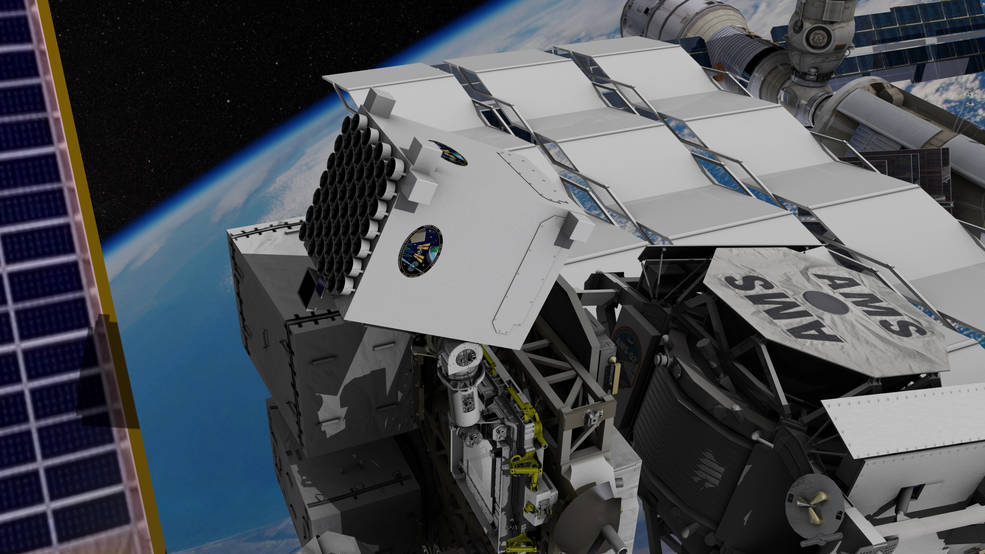
This artist’s illustration shows the NICER mission at work aboard the International Space Station.

Studying space is cool, but studying space from space is even cooler! Today’s morning press conference focused on the latest results from various space telescopes. Keith Gendreau (NASA Goddard Space Flight Center), the Principal Investigator of the Neutron star Interior Composition Explorer/Station Explorer for X-ray Timing and Navigation Technology (NICER/SEXTANT) mission, showed that we can build an interplanetary navigation system (aka a GPS for spaceships) by just observing pulsars. Pulsars are neutron stars — remnants left behind after the deaths of massive stars — that rapidly rotate, forming a beacon of light with clock-like regularity. NICER/SEXTANT uses X-ray telescopes on board the International Space Station (ISS) to measure the arrival time of the pulses from three or more such pulsars, from which we can deduce the spatial location. Through precise measurements with only built-in flight software within the NICER payload, the mission demonstrated that pulsars can serve as reliable navigational landmarks for future journeys in our Galaxy! [Press release]

Next up, William Clarkson (University of Michigan-Dearborn) charted the motions of Sun-like stars in the bulge of the Milky Way as they orbit. The measured motions of the stars revealed that stars with different chemical compositions follow different orbits. This finding provides constraints on the formation and evolution of the galactic bulge. The extension of the project will provide observationally verifiable predictions for how the galactic bulge formed.

AGN

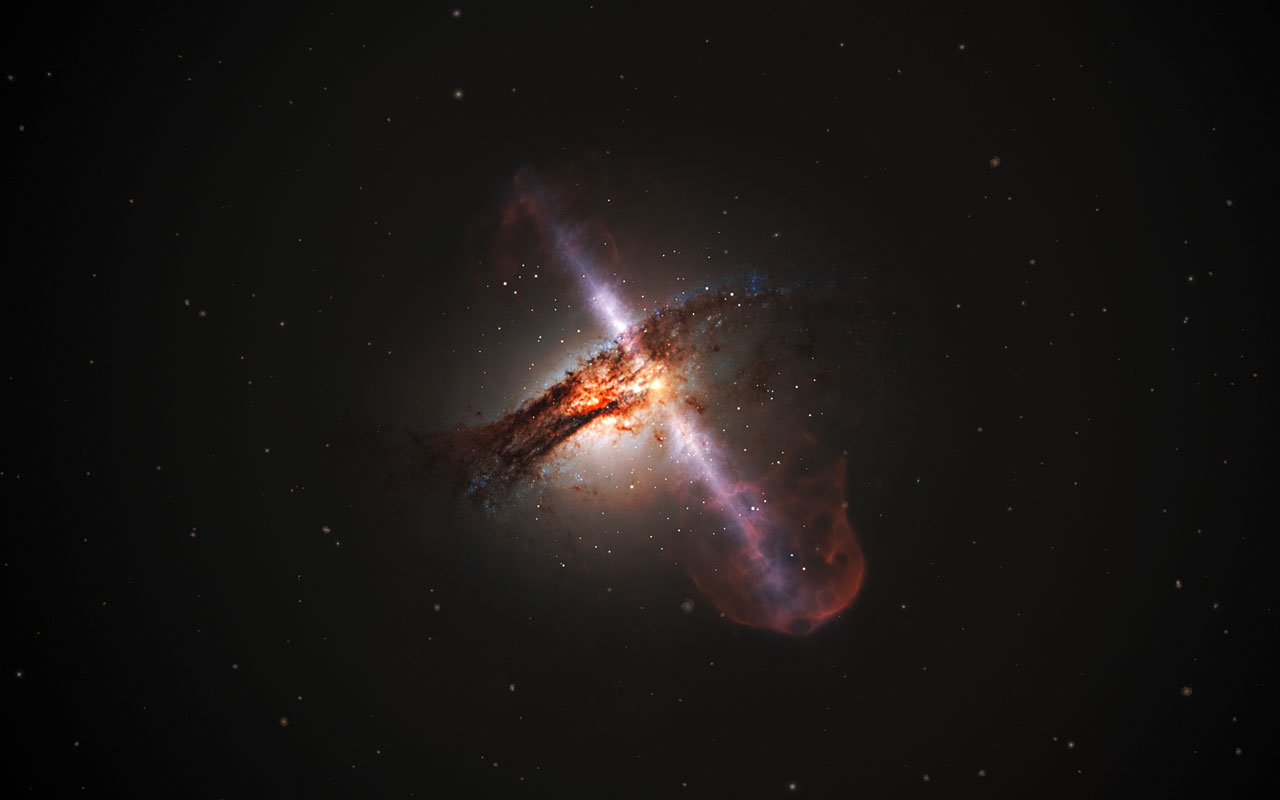
Artist’s impression of high-speed jets emitted from the supermassive black hole at the center of an active galaxy. [ESA/Hubble, L. Calçada (ESO)]

Supermassive black holes live in most of the galaxies in the universe. Their masses range from a million to hundreds of millions of solar masses. It has been known that when the black holes feed on gas, they also expel energy in form of gas burps. Julie Comerford (University of Colorado, Boulder) presented a double-burp captured by the Hubble Space Telescope and Chandra Space Observatory from the galaxy SDSS J1354+1327 800 million light-years away. The presence of a companion galaxy suggests that the separate meals were likely provided by an earlier galactic collision. [Press release]

Brett Salmon (Texas A&M University) reported the discovery of a very old galaxy that existed when the universe was only 500 million years old. This galaxy, SPT0615-JD, was discovered in Hubble’s Reionization Lensing Cluster Survey (RELICS) and companion S-RELICS Spitzer program. While finding old galaxies at high redshifts is not new in astronomy, the novelty of this particular galaxy is that its images were stretched into long arcs due to the distortion of light by a cluster of galaxies in the foreground. Analysis of the arcs showed that the galaxy mass is only about 1% of the Milky Way, and it is only 2,500 light-years across. Salmon also noted that the advent of the James Webb Space Telescope will provide astronomers with details to further constrain the structure of the galaxy, e.g., are there rotational structures in such early galaxies? [Press release]


Warner Prize Lecture: The Evolution of Stars & Galaxies (Chris Lovell)

The Helen D. Warner Prize is awarded annually for “a significant contribution to observational or theoretical astronomy,” and 2017’s winner Charlie Conroy (Harvard University) has certainly satisfied this criterion with his work on modelling the spectra of stellar populations, known as Stellar Population Synthesis (SPS). It is impossible to resolve individual stars in distant galaxies; instead, we see the combined light of many different stars, all with different ages and physical properties. SPS modeling aims to untangle these physical properties from this combined light, and the technique has a long history, starting in the ‘60s.

In order to build a population of stars you need three “pillars”:

  • An initial mass function (IMF) that describes what masses stars are typically born with
  • Models for how these stars evolve with time
  • Models for the light they emit, or their spectra.

An important ingredient for modelling spectra is the ratio of different elements within the stars, which can have a huge impact on the spectra. The abundances of elements can in turn tell you when these stars formed, since different elements are formed in different kinds of supernovae, and different types of supernovae occur in stellar populations of different ages.

One element of SPS models that Conroy highlighted was the IMF, which is typically assumed to be universal throughout the cosmos — stars are born with the same distribution of mass no matter what the local properties of the gas, the host galaxy, or the age. But, to quote Conroy, “It’s really hard to imagine it doesn’t depend on anything”. Unfortunately, untangling any dependences is notoriously difficult. The culprits of this difficulty are the low-mass stars, which dominate the total stellar mass (because there are so many of them compared to high-mass stars) but only contribute a few percent to the galaxy’s total light. Recent measurements, though, suggest that galaxy mass is correlated with how “bottom-heavy” the IMF is (how many low-mass stars there are), and this variation is confined to the central regions of galaxies.

To conclude his talk, Conroy gave a shout-out to researchers performing atomic and molecular line modeling of the Sun and nearby stars, since it is these studies on which much of his work depends, and he made a plea for more researchers to look into this field — it could be where many future gains in SPS modeling, and in astrophysics in general, now lie.

You can read more about Conroy in Ashley Villar’s interview.


Henry Norris Russell Lectureship: Fifty-Four Years of Adventures in Infrared Astronomy (Kerry Hensley)

This year’s Henry Norris Russell Lectureship is awarded “on the basis of a lifetime of eminence in astronomical research” to Eric Becklin of University of California, Los Angeles. As a pioneer in the field of infrared astronomy, Dr. Becklin is more than deserving of this award; while most scientists hope for one or two major discoveries in their careers, Dr. Becklin introduced more than ten eye-popping discoveries that advanced our knowledge of the infrared universe.

His first major discovery came as a grad student at Caltech working with Gerry Neugebauer to complete a 2.2-micron survey of the Orion Molecular Cloud in a search for the first protostar. The pair virtually stumbled upon an extremely bright infrared object with a temperature of 600 K that had no optical counterpart — just the protostar they had been searching for. “The optical astronomers didn’t think we’d discover anything in the survey. We were just out there looking around,” he recalled, before modestly adding that the difficulty of discovering the Becklin-Neugebauer Object, as it came to be known, paled in comparison to the challenge of passing his graduate quantum mechanics course.

The infrared sky survey also led to the discovery of IRC +10216, the brightest object outside the solar system at 5 microns. IRC +10216, also known as CW Leonis, is a nearby (just 100 parsecs away), highly variable carbon star. Or, as Dr. Becklin phrased it, “A dust and carbon molecule factory in space.”

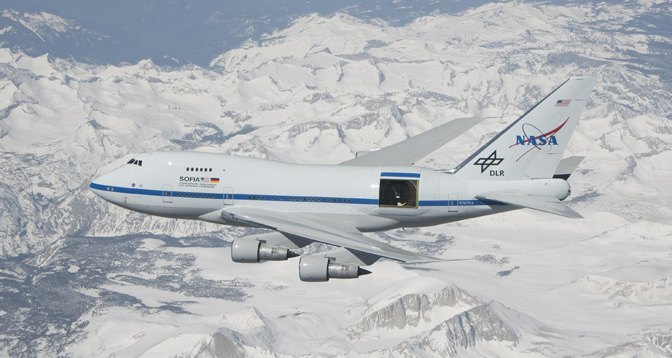
From there, his career expanded to encompass infrared observations of virtually every corner of the universe; from studying highly-extincted stars near the center of the Milky Way to taking (Congressionally-mandated!) 5-micron images of Jupiter as support for the Voyager spacecraft, Dr. Becklin has had a hand in a host of infrared discoveries. One of his most significant contributions is as the Chief Scientist for the Stratospheric Observatory for Infrared Astronomy (SOFIA), a position he still holds. (Recent results from SOFIA were highlighted in a press conference on Day 1 of this AAS meeting.) With SOFIA, Dr. Becklin has studied the gas and dust ringing the center of our galaxy, dynamics of stars orbiting the central black hole, star formation in the Orion Molecular Cloud, and an active galactic nucleus (AGN) at a redshift of z = 3.9.

An animation of the observed orbits of stars circling the supermassive black hole at the center of our galaxy. At closest approach (about 100 AU), the stars travel at 3% the speed of light. One star, S0-2, will have a closest approach in the spring of 2018. [Images/animations created by Prof. Andrea Ghez and her research team at UCLA. Data sets obtained with the W. M. Keck Telescopes.]

It was a pleasure to hear Dr. Becklin speak about his long career in infrared astronomy with such joy. He has clearly taken to heart the advice he gave his audience: Enjoy what you do, and enjoy the discoveries that will come — because they will come.


Plenary Talk: Astro Data Science: The Next Generation (by Nora Shipp)

Chris Mentzel is the program director of the Data-Driven Discovery Institute at the Gordon and Betty Moore Foundation. This means that he spends a lot of time thinking about how data science can be incorporated into scientific research. Particularly as astronomers builder better and better telescopes and collect more and more data, Mentzel emphasized that data science will become an essential part of astronomy research. 

Chris Mentzel

Chris Mentzel

This transition brings up interesting questions about how to incorporate data science into the world of astronomy. Mentzel pointed out that skills like statistics and software development are already common in astronomy, but that there is no accepted way to give credit to people who devote their time to these important tasks. He suggested that software development could be considered instrumentation, just like building a telescope.

He also raised the question of whether there should be a distinction between data scientists and astronomers, or whether all astronomers should be trained in these skills. He pointed out that this depends on whether data-science tools like coding and statistics are as essential to astronomy as something like calculus. If they are essential, then astronomers need to think about how to incorporate these lessons into astronomy education. If not, then we need to think about how to incorporate people with diverse skills into our research groups and collaborations.

An interesting question came up at the end of the talk — how can incorporating data science increase diversity in astronomy? Mentzel’s response was that first of all, requiring these courses would make it easier for people who may not have the free time to learn programming languages and statistics on their own to keep up with the evolving required skills. Second of all, data science techniques can be learned from people who apply them to different research areas. As astronomers begin to fully incorporate data science into their research they will come into contact with fields that are more diverse. There are certainly many questions that need to be resolved as we move towards larger and larger astronomical datasets. It is important that we think carefully about the decisions we make a about how the field of astronomy will evolve to meet upcoming challenges.

BNS

Editor’s Note: This week we’re at the 231st AAS Meeting in National Harbor, MD. Along with a team of authors from Astrobites, we will be writing updates on selected events at the meeting and posting each day. Follow along here or at astrobites.com. The usual posting schedule for AAS Nova will resume next week.

Plenary Talk: Unveiling the Low Surface Brightness Stellar Peripheries of Galaxies (by Nora Shipp)

Annette Ferguson (University of Edinburgh) gave an exciting plenary talk on her work toward using the faint outskirts of galaxies to better understand the origin and evolution of galaxies. She demonstrated how the old, metal-poor stars that show up in deep images of the peripheries of galaxies can tell us a lot about how the galaxy has evolved over time — and particularly about how the stellar mass of a galaxy increases via mergers and accretion.

As an example, she described her work toward discovering that the halo of our neighbor, M31, is dominated by a larger stellar stream — the tidal remnant of a dwarf galaxy. First, Ferguson and her group observed individual resolved stars in the halo of M31 with the PAndAs survey and found two distinct stellar populations — one larger metal-rich stellar population, and one smaller metal-poor population. With follow-up observations by the Hubble Space Telescope, they were able to decipher even more about the stellar populations and found that the metal-rich stars were all quite old and that star formation must have been cut off around 5 billion years ago. Meanwhile, the metal-poor stars were much younger, and seemed to come from a population with ongoing star formation. Taking into account the spatial distributions, they determined that the dominant metal-rich stars had joined M31 as part of a dwarf galaxy that had since been torn apart into a stellar stream, and that the metal-poor stars had been pulled off of the star-forming stellar disk.

Ferguson has been able to form an interesting picture of how stellar mass has been accreted onto M31 by observations of these faint stars in the outskirts of the galaxy, and she explained that she is excited to expand this work to more galaxies at even larger distances by taking advantage of future surveys like Euclid and LSST.


Press Conference: Peering Deeper into the Lair of the Repeating Fast Radio Burst (by Susanna Kohler)

Today’s press conference contained results embargoed until this afternoon, so we had to impatiently hold off on live-tweeting the session! This conference’s topic was the unusual fast radio burst FRB 121102, a mysterious burst of radio emission that recently gained fame by being the only FRB to repeat — and by being kind enough to repeat often, so we were able to pinpoint the host galaxy of an FRB for the first time.

Betsey Adams (ASTRON) kicked the session off with an overview of FRBs (and FRB 121102 in particular). FRBs are millisecond bursts of radio waves that are usually one-off events. We know that they originate from outside our own galaxy, but we don’t yet know what causes these intense flashes of light. The fact that FRB 121102 repeats is interesting because this narrows down its source — it can’t be caused by an explosion, because, as Adams pointed out, “You can’t explode your source, then explode it again.”

frb 121102

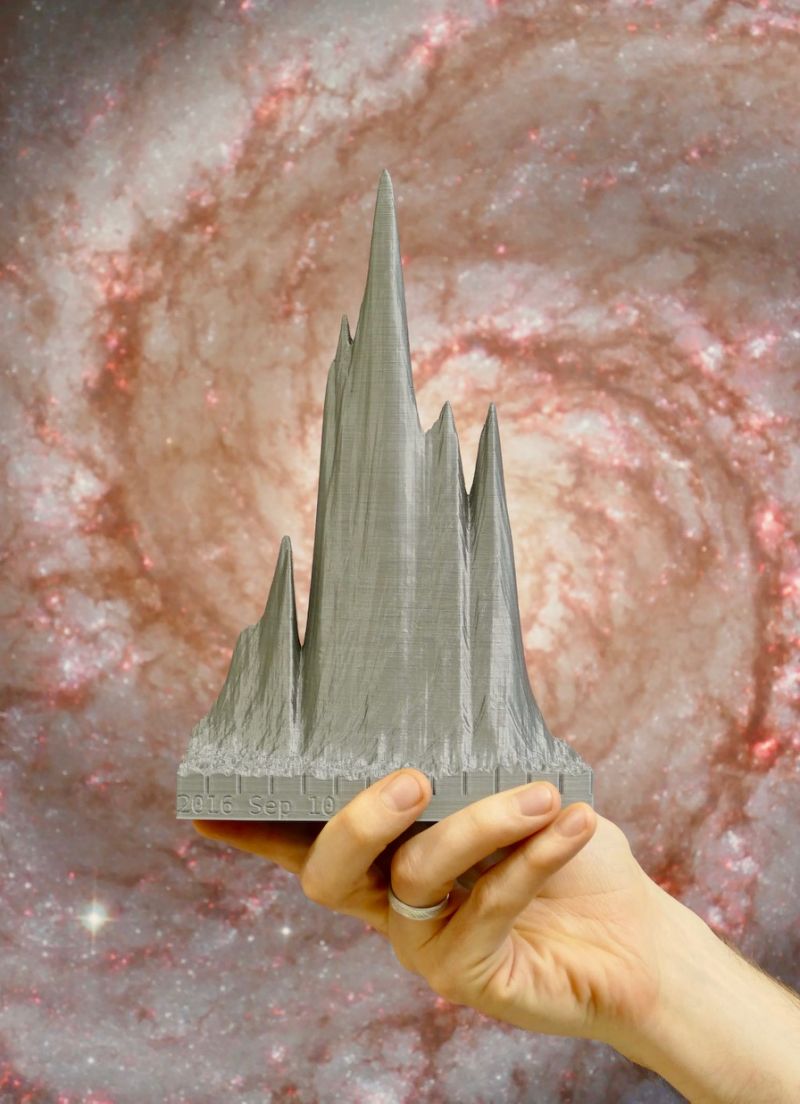
FRB 121102: a 3D printed model of a FRB emission pulse. [Anne Archibald/University of Amsterdam]

Repeated studies of FRB 121102 have allowed us to determine its host galaxy and find a persistent radio source associated with the bursts. Its home is a star-forming dwarf galaxy located 3 billion light-years away — suggesting a connection between FRBs and massive star formation and death. Now we’re using targeted, deep follow-up observations of FRB 121102 to probe the local environment around it.

Andrew Seymour (Arecibo Observatory) talked with us about the new features that we’re seeing within the bursts themselves: the emission isn’t steady over the millisecond period of the bursts, but instead exhibits brief hiccups. The team showed us some awesome 3D-printed models of the emission pulse so we could actually visualize the brief pauses and other substructure of the emission. What causes this structure? Is it something about the emission mechanism, or is it caused by how the burst interacts with its environment? Answering this may help us to figure out the origin of FRBs.

Next up, Vishal Gajjar (University of California, Berkeley) presented on efforts from the Breakthrough Listen project to learn about the highest-frequency components of these bursts. Seeing burst variation on timescales as short as 30 microseconds is an important clue: it tells us that the size of the emission region must be smaller than 10 km. Astronomically speaking, this is a tiny area — which significantly narrows down the types of sources that might be causing FRBs!

faraday rotation

FRB 121102 exhibits unusually high levels of Faraday rotation, even compared to other FRBs. [Daniele Michilli]

Daniele Michilli (ASTRON / University of Amsterdam) spoke next about efforts to explore the magnetic field of the source. The polarization observed from FRB 121102 shows enormous Faraday rotation — twisting of the magnetic fields that occurs as radio waves cross magnetized plasma — implying that the source is located in an extreme environment with very strong magnetic fields.

Finally, Jason Hessels (ASTRON / University of Amsterdam) closed the session by summarizing what we’ve learned about FRB 121102 so far and outlining a few potential models for its origin. A neutron-star source fits many observed properties but leaves us wondering at its surprising energetics. The source could be a massive black hole — but do we really expect to see such massive black holes in small dwarf galaxies like FRB 121102’s host? A powerful nebula is another possibility, but FRB 121102 is a million times brighter than even the Crab nebula. All models we’ve come up so far have their challenges! Luckily we’ll have more help exploring FRBs in the future: upcoming observatories like CHIME (Canada), ASKAP (Australia), UTMOST (Australia), and APERTIF (Netherlands) will help us to hunt for many more such bursts. Hopefully we’ll soon better understand these mysterious sources!

A press release from this conference can be found here.


Plenary Talk: The Stormy Life of Galaxy Clusters (by Kerry Hensley)

There’s more to galaxy clusters than the galaxies themselves. In his plenary session, Larry Rudnick of the Minnesota Institute for Astrophysics explained how our understanding of cluster galaxies and the stuff between them — the intracluster medium (ICM) — has evolved. (Interestingly, Dr. Rudnick traced the discovery of the first galaxy cluster to a drawing of what is now known as the Coma cluster by Max Wolf in 1902 — even before the so-called “spiral nebulae” were recognized as galaxies separate from our own!) The ICM is a turbulent mixture of hot plasma, cosmic rays, and magnetic fields, which is heated by mergers, outflows from galaxies, and feedback from active galactic nuclei (AGN).

During cluster mergers, the entire ICM is perturbed, resulting in turbulence and shocks, both of which generate non-thermal emission. In the X-ray, this non-thermal emission can be drowned out by the thermal emission because the ICM is so hot. However, there is very little thermal emission in the radio, so the structure of the ICM is revealed at the longer wavelengths. What do halos, relics, and phoenixes all have in common? They’re all ICM structures that can be seen in the radio! These structures are tied to ongoing questions about the ICM: How do magnetic fields in the ICM get amplified? How do some particles end up a hundred million times more energetic than others? Why do X-ray and radio observations sometimes yield conflicting results for the strength of shocks in the ICM?

The galaxy cluster Abell 2256 as seen in X-ray (left) and radio (right). [X-ray image from ROSAT/Max Planck Institute. Radio image from LOFAR/Reinout van Weeren]

While not all of these questions have answers yet, one mystery has been solved: Why has the hot, diffuse ICM persisted? Why doesn’t it cool off, collapse, and form stars? Physics tells us that it has to cool off; it’s emitting plenty of thermal radiation and the cooling timescale is much shorter than the age of the universe. However, while it cools, it is constantly re-energized by feedback from AGN which maintains its high temperature. Since we are just beginning to be able to map out the motions of the gas in the centers of clusters, we’re about to enter an era where we’ll be able to discern exactly how the AGN affects the intracluster gas.

Want to learn more about Dr. Rudnick and his work? Check out his interview with Astrobiter Amber Hornsby!


Workshop: Astrobites in the Classroom (by Nathan Sanders)

For the second year in a row, Astrobites organized a workshop at the AAS meeting for educators to discuss how to introduce modern research into undergraduate and graduate classrooms using our site as a resource. Since our workshop last year, we have published a series of lesson-plan templates that outline specific ideas for integrating Astrobites into curricula, and this year we have developed additional ‘ready-to-use’ lesson plans that provide concrete example lessons based on these templates.

We had a great discussion with the dozens of attendees who joined the session. One of the most important outcomes for us was the educators’ detailed feedback on how to adapt our lesson-plan concepts to different teaching environments, and what additional materials we can provide to help more educators make use of them. These extensions will be our top priority in the coming months.

Thanks to a grant from the AAS Education & Professional Development division, we were able to offer this workshop free of charge and we will also be following up with the educators who participated to gather their feedback as they execute the lesson plans in their classes. We are also seeking to conduct an education research study to measure the student impacts of exposure to current research using Astrobites.

If you are an educator seeking to use Astrobites in your classroom, if you would like to be part of our panel of educators providing feedback, or have any other questions or comments, please reach out to us at astrobites@gmail.com!

Astrobites workshop

Attendees brainstorm at the workshop on introducing current research into your classroom with Astrobites.


Press Conference: From Comets to Galaxies (by Chris Lovell)

In this conference we cover the whole range of astrophysical scales, from spinning comets passing close to the Earth to spinning galaxies just a few hundred million years after the Big Bang. Unfortunately we couldn’t live feed this press conference as a couple of the talks — due to be released in Nature — were embargoed until after the session ended, but here’s a summary of what went down.

Dennis Bodewits (University of Maryland) presented new observations of 41P/Tuttle-Giacobini-Kresak, a small comet first discovered in 1858 that passed close to the Earth in 2017. Observing with both the Discovery Channel Telescope (DCT) on the ground, and the UltraViolet-Optical Telescope (UVOT) on the Swift space telescope, they measured the rotation of the comet in April and found a period of 20 hours. By May this had slowed to 46–60 hours, the most rapid increase in rotation period of a comet ever observed. A potential cause for this rapid slow down are huge ejections of gas from the nucleus of the comet, which are particularly pronounced on 41P.

Next up, Paul Hertz (NASA, director of Astrophysics) made a special announcement regarding the Swift telescope, a gamma-ray space observatory that has been responsible for a range or groundbreaking discoveries, most recently catching the UV emission from the neutron-star collision gravitational-wave event. The principal investigator of the Swift mission, Neil Gehrels, passed away in February 2017, and in honour of his contributions to the mission it has been renamed the “Neil Gehrels Swift Observatory”.

Both above and below the plane of the Milky Way, two giant lobes of X-ray and gamma-ray radiation are visible, known as the Fermi bubbles. These huge structures are thought to be due to ejecta from the supermassive black hole at the center of our galaxy — but until now, measuring the velocity of the material in the bubbles has been very difficult. Jay Lockman (National Radio Astronomy Observatory) presented observations of hydrogen clouds within the Fermi bubbles that are moving at incredible speeds of up to 400 kilometers per second — faster than anything else seen in the Milky Way. The clouds appear to be moving outwards in a cone from the center of the galaxy.

fermi bubbles

An artist’s impression of the Fermi bubbles above and below the plane of the Milky Way. [NASA’s Goddard SFC]

Ever wanted to see what the view is like from the center of the Milky Way? Well, now you can, thanks to Christopher Russell (Instituto de Astrofísica / Pontificia Universidad Católica de Chile) and his team, who have built a Virtual Reality view of our galaxy from the position of Sagittarius A*, the black hole at the center of the galaxy. They have predicted the motions of gas in the vicinity of the black hole and made two visualizations: one assuming no outburst effect from the black hole, and another that simulates feedback, preventing the new accretion of material. Check it out on youtube (google cardboard VR glasses required), or if you’re at AAS231, go find Christopher at a booth in the exhibition hall!

Finally, Renske Smit (University of Cambridge) finished the session with observations of galaxies during the epoch of reionization, some 13 billion years ago. Her team used the ALMA sub-millimeter telescope in Chile to follow up on two galaxies identified with the Hubble and Spitzer space telescopes and produce resolved maps of the gas in these galaxies. They could then measure the movement of the gas in these objects, and what they found was highly surprising — a coherent disk of gas, similar to the disk of the Milky Way. Astronomers expected galaxies at these early times to be highly chaotic, with a lumpy distribution of gas, but these observations suggest a much more stable situation.


Dannie Heineman Prize for Astrophysics: The Value of Change: Surprises and Insights in Stellar Evolution (by Susanna Kohler)

The Dannie Heineman prize is awarded to Lars Bildsten (University of California, Santa Barbara) in 2017, for “his leadership and observationally grounded theoretical modeling that has yielded fundamental insights into the physics of stellar structure and evolution, compact objects, and stellar explosions.” Despite Bildsten’s role as director of the Kavli Institute for Theoretical Physics at UCSB (read more about Bildsten in Ashley Villar’s interview), he still finds time for extensive research work in stellar evolution theory. Today he shared with us some of the latest developments in two fields of stellar research: asteroseismology and supernovae.

Bildsten began by introducing the idea of how we can learn about stars based on their oscillations as waves bounce around inside them — the study known as asteroseismology. The theory behind this process is important for understanding what we’re seeing! Each type of wave that we observe in a distant star reveals a different kind of information. Bildsten discussed a few things we’ve discovered we can learn from various oscillation modes — such as the masses and radii of stars across the galaxy, the properties of their cores (which tells you what kinds of stars they are), and even measurements of their magnetic fields.

Next, Bildsten shifted gears to talk about more extreme stellar variations: explosions! In the past, stellar explosions fell into two primary categories: core collapse of a massive star into a neutron star or a black hole, or a thermonuclear explosion triggered in a white dwarf. Recently, a new type of supernova has been discovered that’s significantly brighter than those two categories, earning these the name “superluminous supernovae”. Bildsten suggested that these transients might be the result of a magnetar — a highly magnetized, spinning neutron star — being born.

Bildsten concluded with the sentiment that for stellar evolution studies, the future is bright. Missions like K2 and TESS will continue to fuel asteroseismology studies, and optical surveys like the Zwicky Transient Facility or the Dark Energy Survey will hunt for exploding stars and other stellar transients. Meanwhile, theory and computation will continue to push into new realms to explain our discoveries!


HEAD Bruno Rossi Prize: Gravitational-Wave Astronomy (by Susanna Kohler)

Gabriela González (Louisiana State University, Baton Rouge) and the LIGO Scientific Collaboration were awarded the 2017 HEAD Bruno Rossi prize “for the first direct detections of gravitational waves, for the discovery of merging black hole binaries, and for beginning the new era of gravitational-wave astronomy.” You can read more about González in Ashley Villar’s interview.

González opened her talk with a realization of how far the field of gravitational-wave astronomy has come in the past two years: “I used to give talks about all the things that were going to come. This is the first time I get to start a talk with the news of what has been discovered!”

González began with an overview of the decades of theory that predicted gravitational waves and the work that went into building and improving the complex and highly sensitive LIGO and VIRGO detectors. She emphasized the collaborative nature of the field of gravitational-wave astronomy — when the first detection finally occurred in September of 2015, more than 1,000 authors were on the paper announcing it. Every one of those people was necessary for the discovery, González confirmed.

Since the first detection of gravitational waves from two black holes merging (GW150914), we’ve observed several more of these events. By the fourth one, González joked, the team was already bored: “Fine, another binary black-hole coalescence…” The next detection was anything but mundane, however: in August 2017, a chirp lasting ~100 seconds was detected. Since the previous signals had all been <2 seconds long — and longer signals indicate lower-mass objects — this new detection spurred excitement. The first binary-neutron-star merger had been seen in gravitational waves.

The discovery of GW170817 in gravitational waves was followed by a flurry of activity as ground- and space-based telescopes around the world turned to point in the direction that the signal had come from. Their efforts were rewarded: counterparts to GW170817 were found throughout the next few days across the electromagnetic spectrum, and the source’s host galaxy was identified. These observations — which were contributed by roughly 4,000 astronomers around the world — have given us a remarkably detailed look at this merger.

González wrapped up by describing the bounty of science we are now starting to be able to explore using our combined gravitational-wave and electromagnetic observations. In the next few years, we can expect increasing capabilities as more gravitational-wave detectors come online and their sensitivity improves. “The era of gravitational-wave astronomy is here,” says González, “and it’s here to stay.”

Jupiter pole

Editor’s Note: This week we’re at the 231st AAS Meeting in National Harbor, MD. Along with a team of authors from Astrobites, we will be writing updates on selected events at the meeting and posting each day. Follow along here or at astrobites.com. The usual posting schedule for AAS Nova will resume next week.


Astrobiters

Astrobites at the undergrad orientation.

Undergrad Reception

We loved getting to chat with so many students at the undergrad orientation and reception on Monday night! It was great to hear about your research projects, your goals for the future, and the things you’re passionate about. Keep on being awesome, remember that we want to hear from you about your research, and let us know if there’s anything we can do to help make your entry and progression through the field of astronomy easier.


Kavli Foundation Lecture: The New Jupiter: Results from the Juno Mission (by Kerry Hensley)

Scott Bolton of the Southwest Research Institute, who serves as the Principal Investigator of NASA’s Juno mission, reflected that before his graduate student days, it seemed like scientists knew everything; results were reported with so much confidence that it seemed that there were no puzzles left to solve. Luckily, that’s far from the case, and the Juno mission is a great example of how new results can topple long-held beliefs and open old topics to new ideas.

Juno sweeps close to Jupiter once every 53 days (the closest approach is known as perijove), careening just a few thousand kilometers above the cloud tops, traveling pole to pole in about two hours, and steadily marching along in longitude to make a map of the planet. The Juno mission has upended established theories about Jupiter’s atmosphere, interior structure, and magnetic field. For example, there is more lightning at Jupiter than anyone anticipated, especially in the northern hemisphere. White clouds — possibly containing ammonia ice — are ubiquitous. The magnetic field has stronger high-order components than expected, and unexpectedly peaks in strength closer to the equator than the poles. The auroral trace of the volcanic moon Io has a split tail. In addition to these individual discoveries, the Juno mission highlights the fact that the four seemingly separate foci of the mission — origins, interior, atmosphere, and magnetosphere — are more interconnected than originally thought.

No Juno presentation could be complete without some gorgeous images from JunoCam. (You can access raw JunoCam images and weigh in on where the camera should look next on the JunoCam website!) After a long approach to Jupiter, the first look at cloud formations on Jupiter’s poles didn’t disappoint; the south pole is dotted with storms arranged in a pentagon, while the north pole sports a stormy octagon. With each successive perijove bringing new and intriguing results, Jupiter surely has more surprises and more theory-toppling in store. Dr. Bolton closed the session with a message for the current crop of young investigators: Keep working on the theories, and don’t believe your professors!


Press Conference: Astronomy from the Stratosphere (by Susanna Kohler)

sofia

SOFIA: not a crazy idea, as it turns out. [NASA/Jim Ross]

The first press conference of the meeting kicked off with a look at some of the latest results from the SOFIA mission. SOFIA’s one of my favorite missions — it’s a big plane flying with a garage-door-sized hole in its side for an infrared telescope to point out. What’s not to love? SOFIA’s flights put it above 99% of the Earth’s water vapor, allowing it to make infrared observations that are impossible to make from the ground.

First up, Kimberly Ennico (NASA Ames) provided a broad overview of SOFIA and its different instruments. SOFIA’s instrumentation is renewable: the team regularly swaps out the instrument that flies on its observing runs. Today’s announcements focused on initial results from the new High-Resolution Airborne Wideband Camera-Plus (HAWC+) instrument and outcomes from the German Receiver for Astronomy at Terahertz Frequencies (GREAT) instrument.

The HAWC+ instrument provides both far-infrared images and polarimetry data, allowing us to explore the structure of galactic magnetic fields. Enrique Lopez Rodriguez (USRA/SOFIA Science Center) presented the first detections of polarized far-infrared emission from external galaxies, which can be used to infer the large-scale structure of the galactic magnetic fields. In particular, he showed contrasting observations from two different galaxies: M82, a starburst galaxy with large magnetized outflows, and NGC 1068, a massive spiral galaxy in which we can see a magnetized spiral arm.

B-G Andersson (SOFIA / USRA) gave an overview of some of the theory behind polarization and how it traces magnetic fields. In one model, radiative alignment torque theory, radiation from stars hits dust grains and causes them to spin up. Once the grains are spinning, they interact with magnetic fields, causing the grains to align. Various recent polarization measurements made with SOFIA/HAWC+ seem to support this theory.

Evidence for this from HAWC+ observations was presented by Fabio Santos (Northwestern University), exploring magnetic fields within galaxies. SOFIA/HAWC+ looked at one of the closest star-forming regions to us, Rho Ophiuchi, and demonstrated that the polarization of the dust grains in this interstellar cloud depends on the density within the cloud. These observations support radiative alignment theory: dust grains on the outskirts of the cloud receive more sunlight and align with magnetic fields more readily, whereas dust grains in the dense cloud interior receive less sunlight and don’t align effectively.

Elizabeth Tarantino (University of Maryland) rounded out the session with a discussion of what SOFIA/GREAT observations have revealed about how gas cools to form clouds and collapse into the stars we observe today. The incredible resolution of the GREAT spectrometer allows us to make measurements of ionized carbon within star-forming regions in other galaxies. From these measurements, we’ve determined that both atomic and molecular gas contributes to cooling of gas — but in different ratios, depending on how actively the region is forming stars. These observations are crucial for understanding the initial stages of star formation.

The press release corresponding to this press conference can be found here.


Plenary Talk: A New Measurement of the Expansion Rate of the Universe, Evidence of New Physics? (by Nora Shipp)

Adam Riess (Johns Hopkins University) is an expert in precisely measuring the expansion of the universe. In fact, he won a Nobel Prize in 2011 for his role in proving that the universe is not only expanding, but also accelerating in its expansion. These days he works on getting as precise a measurement as possible of the expansion rate in the local universe.

Riess

Turnout for Adam Riess’s talk on the expansion of the universe. [Kevin Marvel/AAS]

In today’s plenary, Riess discussed the recent tension between the local and distant measurements of the Hubble parameter, H0. Currently there is a 3.4-sigma discrepancy between measurements by Riess’s group of H0 in the local universe and the value determined by the Planck collaboration from the cosmic microwave background (CMB).

Riess did point out that “it’s not a discovery until 5 sigma,” however 3.4 sigma is certainly interesting, and it sounds like Riess and his group have exciting plans for reducing the errors on their measurements. In fact, Riess said that his goal is to go from 2.4% to 1% errors on the local measurement of H0 within the next 5 years, before the end of HST. An important component of this is incorporating the upcoming proper motion measurements from Gaia.

Although he’s still working on improving his measurement before fully accepting the H0 tension, Riess made some suggestions as to possible physical explanations for the difference between the local value of H0 and the value determined from the CMB. One possibility is a new species of relativistic particle. Riess said his particle physicist colleagues have no trouble inventing new particles without messing with accepted physics. It is also possible that dark matter isn’t completely collisionless. Interactions between dark-matter particles and radiation in the early universe could lead to differences in H0.

This is an exciting time for cosmology — it is unexpected results like this discrepancy that reveal the most exciting new insights into our universe!

You can read more about Riess and his work in an interview by Amber Hornsby.


Seminar for Science Writers: NASA’s Transiting Exoplanet Survey Satellite (TESS) (by Susanna Kohler)

TESS

Artist’s illustration of TESS and a transiting exoplanetary system. [MIT]

In addition to today’s press conferences, the AAS Press Office also hosted a seminar for science writers providing an overview of the upcoming Transiting Exoplanet Survey Satellite (TESS). The seminar kicked off with a broad look at the TESS mission and its science objectives, provided by George Ricker (Massachusetts Institute of Technology). TESS is slated to launch in March of this year, and it will survey an enormous field of nearby, bright stars, searching for small transiting exoplanets.

The mission pipeline doesn’t end when TESS discovers objects of interest. Sara Seager (Massachusetts Institute of Technology) described how these objects then get sent on to the TESS follow-up program, which involves hundreds of people around the world. Seager discussed the expected outcomes from TESS for planet discoveries: we may find 70 or so Earths, hundreds of super-Earths, and thousands of sub-Neptunes. The planets discovered with TESS will be orbiting bright stars, making them excellent candidates for follow-up with observatories like the James Webb Space Telescope to explore their atmospheres.

Padi Boyd (NASA Goddard Space Flight Center) next provided an overview of TESS’s guest investigator program, which just completed peer review of its first proposal cycle, receiving more than 140 proposals from the astronomy community. TESS’s large field of view and high-cadence monitoring lends itself well to a variety of projects, like exploring variability in the stars of the Pleiades, hunting for very early-stage supernovae, and exploring the electromagnetic counterparts to gravitational-wave signals.

Kepler v TESS

Kepler vs. TESS. [TESS/Elisa Quintana]

Wrapping up the session, Elisa Quintana (NASA Goddard Space Flight Center) presented on how TESS meshes with other current and future missions. She opened by explaining that TESS isn’t a Kepler replacement: while Kepler’s planet discoveries are on average ~3,000 light-years away, TESS’s will be much loser, at ~300 light-years away on average. TESS’s field of view covers a solid angle that’s ~20x the size of Kepler’s, and the mission’s goal is specifically to hunt for small planets transiting bright stars, which can then be followed up with other current and future telescopes to learn more about the planets’ properties.

We can look forward to TESS’s launch in the next few months, and we have high hopes for its productivity. Though the nominal mission is only 2 years, Ricker points out that the mission won’t be limited by expendables — it could last several decades in orbit if NASA chooses to continue to fund it! I don’t know about you, but I can’t wait to see what TESS shows us.


Press Conference: An Alphabet Soup of Science from SDSS/APOGEE/BOSS/MaNGA (by Chris Lovell)

Karen Masters (Astrophysical Research Consortium / SDSS-IV), spokesperson for SDSS-IV, kicked off this press conference on the Sloan Digital Sky Survey with an overview of this fourth iteration of the program, along with a sneak peek at some of the exciting science to come from the next iteration, SDSS-V.

At the turn of the 19th century, Henrietta Leavitt was studying Cepheid variable stars, which oscillate in size and luminosity with a regular period. She noted that the period was related to the luminosity of the star, which makes these stars great for measuring distances. Sadly, it was only after her death that Leavitt’s contribution was recognised, so to go some way to rectifying this the AAS has recently decided to name this relation the Leavitt law. Much work has been done on the relation since then, but one aspect that is still poorly constrained is how the composition of the star affects the Leavitt law. Katherine Hartman (Pomona College) and Rachel Beaton (Princeton University) presented observations of Cepheids from the Apache Point Galactic Evolution Experiment (APOGEE) survey, and found that measurements of the composition of these stars give consistent results no matter at what point in the cycle they are observed. This is great because it means that, in future, we only need a single observation of a Cepheid to measure its composition, rather than observations over the whole cycle.

Next up, Robert F. Wilson (University of Virginia) demonstrated the power of combining datasets from different observatories, in this instance measurements of the iron content of stars from the APOGEE instrument combined with exoplanet measurements from the Kepler space telescope. The headline result is that iron-rich stars tend to host planets with shorter periods. A mere 25% increase in the iron content can have a significant effect on the average planetary period, which is intriguing since iron makes up only around 2% of the total mass of your average main-sequence star. The physical mechanism leading to this effect is still uncertain, but Robert proposed a couple of physical explanations: either iron-rich protoplanetary disks lead to formation of planets in tighter orbits, or such systems cause planets to migrate inwards from the outer disk.

Supermassive black holes lie at the center of almost every galaxy and are thought to have a big impact on the properties of their host galaxies. Measuring their masses throughout cosmic time is therefore key, but incredibly difficult. The next talk from Catherine Grier (Pennsylvania State University) presented results from the BOSS spectrograph that uses a technique called reverberation mapping to measure these masses. In short, light from the accreting black hole is seen reflecting off gas in the accretion disk in real time; by studying this light, we can measure its rotation speed, which can be used to infer the mass of the black hole at the center. What’s amazing about this study is that they measure the masses of 849 black holes up to 8 billion years ago — a much bigger sample that probes much further back in time than previous studies.

Sticking to the theme of supermassive black holes, Karen Masters presented evidence for these objects in non-star-forming dwarf galaxies. Her team used results from the MaNGA survey to observe the distribution of both stars and gas in these quiet, low-mass galaxies, and found an intriguing result: they aren’t moving together. This suggests that something is blowing out the gas, a process known as feedback. Fortunately MaNGA provides another piece to the puzzle: the ionization state of the gas. The ionization state is very high in the outflowing gas in these dwarf galaxies, which suggests the feedback is from the central black hole, rather than stars. Massive black holes were not expected to be an important driver of evolution in low-mass galaxies, so these results present a challenge to theory.

All of the these press releases are available on the SDSS website.


Doggett Prize Lecture: Tangible Things of American Astronomy (by Kerry Hensley)

Sara Schechner

Astronomers are enamored with immaterial things: photons, magnetic fields, gravitational waves… But our romance with the ethereal is made possible by the material: telescopes and detectors, spacecraft and spectrometers. The careful treatment demanded by delicate and aging astronomical instruments dating back hundreds of years begs the question: why should we care about documenting and preserving obsolete artifacts from the history of astronomy? Dr. Sara Schechner, the curator of the Collection of Historical Scientific Instruments at Harvard University, answered this question with examples of astronomical paraphernalia throughout history and the effect that astronomical events have on society as a whole.

She noted that outdated instruments and texts can provide insight into how people viewed astronomy in the past. For example, 17th century almanacs and instruments reflected the close kinship of astronomy and religion in that era; astronomy had yet to shed its theological (and sometimes ominous) associations. After the 1684 solar eclipse caused Harvard University’s commencement to be rescheduled (such a bad omen shouldn’t coincide with such an auspicious day), the Harvard president, John Rogers, suddenly died on the day of the eclipse — confirming the astronomical event as a harbinger of doom. By 1759, however, the first predicted return of Halley’s Comet was welcomed with awe.

The women computers of the Harvard College Observatory.

Astronomical materials can also reflect other societal shifts. Glass photographic plates evoke memories of the women “computers” of the Harvard College Observatory. Brilliant yet underpaid, the women of the Harvard Observatory classified hundreds of thousands of stars and developed the spectral typing scheme still in use today. Notably, Henrietta Swan Leavitt formulated Leavitt’s Law — a connection between the period of a Cepheid variable’s pulsation and its luminosity — which was used by Edwin Hubble for his discovery of the expansion of the universe. While the work of the Harvard computers advanced the status of women in astronomy, their success didn’t necessarily advance all women; telescope advertisements catering to male astronomers in the 1960s still featured elegant women caressing telescope barrels, showcasing how astronomical materials can reflect attitudes toward women over time.

Lastly, historical materials can highlight the public’s affinity for astronomy, as well. From amateur astronomers’ efforts to track Earth-orbiting satellites in the 1950s via project Moonwatch to advertisers using the allure of the stars to sell their products, the public’s romance with the stars is well-documented in historical artifacts. Dr. Schechner summarized her talk by saying that learning about our past helps us to live critically in the present; from the public’s reception of science to views toward women, astronomical artifacts are a lens through which we can evaluate societal changes through time.

You can read more about Schechner and her work in an interview by Caroline Huang.


RAS Medal Prize Lectureship: The Effect of Non-Linear Structure on Cosmological Observables (by Caroline Huang)

If you ever take an astronomy course that covers some cosmology, probably one of the first things you’d learn is the cosmological principle — the assumption that matter is distributed isotropically and homogeneously on large scales. A somewhat less general version of this, the Copernican principle, says that we don’t live in a special place in the universe. This is one of the most basic assumptions built into Lambda-CDM, the current leading model that describes the universe.

The truth is, however, that we don’t live in a perfectly isotropic and homogeneous universe, and that these density perturbations may (or may not) have effects on what we observe when we try to study cosmology. For example, gravitational lensing causes objects behind over-densities to look brighter, and objects behind under-densities to look fainter. The Hubble diagram of Type-Ia supernovae assumes that there is no flux bias from gravitational lensing, but theorists have actually gone back and forth on what sort of effects we might see for more than half a century. In his plenary lecture, Professor Nick Kaiser (University of Hawaii) discussed the difficulties of calculating distance as a function of redshift and the various conclusions cosmologists have come to over time regarding the effect of inhomogeneity on observables like Type-Ia supernovae.

One way to think of this problem is to consider that our assumptions about isotropy and homogeneity lead us to conclude that a surface of constant redshift would be a sphere. While this true for something that is perfectly isotropic and homogeneous, when you have even small matter under- and over-densities, this is not the case. Since the universe is almost isotropic and homogeneous, there would only be very small perturbations, but that would cause the surface of constant redshift to look something like the surface of a golf ball: almost spherical, but with wrinkles. Since this could cause us to see a flux bias, it could have an effect on things we measure, like the Hubble constant.

How big are these effects? In the question and answer session, Kaiser said that exactly how large these effects may be is unclear, but that he does think that it’s unlikely that they could explain the difference between the CMB and local Hubble constant measurements.

1 15 16 17 18 19 23