AAS News RSS

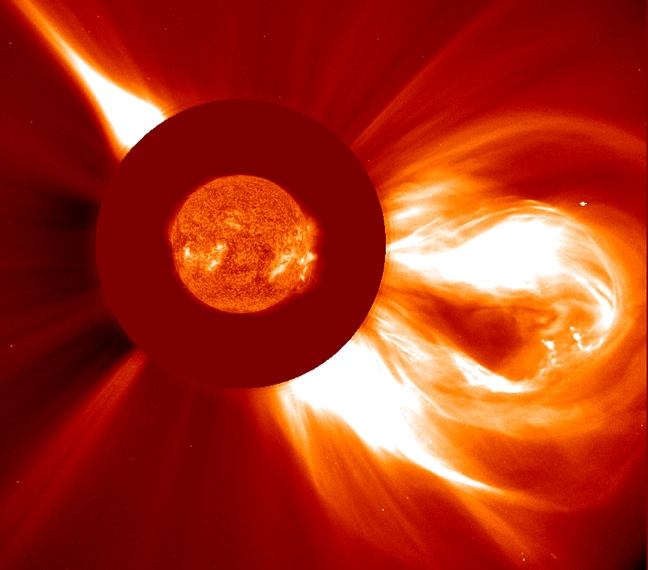
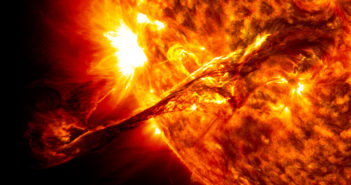
filament eruption

Editor’s Note: This week we’re at the 234th AAS Meeting in St. Louis, MO. Astrobites and AAS Nova will be working together to publish updates on selected events at the meeting this week; the usual posting schedule for AAS Nova will resume next week.

Plenary Lecture: Transiting Exoplanets: Past, Present, & Future (by Susanna Kohler)

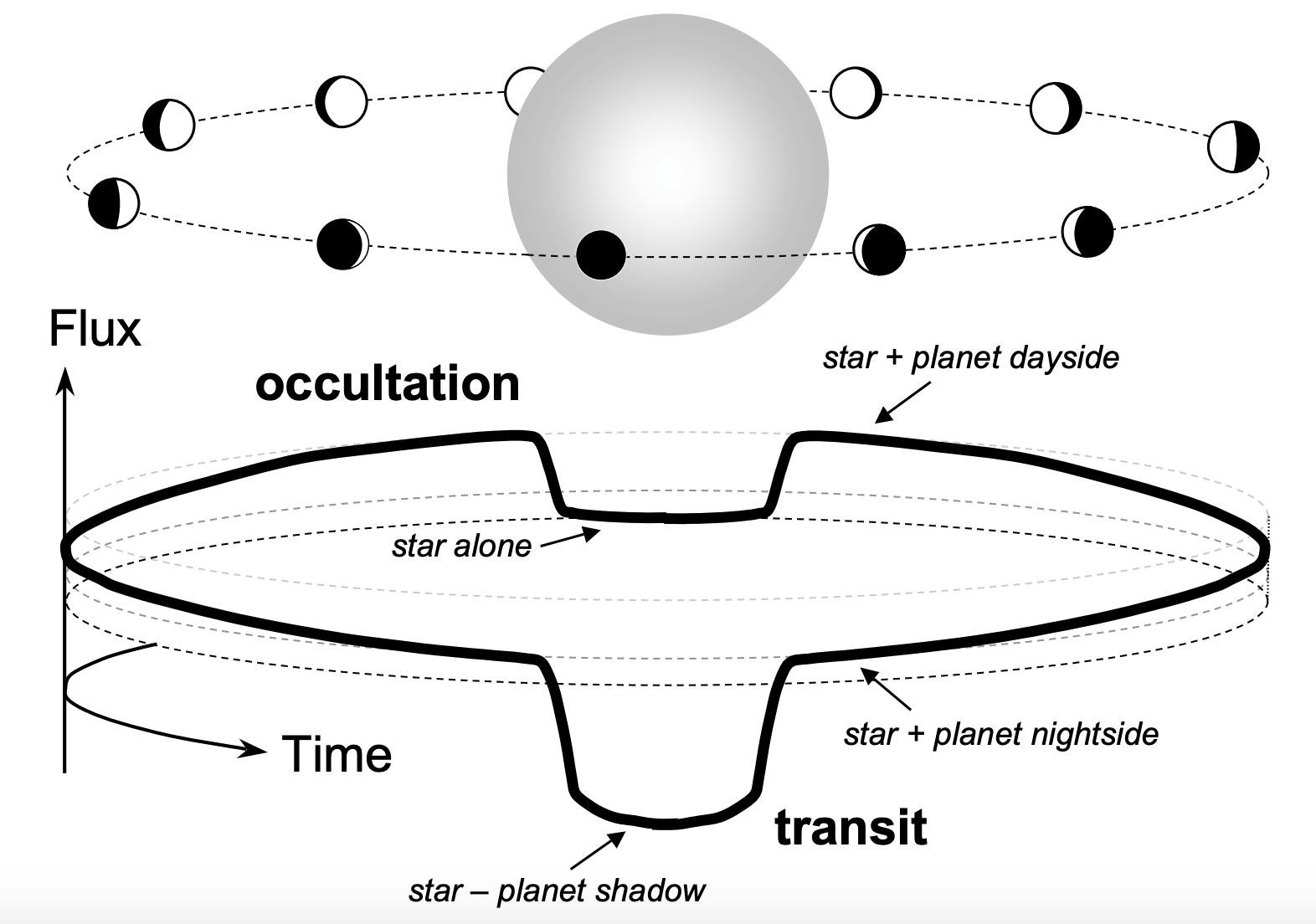
The remarkable thing about planet transits, says Joshua Winn (Princeton University), is the incredible wealth of information we can obtain from simple blips of light. “Transits are by far our richest source of information about planets,” he pointed out in the opening of his plenary — transits can reveal not just properties like masses or periods of planets, but also surprising details like the composition of planet atmospheres or the obliquity of the host star.

Kepler vs. ground-based

Transit data from Kepler (bottom) compared to data from a ground-based telescope of comparable size (top).

The field of transit study has a long history, but it exploded in 2009 with the launch of the Kepler mission. Kepler studied a small patch of sky just above the galactic plane for roughly four years, building up a large sample of planet candidates that could be used to statistically explore the population of exoplanets in our galaxy for the first time. The data quality possible with Kepler was a huge step up from the observations we’d gathered from ground-based telescopes — which allowed for the detection of additional features in transit light curves that could tell us more about unusual systems.

Winn shared with us a few of his favorite weird Kepler systems, which include:

  • Kepler-89, in which we observe a planet being eclipsed by another planet as the two bodies transit their host star
  • Kepler-36, a system challenging our understanding of planet formation, since it contains two planets that lie at very nearly the same orbital radius but are vastly different in nature: one is a dense, rocky super-Earth, whereas the other is a fluffy, gaseous mini-Neptune
  • Kepler-16, a star with a bizarre light curve that turns out to be perfectly explained by a circumbinary planet transiting across the faces of both of its hosts
sky coverage

Comparison of TESS’s planned coverage of the sky (blue) compared to Kepler’s coverage (yellow).

“As much as we love the Kepler mission, it did have one tragic flaw,” Winn lamented. “It didn’t cover the whole sky.” Even with Kepler’s extended K2 mission, it only accessed about 5% of the sky. This brings us to the current leader in exoplanet transit detections: the Transiting Exoplanet Survey Satellite (TESS).

TESS, launched 14 months ago, is designed to tile almost the entire sky during its 2-year primary mission; at this point, it’s already mostly through observing the southern hemisphere. TESS’s data — which is all made public immediately — includes two types: 30-minute full-frame images, and 2-minute subimages tracking 100,000 selected stars. Though TESS spends less time looking at each individual patch of sky, it will discover short-period transiting planets around a huge variety of stars throughout the galaxy. As of this morning, Winn reported, the number of TESS planet candidates stood at ~700 — and we can expect many more to come!

missions

Past, current, and upcoming missions contributing to exoplanet exploration.

What’s the future of exoplanet study look like? TESS will serve as a bridge between Kepler and a number of upcoming missions. Targets selected by TESS can be followed up for atmospheric studies with the James Webb Space Telescope (JWST) and radius measurements with the CHaracterising ExOPlanets Satellite (CHEOPS). And the Wide Field Infrared Survey Telescope (WFIRST) stands to revolutionize exoplanet exploration for microlensing in the same way that Kepler revolutionized the field for transits.

Winn concluded with a message for any students in the audience deciding on a field of study: with transiting exoplanets, you have a rare opportunity to join an exciting field with few barriers to entry, massive amounts of data, and a very clear agenda for the next decade. It’s definitely an option worth considering!

Don’t forget that you can learn more about Winn and his work by checking out the interview conducted by Mike Foley here.


Press Conference: Even More Sun & More Milky Way (by Susanna Kohler)

This morning’s conference is following a familiar theme: even more studies about the Sun and the Milky Way! The first two presentations of the day focused on a favorite solar topic: predictions about the solar cycle and its impacts on Earth.
solar activity and El Nino

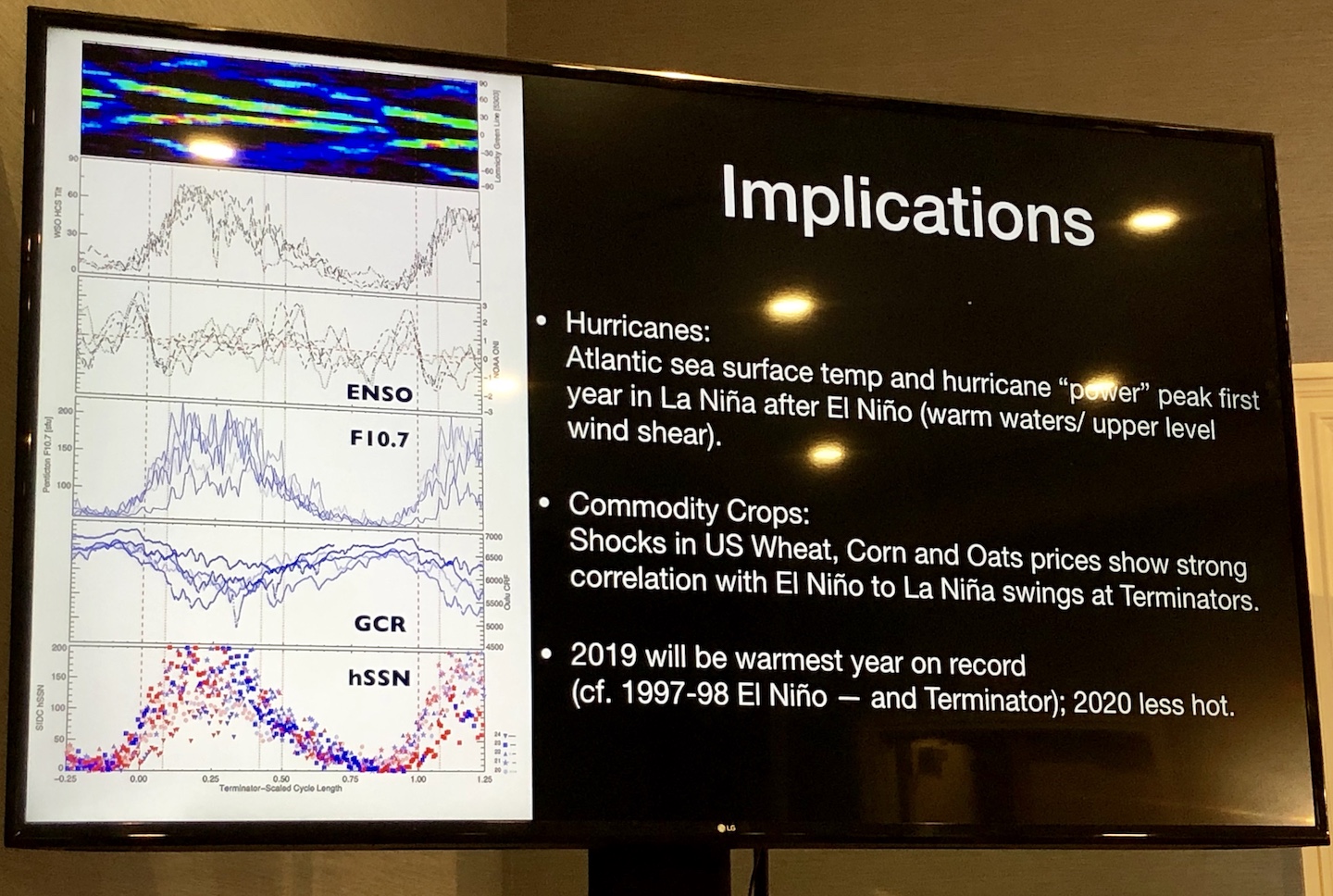
When data is scaled and stacked by terminator-to-terminator solar-cycle length, patterns become evident in factors like El-Niño behavior (ENSO), galactic cosmic-ray measurements (GCR), and sunspot number (hSSN).

Is there a relation between the solar cycle and large-scale weather patterns on Earth, like El Niño? Robert Leamon (University of Maryland & NASA Goddard SFC) argues yes — but it’s not tied to local solar-activity minima or maxima. Instead, he suggests that it’s the termination of each solar cycle — which occurs every ~11 years on average, but varies in exact timing — and the corresponding decrease in cosmic-ray flux that drives the swing on Earth from El Niño to La Niña. Leamon and collaborators use a signal processing method to analyze past data and project when the current cycle, Cycle 24, will terminate, finding that the termination will occur in April 2020 and drive the El-Niño-to-La-Niña transition shortly thereafter. Leamon concluded by emphasizing that this connection does not mean that the Sun is the cause of global warming; indeed, this coupling between the Sun’s activity and Earth’s atmosphere is only possible because climate change has already occurred.
solar cycle strengths

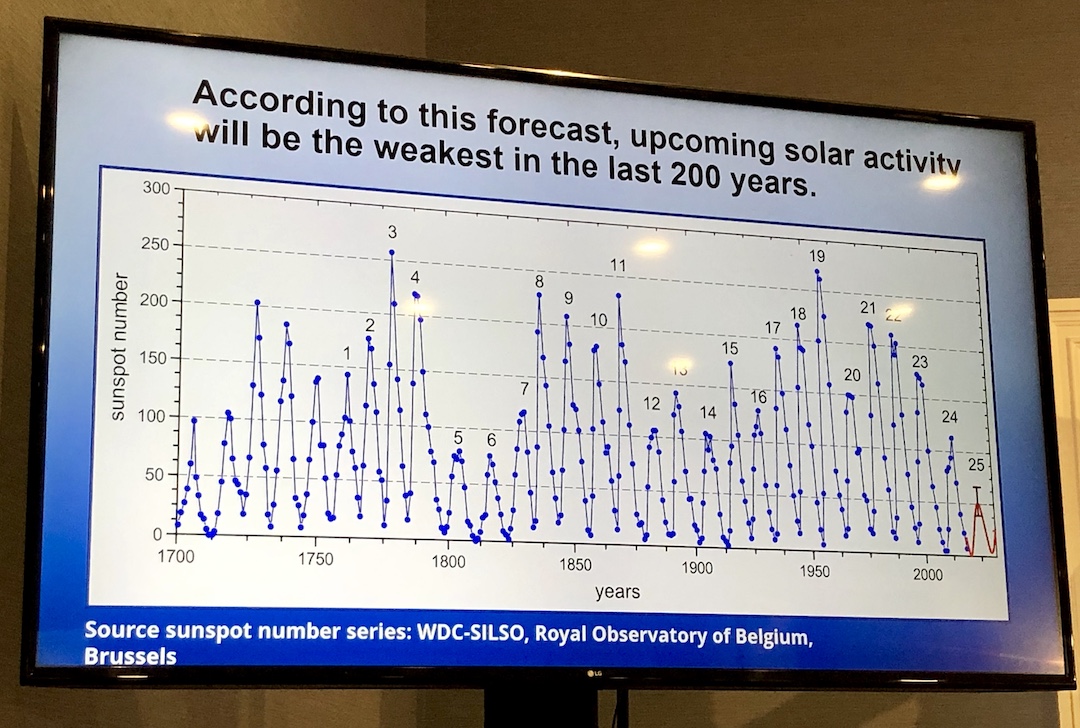
Kitiashvili and collaborators predict that the next solar cycle will be significantly weaker than previous ones.

Next up, Irina Kitiashvili (NASA Ames Research Center) introduces some predictions for long-term solar activity. By using a new technique that relates observations of the magnetic fields on the Sun’s surface to the state of the solar dynamo deep in the Sun’s interior, and by taking into account uncertainties in the data and the dynamo model, Kitiashvili and collaborators generate predictions of the future state of the Sun. They, too, estimate that the next solar cycle will begin in 2020, and they predict that the next solar maximum will be 30–50% lower than the most recent one — making it the weakest cycle of the last 200 years. Press release

yellowballs

Green circles mark citizen-scientist-identified “yellowballs”, intriguing young star-forming regions. [Milky Way Project]

Changing gears, Grace Wolf-Chase (Adler Planetarium) brought our focus away from our own star to star formation in our galaxy. The Milky Way Project, part of the Zooniverse suite, used the power of citizen science to identify infrared bubbles in nebulae that trace out sites of recent massive star formation. In the process of this identification, however, the citizen scientists serendipitously discovered more than 6,000 bizarre objects that the team named “yellowballs” for their shape and color. Since then, Wolf-Chase and collaborators have gathered more information about these objects, determining that they are young star-forming regions that span a huge range in luminosity and mass. Yellowballs provide a unique opportunity: many of them harbor newly forming stars and are still embedded in their birth clouds. This combination rarely occurs, since the hot radiation from young stars rapidly destroys their birth environments. Yellowballs may therefore offer unique insight into how stellar properties link to their birth clouds. Press release [pdf]

It’s not often that you get confirmation of a prediction you made a decade ago; Sukanya Chakrabarti (Rochester Institute of Technology), however, is having that experience now. Ten years ago, she and collaborators used dynamical analysis to predict the presence of a large, dark-matter dominated dwarf galaxy that crashed into the Milky Way and produced large ripples seen in the gas of our outer galaxy. The problem? They couldn’t find a dwarf galaxy that matched their predictions. Now, a decade later, Chakrabarti may have found the culprit at last.

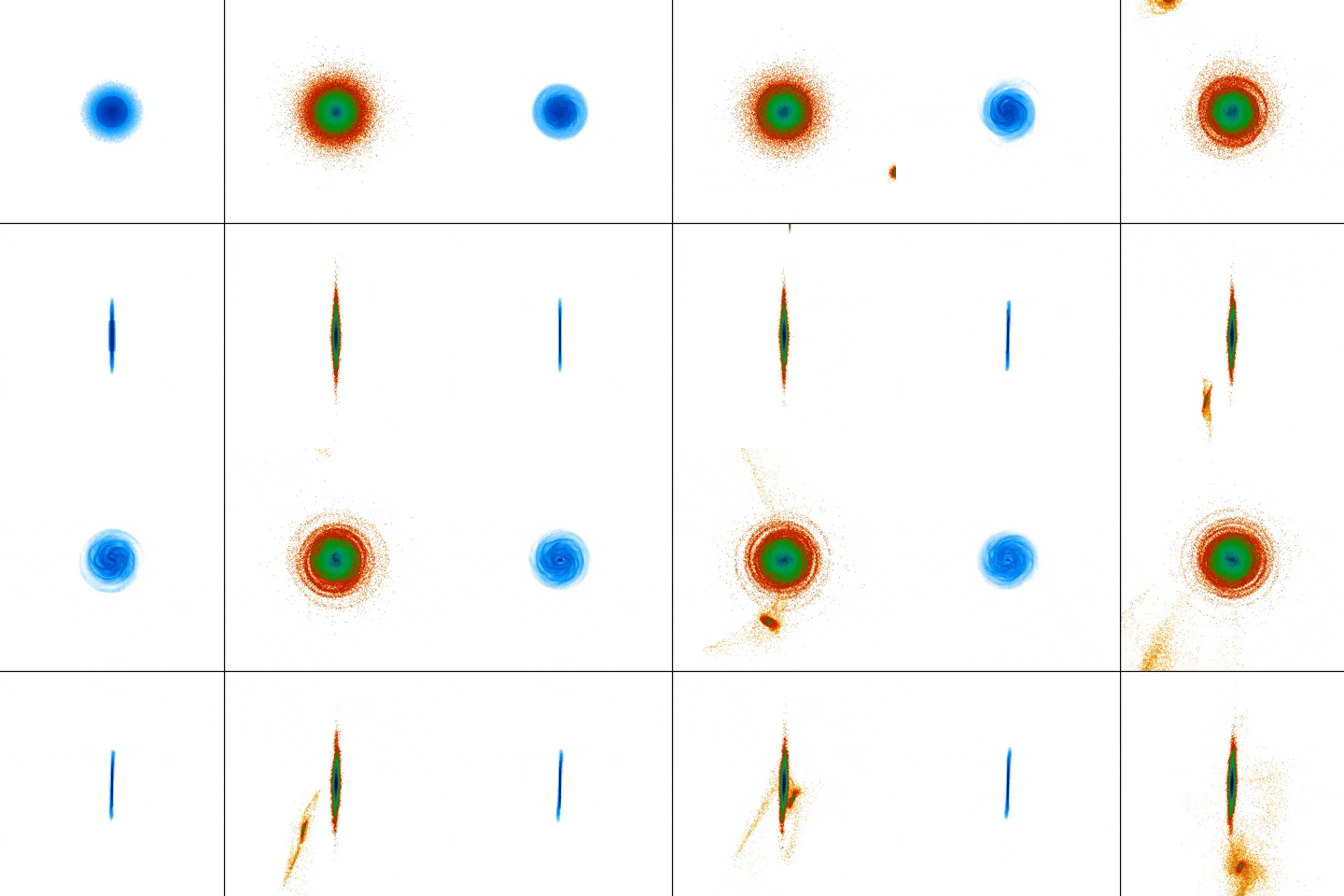
Gaia data recently revealed a new dwarf galaxy, Antlia 2, that has very few stars but a large amount of dark matter. Though similar in extent to the Large Magellanic Cloud, Antlia 2 is two orders of magnitude fainter! Chakrabarti and collaborators have shown that the properties and position of this galaxy beautifully match the predictions for the perturber they think smashed into the Milky Way long ago (see the gif below for the simulation of this interaction; gas is shown on the left, stars on the right). As an added test, they predict precisely where Antlia 2’s stars should be located in the future if this is, indeed, their missing galaxy. We can check whether they’re right in a year or two with the next Gaia data release! Press release

Plenary Lecture: Cosmological Inference from Large Galaxy Surveys (by Susanna Kohler)

The most surprising cosmological discovery of recent decades is the accelerating expansion of the universe — an unexpected outcome that has simultaneously driven theorists to develop new models and inspired a new generation of large cosmological surveys. These surveys will each gather a wealth of data — perhaps higher-precision measurements of the cosmic microwave background radiation, or better spectroscopic and photometric galaxy statistics — that can be individually used to provide constraints on the universe’s composition and evolution. But Elisabeth Krause (University of Arizona) asserts that the most stringent cosmological constraints will be obtained when we analyze these data with a careful eye for systematics, and when we combine the information from these different probes.
photometric cosmology surveys

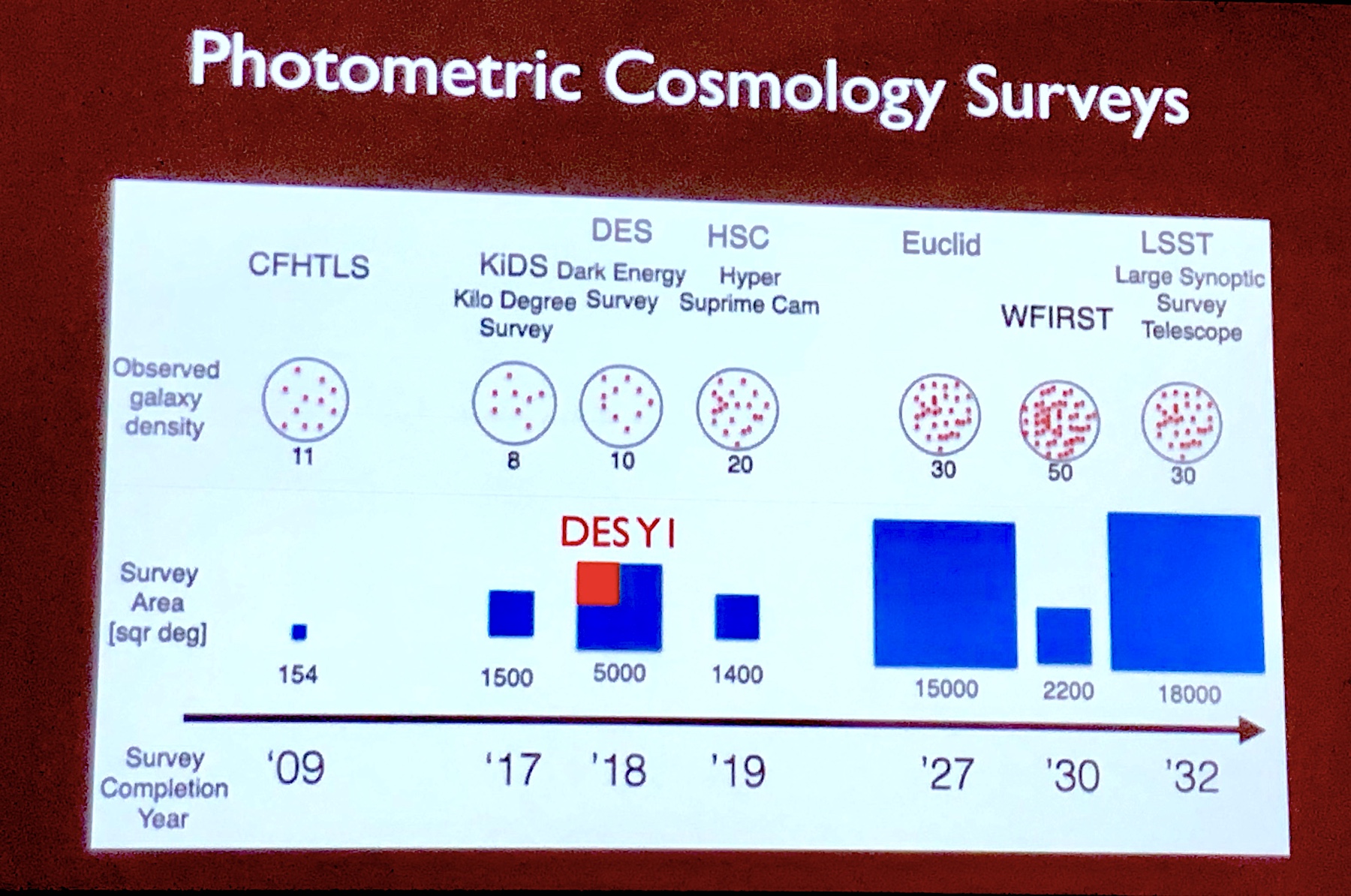
Current and upcoming photometric cosmology surveys. Can we combine information from these different probes to obtain tighter constraints?

How do we do this? First, it’s important to note that this upcoming decade of large surveys marks a new era. Gone are the days in which observations were easily analyzed, maps and catalogs easily produced, and lone geniuses were easily able to develop cosmological models from those products. In the current era of large-scale projects, Krause says, this model is no longer possible; now entire teams of people are needed to process the enormous volumes of data and jointly draw useful conclusions from them.

This new collaborative model is certainly evident in the Dark Energy Survey (DES) project, a visible and near-infrared wide-field survey that imaged millions of galaxies to produce a dataset that astronomers can use to learn about the growth of large-scale structure in the universe. But the key to good analysis is to properly account for systematics — which can include things like experimenter bias. In a collaboration of several hundred people, how do you make sure that eager scientists hoping for results for conferences, for instance, don’t end up unintentionally biasing the results? DES solved this problem by using complex blinding schemes that prevented the experimenters from seeing the data as they worked. Only once they all signed off on the conclusion of the analysis were they able to “open the box” and see what constraints came out.
LSST collaboration

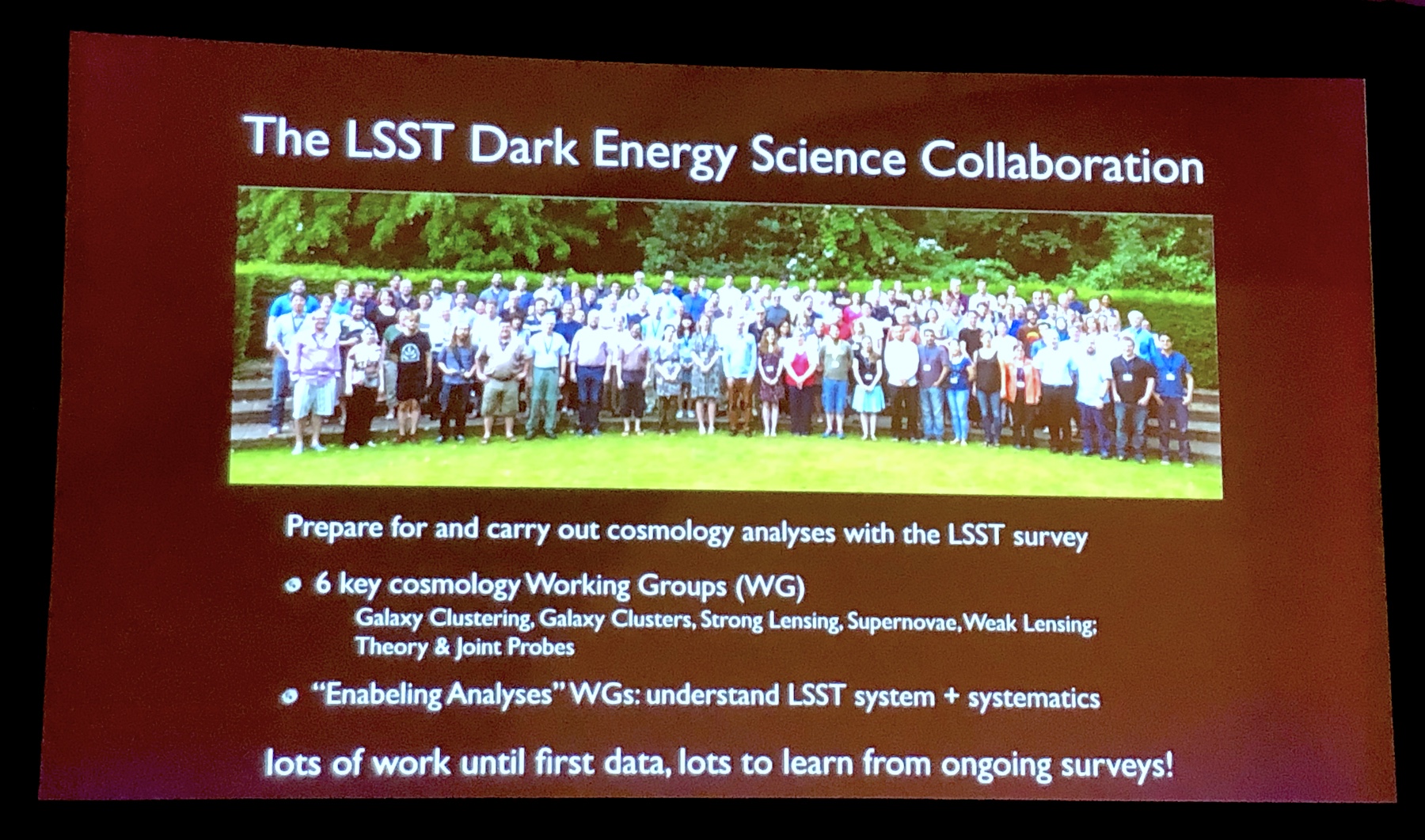
The LSST collaboration already consists of more than 600 people.

Strategies like this will be even more important in the future, as we move from datasets containing a few million galaxies to many billions of galaxies once WFIRST, Euclid, and the newly renamed Vera Rubin Survey Telescope (formerly LSST) come online, with correspondingly larger collaborations. But if we analyze these upcoming observations with careful attention to systematics, and if we combine the constraints of these surveys in thoughtful ways, we will soon have a better understanding of the nature of our universe than ever before.


Press Conference: Cold Quasars & Hot Cosmology (by Susanna Kohler)
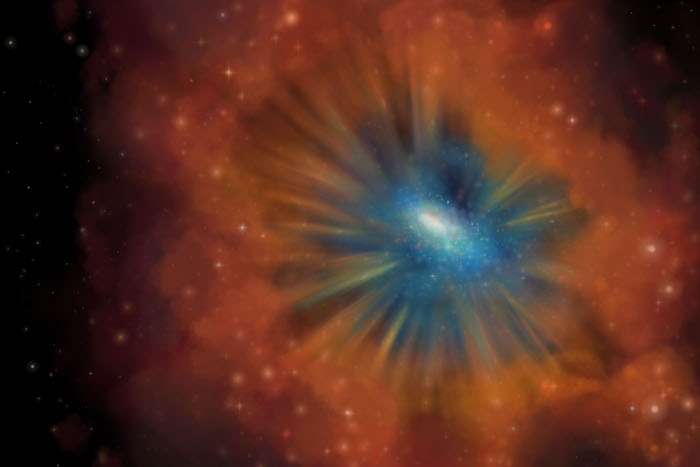
quasar clearing surroundings

Artist’s illustration of a bright blue quasar clearing the gas and dust out from around it. [Michelle Vigeant/University of Kansas]

We made it to the sixth and final press conference of the week! This final session touched on all-new topics compared to the previous few sessions. The first presenter was Allison Kirkpatrick (University of Kansas), who spoke on a new population of galaxies that she and her collaborators have termed “cold quasars”. In the theorized picture of a galaxy merger, fresh gas from the merger gets driven toward a central supermassive black hole. The sudden accretion of this rich supply of food causes the black hole to light up, forming a quasar. This brightly shining source is initially red, as it is still enshrouded by the dust churned up in the merger; once it has consumed or blown out all the dust around it, it will appear blue. But Kirkpatrick and collaborators found something intriguing: in a sample of quasars, they found that roughly 4% are blue but also have plenty of gas and dust remaining in their host galaxy. The authors dub these objects “cold quasars”; these likely represent a transition phase during which the galaxy rids itself of the fuel that can be used to make stars. After this last hurrah, the galaxy will retire as a passive elliptical galaxy.

Fun side story: the upcoming merger of the Milky Way and Andromeda will likely proceed in exactly this way. Though both our galaxy’s supermassive black hole and Andromeda’s are quite anemic, the influx of fuel from a merger will cause the resulting, merged black hole to light up as a stunning quasar, dominating the night sky and eventually expelling the gas of the galaxy. No new stars will form after this point, so “this will spell the beginning of the end for life in the Milky Way,” cautions Kirkpatrick. Of course, she continues, this will be in ~3–4 billion years and will be around the time when the Sun evolves into a red giant, so we may have other, more pressing concerns at the time. Press release

The other two presentations of the session both addressed the same problem: the tension between local and global measurements of the Hubble constant (H0), a value that describes the rate of expansion of the universe. The best way to measure this constant in the local universe is to use the distance ladder to measure the distance to and recession speed of local galaxies. The most recent study using this approach gives a value for the Hubble constant of H0 = 74.03 ± 1.46 km/s/Mpc. Other experiments — like Planck — have instead measured H0 on global scales. By determining H0 in the early universe using observations of the cosmic microwave background (CMB) radiation, we can then evolve this value forward to present-day using ΛCDM cosmology, our best-guess model describing our universe’s evolution. This technique produces a value for the Hubble constant of H0 = 67.4 ± 0.5 km/s/Mpc. The local and global values are therefore in tension: there’s a 9% unexplained difference between the measurements. Is this difference due to systematics? Or is there new physics involved that we haven’t yet considered?
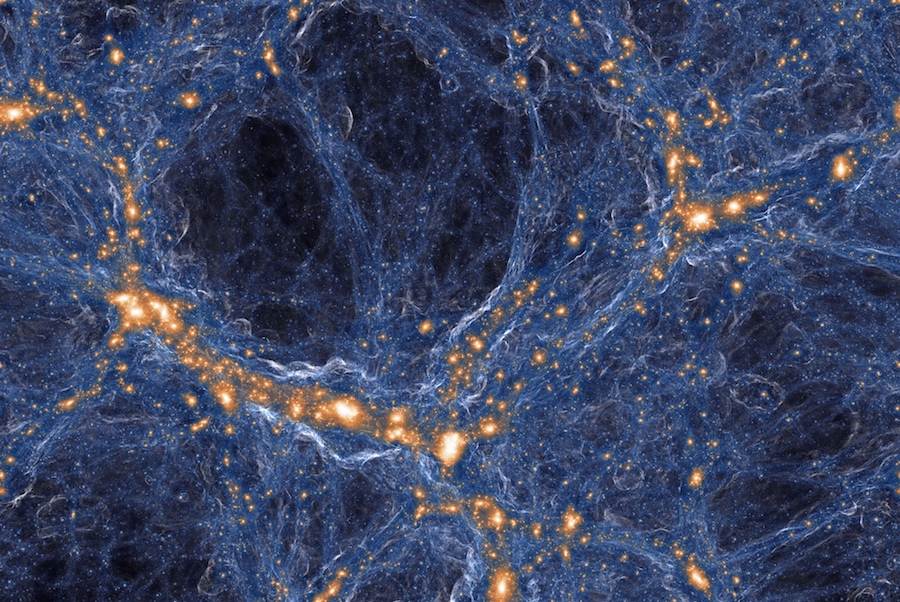
voids

In this computer simulation, we see a region of the universe wherein a low-density “void” (dark blue region at top center) is surrounded by denser structures containing numerous galaxies (orange/white). Could such a void explain inconsistencies in the measured Hubble constant? [TNG collaboration]

D’Arcy Kenworthy (Johns Hopkins University) first addressed one of the leading theories: that these measurements are different because we live in a local void. If our galaxy lies in an underdense region of the universe, this would explain why we measure a different expansion rate immediately around us, as compared to the average expansion rate of the universe measured on global scales. But when Kenworthy and collaborators tested this theory by using a sample of more than 1,000 supernovae to look for variation in the local value of the Hubble constant, they came up empty-handed: their results suggest that a local void can’t resolve the tension between the two measurements of H0. Astrobites article

So if local voids are out, it would seem that perhaps new physics is, indeed, needed to resolve the problem. Maurice Van Putten (Sejong University) has an idea: what if the fact that the universe is evolving means that ΛCDM cosmology isn’t the best model at all orders? If we take into account deviations from ΛCDM predicted by quantum cosmology, then Van Putten shows that this new model applied to CMB measurements produces a global value for H0 that nicely matches the value found from local measurements. Voila, tension is gone! It seems surprisingly simple (though the math really isn’t!), but comparison to future observations should provide a check of this theory.


Karen Harvey Prize Lecture: Where Do Solar Eruptions Come From? (by Susanna Kohler)

The final plenary of the day was given by Anthony Yeates (Durham University), who is the recipient of this year’s AAS/SPD Karen Harvey Prize, an award that recognizes early-career individuals who have made a significant contribution to the study of the Sun. In Yeates’s case, his contribution is in the form of work advancing our understanding of “how the Sun’s magnetic fields originate, evolve, and govern the dynamics of the solar corona,” and he was ready today to give us his take on where solar eruptions come from.
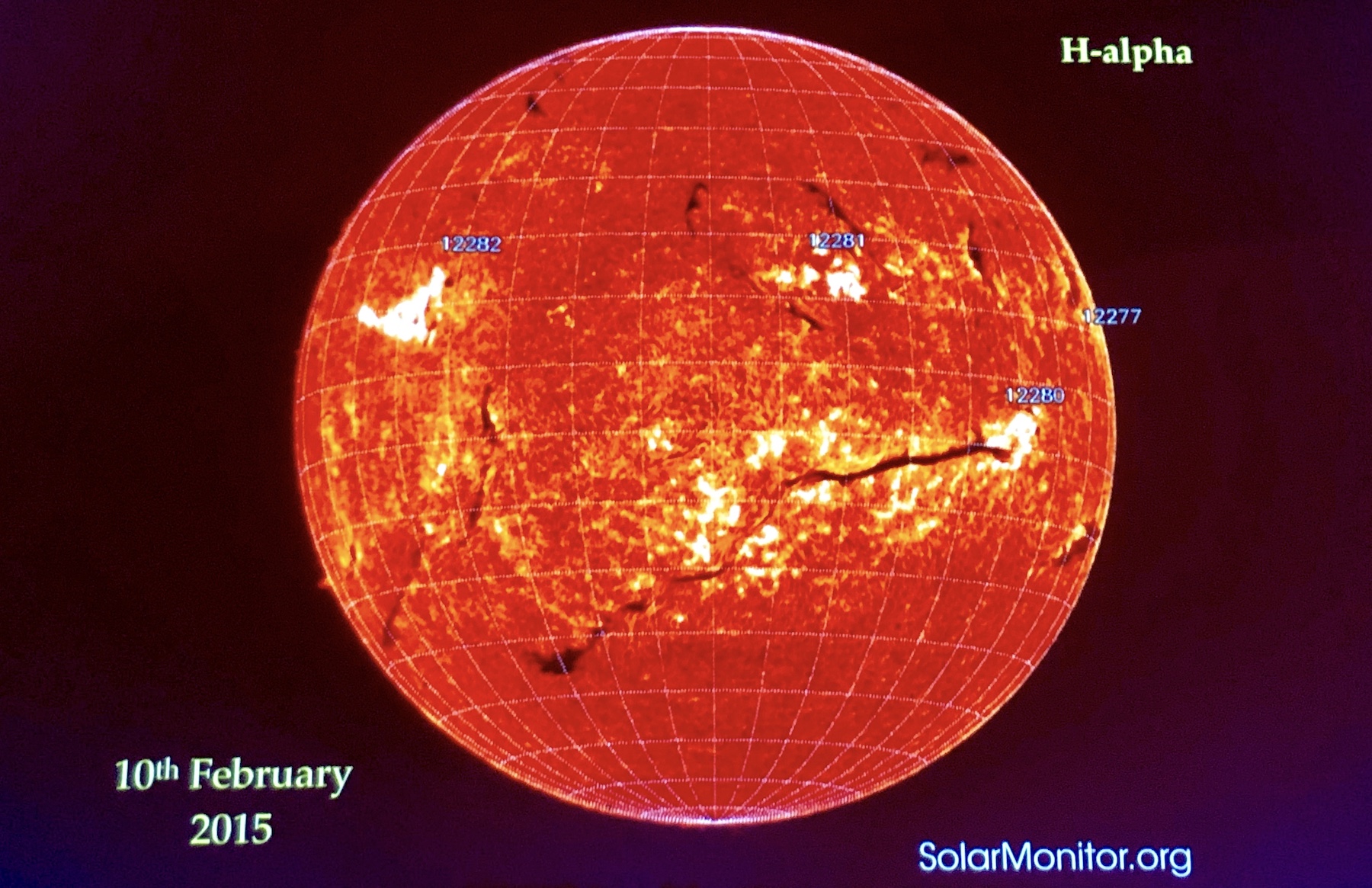
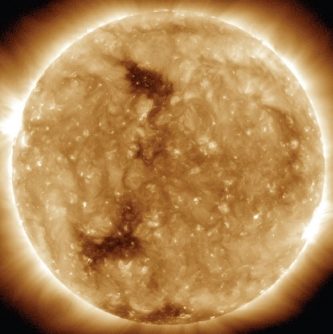
solar filaments

The dark structures visible against the Sun’s disk are solar filaments.

Yeates argued that the key to understanding solar eruptions is to understand how magnetic helicity is injected into and removed from the Sun’s atmosphere. He opened by showing us images of enormous magnetic filaments — dark, string-like structures visible against the Sun’s disk. These magnetically-confined channels of cool gas are what eventually give rise to eruptions and flares, and the twisted and helical magnetic fields that govern them become evident when you look at them closely. Magnetic helicity is the measure of how tangled, twisted, and linked these fields are.

Over the next half-hour, Yeates built up a compelling picture of how energy is freed from the Sun’s surface and expelled into space in an eruption.

  • Step 1: Magnetic helicity is injected into the Sun’s corona by motions on the surface of the Sun. There are multiple components to this: the Sun’s rotation generates helicity, and more is added as the footpoints of magnetic field lines wander via diffusion, tangling the fields.
  • Step 2: Once helicity has been added into the atmosphere, it accumulates at polarity inversion lines, locations where the magnetic polarity swaps. This build-up allows field lines to get close together — exactly what’s needed for magnetic reconnection to occur.
  • Step 3: Helicity is removed from the atmosphere via coronal mass ejections. Sudden eruptions (likely following reconnection) throw some of this tangled magnetic field out into space, removing it from the Sun’s atmosphere.
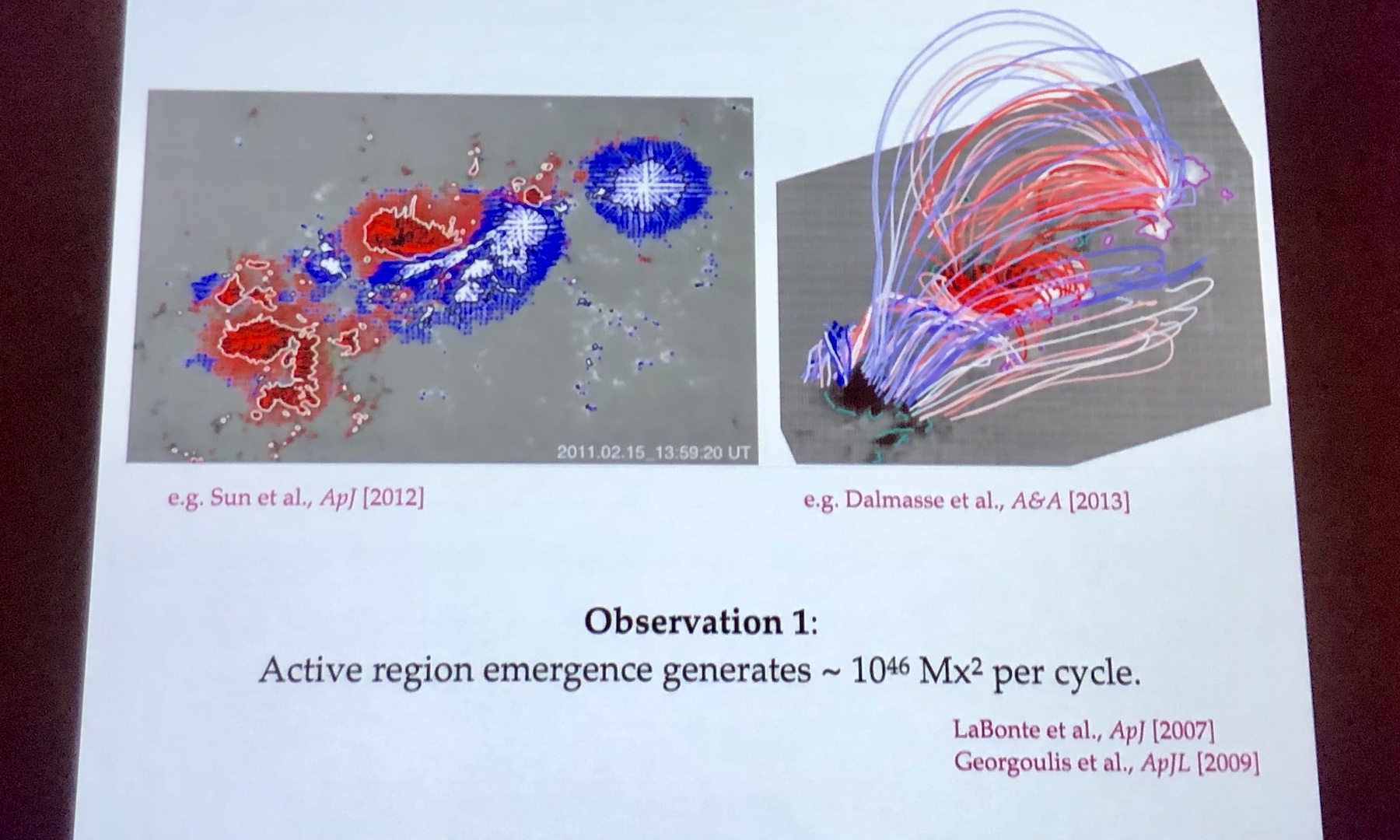
active region magnetic fields

Magnetic fields on the Sun are complicated!

Currently, Yeates said, observations and models are in good agreement, leading to general acceptance of this paradigm. But we still have plenty more work to do! The ultimate goal, of course, is to be able to predict when eruptions will occur. We’re certainly not there yet — Yeates earned a laugh when he described the current state as “we can predict them after they happen” — but this understanding of how energy makes its way from the solar surface into eruptions is a huge step in the right direction.

You can read more about Yeates in the interview conducted by astrobiter Mia de los Reyes here.
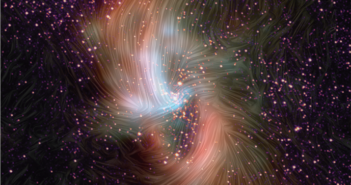
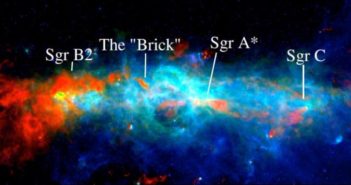
galactic center magnetic fields

Editor’s Note: This week we’re at the 234th AAS Meeting in St. Louis, MO. Astrobites and AAS Nova will be working together to publish updates on selected events at the meeting this week; the usual posting schedule for AAS Nova will resume next week.

Laboratory Astrophysics Division (LAD) Plenary Lecture: The Role of Dust in the Molecular Universe (by Kerry Hensley)

Grand Prismatic Spring

Grand Prismatic Spring in Yellowstone National Park. [Clément Bardot]

Dr. Xander Tielens (Leiden University, Netherlands) began his talk by reflecting on the enormous paradigm shift he has seen over the course of his career. Over the past several decades, we’ve learned that nearly all stars host planetary systems, and many of those systems harbor Earth-like planets: studies have shown that as many as a fifth of Sun-like stars have a rocky planet orbiting in the habitable zone. We’ve also learned that life on Earth is much hardier than anyone ever expected. We’ve found bacteria in the scalding water of the Grand Prismatic Spring in Yellowstone National Park, fossilized under frozen lakebeds in Antarctica, and clinging to salt crystals in the Atacama Desert in South America, the driest place on Earth. There’s life everywhere, and it developed quickly (in the comic sense) after Earth was formed.

These discoveries give us a hint — and hope — that life may be widespread in the universe, able to withstand even the harshest environments. Life on Earth is built from organic molecules, which are composed of carbon, hydrogen, nitrogen, oxygen, phosphorous, and sulfur. How did the organic molecules that life is built from end up on Earth in the first place? They can either exist in the material that the Earth formed from (starting with tiny dust grains in the Sun’s protoplanetary disk) or they can be delivered to the planet later on in the form of asteroids and comets (particularly the ones that were scattered into the inner solar system during the Late Heavy Bombardment).

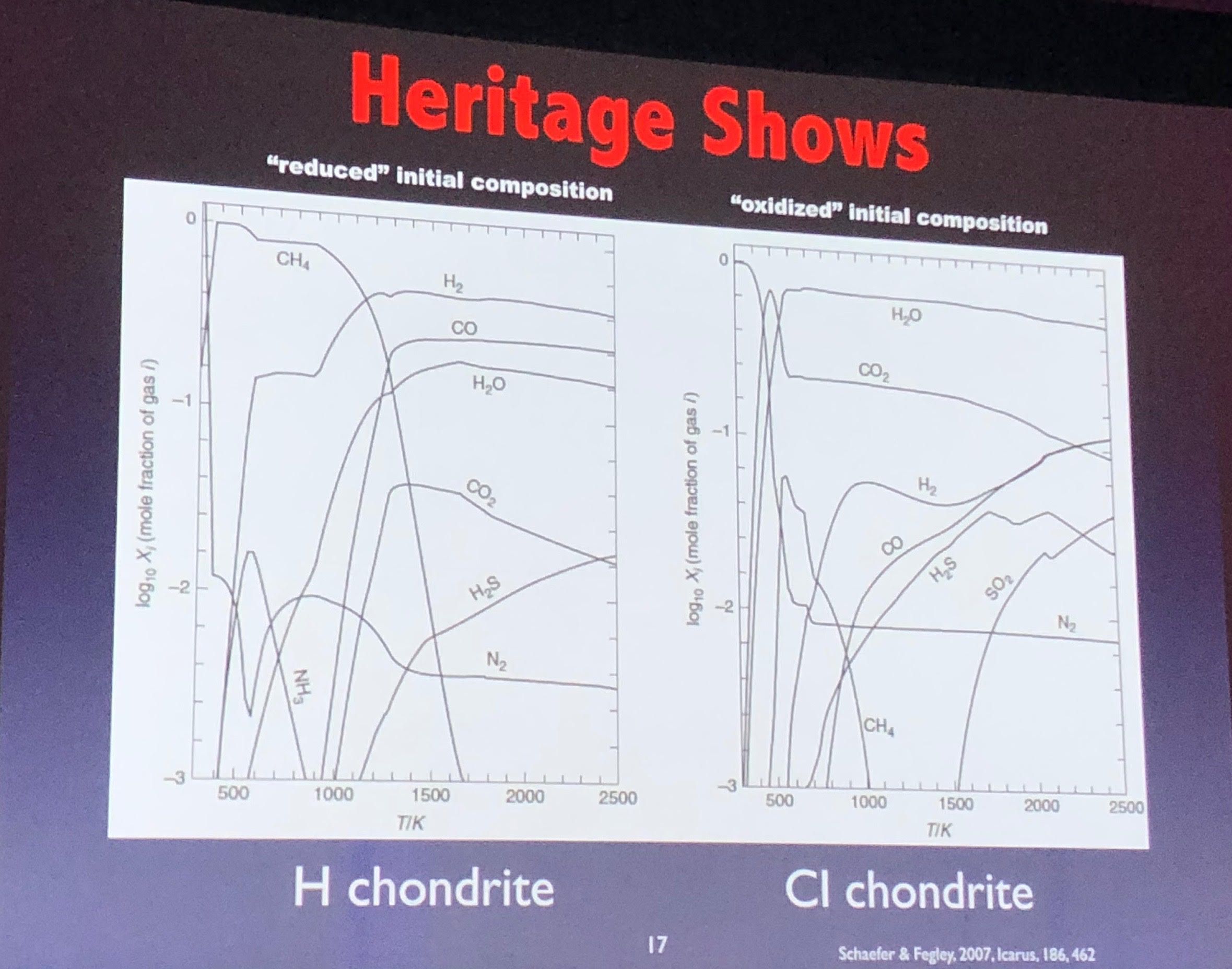
An example of how the composition of chondrites (stony meteorites) can affect the composition of a planet’s
atmosphere.

The chemical makeup of this material is important because it determines, in part, the composition of Earth’s atmosphere. For example, if most of the material has a “reduced” composition, the atmosphere will tend to be methane-rich. If most of the material has an “oxidized” composition, the atmosphere will tend to be nitrogen-, carbon-dioxide-, or water-vapor-rich, depending on the temperature. It’s really easy to make amino acids (important for life!) in the presence of methane, and really hard to make them without, so the composition of the atmosphere is crucial.

A lot of the exciting chemistry happening in the interstellar medium that has important implications (much later on) for planetary habitability takes place on icy dust grains. Dust grains are important because they provide a surface onto which atoms and molecules can stick, move around, and react to form other compounds. The timescales are a lot longer than in the gas phase, where you basically get a split-second chance at a reaction during a collision. Dust grain-surface chemistry creates a lot of molecules we care about like oxygen, carbon dioxide, and methanol — we likely have dust to thank for life on Earth!

Dr. Tielens closed his talk with an encouragement for laboratory astrophysicists everywhere: everything you can study in the lab will be relevant somewhere in the universe — it’s your job to find out where!


Press Conference: Spiral Galaxies Near and Far (by Susanna Kohler)

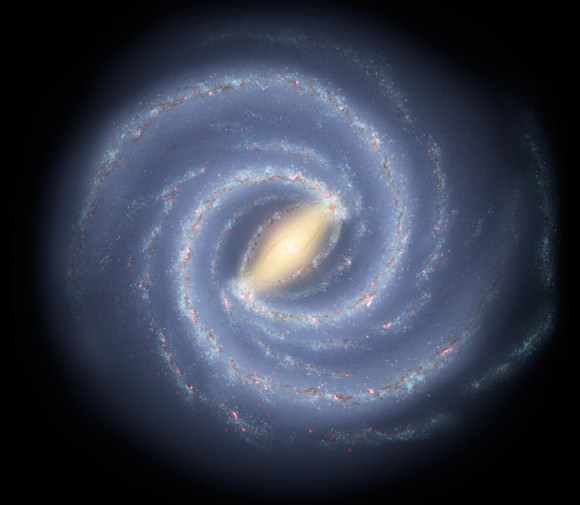
Milky Way

Artist’s impression of the Milky Way galaxy. [NASA]

This morning’s press conference threatened to make us all dizzy with four talks about spiral galaxies. We started with the nearest spiral galaxy — our own Milky Way — and then moved on to talk about these twisted galaxies more broadly.

What’s going on at the very heart of our galaxy, in the central ~15 light-years? This region contains a tilted disk of gas and dust rotating counterclockwise around our galaxy’s supermassive black hole, Sgr A*. This ring is best observed at ~50 µm, a wavelength that can only be accessed from high altitudes; luckily, we’ve got SOFIA, our favorite flying observatory, on the job.
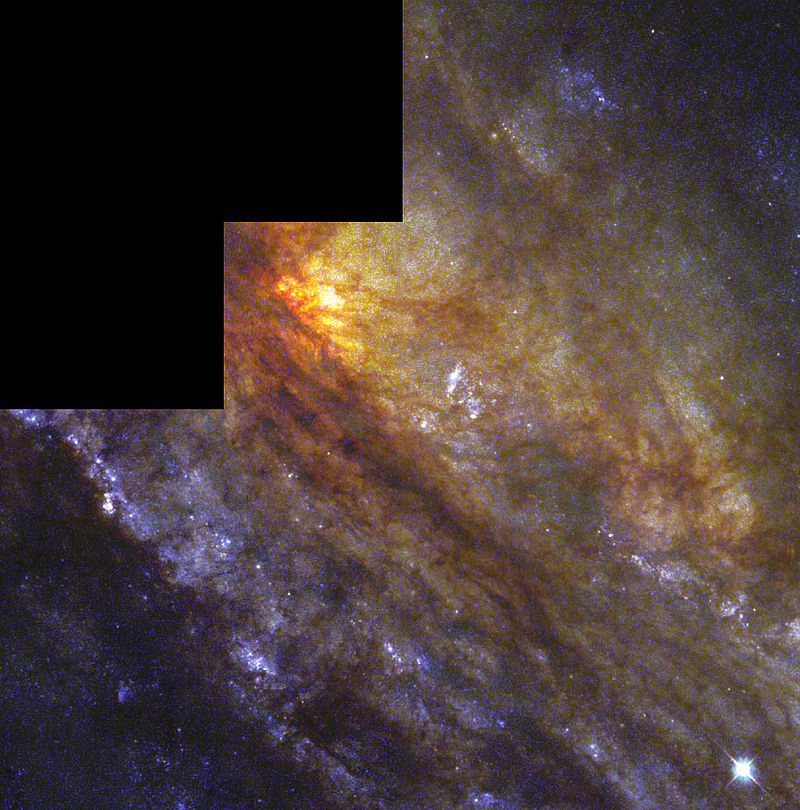
SOFIA’s HAWC+ instrument obtained both images and polarimetry — measurements of magnetic fields — of the central ~15 light-years of the galaxy. C. Darren Dowell (Jet Propulsion Laboratory) showed us the results: a spectacular map of the streamlines tracing the magnetic field within the heart of our galaxy (see the cover image at the top of the page). HAWC+’s measurements reveal a beautiful spiral structure to the dust that indicates the magnetic field is strong enough to channel material into orbit around the black hole. This subtle redirection may be enough to explain why our black hole is unusually quiet: magnetic fields might be preventing Sgr A* from getting a proper meal! Press release

density wave theory

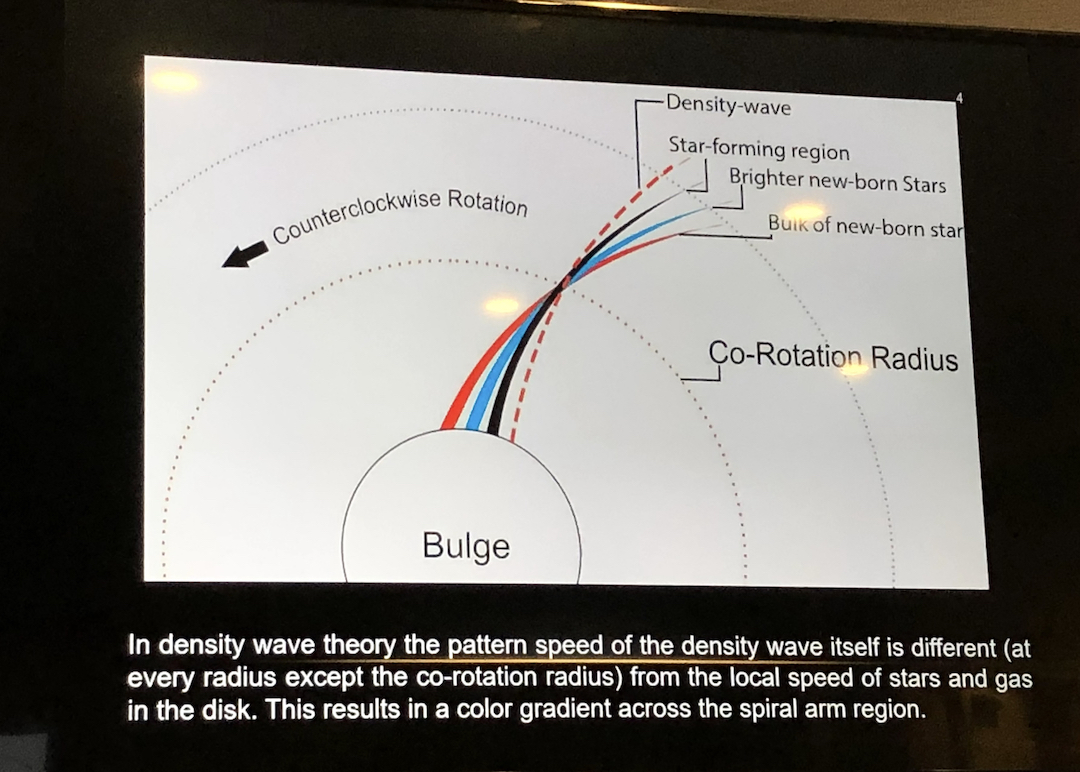
Spiral arms will have different apparent angles at different wavelengths as stars propagate away from spiral density waves.

The next two speakers both described tests of the dominant theory for what causes spiral structure in galaxies: density wave theory. According to this model, density waves propagate through the disk of a galaxy. Gas and stars don’t remain stationary relative to these spiral waves, though; instead, their rotation speed is set by their distance from the center of the galaxy, and this speed matches the pattern speed of the density wave only at one location, known as the co-rotation radius. Inside this radius, newly formed stars caused by compression of the gas will disperse ahead of the density wave; outside of the co-rotation radius, they trail behind the wave. According to the density wave theory, the shape of a spiral arm will therefore look different at different wavelengths: bluer wavelengths will trace the younger stars distributed close to the density wave, appearing as a more radial arm, whereas redder wavelengths will trace the older stars that have trailed further ahead of and behind the density wave, appearing as a more angled arm.

To test the picture of density wave theory, a team of scientists looked for these differences in arm shape across different wavelengths for ~30 galaxies. Daniel Kennefick (University of Arkansas) presented the results: the arms were indeed angled differently at different wavelengths, exactly as predicted by density wave theory. Kennefick remains cautious, however: this seems like a triumph for the density wave model, but other research groups have found opposing results. As always, more work remains to be done!

Shameer Abdeen (University of Arkansas) and collaborators took a different approach to test density wave theory: they attempted to measure the co-rotation radius for a sample of ~20 spiral galaxies. They did this by tracing out the galaxy’s spiral arms at different wavelengths, and then identifying the location where these arms crossed over one another. The good agreement of their results with other, independent measures of the co-rotation radius provides additional confirmation that density wave theory is a solid model.

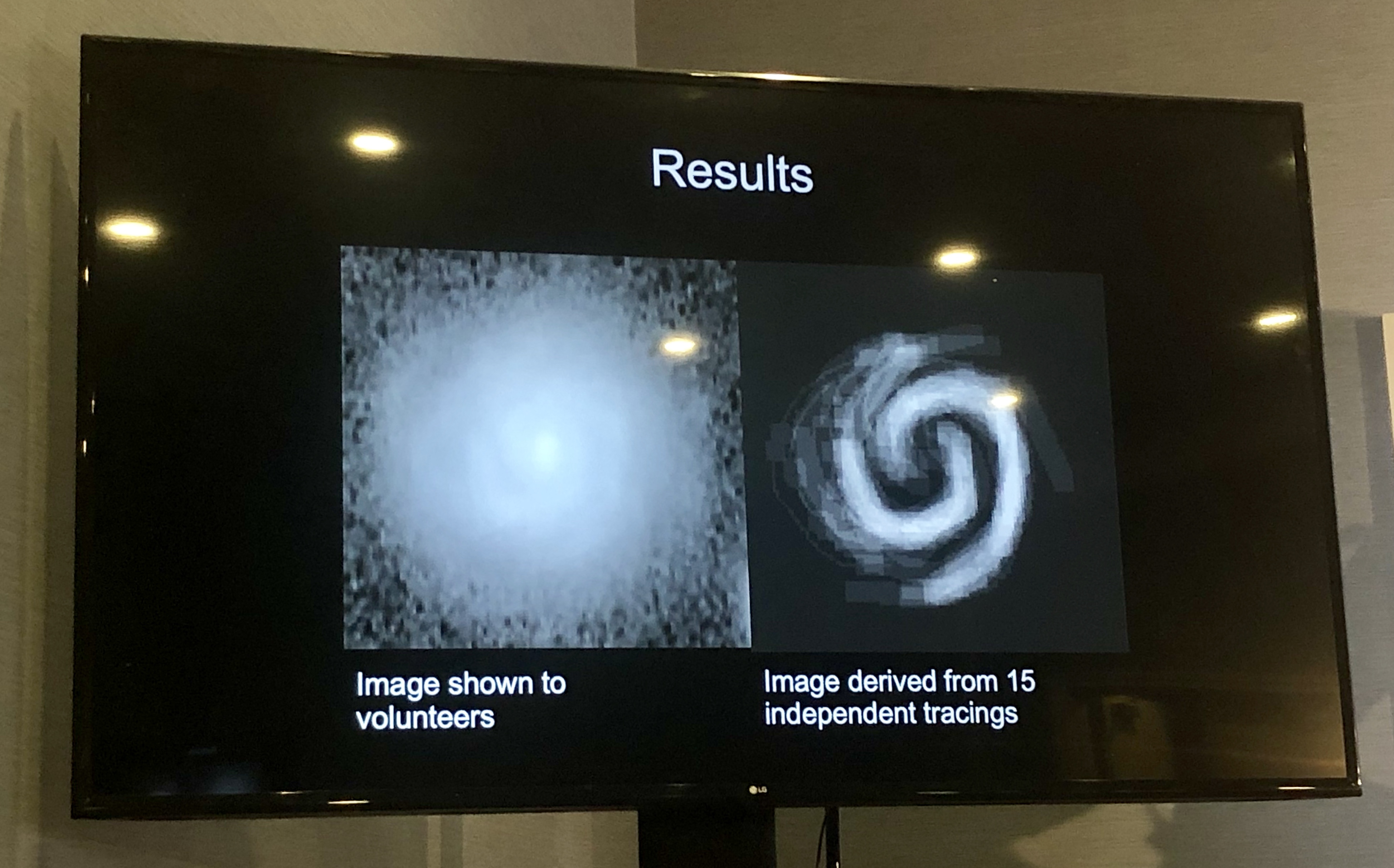
Spiral Graph

In the Spiral Graph citizen science project, volunteers trace out the spiral arms of galaxies. These tracings are stacked to produce a final map of a galaxy’s arms, which can then be used in the hunt for intermediate-mass black holes.

Abdeen and collaborators were able to trace out the spiral arms of their sample by hand, but what do you do if you have a sample of galaxies larger than ~20? Patrick Treuthardt (North Carolina Museum of Natural Sciences) has the answer: enlist the help of citizen scientists! Since computers have a hard time picking out spiral arms in low-contrast images, Treuthardt and collaborators looked to humans, who are inherently quite good at identifying patterns — even in faint images. To enlist enough humans to trace the spiral arms of a sample of thousands of spiral galaxies, the group set up a citizen science project based on the Zooniverse platform: Spiral Graph. In this project, anyone can go look at images of galaxies and mark where you think their spiral arms lie. Tracings of multiple citizen scientists are then averaged to produce a map of each galaxy’s arms.
Beyond being a fun way to kill time, this exercise has a purpose! Once we’ve mapped the arms of these galaxies, we can easily estimate their pitch angles. Intriguingly, how tightly these arms are wound correlates with the mass of the black hole hosted at the center of the galaxy. By selecting galaxies with very loose spirals, the team hopes to identify those galaxies most likely to host elusive intermediate-mass black holes (IMBHs). Astronomers only know of a dozen or so confirmed IMBH candidates thus far — so go do some spiral tracing and contribute to the discovery of more!


Plenary Lecture: The Tools of Precision Measurements in Exoplanet Discovery and Characterization: Peeking under the Hood of the Instruments (by Kerry Hensley)

Suvrath Mahadevan (Penn State University) gave the audience a peek “under the hood” of the highly precise instruments bringing us exoplanet detections and atmospheric characterizations. Thanks to missions like Kepler and the Transiting Exoplanet Survey Satellite (TESS), we’ve discovered thousands of exoplanets, with many more on the way. As a result, some of our focus has shifted from detection to characterization — we want to know what’s in the atmospheres of these planets and whether they might be habitable or not.

10 cm/s put in context

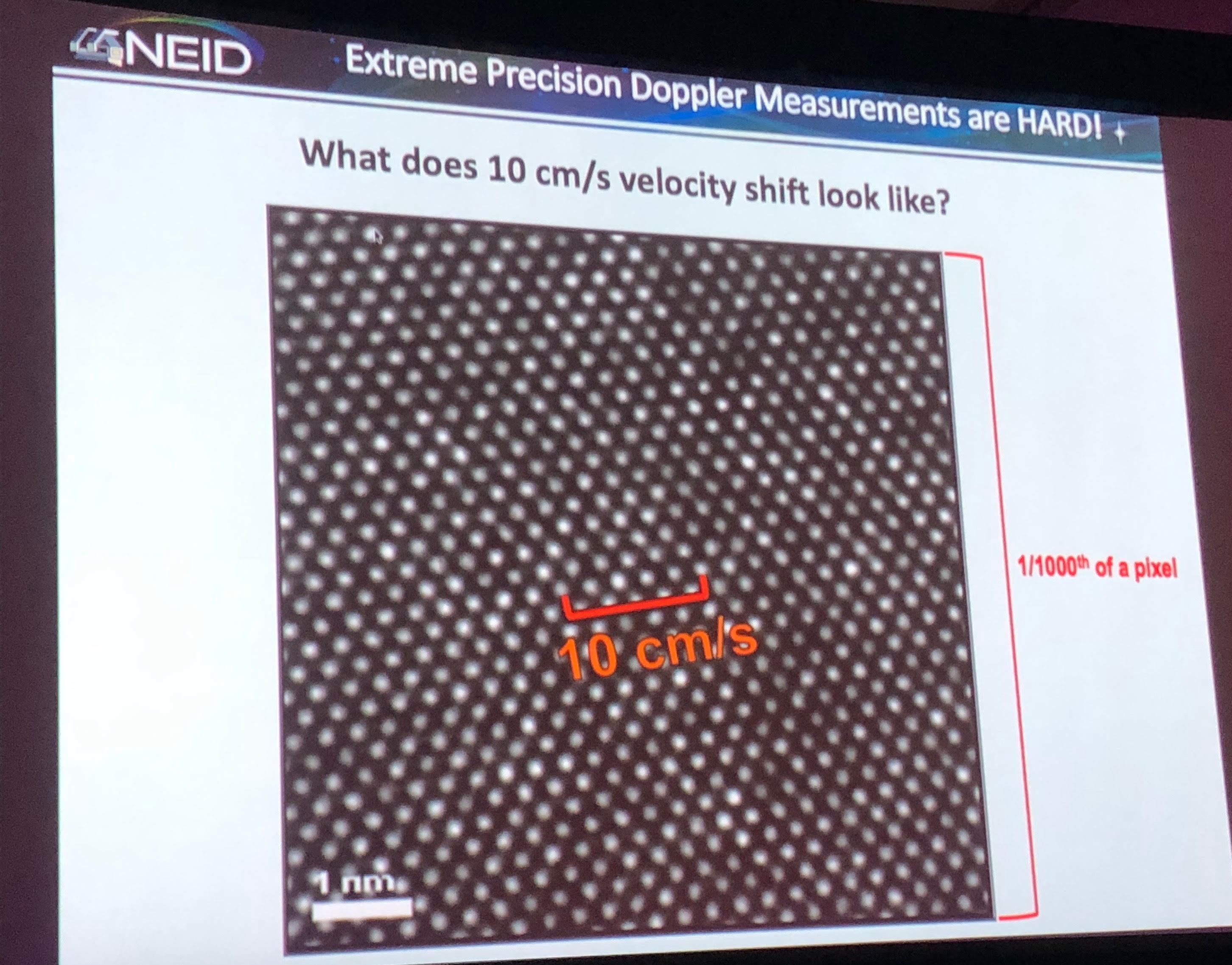
A depiction of what a shift corresponding to a velocity of 10 cm/s looks like on a detector. The silvery dots are individual silicon atoms.

What will it take to detect small, rocky planets and learn about their atmospheres? Really, really, really precise instruments. Currently, we can measure radial velocities of about 1 m/s. This is pretty good, but we’d like to get down to the tens-of-centimeters-per-second or centimeters-per-second level to detect lots of Earth-mass planets around faraway stars. That’s easier said than done, though! A velocity of 10 cm/s corresponds to a shift of just a few lattice-spacings on a detector — that’s 1/6000 of a 10-micron pixel!

What do we need in order to get down to that level of precision? A lot of things need to come together to make it happen: a really good spectrograph, a high-performance detector, a way of calibrating the instrument (e.g. laser combs), precise temperature and/or vacuum control of the environment that the instrument and detector are housed in, and an excellent data reduction pipeline, to name just a few.

Mahadevan highlighted a couple of current instruments: the Habitable Zone Planet Finder (HPF) on the Hobby-Eberly Telescope, and NEID, which will be installed on the WIYN telescope at Kitt Peak. HPF has given us the highest-precision near-infrared radial velocities ever reported. (As an aside, things get really interesting in the infrared: the act of reading out the detector warms it enough that the detector itself becomes a source of noise. There are also crystalline lattice defects that cause shifts in the quantum efficiency of the detector at sub-pixel scales, which can’t be removed through flat-fielding.)

Let’s say we can overcome these issues and build spectrographs and detectors capable of detecting the subtle shift in spectral lines corresponding to velocities of ~10 cm/s. We still have a problem: getting our instruments down to 10 cm/s won’t help us if we can’t disentangle the competing effects of transiting planets and solar activity. So, there’s still plenty of work to be done on the science side as well as the instrumentation side, both of which will help us in our quest to track down Earth-like planets.


Press Conference: More Sun & More Milky Way (by Susanna Kohler)

AAS 234 press conference

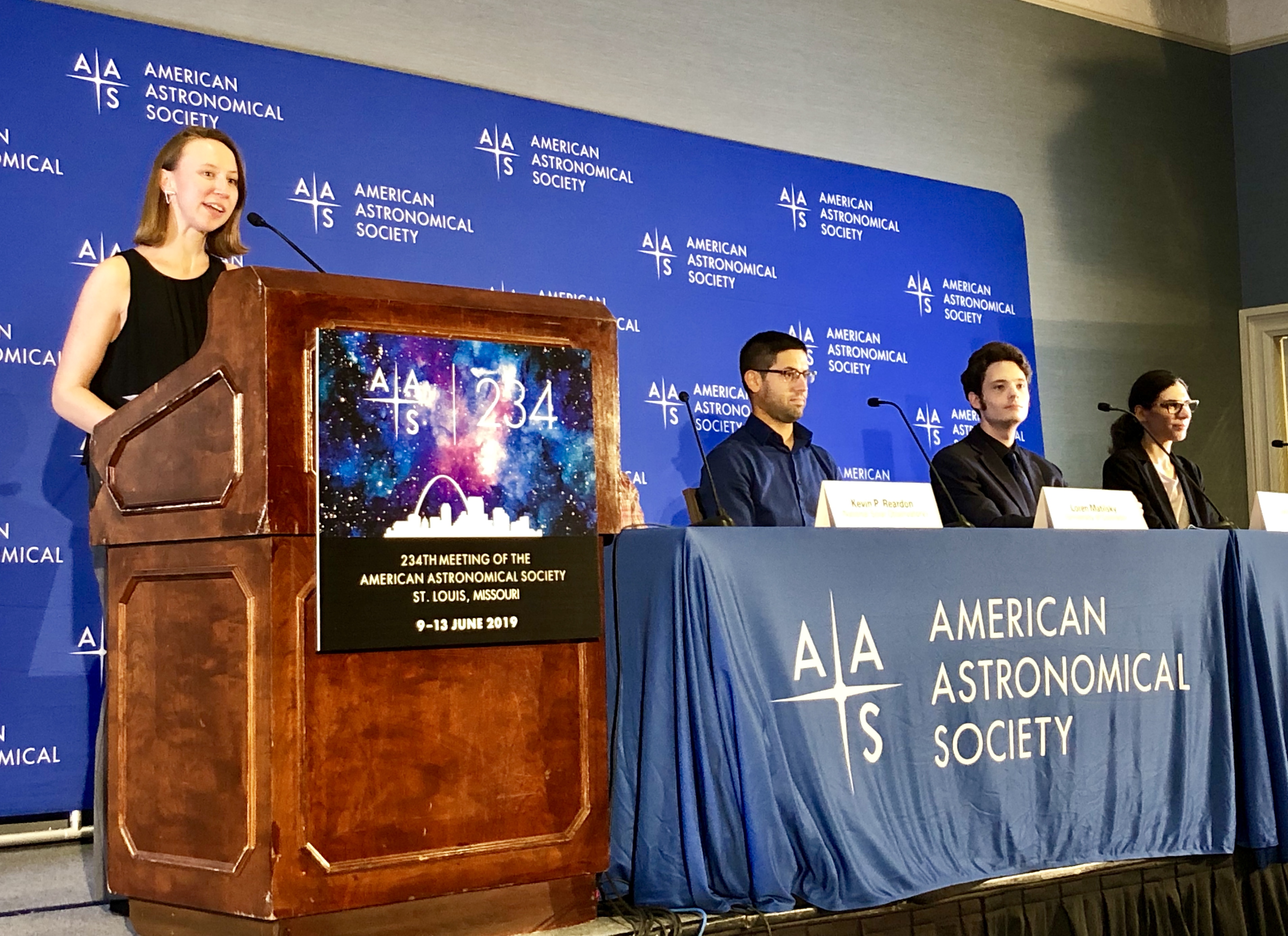
The afternoon press conference presenters are ready to go under the direction of AAS Media Fellow Kerry Hensley!

This afternoon’s press conference was hosted by AAS Media Fellow and astrobiter Kerry Hensley, and it promised more exciting results from our nearest star and galaxy.

First up, Kevin Reardon (National Solar Observatory) presented observations of the Sun from the millimeter/submillimeter powerhouse ALMA. The wavelengths probed by ALMA’s 64 antennae provide views of different layers of the Sun’s chromosphere, the atmospheric layer sandwiched between its cooler surface (the photosphere) and its hotter outer atmosphere (the corona). As “the gateway to the corona”, the chromosphere may eventually provide us with information about how heat is transferred from deep in the Sun’s interior to its outermost layers — if we can understand observations of it! Reardon and collaborators showed that ALMA’s 3.1-mm images of the Sun showed striking similarities to the more easily obtained optical images made using the Hα emission line (656.3 nm). This discovery will help us to better interpret Hα images in the future and further explore the layers of our Sun.

Next, Loren Matilsky (University of Colorado) presented the results of some heavy computer lifting. Since we can’t dive into the Sun and measure its magnetic fields, he reasonably points out, we have to make do with the next best thing: detailed computational models. Matilsky and his advisor Juri Toomre ran a massively parallel, fully 3D computer simulation of the Sun’s magnetic field evolution to understand what’s going on beneath the Sun’s surface and how that might drive the observed 11-year solar cycle. They found that a magnetic dynamo is generated to the north and south of the equator, migrates toward the equator, and is then reset — following the same pattern that we observe in sunspots. But in addition to this expected churning, Matilsky and Toomre found odder behavior: a wreath of magnetic field wandered back and forth between hemispheres, occasionally reversing polarity on a much longer cycle than the normal 11-year solar cycle. Is this a fluke of the simulation, or could this actually be representative of the behavior of magnetic fields beneath the Sun’s surface? Matilsky and Toomre aren’t sure yet, but they do note that the timing and behavior of this wandering dynamo is consistent with past observations that sometimes show heavier clustering of sunspots in one hemisphere for a while, and then in the other. Press release

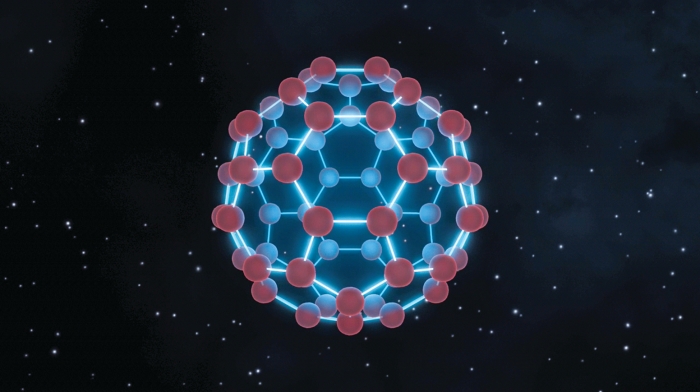
buckyball

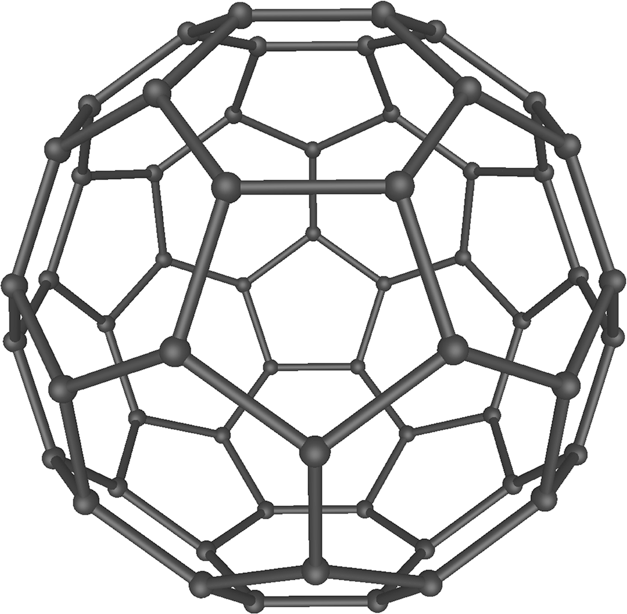
Model of the structure of a buckyball. [Mstroek]

Moving away from our star and into the galaxy, Jacob Bernal (University of Arizona) next presented laboratory astrophysics results related to everyone’s favorite molecule, Buckminsterfullerene (C60) — buckyballs, for short. Though this complex molecule — which consists of 60 carbon atoms arranged into a soccer-ball shape — has been discovered in a variety of environments throughout the universe, we’re still not quite sure how it forms. The ordered assembly of 60 atoms in the harsh environment of space is quite a feat! Bernal and collaborators propose that the key is to shock-heat a silicon carbide grain and then bombard it with ions — a process that could occur naturally around a star that is evolving off of the asymptotic giant branch. The team tested their theory by attempting to reproduce this process in the laboratory, with great success: they were able to create quasi-spherical carbon nanostructures that could subsequently evolve into buckyballs within this picture.

GD-1

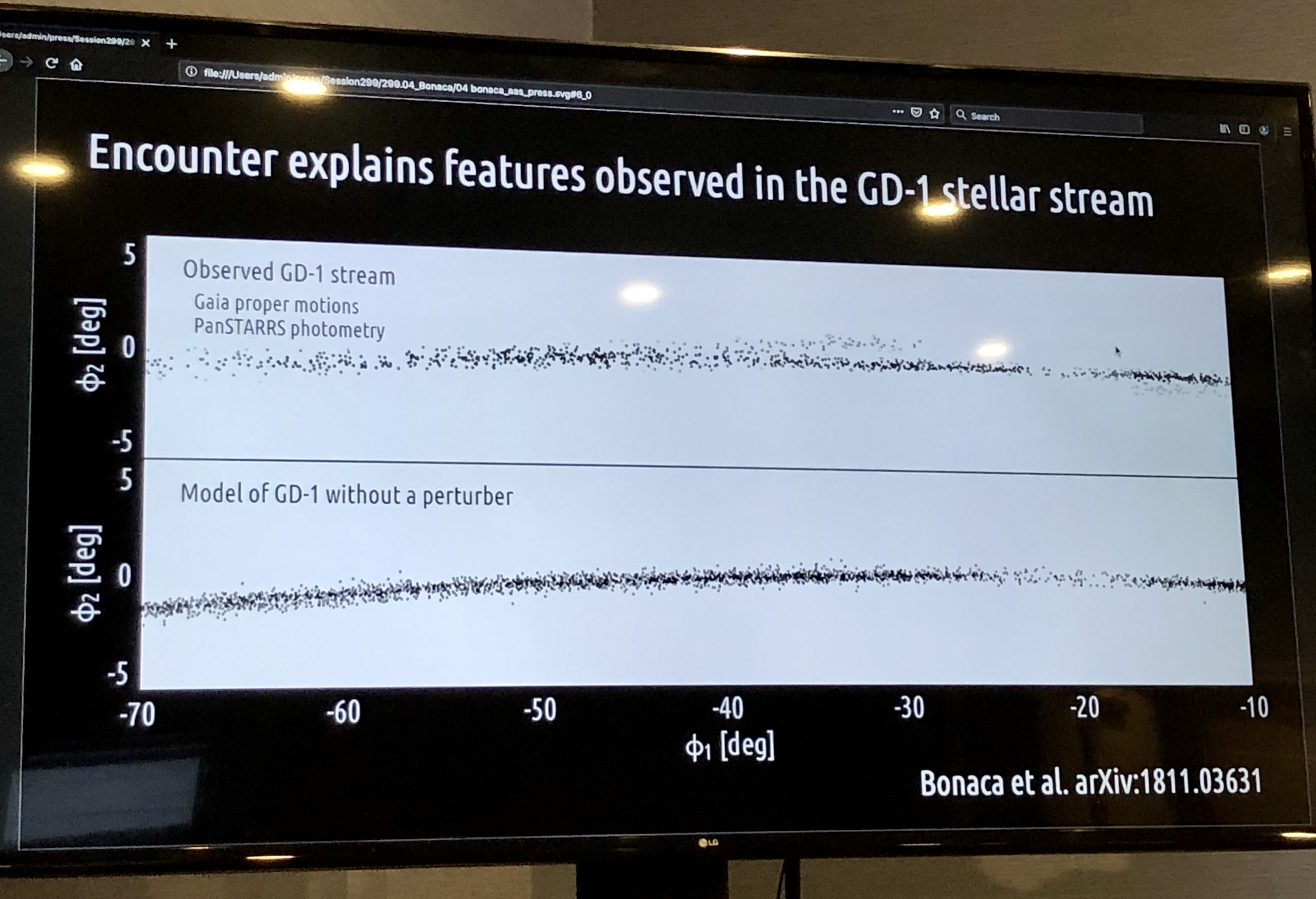
Can you spot the differences between the observations of the stellar stream GD-1 (top) and an unperturbed model (bottom)? Something massive appears to have passed through this stream, generating the gap and the small spur of stars.

The last speaker of the conference took us even further away, to the outskirts of the galaxy. There, stellar streams orbit within the Milky Way’s halo — and Ana Bonaca (Center for Astrophysics) and collaborators think these streams might reveal clues about the nature of dark matter. Stellar streams are thought to be created when stellar clusters in our halo are disrupted, drawing out long tails of stars that then orbit the Milky Way. The longer the tail, the longer the stream has likely been in existence. Bonaca reported on a study of one particular long stream of stars, GD-1, which she and collaborators analyzed in detail using data from PanSTARRS and Gaia. The team found that, upon closer inspection, the stream isn’t the smooth, continuous line of stars it appears to be. Instead, it has been perturbed: there are gaps and a small spur of stars mid-stream. Based on the team’s models, the most likely perturber was a compact object of around 5 million solar masses — yet such a perturber is nowhere to be seen. Could this perturber be a contributor to dark matter? Bonaca and collaborators plan to examine more streams to see if GD-1 is a fluke or a sign of more to come. If other streams show similar perturbations, we may be able to use these tracers to home in on dark matter models and explain where the invisible 90% of our galaxy is hiding.


Plenary Talk: Sexual Harassment – Changing the System (by Susanna Kohler)

In a replacement talk for the planned plenary — which Betsy Mills was unfortunately unable to give today — AAS Vice President Joan Schmelz (Universities Space Research Association) provided insightful and much-needed insights into how we can help change the system that allows sexual harassment to occur in astronomy.

In the wake of three very public sexual harassment cases in the field, Schmelz wondered what could be done to shift the burden from the vulnerable to the powerful members of the astronomy community. Since then, she has worked in her role as the former chair of the Committee for the Status of Women in Astronomy to identify ways we can shift the culture of the field.

advocacy axis

Each of us falls somewhere on the advocacy axis. We can start by trying to do one step better.

Schmelz has since delivered talks at numerous institutions discussing ways that bystanders can move toward becoming allies and advocates. Her first recommendation is simple: each of us can start by moving one step up in the advocacy axis (see her slide at right). That means that if we’ve been the person telling sexist jokes, we should stop doing that. If we’ve been the person laughing at the jokes, we should stop laughing. If we’ve been a silent bystander before, next time we should speak up. Simple words such as “I disagree,” can shut down offensive conversation effectively. And, as with anything, practice makes perfect! Speaking up may not be easy at first, but it becomes easier with practice.

Schmelz addressed actions that can be taken at increasingly higher levels of leadership within an institution to change the culture around sexual harassment in the field. One interesting point she brought up is that faculty at many universities are mandatory reporters: they are legally required to (non-anonymously!) report cases of sexual harassment to the Title IX office or another campus authority. The Title IX office isn’t there to protect you, it’s there to protect the university, Schmelz points out. She argues that departments need to clearly present information like who is a mandatory reporter, and where targets of harassment can go on campus to receive guidance while keeping their identity anonymous.

reasons don't report

Just a few of the many reasons why targets of harassment may not file a report.

The final topic Schmelz addressed is that of serial harassers. Targets of harassment are often — understandably — unwilling to report, fearing a he-said, she-said scenario. But what if it’s he-said, she-said, she-said, she-said? In the fluid environment of academia where people frequently move between institutions, the target of a serial harasser may have no idea that their experience wasn’t unique. An information escrow addresses this problem.

In an information escrow, an individual can file a report that will remain confidential unless and until a second report is filed against the same harasser. At that time, both filers are notified and can make the decision of how to proceed — whether they wish to have contact with one another, file a Title IX complaint, wait for a third case, or pursue another course of action. Schmelz pointed out that such an information escrow would be most effective if managed by the astronomy community as a whole, so that records remain intact as individuals move between institutions. She welcomed the community to take collective action to make such an escrow happen.

It’s clear that the astronomy community as a whole benefits when everyone is able to work to the best of their potential in a positive department climate. So why wouldn’t we all come together to change the system? It’s time that we each do our part.


Town Hall: The National Academies of Sciences: The Astronomy and Astrophysics Decadal Survey: 2020 (by Susanna Kohler)

They promised that we’d have town halls as part of Astro 2020, and here we are! The Astro 2020 Decadal Survey is a process during which the astronomy community assesses the current state of the profession and makes recommendations for what missions and projects should be prioritized over the coming decade. This evening Robert Kennicutt, co-chair of the Astro 2020 survey committee, presented an update on the current state of the survey.

Astro2020

The Astro2020 Decadal Survey is underway. [National Academies]

In a quick overview, Kennicutt reminded us of what the committee has been tasked to do. Notably, in addition to apprising stakeholders of the state of the field and making recommendations, the survey committee must also temper their recommendations with what Kennicutt called “what-if” scenarios — i.e., they should develop contingency recommendations for cases where a proposed mission runs over budget or behind the proposed timeline.

Where are we currently in the process? White papers have been solicited from the community, the survey committee has been selected, and the committee is currently building topical panels to review white papers and advise the survey committee. Panel deliberations will be conducted in late 2019, and survey-committee deliberations and report-writing will occur in spring and summer 2020.

We’re early in the game yet, but so far it looks like community involvement is high! As an example, the number of received science white papers is up by ~75% compared to the previous decadal survey, reports Kennicutt. The call for Activities, Projects, or State of the Profession Consideration white papers will be open for another month, and after that time the community can look for a few more town halls — including one at the winter AAS meeting in Honolulu, HI — as a means of keeping up to date with Astro 2020.

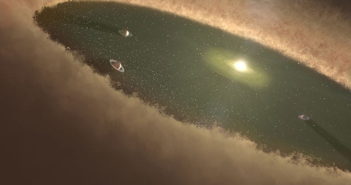
young planetary system

Editor’s Note: This week we’re at the 234th AAS Meeting in St. Louis, MO. Astrobites and AAS Nova will be working together to publish updates on selected events at the meeting this week; the usual posting schedule for AAS Nova will resume next week.

Kavli Foundation Lecture: Key Outstanding Questions in Galaxy Formation and How to Answer Them (by Kerry Hensley)

Dr. Alice Shapley (UCLA) kicked off the 234th meeting of the AAS with a discussion of some big open questions in galaxy formation and how we can work toward answering them. The biggest overarching question in the study of galaxy evolution is how the tiny density fluctuations in the early universe, long before galaxies formed and the first stars began to shine, resulted in the incredible diversity of galaxies we see in the universe today. She broke that question down into six smaller questions:

  1. What physical processes drive the formation of stars in individual galaxies?
  2. Why do galaxies today seem to fall into one of two categories: blue star-forming disks and “red and dead” spheroids?
  3. How does matter assemble to form galaxies? Is it mostly in situ star formation or does a lot of the material and structure come from galaxy mergers?
  4. Why is galaxy formation so inefficient?
  5. How do galaxies exchange chemically enriched material with the intergalactic medium?
  6. How do galactic stellar populations and central black holes co-evolve?
Observational approaches to galaxy evolution

An (extremely blurry) example of how we can piece together a picture of how a single galaxy has evolved by observing similar galaxies at different points in cosmic time.

Dr. Shapley focused on galaxies with redshift between 1.5 and 3.5, since there was a lot going on in this time period: between a redshift of 2 and 3 was cosmic “high noon,” when the star-formation rate was at its maximum, and, coincidentally, the central black hole accretion rate was at a maximum as well. Observations show that galaxies at z~2 have more than an order of magnitude more star formation than galaxies today, are smaller (for a given mass), and have lots of gas inflows and outflows.

In order to study galaxies at these redshifts, Dr. Shapley uses optical spectroscopy. We can learn a lot from spectral lines: measuring the dust extinction, instantaneous star-forming rate, abundance of oxygen and other “metals”, and electron density, as well as determining whether the dominant ionization source is an active galactic nucleus or high-mass stars, and what kind of outflows are happening.

Of particular importance is the abundance of oxygen. If we measure the oxygen abundance in galaxies over the course of cosmic history, we can understand how galaxies become chemically enriched through stellar evolution and inflows, and chemically depleted through outflows.

Want to learn more about Dr. Shapley and her work? Check out her interview with Mia de los Reyes here!


Press Conference: Exoplanets, Flare Stars, and a Crab (by Susanna Kohler)

The first press conference of AAS 234 was a fun hodgepodge of topics, from exciting planet detections and updates on habitability to intriguing news about Sun-like stars.

In the first presentation, Lisa Prato (Lowell Observatory) and Christopher Johns-Krull (Rice University) jointly presented on the direct detection of CI Tau b, the youngest hot Jupiter to ever be observed directly. Hot Jupiters — gas-giant planets that orbit extremely close to their host stars — pose a particular challenge to detection: because they are so near to their stars, it’s quite difficult to separate the planet’s signal from its host’s, which is often hundreds of times brighter. But by combining 4 years of near-infrared spectroscopic observations of the CI Tau system, Johns-Krull, Prato, and collaborators were able to disentangle the carbon monoxide spectral lines of the planet CI Tau b from it’s star’s lines. This success is remarkable in such a young system; CI Tau is only around 2 million years old, and the star is still surrounded by the circumstellar disk of dust from which its planets formed. The system’s young age means that these observations of CI Tau b can provide unique constraints on models of how hot Jupiters like this one form — a long-standing question in exoplanet studies. Press release

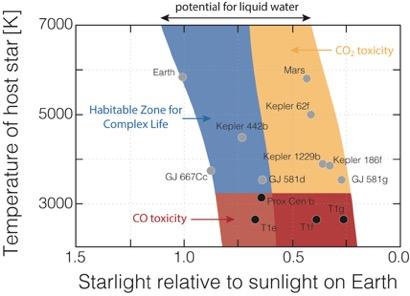
habitable zone for complex life

Plot showing the narrowing of the habitable zone as a result of Schwieterman and collaborators’ work. The shaded region is the traditional habitable zone; blue indicates the part of this region that could support complex life. Click to enlarge. [Schwieterman et al. 2019]

Next up, Edward Schwieterman (University of California, Riverside) shared details of his team’s recent work, which may put a damper on the hopes of extraterrestrial-life enthusiasts. A star’s habitable zone is typically defined as the range of distances from a star within which a hypothetical planet could maintain liquid water on its surface. But Schwieterman argues that this definition is too broad when looking for regions that could support complex life, like animals and humans. Schwieterman and collaborators use climate models to show that the habitable zone for complex life is much narrower. In particular, outer-habitable-zone planets are out, because the levels of carbon dioxide needed to keep these planets from freezing would be toxic to complex life. Furthermore, Earth-like planets orbiting within the habitable zone of M-dwarf stars would accumulate toxic levels of carbon monoxide due to the intensity of ultraviolet radiation from their hosts. While the narrowing of the habitable zone in this study may seem disappointing, it has the benefit of helping us understand where best to focus future search efforts for intelligent extraterrestrial life. Press release

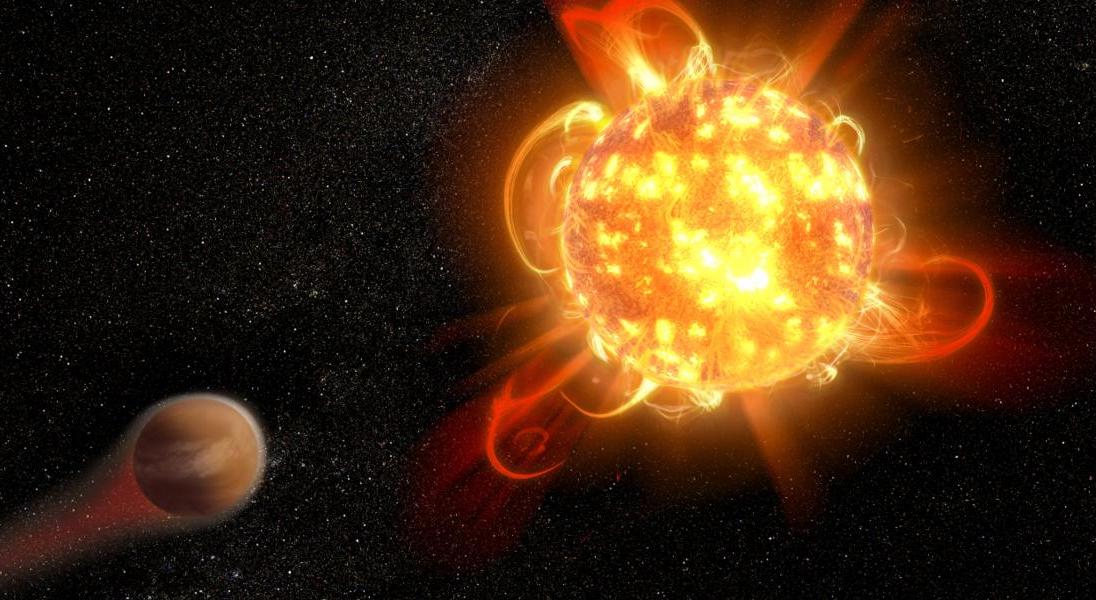
superflare

Artist’s depiction of a planet orbiting a flaring star. [NASA, ESA and D. Player]

Could our Sun — and stars like it — be a little less boring than we once thought? Rounding out the session, Yuta Notsu (Kyoto University & University of Colorado) informed us that we might need to keep an eye on our nearby star in the future. Notsu and collaborators have challenged the assumption that superflares — enormous releases of energy that can be hundreds to tens of thousands of times more powerful than the ordinary flares we see from our Sun — typically only occur on young, rapidly rotating stars. Four years of Kepler data show evidence for superflares on hundreds of solar-type stars. Notsu and collaborators have now followed up this surprising result with spectroscopic and astrometric observations to determine whether these stars are truly Sun-like, or whether they might actually be giant stars or quick rotators. The result? The sample does, indeed, include true Sun-like stars, which demonstrates that the Sun and Sun-like stars are also capable of tremendous releases of energy. No need to panic — a superflare from the Sun is unlikely to harm life on Earth. But we may want to think about taking some extra steps to make sure our ground- and space-based electronics are protected, Notsu cautions. Press release


Helen B. Warner Prize Lecture: Hunting for Dark Matter in the Early Universe (by Kerry Hensley)

Dr. Yacine Ali-Haïmoud (New York University) began his talk with an overview of dark matter. Dark matter doesn’t seem to emit, scatter, or absorb light, but does interact with luminous (aka “normal”) matter gravitationally. Dark matter clumps together and forms the filamentary structure along which galaxies form. Astronomers infer the presence of dark matter in our observations of large-scale structures like galaxy clusters as well as small-scale structures like dwarf galaxies, and it turns out there’s a lot of it — it’s more than five times more common than normal matter.

But what is dark matter? Well, that’s the million-dollar question! Dr. Ali-Haïmoud outlined a few options:

  • A new kind of particle. We’ve already discovered a whole host of particles, but there’s plenty of parameter space left unexplored. If it turns out that dark matter isn’t completely “dark” — that is, that it interacts very, very weakly with photons — there’s a chance that we could detect it with any of the many ongoing or planned experiments like CDMS, EDELWEISS, or ZEPLIN.
  • Macroscopic objects that are hard to detect. The frontrunners here are primordial black holes, which are thought to form within microseconds of the Big Bang when dense patches of the universe collapse directly into black holes.
  • A combination of the two. There’s no reason that the “missing matter” has to come from just one source!
  • Not a physical object at all. Instead, dark matter could be a modification of the laws of gravity that only shows up under certain conditions.
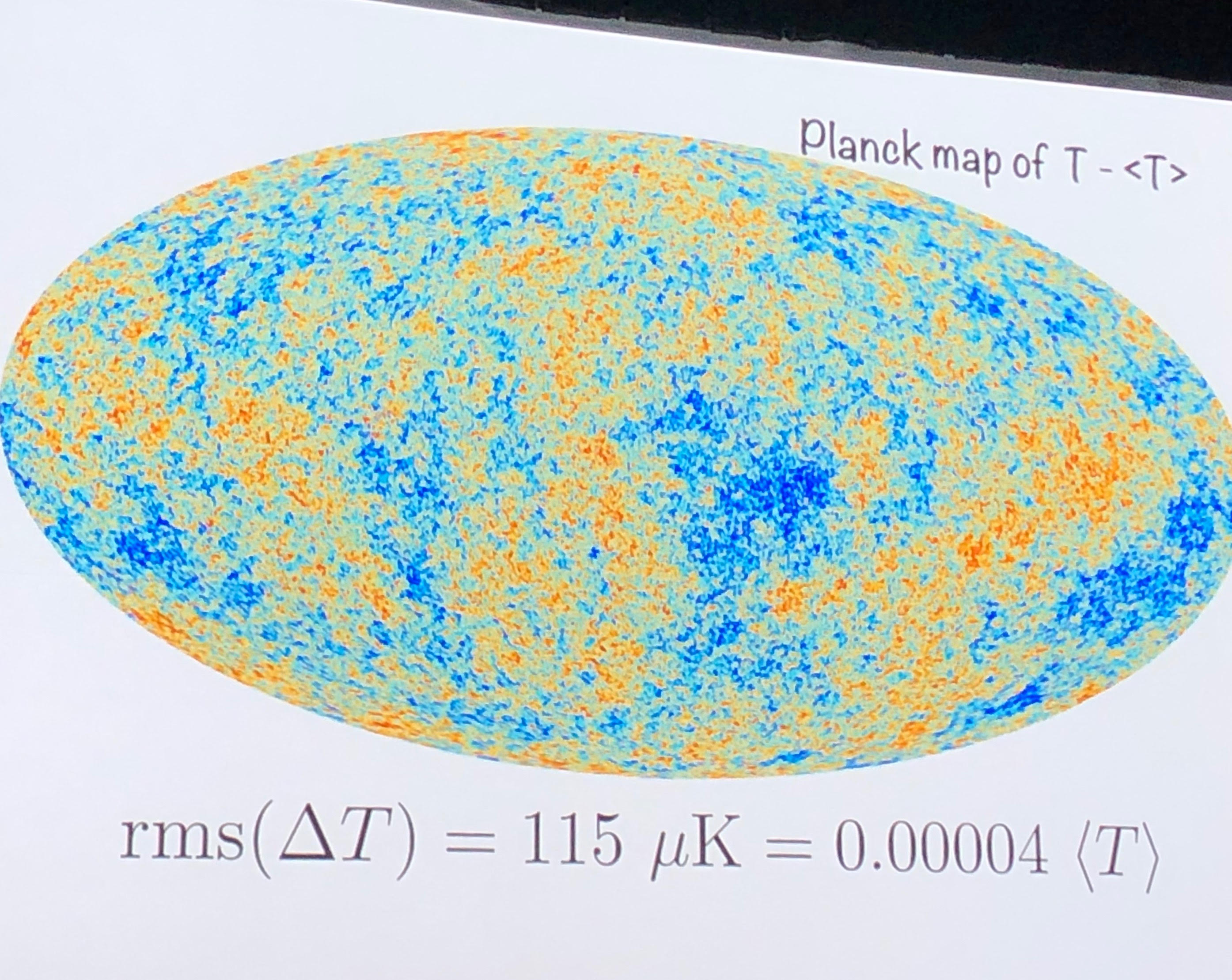
CMB from Planck

A map of the anisotropies (temperature fluctuations) in the CMB from Planck.

We can try to figure out what dark matter is made of by studying the very early universe through observations of tiny temperature fluctuations in the cosmic microwave background (CMB). The CMB radiation almost perfectly matches that of a blackbody with a temperature of 2.73 K, but it has tiny fluctuations — called anisotropies — smaller than one part in 10,000.

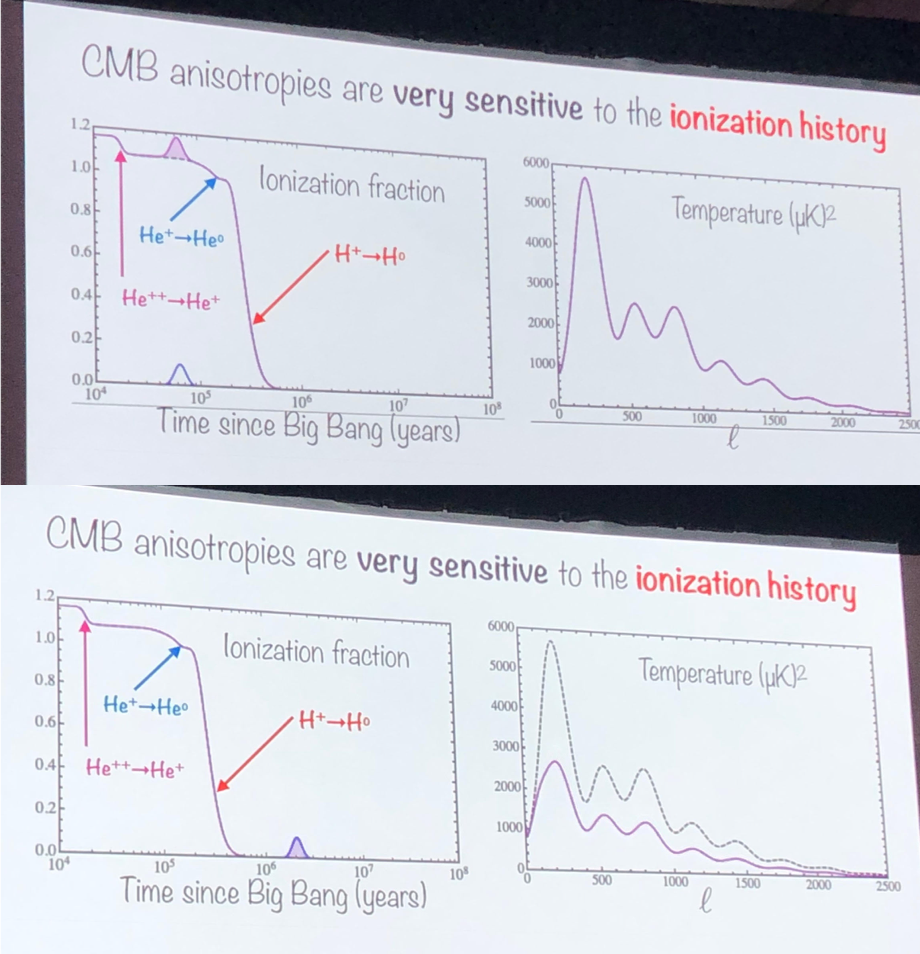
These anisotropies are sensitive to the nature of dark matter. For example, if dark matter is made up of primordial black holes, the photons generated when matter falling into those black holes heats up (similar to the emission we see from active galactic nuclei) could ionize the surrounding hydrogen, which would have an effect on the ionization history of the universe. This change would be imprinted upon the anisotropies in the CMB.

The power spectrum of the CMB is very sensitive to the ionization history of hydrogen and helium. This figure shows how the power spectrum changes if you add in a little extra ionization in the past.

Observations of the CMB indicate that primordial black holes can’t be the only source for dark matter if they have masses greater than 100 solar masses. The potential range of primordial black hole masses is huge, though — anywhere from 10-16 to 1010 solar masses. Twenty-six orders of magnitude! As far as our prospects of detecting these primordial black holes go, we have a chance of spotting them with the Laser Interferometer Gravitational-wave Observatory (LIGO) if they form in the correct mass range (a few to a few hundred solar masses) and form binaries. It’s still not clear whether or not these binaries, which would have formed very early in the universe’s history, would be able to survive the formation of large-scale structure in the universe. Clearly, there are lots of interesting questions left to be answered in our search for dark matter!

Learn more about Dr. Ali-Haïmoud in his interview with Kate Storey-Fisher here.


Press Conference: What’s New Under the Sun (by Susanna Kohler)

Though it’s been studied for centuries, our nearest star still poses a number of unsolved mysteries. This afternoon’s press conference introduced us to recent work addressing just a few of the open questions about the Sun.

Think the best images of our star all come from well-established, orbiting space telescopes? Think again! The High resolution Coronal Imager (Hi-C) is a telescope that was briefly launched to sub-orbital space on a sounding rocket; on each flight, it captured only a few minutes of observations of an active region of the Sun before returning to the ground. In that brief time, however, Hi-C took images with spectacular spatial and temporal resolution; just look at the video below (originally published on the Hi-C website) for a comparison of data from the orbiting Solar Dynamics Observatory AIA instrument to Hi-C observations!

In the first presentation of this press conference, Sanjiv Tiwari (Lockheed Martin Solar & Astrophysics Laboratory) presented discoveries made from data gathered during Hi-C’s second launch, just last year. The imager’s high-resolution observations revealed several different types of energy release — dot-like, loop-like, and jet-like brightenings — occurring on very small scales (perhaps a tenth of the diameter of Earth) within the core of an active region on the Sun. These energy releases appear to occur in the lower solar atmosphere in response to changes in the magnetic field on the Sun’s surface.

coronal bright points

The small bright spots in this SDO image of the Sun represent coronal bright points, short-lived analogs of active regions. [NASA/SDO]

The connection between magnetic-field evolution and solar activity is evident, but understanding just how this process works is difficult. One particular challenge is that our observations are often incomplete: due to the Sun’s rotation, we can only capture about 8 days of data before an active region rotates out of view for the next 20 days. Since the lifetimes of these regions may be weeks to months, this means we’re only seeing bits and pieces of the story as we attempt to study magnetic-field evolution and connect it to the activity seen in the solar corona.
Karin Muglach (NASA Goddard Space Flight Center) and collaborators have found a potential solution to this problem: instead of trying to learn directly from large active regions, they propose studying their smaller-scale analogs, coronal bright points. The small size of these regions means that their lifetimes are correspondingly shorter — which allows us to observe them continuously from birth to death. When Muglach and collaborators watched four coronal bright points using imaging and magnetic-field monitoring from the Solar Dynamics Observatory, they found that the bright points appeared in the corona as bipolar magnetic flux emerged in the solar photosphere. The cancellation of that magnetic flux was related to eruptive events — jets — in the corona, immediately after which the intensity of the bright points faded.

Can we make any predictions about solar activity? According to Alexander G. Kosovichev (New Jersey Institute of Technology), the answer is yes. Kosovichev reported on how helioseismology — the study of oscillations on the Sun’s surface — has given us clues as to the origin of the 11-year solar activity cycle. By using helioseismology to map zonal flows in the Sun, Kosovichev and collaborators found that hydromagnetic waves are generated at the bottom of the solar convection zone (that’s 120,000 miles below the Sun’s surface) and at about 60° latitude. These waves slowly travel to the surface and toward the Sun’s equator, eventually regulating the appearance of sunspots — but they are slowed by magnetic fields. This connection, Kosovichev argues, allows us to use observations of polar magnetic field strength to predict the strength of the next solar maximum. Based on the currently observed polar magnetic fields, Kosovichev and collaborators expect that the next solar maximum will be even weaker than the solar maximum of our current solar activity cycle.

The benefits of helioseismology as a tool for studying the Sun are clear, but the data products of this study can be difficult to intuitively understand. A new tool called Sonification of Solar Harmonics (SoSH, for short) is now helping to make helioseismology a little more accessible. The Sun’s surface oscillates because plasma flows excite sound waves that then bounce around the Sun’s interior; the star is effectively a giant resonant cavity for low-frequency sound waves. In helioseismology, we measure these waves to learn about the solar interior, but we don’t actually listen to the sound waves themselves … that is, until now. Solar physicist Timothy Larson (Moberly Area Community College) worked with composer collaborators to develop the SoSH project, in which helioseismology data is filtered and frequency-shifted into a hearable range. So far, SoSH has sonified two full solar cycles of data from two instruments (MDI and HMI on the Solar Dynamics Observatory), and these sonifications are publicly available so that everyone can listen to the surface of the Sun sing. More information and sample sonifications are located here.

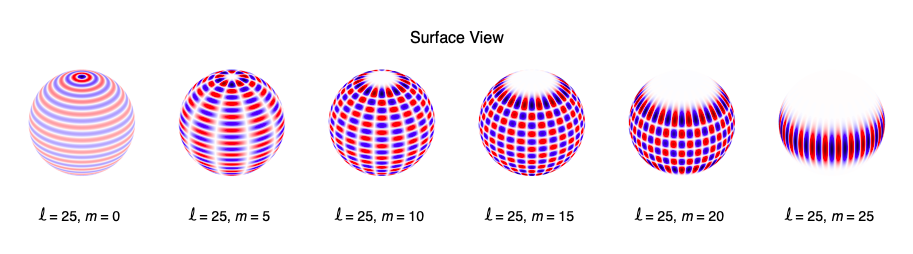
modes

Examples of different oscillation modes on the Sun’s surface. [SoSH]


George Ellery Hale Prize Lecture: Observations about Observations of the Sun (by Kerry Hensley)

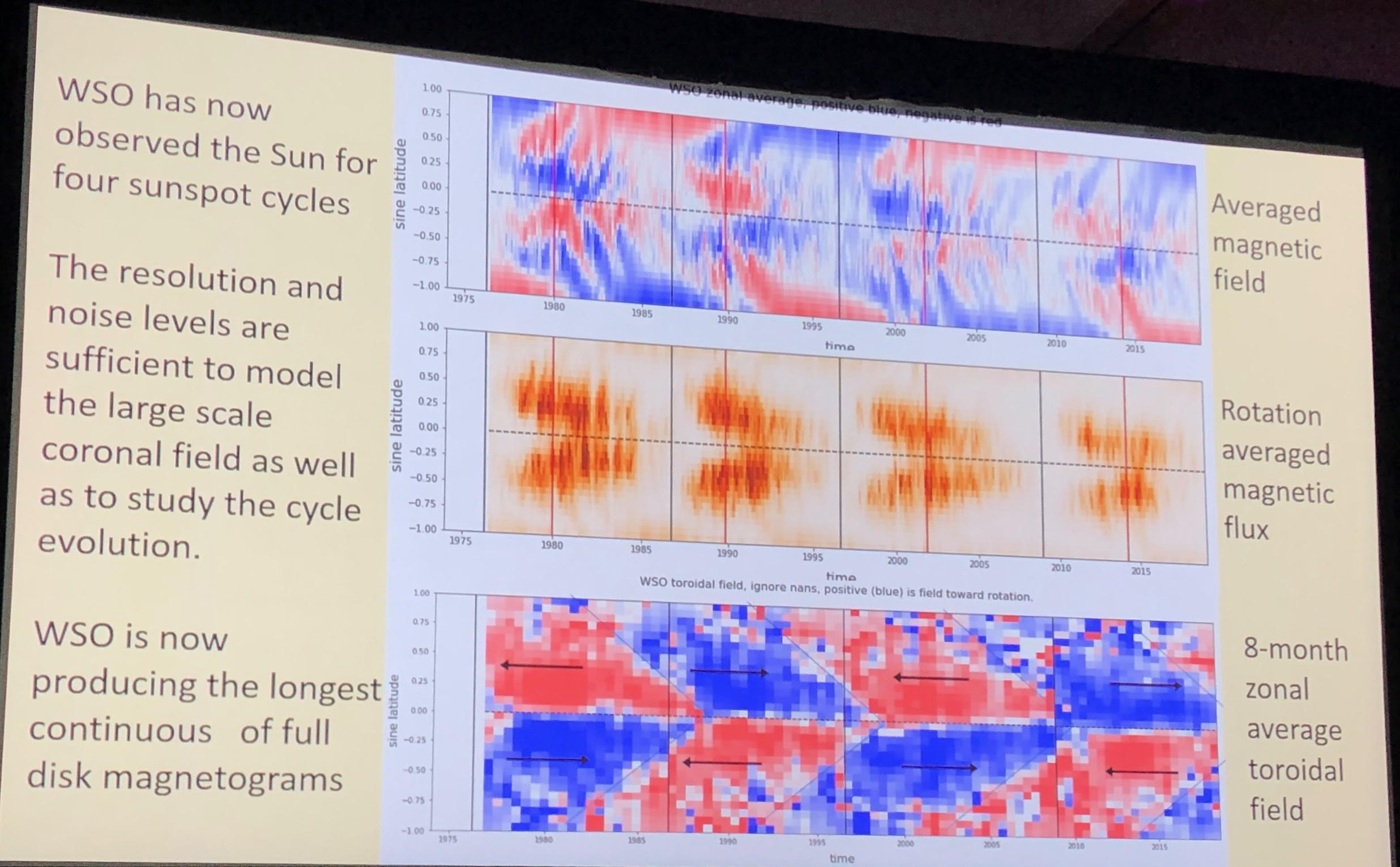
Solar observations from WSO

WSO has amassed an amazing amount of data over the past 44 years!

Dr. Philip Scherrer (Stanford University) gave a broad overview of advances in solar physics over the past four decades through the eyes of three observatories: the Wilcox Solar Observatory, ESA/NASA’s Solar and Heliospheric Observatory, and NASA’s Solar Dynamics Observatory. Those three observatories have contributed to thousands of research papers with more than 4,600 unique authors and 40 PhD theses!

The Wilcox Solar Observatory (WSO), a ground-based solar telescope, has been observing the Sun since 1975. The WSO is responsible for the longest-running set of measurements of the Sun’s mean magnetic field as well as low-resolution magnetograms, both of which are used to study and predict the solar activity cycle. WSO has been observing the Sun for four full sunspot cycles! (Or two 22-year magnetic cycles. Your choice.)

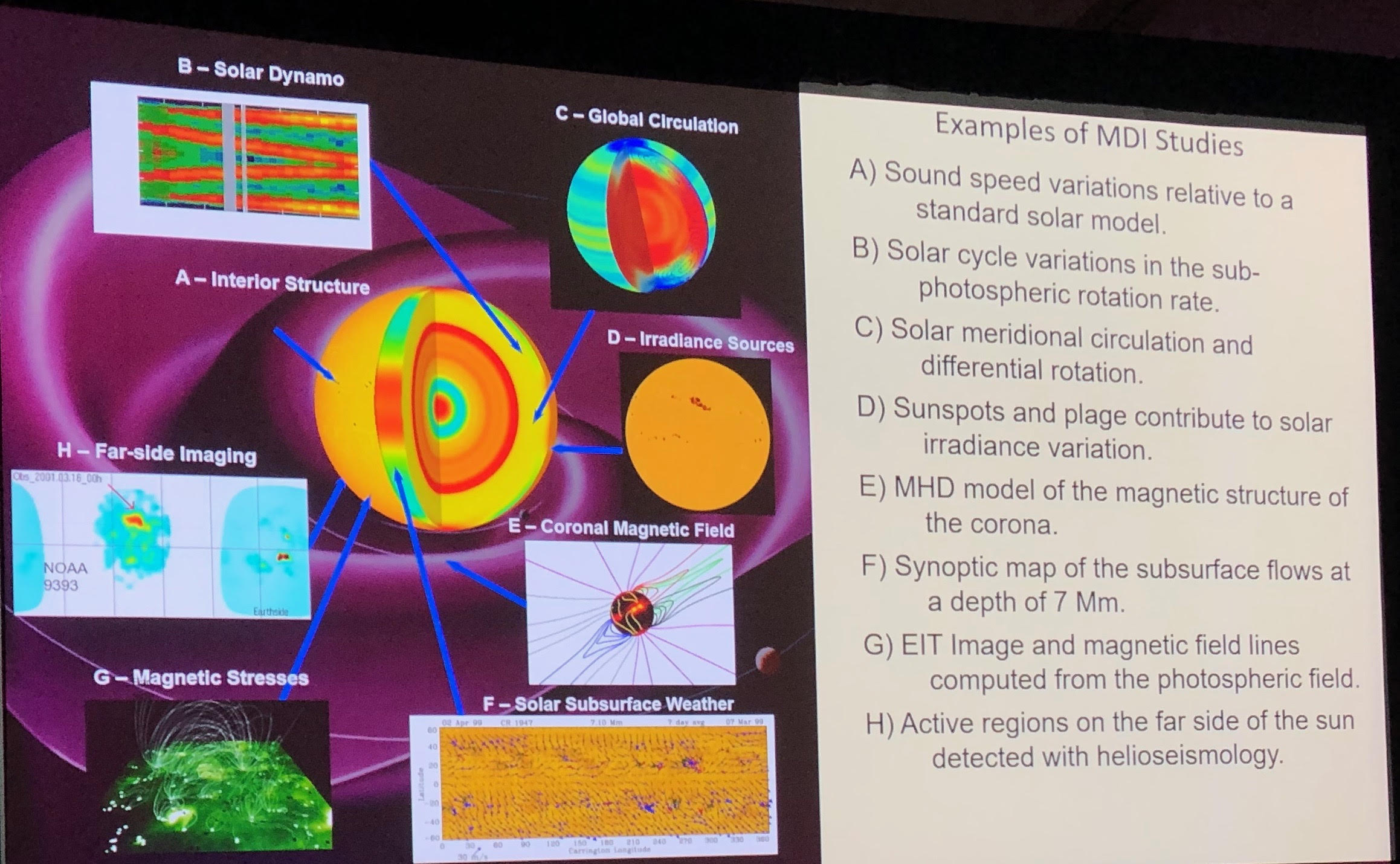
MDI science

A list of all the cool science MDI was designed to do.

Next came the Solar and Heliospheric Observatory (SOHO), which was launched in 1995. While SOHO is still alive and well, the Michelson Doppler Imager (MDI), which was used to make measurements of the Sun’s magnetic field, hasn’t been used for science since 2011. SOHO/MDI brought about huge advances in the field of helioseismology — a method of studying the interior of the Sun through observations of waves on its surface — including allowing scientists to “look” through the Sun to “see” sunspots on the other side!

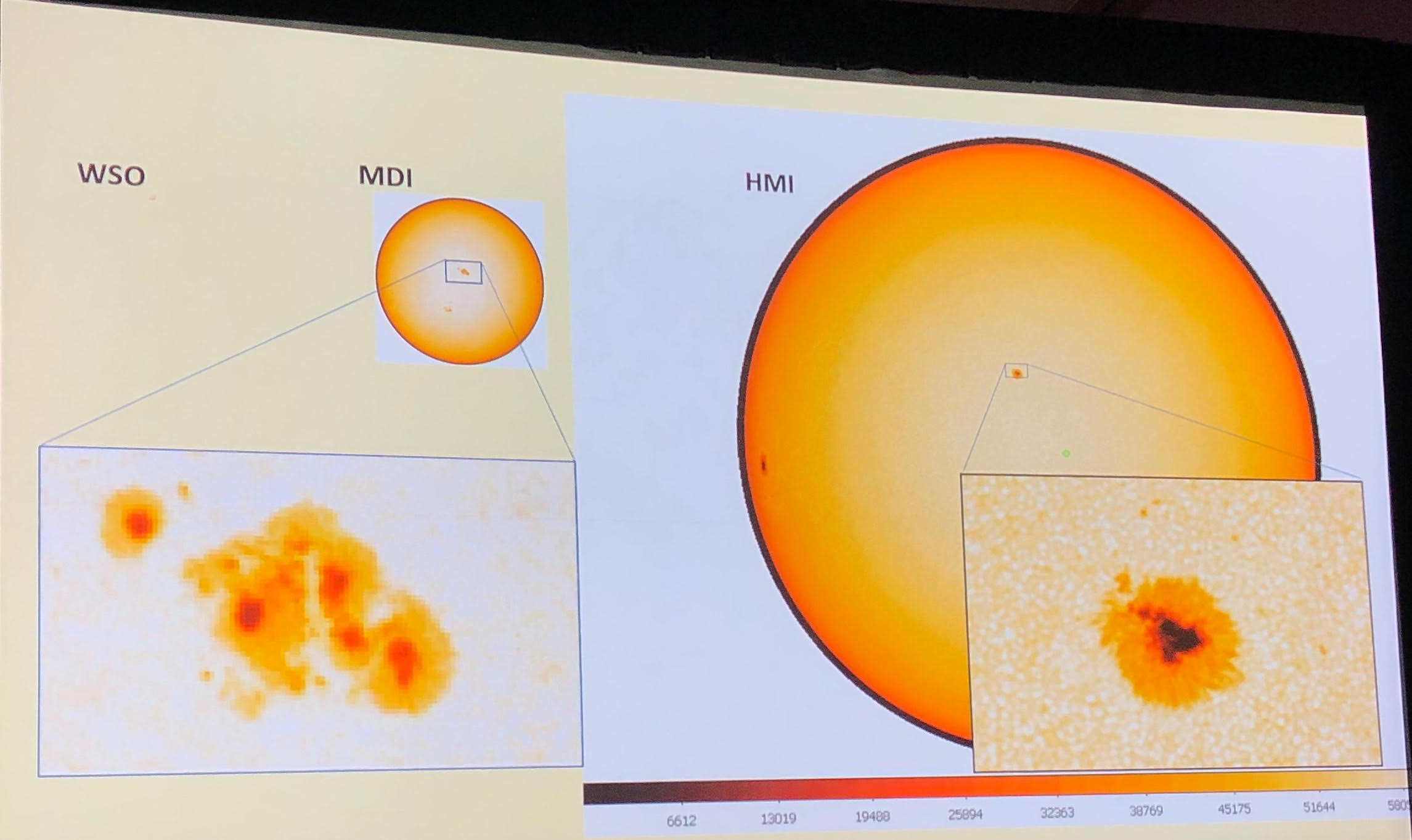
Comparison of observations by WSO, MDI (SOHO), and HMI (SDO).

Finally, Dr. Scherrer showed some fantastic data and videos from Solar Dynamics Observatory (SDO), which was launched in 2010 and is still happily taking data from its vantage point in Earth orbit. One of SDO’s three instruments is the Heliospheric and Magnetic Imager (HMI), which makes measurements of the magnetic field of the Sun’s disk all at once. SDO has helped us better understand the large-scale motions of material within the Sun.

Throughout the talk, Dr. Scherrer shared some of his advice and lessons learned from his career. He shared his story of retracting a Nature paper claiming the discovery of the ever-elusive solar g-mode oscillations, which highlighted the importance of open discussion with collaborators and others, not rushing to publish science you aren’t confident in, and — perhaps most importantly — being mindful of your systematic errors!

Want to know more? Read his interview with Briley Lewis here.

This week, AAS Nova and astrobites are attending the American Astronomical Society (AAS) meeting in St. Louis, MO!

We had a great time at the undergrad reception this evening chatting with all the awesome students who came out for the event. Thanks to all of you for joining us; we hope to see you around at the rest of the meeting!

astrobites swag

Need some astrobites swag? Come stop by the AAS booth at #AAS234!

If you’re at the meeting and missed us at the undergrad reception, please stop by and visit this week. You can find us at the AAS booth in the exhibit hall — we’ve got stickers and brand new astrobites pins (you asked and we delivered!), so swing by to pick up some swag and say hi.

For anyone who’s missing the meeting, or for those attending who can’t make all the sessions you want to: Astrobites and AAS Nova will be reporting highlights from each day. Note that we’re a little understaffed at this meeting, so we won’t be able to capture as many sessions as we usually do — but we’ll do our best to bring you brief summaries of most of the keynote talks and the press conferences. You can follow along here on aasnova.org this week, and we’ll repost the summaries on astrobites.org when the site is back online (we’re working on that!).

Lastly, if you’re interested in reading up on some of the keynote speakers before their talks at the meeting, be sure to check out the interviews conducted by astrobites authors, linked below! This is a great opportunity to learn more about these prominent astrophysicists and the path they took to where they are today.

Meet the AAS 234 Keynote Speakers: Joshua Winn and Elisabeth Mills
Meet the AAS 234 Keynote Speakers: James Head III and Xander Tielens
Meet the AAS 234 Keynote Speakers: Yacine Ali-Haïmoud and Anthony Yeates
Meet the AAS 234 Keynote Speakers: Alice Shapley

M101

The 234th meeting of the American Astronomical Society will take place June 9–13 in St. Louis, MO. In advance of the meeting, Astrobites authors have conducted interviews with some of the meeting’s keynote speakers to learn more about their research and careers. We’ll be publishing those interviews here over the coming days as part of our #AAS234 series!

Professor Alice Shapley (interviewed by Mia de los Reyes)

After nearly a century of study, we’ve learned a lot about galaxies. We know (mostly) what they’re made of: gas, dust, stars, and dark matter. We’ve been able to identify several different galaxy types: the basic “spiral” and “elliptical” classifications, but also more obscure varieties like “blue compact dwarf galaxies” and “post-starburst galaxies.” We have a pretty good idea about how they form: over-densities of dark matter in the early universe formed massive halos that pulled in gas, some of which formed stars, and larger galaxies were built up from mergers of smaller galaxies.

But the list of open questions about galaxies has grown faster than we’ve been able to get answers. And that’s because … well, because galaxies are really, really complicated.

Dr. Alice Shapley

Few people understand this as well as Dr. Alice Shapley. Shapley, a professor at UCLA and the 2019 Kavli Foundation Plenary Lecturer, will discuss these open questions at #AAS234 with her keynote lecture on “Key Outstanding Questions in Galaxy Formation and How to Answer Them.”

What are some of these outstanding questions? “One of them has to do with chemical enrichment in galaxies as a function of cosmic time,” says Shapley. “This is one of the most important components of a successful model of galaxy evolution.” This is a multi-faceted problem — how do stars in a galaxy enrich their surroundings with heavy elements? How do outflows and inflows of gas affect the chemical composition of galaxies in a process called the “baryon cycle”? As Shapley points out, “We still don’t really have an accurate model of [these processes].”

How can we improve our models? Shapley’s approach is to use spectroscopic information to tackle these questions. Spectra are treasure troves of information about galaxy properties, such as how quickly galaxies form stars, their chemical composition, and their dust content. “One of the things I’m super excited about is pushing some of our spectroscopic measurements […] to the early universe,” Shapley says. Right now, we have very few optical spectra of galaxies beyond redshift z~4 — but that will soon change with the James Webb Space Telescope, a project that Shapley and other galactic astronomers are excited about.

Another big question Shapley aims to answer is how much galaxies contributed to the reionization of the universe. When the early universe cooled, it formed neutral hydrogen — but a large fraction of the hydrogen in the universe today is ionized. What role did galaxies play in this reionization?

Unfortunately, the main era of reionization ended around redshift z~6. It’s difficult to measure galaxies’ ionizing properties at this redshift, since the large amount of neutral hydrogen between these galaxies and the Milky Way obscures our line of sight. However, Shapley and collaborators have confirmed that some galaxies at redshift z~3 appear to be “leaking” Lyman continuum radiation (radiation that’s blue enough to ionize hydrogen). These lower-redshift galaxies may be analogs to the galaxies that were present during the main duration of reionization, making them excellent probes to test how galaxies can contribute to reionization.

cosmic ionization

Schematic of the process of cosmic ionization [Loeb 06].

Shapley didn’t start studying questions of galactic evolution until she went to graduate school. “The field was completely wide open. When I started, it was all fair game — we didn’t know anything about galaxies beyond z~1.” Fortunately, she was able “to find an advisor with whom I had a really good relationship. […] I think that made a huge difference for me going forward.”

Shapley’s initial interest in astronomy was sparked when she was young. “I always trace my interest back to my fifth-grade class,” she says. “We were watching a film strip about these mysterious objects called quasars […] that were so far away that when the light reached you from the quasar, you were looking back in time.” She then took a summer astronomy course, where she learned the basics of astronomy research. “Ninety percent is drudgery, then you have this wonderful a-ha moment when you realize ‘Oh my gosh, this is truly amazing!’” she remembers. And when she started undergrad, she eventually “found a home doing astronomy research.”

What advice does Shapley have for undergraduates interested in astronomy research now? “Read,” Shapley replies instantly. “You have to read papers, so that you can understand the context of your research. And not just astro-ph, but also the background and old papers in the field. That’s how I get most of my ideas!” (Some shameless self-promotion: Astrobites not only posts daily summaries of astro-ph papers, but also summaries of classic papers in astrophysics!)

“Oh, one more thing,” Shapley says. “Don’t be shy about asking questions during talks!”

So, if you want to ask Dr. Alice Shapley some questions, come check out her plenary talk at 8:30AM on Monday, June 10 at #AAS234!

solar magnetic field

The 234th meeting of the American Astronomical Society will take place June 9–13 in St. Louis, MO. In advance of the meeting, Astrobites authors have conducted interviews with some of the meeting’s keynote speakers to learn more about their research and careers. We’ll be publishing those interviews here over the coming days as part of our #AAS234 series!

Professor Yacine Ali-Haïmoud (interviewed by Kate Storey-Fisher)

Primordial black holes are like dark matter particles; spinning grains of dust are like binary black holes; the gravitational wave background from pulsar arrays is like the cosmic microwave background from radio interferometry. This is how Yacine Ali-Haïmoud, Assistant Professor of Physics at New York University, sees the world. “I like to look for analogies between things which seemingly have nothing to do with one another,” he says. Physics is full of phenomena in far-flung regimes that follow similar laws. Ali-Haïmoud, who is giving the Warner Prize Lecture at AAS 234 this month, follows these physical analogs to theorize about cosmological imprints on observables.

Yacine Ali-Haïmoud

Prof. Yacine Ali-Haïmoud

A primary interest for Ali-Haïmoud is primordial black holes (PBHs), which have recently made a comeback as a dark matter candidate. This idea was first floated in the 1960s, and became popular again after the 2015 detection of black holes by LIGO (see this astrobite). These hypothetical black holes may have formed via gravitational collapse in the early universe, and could range from the mass of an asteroid to thousands of times the mass of the Sun.

Ali-Haïmoud is using the cosmic microwave background (CMB) to place constraints on PBHs. Black holes accrete nearby gas, heating up the gas and injecting more energy into the surrounding plasma. This leads to a change in the ionization history of the plasma, which changes the time of last scattering of CMB photons. We would then see a signature of this effect in the statistics of the CMB temperature anisotropies that we measure today. Ali-Haïmoud and others have already constrained PBH parameter space with Planck data, but they have not yet found evidence that PBHs contribute to the dark matter budget. “What I’ve been working on is building more precise translations from microphysical models to observables,” Ali-Haïmoud says, “such that if you do see something that departs from the standard cosmology, you should be able to actually pinpoint more accurately what possible dark matter model could cause this.” Future CMB maps from the Simons Observatory will probe this effect with higher sensitivity and hone in on dark matter candidates including PBHs.

interstellar dust

A close up view of interstellar dust. [Gemini Observatory/AURA]

Ali-Haïmoud is also interested in the story of interstellar dust, approaching it both theoretically and observationally. Large dust grains absorb ultraviolet photons and heat up, exciting the internal degrees of freedom of the grains. This is re-radiated in the infrared, but observers have also detected an unexplained bump in microwave emission. One hypothesis is that some dust grains are spinning at just the right frequency to produce this emission. A class of molecules called polycyclic aromatic hydrocarbons (PAHs) might fit the bill; Ali-Haïmoud describes these as “the dark matter of interstellar physicists.” We have a lot of indirect evidence of these large chemical compounds in the interstellar medium, but it is difficult to identify the exact types of molecules and their abundances.

As a step towards identifying interstellar PAHs, Ali-Haïmoud worked out the spectrum that PAH dipoles would produce. He notes that the electric dipole moments of the PAHs are analogous to the mass quadrupole moment of a binary black hole. But unlike black holes, PAHs are small enough to be governed by quantum laws, so they undergo discrete rotational transitions. These manifest in spectral lines that clump together in comb-like features, producing unique signatures for each molecule. Ali-Haïmoud went observing to hunt for these features (“I’m pretty proud of this because I’m a theorist,” he says), taking data of a cloud known to host anomalous emission. Alas, he didn’t find any spectral comb signatures, but he used this non-detection to place limits on the amounts of certain PAHs. “One of the things I’m hoping is that other people will do this kind of observation, which no one had done before,” he says.

Along a different vein, recent discussions with colleagues got Ali-Haïmoud interested in pulsar timing arrays (PTAs) as a way to map out the gravitational wave background. PTAs measure frequencies far below LIGO by monitoring pulsars — stable, rotating neutron stars that emit a beam of radiation. This beam appears as a pulse when it swings across the detector, and in the absence of gravitational waves, PTAs would detect pulses at extremely regular time intervals. A stochastic gravitational wave background, such as that from binary supermassive black holes, would perturb these arrival times. Ali-Haïmoud is working with PTA experts and bringing in his own expertise to develop the formalism for mapping the gravitational wave sky with these arrays. He compares this technique to the interferometric mapping of the electromagnetic background (the CMB) with arrays of detectors, which provided the first constraints on anisotropies and later polarization. “Here it’s philosophically similar, what we’re trying to do,” he says, “in the sense that we’re trying to understand what are the geometric properties of the maps that one could obtain from arrays of pulsars.”

pulsar timing array

An artist’s illustration showing how a network of pulsars could be used to search for the ripples in space-time. [David Champion/NASA/JPL]

Ali-Haïmoud considers himself lucky to have discovered his interest in physics early on. He attended École Polytechnique in France to study physics and math as an undergraduate, and there took a course on cosmology that piqued his interest. A drive for this research led him to start a PhD at Caltech — but this required a bit of luck and determination as well. He didn’t do very well on a nuclear astrophysics exam at Polytechnique, and the professor was supposed to write him a recommendation for PhD programs. “I still went and talked to him, and was like, ‘Look — this is really my passion and I really need your letter, and I’m willing to redo the exam or [do whatever extra work]it takes,’” Ali-Haïmoud says. “So don’t despair, and if you have a passion, you have to really push for it and not stop at errors.”

For undergraduates aspiring to a career in academia, Ali-Haïmoud emphasizes the importance of talking to professors and others in your field of interest. “Towards the last couple years of undergrad, I think it’s good to get in touch with faculty members to try and go beyond just what you learn in class, and try to see connections,” he says. More generally, “It’s always better to go and talk to people, whether they’re big shots or not big shots. You always learn more — even if you just have some poorly phrased idea, you always learn more by sharing this [idea]with people and getting some kind of feedback.”

After completing his graduate studies at Caltech, Ali-Haïmoud completed postdocs at the Institute for Advanced Study and Johns Hopkins University. In 2017, he became an Assistant Professor of Physics at New York University. “It’s good to be aware that it’s a long road and it’s not guaranteed for anyone, that there’s unfortunately a huge amount of luck involved,” Ali-Haïmoud advises. “So professors are really people who are hardworking and were also extremely lucky.”

Hear from Ali-Haïmoud at his Helen B. Warner Prize Lecture, “Hunting for Dark Matter in the Early Universe,” on Monday, June 10 at 12:20pm at #AAS234.


Professor Anthony Yeates (interviewed by Mia de los Reyes)

The Sun is the single most important astrophysical object for life on Earth. Its light is the basis for nearly all the food and energy on Earth; its heat provides just the right amount of warmth to keep Earth’s oceans liquid. Even the passage of time has been historically marked by the Sun — the radioactive decay of atoms might be a more fundamental unit of time, but it is the Sun’s motion relative to the Earth that defines the natural timescales of life.

Dr. Anthony Yeates

Prof. Anthony Yeates

Yet despite centuries of human observations, the Sun still harbors some secrets. “You tend to think that the Sun is the nearest astrophysical object,” says Anthony Yeates, so we should understand it pretty well. “But […] it’s even more complicated than we thought.”

Yeates, an associate professor from Durham University, studies the structure and evolution of the solar magnetic field, one of the most enduring mysteries about the Sun. As this year’s winner of the Karen Harvey Prize, he will give a prize lecture at #AAS234 addressing the question “Where Do Solar Eruptions Come From?” The answer to this question — perhaps unsurprisingly, given Yeates’ area of expertise — has to do with the Sun’s magnetic field.

Unfortunately, the solar magnetic field cannot be directly observed. So, Yeates says, “you need numerical models to try to get a handle on what it actually looks like.” These models aim to piece together a patchwork of indirect observations. For example, we can directly measure the solar magnetic field at the location of Earth, then try to extrapolate it back to the Sun, where we can compare with data about the Sun’s surface obtained from instruments like the Solar Dynamics Observatory.

Patterns from the solar magnetic field can also imprint themselves on the Sun’s corona (lower atmosphere), leading to observable energetic phenomena. One such phenomenon is a so-called coronal mass ejection (CME), which occurs when a huge quantity of solar plasma is released from the Sun. The energetic output from a CME — up to billions of tons of material! — can, when directly aimed at the Earth, produce geomagnetic storms that disrupt navigational systems, GPS, and power grids.

CMEs are thought to result from twists in the solar magnetic field. As the Sun’s magnetic field twists into helical structures, it builds up energy until the energy is somehow forcefully released — like a rubber band deformed to the point of snapping.

However, there are still open questions about how this happens, especially on small scales. How are these twists (“magnetic helicity”) injected into the corona? Where are they stored? How does magnetic helicity become concentrated enough to cause an eruption?

CME

Coronal mass ejection from 2003. [SOHO/NASA/ESA]

These are the questions that Yeates hopes to answer: “We’re trying to develop mathematical tools for identifying where within the coronal magnetic field you have interesting structure: where the magnetic field is tangled, twisted, where energy is stored.” If we can understand this, Yeates says, we may be able to predict where and when CMEs can occur — and even their internal structure, which may have a significant impact on how strongly they impact the Earth’s magnetic field.

Yeates has always enjoyed using mathematics as a tool; as an undergraduate, he studied applied mathematics, originally intending to pursue solid mechanics or fluid mechanics. But when he applied for PhD programs in the UK, he found a research project on the Sun that “seemed interesting,” and he took the opportunity.

“I just drifted into it by accident,” Yeates laughs. “I didn’t know anything about the Sun, I had no life-long ambition to study anything like this. […] I never even studied physics, as such.” He now finds that his mathematical training helps give him another point of view when solving astrophysical problems, though he does think it’s important to understand the background physics.

When asked what advice he’d give to more junior researchers, Yeates says, “Keep better notes! Write down literally everything you do.” And, true to his roots as a mathematician, he adds, “Never believe anything you calculate. Assume you made a mistake … because nine times out of ten, you did make a mistake! No one does things correctly the first time.”

If you’re interested in hearing more about how Prof. Yeates applies mathematics to understand the Sun’s magnetic field, come check out his plenary talk at 4:30PM on Wednesday, June 12 at #AAS234!

South Pole–Aitken basin

The 234th meeting of the American Astronomical Society will take place June 9–13 in St. Louis, MO. In advance of the meeting, Astrobites authors have conducted interviews with some of the meeting’s keynote speakers to learn more about their research and careers. We’ll be publishing those interviews here over the coming days as part of our #AAS234 series!

Professor James Head III (interviewed by Emma Foxell)

James Head

Prof. James Head III, Brown University

“Our job is to think our way to the Moon and back.” These were the twelve words on the job advert that changed the course of Prof. Jim Head’s career. This was 1968 and, armed with a PhD in geology, Head joined the Apollo space program to help realise President Kennedy’s dream of sending humans to the Moon.

James Head III is the Louis and Elizabeth Scherck Distinguished Professor in the Department of Earth, Environmental and Planetary Sciences at Brown University. Growing up in Washington, D.C. in the 1940s and 50s, Head was always looking at the ground, fascinated by the rocks beneath our feet. This led him to study geology at both undergraduate and graduate levels. However, this was the era of the Space Race and something caused him to look up. In 1957, with his “internet” (actually a shortwave radio), he used the timings sent by Radio Moscow to hear the characteristic “beep, beep, beep” that signalled the first manmade satellite, Sputnik 1, passing overhead.

Another major influence on Head’s career was one of his professors in grad school. This “far-thinking” professor taught a course on remote sensing techniques, allowing them to apply what they had learnt about geology on Earth to look at other planets. After gaining his PhD from Brown University, Head was looking through the university’s job catalog, where he came across that influential job advert.

While the primary goal of Apollo was to send people to the Moon, those working on the missions realised the scientific opportunity. Working for NASA, Head helped select landing sites for the Apollo missions that maximized both safety and scientific merit. He trained (and continues to train) astronauts in geological techniques and surface exploration. He helped select experiments for the Moon and analysed the returned lunar samples. While the Earth has evolved due to its dynamic atmosphere, oceans and continents, the barren, airless Moon is comparatively preserved, allowing geologists to study the formative years on the Moon and fill in the missing record on Earth.

irregular mare patch

Figure 1: An example of an irregular mare patch, a depression within the lunar mare (the dark, flat planes mistakenly identified as seas by early astronomers). [NASA/GSFC/Arizona State University]

Current and Future Exploration of the Moon

After working at NASA, Prof. Head returned to Brown University. He continues to work on both lunar and planetary geology. He is involved with the Lunar Reconnaissance Orbiter (LRO) mission, launched as part of President Bush’s vision to go back to the Moon. The LRO has been surveying the Moon for nearly 10 years, gathering data on its topography and mineralogy. The LRO’s Lunar Orbiter Laser Altimeter uses a laser to bounce light off the Moon, timing how long the echo takes to measure the height of the Moon’s surface. The topographical data it collects can be used both for identifying landing sites and to inform our understanding of the Moon’s geological past. A surprising result from the LRO is the presence of small and pesky to explain irregular mare patches (IMPs) — unusual depressions, often with mounds, on the Moon’s surface. Some geologists have hypothesised that IMPs are incredibly young, perhaps under 100 million years old. If they are due to volcanic activity, this would mean rewriting our understanding of the Moon (as volcanic activity was believed to have ceased 1 billion years ago).

One place that Head would like to explore further is the South Pole Aitken Basin, caused by the oldest known impact on the Moon. This provides a ready-made drill hole, allowing us to sample the mantle below the Moon’s crust and date the material. This is the landing site of Chang’e 4, the first mission to land (rather than crash) on the far side of the Moon, and part of the Chinese series of missions that Head has helped advise on. A future possible mission, Chang’e 6, may return a sample from this region.

While some believe that the next destination of human space exploration should be an asteroid or Mars, Head quotes the Apollo astronauts as saying, “We made going to the Moon look too easy.” He believes that the Moon would act as a good training base for astronauts on missions to Mars. Head explains, “We took the Apollo astronauts out to different places on the Earth’s surface, from Hawaii to Iceland, all over the world to train them in different geology. The next wave of astronauts will go to the Moon to learn how to do activities as they are training to go to Mars.” Training on the Moon would allow us to learn how to explore another world again just a few days’ space travel from the safety of Earth, before committing to the hundreds of days required to reach Mars.

Martian rocks

This scene from the Spirit rover captures volcanic-looking rocks strewn across Mars’s surface. Can we learn about these by studying rocks in Antarctica? [Mars Exploration Rover Mission/Cornell/JPL/NASA]

While the Moon acts as a useful museum for Earth’s earlier history, studying geology on Earth can inform our understanding of other, more distant, planets. The very cold and dry Antarctica is an analog for an earlier, wetter Mars, and studying it could help us understand how channels on Mars’s surface formed and perhaps how Mars evolved into the cold, dry rock we see today. Studying Antarctica is also important for understanding climate change. Since summer in Antarctica has highs of a few degrees above freezing, a small increase in temperature can have large effects on how much ice melts. Head has a black volcanic rock from Antarctica, with what appeared to be deep drill holes in it. In fact, these holes occur naturally; falling snow melts, and gets into the pores of the rock. Head worked this out by noticing that snow landing in the holes melted faster, and over time formed the deep holes. This is one example of how being able to observe these processes in action on Earth can allow us to piece together how similar looking rocks we see today on Mars may have formed.

Advice for Students

What advice does Head have for students about to start their careers? “Don’t be afraid to leap into the not very well known,” he says, and to seize an opportunity even if it seems beyond your capability. He points out that we do not know everything, that “none of us were qualified to plan the lunar landings,” and reassures us that “it is okay to have a non-linear career path.”

More generally, Head is an advocate for daydreaming — difficult in this age of iPhones and distractions, but it’s “really important to let the mind make seemingly random associations.” He suggests to plan your day to prevent letting the schedule of others stop you from doing what is most important. And finally, be “passionate about what you do.”

Find out more at Professor James Head III’s plenary talk, “The Apollo Lunar Exploration Program: Scientific Impact and the Road Ahead,” on Thursday 13th June at 12:20 PM at #AAS234.


Professor Xander Tielens (interviewed by Kate Storey-Fisher)

“Can we turn molecules into tools for astronomers?”

This is one of the questions that Xander Tielens, Professor of Physics and Chemistry at Leiden University, has spent his career trying to answer. We have known for decades that there are chemical compounds floating around interstellar space, ranging from water to large organic molecules. However, their complex spectral signatures make them a challenging avenue for studying the interstellar medium and intragalactic processes. Tielens, who is the LAD Plenary Speaker at AAS 234 this month, studies these molecules from all angles. His research group observes them in space, models them on the computer, and probes them in the lab in order to sharpen interstellar molecules into research tools.

For these compounds to be useful, we first need to build up a molecular inventory. This is done by comparing laboratory experiments with space observations, which Tielens describes as analogous to identifying a thief from their fingerprints by comparing them to a database of collected prints. Molecular transitions are the fingerprints of a molecule: they are specific to each molecule, so when we observe certain transitions in spectra we should be able to uniquely determine the molecule that produced them. However, we don’t have a comprehensive database of all of these transitions, so researchers do a bit of detective work to narrow down the possible molecules that could produce such transitions, and then measure these in the laboratory. By comparing the observed transitions to this database of molecular fingerprints, we can identify unknown molecules in space.

buckyball

Artist’s illustration of Buckminsterfullerene, a molecule that consists of 60 carbon atoms. [NASA/JPL-Caltech]

This process recently identified its first big suspect, C60+, or ionized Buckminsterfullerene. This soccer ball-shaped carbon molecule was first detected in planetary nebulae in 2010, and this finding was just confirmed by the Hubble Space Telescope in April. “So that is very exciting, and that also gives us ideas of where we should look for the other fingerprints,” Tielens says.

Researchers have now identified many molecular species in space. We can use these as galactic thermometers and barometers, quite literal tools to measure the temperature and pressure of a galaxy. “We use these molecules to study the conditions where they are, and that’s because the molecules are sensitive to their environment,” Tielens says. The local conditions affect the spectral signatures of these molecules, so we can calibrate the tools by looking at the signatures in places where we know the conditions. Then when we observe the same molecules in distant galaxies, we can infer the properties of the regions they reside in.

Organic compounds in space are also key to answering one of science’s biggest questions: what is the origin of life on Earth? One plausible theory is that amino acids, the organic building blocks of life, hitched a ride on a meteorite that crashed into our planet. To test this, we study other meteorites and see that they indeed carry a wide variety of amino acids. By looking at their isotopic signatures, we can trace their history and find that they likely have interstellar origins. We can also use these compounds to study life on other planets. We observe the absorption spectra of exoplanet atmospheres to determine which molecules are present. Zooming out, these molecules must have come from the regions where these planets formed, so we can start to build a map of where the organic inventory is stored.

The near-future launch of the James Webb Space Telescope will be able to probe these questions in unprecedented detail. “James Webb is going to open up the near and mid-infrared window where all the informational transitions are for most molecules,” Tielens says. In particular, the telescope will be able to study polycyclic aromatic hydrocarbons (PAHs), which contain 10% of the carbon in the universe. These molecules are also common on Earth, released in your car exhaust or when you burn meat on a barbecue — though JWST will be able to search for PAHs a bit beyond your backyard. Tielens says that it will “find these molecules not only in the local galaxies, but all the way out to a redshift of 3 or so, where most of the stars were formed and galaxies were assembled.” This will be critical to building our understanding of early galaxy formation.

Xander Tielens

Professor Xander Tielens

Tielens has nurtured an interest in astronomy since growing up in the era of lunar missions. A self-described “moon child,” he recalls, “It was a time where of course you were going into physics, of course you went into space, of course you went into astronomy … it was just a very exciting time.” Tielens, who is from the Netherlands, completed his undergraduate degree in astronomy at Leiden University. A molecular astrophysics group had just started there and had an open position, so he grabbed this opportunity and stayed for his PhD. “There are so many opportunities and you just have to keep your eyes open and you step into it and you will have an interesting career,” he says.

Throughout the rest of his career, Tielens has hopped back and forth between the Netherlands and the United States. After graduating he went to NASA Ames in California to work on the Kuiper Airborne Observatory, a precursor to SOFIA. Tielens knew nothing about the project going in, but he chose the position due to the people. “It’s very important to do fun things with fun people,” he advises young astronomers. “Make sure that you pick a group or an advisor with which it is fun to work.”

A decade and a half later, Tielens returned to Holland to become a professor at Leiden University, as well as the project scientist for the HIFI instrument on the Herschel telescope. He subsequently went back to NASA Ames for a position as the SOFIA project scientist. He finally settled back in Leiden, though he now also holds an adjunct professorship at the University of Maryland.

Tielens has chosen paths that have taken him across the world and through many significant research areas. But he believes that these choices aren’t all-important. “My advice is that it doesn’t really matter which path you take,” he says. “Make sure that you have interest in it, that you like it, you can apply yourself, and all will be right.”

Learn more at Tielens’s plenary titled “Dust Grains, Ices, and Surface Processes in the Interstellar Medium” on Tuesday, June 11 at 8:30am at #AAS234.

CMZ

The 234th meeting of the American Astronomical Society will take place June 9–13 in St. Louis, MO. In advance of the meeting, Astrobites authors have conducted interviews with some of the meeting’s keynote speakers to learn more about their research and careers. We’ll be publishing those interviews here over the coming days as part of our #AAS234 series!

Professor Joshua Winn (interviewed by Mike Foley)

Joshua Winn

Professor Joshua Winn

The field of exoplanets has come a long way since the discovery of the first exoplanets in the late 1980s and early 90s. Since then, over 4,000 exoplanets have been confirmed. Given that this sizable sample of exoplanetary orbits is now available, questions can be posed about the architecture and prevalence of different types of orbital geometries. However, we still are a little ways away from figuring out just how common our own solar system is. “If you pick a random, Sun-like star, there’s about one chance in three that it will have a compact system of multiple planets ranging in size between Earth and Neptune (and maybe a bit larger) and orbital periods of less than a couple years,” says Professor Joshua Winn. “What that means is, if you pick a random Sun-like star, there’s a one-in-three chance that it doesn’t resemble the solar system. But, for the other two thirds, we don’t know as much. So it’s going to take a little while longer before we can make a clear statement about how our solar system fits into the bigger picture.”

Winn, a professor at Princeton University, is one of the people who is most interested in the answer to this question. He will be speaking at AAS 234 about the history and future of exoplanet studies using the transit method, from the success of the Kepler mission to the exciting discoveries being made right now by the Transiting Exoplanet Survey Satellite (TESS). While TESS won’t be able to address how common our solar system is due to the short amount of time it will spend looking at each star, it will transform our understanding of close-in, short-period planets by studying smaller stars across the whole sky. Simulations show that TESS should find a few dozen potentially habitable planets, adding to the couple dozen habitable-zone planets already discovered by Kepler and other studies. “That’s what TESS is all about: finding systems that we know are out there and are very exciting,” Winn says.

Although Winn has worked on a variety of topics, ranging from stellar astronomy to planetary dynamics to gravitational microlensing, he developed a special affinity for the transit method in planetary discoveries. As a participating scientist in the Kepler team and a Co-Investigator for TESS, Winn has played a major role in using the transit method to shape our modern understanding of exoplanets. The transit and occultation of a planet are shown in Figure 1. “[The transit method] has been such a productive technique for finding planets, responsible for most of the planets we know about today,” says Winn. “It’s better than just finding a planet; you get to learn a lot. You learn the size of the planet from the amount of light that gets blocked. You learn the mass of the planet by following up with Doppler monitoring or by measuring gravitational effects between different planets. And you can even learn a few things about the atmosphere of the planet. By performing spectroscopy and other things throughout transit, you can learn the orientation of the star relative to the orbit of the planet. You can detect non-transiting planets by timing the transits of the known planet, and all kinds of wonderful things.”

transit method

Figure 1: Diagram showing a typical light curve for a planet orbiting a star that is observed using the transit method. The primary dip in brightness occurs when the planet passes in front of the star, and a secondary dip in brightness occurs when the planet passes behind the star. This is because, when not directly in line with the star, the planet will reflect some of the light from the star, increasing the observed brightness of the whole system. [Winn 2010]

Though a remarkable number of discoveries have been made in exoplanets over the past couple of decades, there is still much to learn. Winn finds this exhilarating: “Among the many exciting things about exoplanet science is that it is so new. You go to an exoplanet meeting, and then you go to the same one next year. And it’s all different! It’s all different people there, and we’re talking about different things. It’s just rapid progress, and lots of young people are getting involved.”

However, there was a time when Winn thought his own career would go in a completely different direction; he only began to work on exoplanets near the end of his first postdoctoral position. “I was working on optical physics and optical electronics, and I spent some time studying medical physics. It was in the middle of my third year of graduate school that I started studying astrophysics … so I started working on planets around 2005,” he says.

With this infusion of young people, some may wonder whether they will face a tougher job market in the coming years. Winn experienced similar feelings when switching to astrophysics. He found that it is easy to underestimate yourself, but ultimately discovered that sticking with it is they key to finding success in academia. “It took me a long time, even to choose a field to contribute to and commit to getting a PhD. And at each checkpoint along the way, I figured, ‘Okay, well, now the game’s over,’” he says. “At each point in the way, I proved myself wrong to my surprise. So I don’t think I’m that unusual … most people I talk to tell a similar story to me that we just feel lucky. Don’t worry excessively about whether you’re going to make it to the next level. Just do your best, and realize that there’s a chance and it’s probably higher than you think.”

Find out more at Professor Joshua Winn’s plenary talk, “Transiting Exoplanets: Past, Present, and Future” on Wednesday, June 12 at 8:30 AM at #AAS234.


Professor Elisabeth Mills (interviewed by Mike Foley)

The center of our galaxy is home to an incredible number of stars, lots of gas, and a supermassive black hole. This is region is far from static — it is hot and turbulent and violent. And since this region can’t be observed at optical, ultraviolet, or X-ray wavelengths due to the massive amount of interstellar dust between us and the center, it is also one of the most mysterious. Instead, astronomers must turn primarily to infrared, submillimeter, and radio observations. ALMA has been revolutionary in this area, yielding resolution on scales of thousands of AUs in the center of our galaxy and subparsec scales in galaxies 3–4 megaparsecs away from us. “It’s helping us better understand the center of our own galaxy,” says Elisabeth (Betsy) Mills, a Research Assistant Professor at Brandeis University.

Elisabeth Mills

Professor Elisabeth Mills

Mills is at the forefront of these studies, focusing on the physical processes responsible for extreme molecular gas conditions in the Milky Way and other nearby galaxies. She first became interested in the galactic center by doing an exploratory Research Experiences for Undergraduates project. She recalls, “My advisor just sort of threw a dataset at me. It was like, ‘Here’s this image that we made of the galactic center. What can we do with it?’ And that summer ended up with me reading everything I could on the galactic center and getting really excited about it.”

Nowadays, the Central Molecular Zone (CMZ), a roughly 300-parsec-wide region in the center of our galaxy, is the focus of most of Mills’ work. Nearly 10 million solar masses of gas are contained in this region, and about 10,000 of those are found in the disk that orbits our supermassive black hole, Sgr A*, at a radius of about 1 parsec. Mills is trying to identify how this gas behaves on scales of hundreds of parsecs down to fractions of a parsec around the black hole. “As gas gets closer to the black hole, even if it’s just orbiting, … you’re going down into this gravitational potential. Because you’re getting closer and closer, you have all of this energy … so the gas gets hotter and hotter. So there’s several ways that we think the black hole can be really messing with its environment,” says Mills.

For example, studies show that stars could have formed long ago at a fraction of a light-year from the black hole. The gas there is much hotter and denser than typical regions of star formation, though, which could mean that star formation proceeds differently in the center of a galaxy than it does in the disk. However, it can be difficult to tell just how rigorous these constraints on star formation are because of uncertainties in the distances to stars and gas in these regions. Determining how far stars and gas are from Sgr A* is challenging since we live in the Milky Way ourselves, as Mills explains: “That means that our view of [the Milky Way]isn’t necessarily edge on. Right? So it can be very hard to actually get that last piece of data in terms of how distant is a piece of gas from the black hole in the center of our galaxy,” she says. “That is the reason why it’s very useful to look at other galaxies.”

NGC 253

NGC 253 is a nearby starburst galaxy that we can observe the nucleus of in great detail. [HST/NASA/ESA]

Mills is attempting to build up the sample of galaxy centers that can be studied in detail. This can, in turn, help us better characterize the center of our own galaxy. In the nucleus of the Milky Way, there is not much star formation and no AGN (check out this astrobite for a discussion of AGN in different galaxy types). But by building up a sample of galaxies that exhibit either lots of star formation or an AGN (or both!), she can draw better conclusions about the dynamics at play in the center of a galaxy. Star formation and AGN can start to be disentangled, and clues about how they talk back and forth to each other begin to emerge.

One reason Mills is excited about this work is because of its potential to illuminate how most of the stars in the universe formed. While the metallicity in the galactic center is different than in primordial gas, the physical conditions of the gas (temperature, turbulence, density etc.) there could be very analogous to the conditions under which the first stars formed. “This environment … is actually in many ways quite similar to the sort of typical conditions of these high redshift galaxies,” says Mills. “And then this becomes a question of not just do stars form weirdly in the center of our galaxy, but is there something we can understand about how stars are forming here that was actually the normal mode of star formation in the past?” The centers of galaxies can also give clues about what will happen as the metallicities in the disks of galaxies grow. This means that we can potentially use these regions to study both the past and the future.
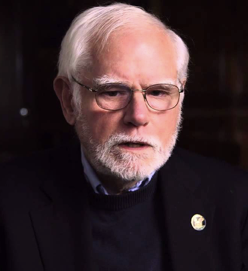
There was a time when Mills’ future was uncertain, though. Going into college, she knew that she wanted to be an astronomy major. However, that wasn’t her only interest. She took a year in which she stopped doing astronomy and started working towards a Bachelor of Fine Arts in painting. After getting accepted into the program she wanted and finding a studio, she realized that it wasn’t as fulfilling as she had hoped. She was drawn back to astronomy and the challenge that it gave her. She still maintains her artistic side, and enjoys spending a lot of time thinking about the visuals that go into communicating science. When asked about advice she has for other students who are considering pursuing a different field or interest, Mills emphasized the importance of spending time giving your alternative plan a fair shot. “For me, it was very important just to fully try it out. There were those couple of semesters where I really just stopped taking the physics and astronomy courses and just went all in on trying to do art. In the end, there’s nothing wrong with keeping multiple interests going at the same time, but I think it’s important to give something that you think you might want to do a fair go,” she says.
She has found that putting time and work into different activities is the best way to discover how you truly feel about them. Public speaking is one example. Mills says that, despite being very excited about giving talks now, she used to be very stressed out about it. Over-preparing for a physics presentation she gave in undergrad changed this for her. “I suddenly realized that, when I was giving that talk, I knew it so well and knew exactly what I was going to say, so I could for the first time start to think on my feet about how I was saying it,” she says. “And it went really well. It’s really important for me to acknowledge my progress as something that is the result of putting work in and something that is totally attainable.”

Find out more at Professor Elisabeth Mill’s plenary talk, “Journey to the Center of the Galaxy: Following the Gas to Understand the Past and Future Activity of Galaxy Nuclei” on Tuesday, June 11 at 4:30 PM at #AAS234.

Astro2020

What are the big topics in astronomy research that we’ll be working to address in the next decade? No need to pull out a crystal ball … astronomers have a pretty good guess, and they’ve shared what they think in a series of white papers that are part of the 2020 Decadal Survey.

What’s a Decadal Survey?

astro2010

Have we achieved our goals from the previous Decadal Survey, Astro2010? You’ll have to check out the Astro2010 report and decide for yourself. [National Academies]

The Decadal Survey on Astronomy and Astrophysics (otherwise known as Astro2020) is a process that occurs once every 10 years under the oversight of the National Academies of Sciences, Engineering, and Medicine. During this process, the astronomy community comes together to summarize the current state of the field and identify key priorities for the upcoming decade. These recommendations then serve as a guide for scientists, policy makers, and funding agencies over the next 10 years.

How Does It Work?

Astro2020 begins with various calls for “white papers”, brief write-ups to be submitted by individuals or collaborations within the astronomy community. These white papers are next reviewed by a steering committee made up of prominent members of the astronomy community. Finally, the committee — with input from topical panels, subcommittees, town halls, and more — composes a report that describes the current state of the field, identifies research priorities, and makes recommendations for the next decade.

What’s Happening Now?

The first Astro2020 white-paper call closed in March. The assignment:

“succinctly identify new science opportunities and compelling science themes, place those in the broader international scientific context, and describe the key advances in observation, experiment, and/or theory necessary to realize those scientific opportunities within the decade 2020-2030.”

The result? A collection of 573 white papers from the community that beautifully summarizes the most interesting research questions that are driving the field forward at this time. Want a glimpse of what’s interesting in astronomy right now? All you have to do is look through these papers to get a very good idea.

BAAS

Astro2020 white papers will be published in the Bulletin of the American Astronomical Society. [AAS]

This Decadal Survey, for the first time, the American Astronomical Society is collecting the submitted white papers and making them available in a central location: the Bulletin of the American Astronomical Society. A list of all 573 science white papers has been published there, with titles, authors, and the paper PDFs (for those authors who did not opt out of publication). Each paper is also indexed in the SAO/NASA Astrophysics Data System so that it can be found and cited in the future.

How About a Brief Sample?

Astronomy is an enormous field, and these white papers prove it. Below is a tiny sample of papers covering each of the eight primary thematic science areas (plus two bonus interdisciplinary ones).

  1. Planetary systems
    The Sun-like Stars Opportunity
    Solar System Science with Space Telescopes
    A Balancing Act: Biosignature and Anti-Biosignature Studies in the Next Decade and Beyond
  2. Star and planet formation
    The Life Cycle of Dust
    Planet formation — The case for large efforts on the computational side
    Astrochemical Origins of Planetary Systems
  3. Stars and stellar evolution
    • Stellar Physics and Galactic Archaeology using Asteroseismology in the 2020’s
    Stars at High Spatial Resolution
    Radio, Millimeter, Submillimeter Observations of the Quiet Sun
  4. Formation and evolution of compact objects
    Populations of Black holes in Binaries
    Radio Pulsar Populations
    Ultra-heavy cosmic-ray science: Are r-process nuclei in the cosmic rays produced in supernovae or binary neutron star mergers?
  5. Resolved stellar populations and their environments
    Increasing the Discovery Space in Astrophysics: The Exploration Question for Resolved Stellar Populations
    Local Dwarf Galaxy Archaeology
    Far Reaching Science with Resolved Stellar Populations in the 2020s
  6. Galaxy evolution
    The Magellanic Stream as a Probe of Astrophysics
    Simultaneous Measurements of Star Formation and Supermassive Black Hole Growth in Galaxies
    Observing Galaxy Evolution in the Context of Large-Scale Structure
  7. Cosmology and fundamental physics
    The Role of Machine Learning in the Next Decade of Cosmology
    Tests of General Relativity and Fundamental Physics with Space-based Gravitational Wave Detectors
    Cosmology with the Highly Redshifted 21 cm Line
  8. Multi-messenger astronomy and astrophysics
    A Summary of Multimessenger Science with Neutron Star Mergers
    Astrophysics Uniquely Enabled by Observations of High-Energy Cosmic Neutrinos
    • Gravity and Light: Combining Gravitational Wave and Electromagnetic Observations in the 2020s

What Comes Next?

We’re nowhere near done yet! The papers published now were submitted to the call for science white papers in March. At present, there’s another call open for white papers on activities, projects, and the state of the profession, with a deadline of 10 July.

All of these white papers will be included in the BAAS as well. Check back for those later this year, and keep an ear to the ground as the year progresses for more news from Astro2020.

Citation

The full set of Astro2020 science white papers can be found here:
https://baas.aas.org/community/astro2020-science-white-papers/

AAS journals videos

How do you write a good title for your article? What are data editors and how can they help improve your work? What happens during the peer review process after you submit a research manuscript? When is an article an ApJ Letter? What is the AAS journals’ business model? How can I be a good referee?

You’ve got questions about AAS Publishing, and AAS Journals Lead Editor Frank Timmes has answers. In a new series of videos published on the AAS Youtube channel, Timmes provides clear, concise overviews of a variety of topics related to the American Astronomical Society’s journals.

In the first series of eight videos, released today and entitled “On publishing in the AAS Journals (as an author)”, Timmes discusses the various steps involved in writing and submitting an article to AAS journals. The videos include topics like composing a useful article title, responding to a referee report, and selecting an appropriate journal corridor.

Future video series will be released on a regular basis, and they’ll be broad in scope — a few upcoming videos include a look at the AAS journals’ business model, an overview of the recently rebooted Bulletin of the AAS, guidance in making engaging figures for articles, and a discussion of how to become a scientific editor for the AAS journals.

Want to keep on top of the latest AAS Publishing news? Subscribe to the AAS Youtube channel!

You can view the whole first video series here, or check out the first video in the series below.

1 13 14 15 16 17 23